Recognition: unknown
Sensitivity to top-quark FCNC interactions at future muon colliders
Pith reviewed 2026-05-10 13:32 UTC · model grok-4.3
The pith
A 10 TeV muon collider can probe top-quark FCNC couplings at the O(10^{-3}) level, setting branching ratio limits of O(10^{-6}) that beat current LHC bounds by more than an order of magnitude.
A machine-rendered reading of the paper's core claim, the machinery that carries it, and where it could break.
Core claim
The central claim is that the process mu+ mu- to nu_mu mu+ b j at sqrt(s) = 10 TeV, analyzed with a multivariate boosted decision tree after full simulation including parton showering and detector effects, yields projected sensitivities of O(10^{-3}) on the effective couplings kappa_tqZ and lambda_tq gamma. These limits correspond to branching ratio bounds of O(10^{-6}) for t to qZ and t to q gamma decays and improve existing LHC constraints by more than one order of magnitude at an integrated luminosity of 10 ab^{-1}.
What carries the argument
The boosted decision tree discrimination applied to Monte Carlo events for the mu+ mu- to nu_mu mu+ b j final state, used to extract limits on the effective field theory parameters kappa_tqZ and lambda_tq gamma.
If this is right
- The muon collider would set branching ratio limits of O(10^{-6}) on t to qZ and t to q gamma decays.
- These limits would extend current CMS and ATLAS bounds by more than an order of magnitude.
- A multi-TeV muon collider would serve as a powerful and complementary platform for studying rare top-quark interactions.
- It would provide a unique opportunity to explore physics beyond the Standard Model through FCNC processes.
Where Pith is reading between the lines
- The lepton-collider environment suppresses QCD backgrounds that hinder similar searches at hadron colliders, allowing cleaner extraction of rare top decays.
- Higher integrated luminosities at the same energy would tighten the coupling limits further without changing the analysis strategy.
- The results could be reinterpreted in specific new-physics models that predict particular patterns of top FCNC strengths.
Load-bearing premise
The Monte Carlo event generation, fast detector simulation, and boosted decision tree analysis accurately capture all relevant physics and detector effects without large unmodeled systematic uncertainties.
What would settle it
An observed event yield in the signal region after BDT selection that is inconsistent with the background-only prediction at the level required to reach the projected O(10^{-3}) coupling sensitivity would either support or rule out the anomalous couplings at the claimed precision.
Figures



read the original abstract
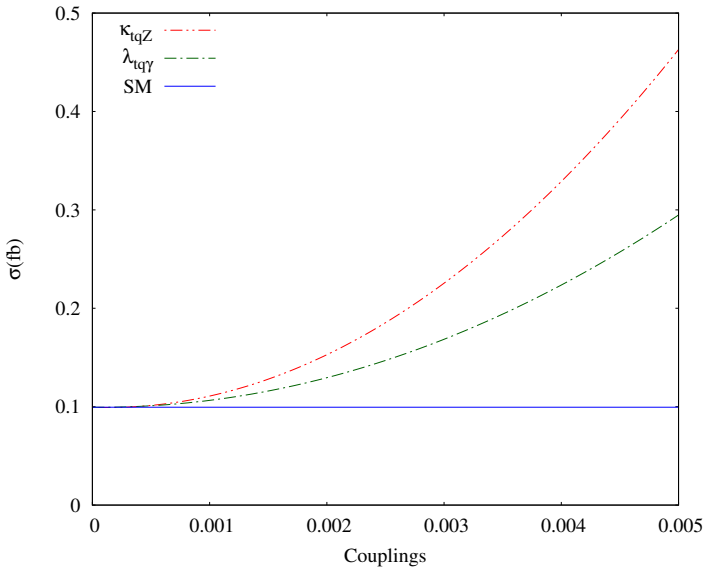
We investigate flavor-changing neutral current (FCNC) interactions of the top quark at a future muon collider with a center-of-mass energy of $\sqrt{s} = 10~\mathrm{TeV}$. The process $\mu^{+}\mu^{-} \to \nu_{\mu}\,\mu^+\,b\,j$ and its corresponding charge conjugate are considered as a probe of anomalous $tqZ$ and $tq\gamma$ couplings, parametrized within an effective field theory framework in terms of $\kappa_{tqZ}$ and $\lambda_{tq\gamma}$. Signal and background events are simulated using Monte Carlo techniques, including parton showering and hadronization with \texttt{Pythia} and a fast detector simulation based on \texttt{Delphes} with a dedicated 10~TeV muon collider setup. A multivariate analysis based on boosted decision trees is employed to enhance the signal discrimination. Assuming an integrated luminosity of $10~\mathrm{ab}^{-1}$, we obtain projected sensitivities to the anomalous couplings at the $\mathcal{O}(10^{-3})$ level, corresponding to branching ratio limits of $\mathcal{O}(10^{-6})$ for the rare $t \to qZ$ and $t \to q\gamma$ decays. These results significantly improve upon the current bounds from the CMS and ATLAS collaborations, extending the sensitivity by more than one order of magnitude. Our findings demonstrate that a multi-TeV muon collider provides a powerful and complementary platform for probing rare top-quark interactions, offering a unique opportunity to explore physics beyond the Standard Model through FCNC processes.
Editorial analysis
A structured set of objections, weighed in public.
Referee Report
Summary. The manuscript investigates flavor-changing neutral current (FCNC) interactions of the top quark at a proposed 10 TeV muon collider. It considers the process μ⁺μ⁻ → ν_μ μ⁺ b j (and charge conjugate) as a probe of anomalous tqZ and tqγ couplings parametrized by κ_tqZ and λ_tqγ in an EFT framework. Signal and background events are generated with Pythia, passed through a dedicated Delphes fast simulation for a 10 TeV muon collider detector, and analyzed with boosted decision trees to enhance discrimination. With an assumed integrated luminosity of 10 ab^{-1}, the paper projects sensitivities at the O(10^{-3}) level for the couplings, corresponding to branching-ratio limits of O(10^{-6}) for t → qZ and t → qγ, which would improve on existing CMS and ATLAS bounds by more than an order of magnitude.
Significance. If the simulation chain accurately reproduces efficiencies, background rejection, and kinematic distributions, the projected limits would constitute a meaningful advance over current LHC constraints on top-quark FCNC processes. The study employs standard Monte Carlo tools (Pythia + Delphes) and a multivariate technique that is conventional for such projection studies, thereby providing a clear benchmark for the physics reach of a multi-TeV muon collider in the top sector.
major comments (1)
- The central claim of O(10^{-3}) sensitivity (abstract and results) rests on the accuracy of the Pythia+Delphes+BDT pipeline for the μ⁺μ⁻ → ν_μ μ⁺ b j final state. The Delphes card encodes assumed resolutions, efficiencies, and beam-induced backgrounds for a hypothetical 10 TeV muon collider that cannot be calibrated against data. No dedicated variation of muon ID, b-tagging, or jet energy scale is reported to quantify how such changes propagate into the BDT performance and extracted limits. Because even modest shifts in these parameters can alter the projected reach by an order of magnitude, the robustness of the quoted sensitivities cannot be assessed from the presented material.
Simulated Author's Rebuttal
We thank the referee for the careful reading of our manuscript and the positive assessment of its significance. We address the major comment below and commit to revisions that will strengthen the robustness discussion of our projections.
read point-by-point responses
-
Referee: The central claim of O(10^{-3}) sensitivity (abstract and results) rests on the accuracy of the Pythia+Delphes+BDT pipeline for the μ⁺μ⁻ → ν_μ μ⁺ b j final state. The Delphes card encodes assumed resolutions, efficiencies, and beam-induced backgrounds for a hypothetical 10 TeV muon collider that cannot be calibrated against data. No dedicated variation of muon ID, b-tagging, or jet energy scale is reported to quantify how such changes propagate into the BDT performance and extracted limits. Because even modest shifts in these parameters can alter the projected reach by an order of magnitude, the robustness of the quoted sensitivities cannot be assessed from the presented material.
Authors: We agree that the robustness of the projected sensitivities merits explicit quantification, given that the study relies on a fast simulation with a dedicated Delphes card for a hypothetical detector. The original manuscript did not report dedicated variations of muon identification efficiency, b-tagging efficiency, or jet energy scale and their propagation into the BDT performance and limits. To address this point, the revised manuscript will include a new subsection presenting additional studies in which these parameters are varied within conservative ranges informed by LHC extrapolations. The impact on signal efficiency, background rejection, and the resulting coupling limits will be quantified and discussed. This addition will allow a clearer evaluation of the stability of the O(10^{-3}) reach. revision: yes
Circularity Check
No circularity in projected FCNC sensitivities
full rationale
The paper performs standard Monte Carlo simulations of signal and background processes for a hypothetical 10 TeV muon collider using Pythia and Delphes, followed by BDT discrimination to extract projected limits on EFT couplings at assumed luminosity. No load-bearing step reduces by construction to its own inputs: there are no self-definitional equations, no parameters fitted to a data subset and then relabeled as predictions, and no uniqueness theorems or ansatze imported via self-citation. The derivation chain consists of forward-looking estimates dependent on modeling assumptions, but remains independent of the target results and self-contained against external benchmarks such as existing LHC bounds.
Axiom & Free-Parameter Ledger
free parameters (2)
- center-of-mass energy =
10 TeV
- integrated luminosity =
10 ab^{-1}
axioms (2)
- domain assumption The effective field theory framework with kappa_tqZ and lambda_tqgamma accurately captures the anomalous couplings up to the energies considered.
- domain assumption Pythia parton showering, hadronization, and the Delphes fast simulation with the dedicated 10 TeV muon collider card faithfully model signal and background at this energy.
Reference graph
Works this paper leans on
-
[1]
S. L. Glashow, J. Iliopoulos, and L.Maiani, Phys. Rev. D2, 1285 (1970)
1970
-
[2]
Eilam, J
G. Eilam, J. L. Hewett and A. Soni, Phys. Rev. D44, 1473 (1991), Phys. Rev. D59, 039901(E) (1998)]
1991
- [3]
- [4]
-
[5]
C. S. Li, R. J. Oakes and J. M. Yang, Phys. Rev. D49, 293 (1994) Erratum: [Phys. Rev. D56, 3156 (1997)]
1994
- [6]
- [7]
-
[8]
J. A. Aguilar-Saavedra, Nucl. Phys. B821(2009), 215-227 [arXiv:0904.2387 [hep-ph]]
work page Pith review arXiv 2009
-
[9]
G. Abbiendiet al.[OPAL], Phys. Lett. B521, 181-194 (2001) [arXiv:hep-ex/0110009 [hep-ex]]
-
[10]
A. Heisteret al.[ALEPH], Phys. Lett. B543, 173-182 (2002) [arXiv:hep-ex/0206070 [hep-ex]]
-
[11]
P. Achardet al.[L3], Phys. Lett. B549, 290-300 (2002) [arXiv:hep-ex/0210041 [hep-ex]]
-
[12]
J. Abdallahet al.[DELPHI], Phys. Lett. B590, 21-34 (2004) [arXiv:hep-ex/0404014 [hep-ex]]
-
[13]
H. Abramowiczet al.[ZEUS], Phys. Lett. B708, 27-36 (2012) [arXiv:1111.3901 [hep-ex]]
-
[14]
T. Aaltonenet al.[CDF], Phys. Rev. Lett.101, 192002 (2008) [arXiv:0805.2109 [hep-ex]]
- [15]
-
[16]
G. Aadet al.[ATLAS], Eur. Phys. J. C76, no.1, 12 (2016) [arXiv:1508.05796 [hep-ex]]
-
[17]
Aaboudet al.[ATLAS], JHEP07, 176 (2018) [arXiv:1803.09923 [hep-ex]]
M. Aaboudet al.[ATLAS], JHEP07, 176 (2018) [arXiv:1803.09923 [hep-ex]]
-
[18]
G. Aadet al.[ATLAS], Phys. Lett. B842(2023), 137379 [erratum: Phys. Lett. B847(2024), 138286] [arXiv:2205.02537 [hep-ex]]
-
[19]
S. Chatrchyanet al.[CMS], Phys. Rev. Lett.112, no.17, 171802 (2014) [arXiv:1312.4194 [hep-ex]]
- [20]
-
[21]
G. Aadet al.[ATLAS], Phys. Rev. D108, no.3, 032019 (2023) [arXiv:2301.11605 [hep-ex]]
-
[22]
A. Hayrapetyanet al.[CMS], Phys. Rev. D109(2024) no.7, 072004 [arXiv:2312.08229 [hep-ex]]
- [23]
- [24]
-
[25]
H. Khanpour, S. Khatibi, M. Khatiri Yanehsari and M. Mohammadi Najafabadi, Phys. Lett. B775 (2017), 25-31 [arXiv:1408.2090 [hep-ph]]
-
[26]
Tizchang, H
S. Tizchang, H. Khanpour and M. Mohammadi Najafabadi, Iran. J. Phys. Res.24(2024) no.4, 333-341
2024
-
[27]
S. Khatibi and M. Moallemi, J. Phys. G48(2021) no.12, 125004 [arXiv:2106.08231 [hep-ph]]
- [28]
-
[29]
Abramowiczet al.[CLICdp], JHEP11(2019), 003 [arXiv:1807.02441 [hep-ex]]
H. Abramowiczet al.[CLICdp], JHEP11(2019), 003 [arXiv:1807.02441 [hep-ex]]
- [30]
-
[32]
Stratakiset al.[Muon Collider], [arXiv:2203.08033 [physics.acc-ph]]
D. Stratakiset al.[Muon Collider], [arXiv:2203.08033 [physics.acc-ph]]
- [33]
- [34]
-
[35]
Accettura et al.,Towards a muon collider,Eur
C. Accettura, D. Adams, R. Agarwal, C. Ahdida, C. Aim` e, N. Amapane, D. Amorim, P. Andreetto, F. Anulli and R. Appleby,et al.Eur. Phys. J. C83(2023) no.9, 864 [erratum: Eur. Phys. J. C84 (2024) no.1, 36] [arXiv:2303.08533 [physics.acc-ph]]
- [36]
- [37]
-
[38]
UFO - The Universal FeynRules Output
C. Degrande, C. Duhr, B. Fuks, D. Grellscheid, O. Mattelaer and T. Reiter, Comput. Phys. Commun. 183(2012), 1201-1214 [arXiv:1108.2040 [hep-ph]]
work page Pith review arXiv 2012
-
[39]
FeynRules 2.0 - A complete toolbox for tree-level phenomenology
A. Alloul, N. D. Christensen, C. Degrande, C. Duhr and B. Fuks, Comput. Phys. Commun.185(2014), 2250-2300 [arXiv:1310.1921 [hep-ph]]
work page Pith review arXiv 2014
-
[40]
J. Alwall, R. Frederix, S. Frixione, V. Hirschi, F. Maltoni, O. Mattelaer, H. S. Shao, T. Stelzer, P. Torrielli and M. Zaro, JHEP07(2014), 079 [arXiv:1405.0301 [hep-ph]]
work page internal anchor Pith review arXiv 2014
-
[41]
T. Sj¨ ostrand, S. Ask, J. R. Christiansen, R. Corke, N. Desai, P. Ilten, S. Mrenna, S. Prestel, C. O. Ras- mussen and P. Z. Skands, Comput. Phys. Commun.191(2015), 159-177 [arXiv:1410.3012 [hep-ph]]
work page internal anchor Pith review arXiv 2015
-
[42]
DELPHES 3, A modular framework for fast simulation of a generic collider experiment
J. de Favereauet al.[DELPHES 3], JHEP02(2014), 057 [arXiv:1307.6346 [hep-ex]]
work page internal anchor Pith review arXiv 2014
-
[43]
M. Cacciari, G. P. Salam and G. Soyez, Eur. Phys. J. C72, 1896 (2012)[arXiv:1111.6097 [hep-ph]]
work page internal anchor Pith review arXiv 2012
-
[44]
The anti-k_t jet clustering algorithm
M. Cacciari, G. P. Salam and G. Soyez, JHEP0804, 063 (2008) [arXiv:0802.1189 [hep-ph]]
work page internal anchor Pith review arXiv 2008
-
[45]
Asymptotic formulae for likelihood-based tests of new physics
G. Cowan, K. Cranmer, E. Gross and O. Vitells, Eur. Phys. J. C71, 1554 (2011) [erratum: Eur. Phys. 23 J. C73, 2501 (2013)] [arXiv:1007.1727 [physics.data-an]]
work page internal anchor Pith review arXiv 2011
-
[46]
N. Kumar and S. P. Martin, Phys. Rev. D92, no.11, 115018 (2015) [arXiv:1510.03456 [hep-ph]]. 24
discussion (0)
Sign in with ORCID, Apple, or X to comment. Anyone can read and Pith papers without signing in.