From Brain Models to Executable Digital Twins: Execution Semantics and Neuro-Neuromorphic Systems
Pith reviewed 2026-05-10 12:46 UTC · model grok-4.3
The pith
Brain digital twins achieve fidelity through preserved execution semantics under physical constraints rather than model accuracy alone.
A machine-rendered reading of the paper's core claim, the machinery that carries it, and where it could break.
Core claim
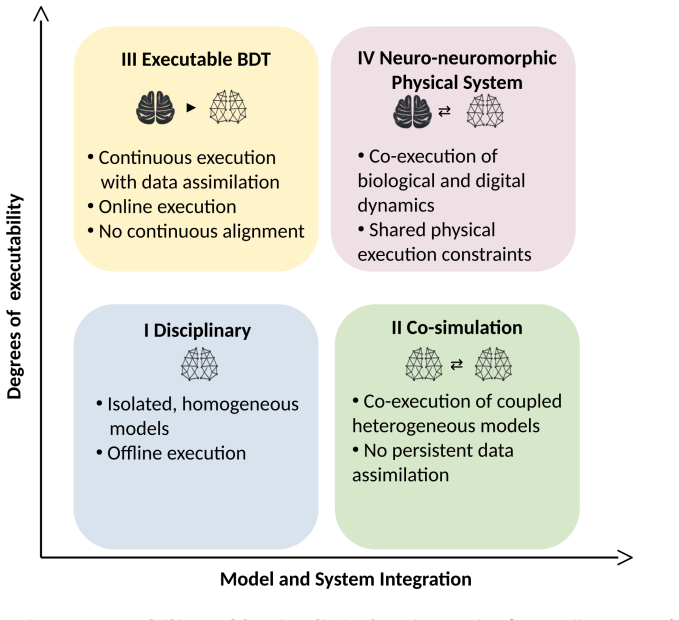
Brain digital twins aim to provide faithful, individualized computational representations of brains as dynamical systems but stay fragmented, which blocks preservation of execution semantics across the end-to-end workflow. Physically constrained executability supplies the unifying view by checking persistence of the execution state, the events permitted to update it, and the strength of temporal and causal coupling to neurobiological dynamics. This view supports a taxonomy of execution regimes ranging from isolated offline models through coordinated co-simulation and online data-assimilating twins to neuro-neuromorphic physical systems where biological and computational dynamics share the sa
What carries the argument
Physically constrained executability, the mechanism that compares approaches by persistence of execution state, permitted updating events, and degree of temporal-causal coupling to neurobiological dynamics.
If this is right
- Approaches become comparable and interoperable by execution regime rather than by model form or application domain.
- Neuro-neuromorphic systems allow biological and computational dynamics to co-execute under shared physical constraints.
- Evaluation protocols must incorporate hybrid-time correctness to verify faithful dynamics.
- Scalable reproducible workflows become necessary to move from models to validated digital twins.
- Safe closed-loop validation for clinical interventions becomes feasible once semantics are preserved.
Where Pith is reading between the lines
- The same execution-regime lens could organize digital-twin development in other fragmented domains such as climate or manufacturing systems.
- Neuro-neuromorphic co-execution may enable lower-latency real-time modeling than conventional hardware.
- Applying the taxonomy to existing brain models could identify which regimes best support individualized clinical predictions.
- The runtime-oriented perspective connects naturally to verification techniques already used in cyber-physical systems.
Load-bearing premise
Preserving execution semantics across the full workflow is the primary barrier to faithful individualized brain digital twins.
What would settle it
A controlled test in which two brain models with matched accuracy but differing execution regimes—one with persistent state and strong coupling, the other isolated offline—are evaluated side-by-side for success in cross-platform interoperability or clinical outcome prediction.
Figures




read the original abstract
Brain digital twins aim to provide faithful, individualized computational representations of brains as dynamical systems, enabling mechanistic understanding and supporting prediction of clinical interventions. Yet current approaches remain fragmented across data pipelines, model classes, temporal scales, and computing platforms, which prevents the preservation of execution semantics across the end-toend workflow. This survey introduces physically constrained executability as a unifying perspective for comparing approaches at the level of execution: whether an execution state is persistent, which events are permitted to update it (simulation, measurement, actuation), and how strongly execution is temporally and causally coupled to neurobiological dynamics. Building on modeling and simulation theory, I propose a taxonomy of execution regimes ranging from isolated offline models to coordinated co-simulation, to continuously executing digital twins sustained by online data assimilation, and ultimately to neuro-neuromorphic physical systems in which biological and computational dynamics are co-executed under shared physical constraints. The executability concept clarifies why accuracy alone is insufficient, and motivates an agenda centered on semantic interoperability, hybrid-time correctness, evaluation protocols, scalable reproducible workflows, and safe closed-loop validation. This survey adopts a systems and runtime-oriented perspective, enabling comparison of heterogeneous approaches based on their execution semantics rather than on model form or application domain alone.
Editorial analysis
A structured set of objections, weighed in public.
Referee Report
Summary. The manuscript surveys brain digital twins as computational representations of brains as dynamical systems. It argues that fragmentation across data pipelines, model classes, temporal scales, and platforms prevents preservation of execution semantics in end-to-end workflows. The paper introduces 'physically constrained executability' as a unifying lens—focusing on persistence of execution state, permitted update events (simulation/measurement/actuation), and temporal/causal coupling to neurobiological dynamics—and proposes a taxonomy of execution regimes from isolated offline models through coordinated co-simulation and online data-assimilation twins to neuro-neuromorphic physical systems. It motivates an agenda on semantic interoperability, hybrid-time correctness, evaluation protocols, reproducible workflows, and safe closed-loop validation, adopting a systems/runtime perspective rather than model-form or domain-based comparison.
Significance. If the taxonomy and executability perspective prove robust in application, the work could provide a valuable organizing framework for comparing and integrating heterogeneous brain modeling approaches in computational neuroscience and digital-twin engineering. By shifting emphasis from accuracy alone to execution semantics and interoperability, it addresses a recognized fragmentation barrier and supplies concrete research directions (e.g., hybrid-time correctness and closed-loop validation protocols) that could accelerate progress toward faithful, individualized twins. The conceptual, non-empirical nature is appropriate for a survey and avoids overclaiming demonstration of solutions.
major comments (1)
- The central claim that the proposed taxonomy of execution regimes will enable semantic interoperability where model accuracy alone has failed is load-bearing for the unifying contribution. However, the manuscript does not appear to include systematic mappings of representative existing brain-modeling approaches (e.g., specific papers or model classes) onto the regimes, which would be required to substantiate exhaustiveness and practical utility. Without such concrete applications, it remains unclear whether gaps in coverage undermine the taxonomy's ability to unify the field.
minor comments (2)
- The abstract states that the survey 'builds on modeling and simulation theory' yet does not explicitly list the key prior frameworks or theorems invoked; adding a short dedicated subsection or table citing the foundational references would improve traceability of the taxonomy construction.
- The phrase 'end-toend workflow' in the abstract is missing a hyphen and should be corrected to 'end-to-end workflow' for consistency with standard technical writing.
Simulated Author's Rebuttal
We thank the referee for their constructive and positive review, including the recommendation for minor revision. The feedback identifies a valuable opportunity to strengthen the manuscript's substantiation of the proposed taxonomy. We address the major comment below and will update the manuscript accordingly.
read point-by-point responses
-
Referee: The central claim that the proposed taxonomy of execution regimes will enable semantic interoperability where model accuracy alone has failed is load-bearing for the unifying contribution. However, the manuscript does not appear to include systematic mappings of representative existing brain-modeling approaches (e.g., specific papers or model classes) onto the regimes, which would be required to substantiate exhaustiveness and practical utility. Without such concrete applications, it remains unclear whether gaps in coverage undermine the taxonomy's ability to unify the field.
Authors: We agree that systematic mappings of representative approaches would strengthen the demonstration of the taxonomy's coverage and practical utility for enabling semantic interoperability. The manuscript introduces physically constrained executability as a conceptual framework grounded in modeling and simulation theory, with illustrative references to existing work across regimes. To address the concern directly, the revised version will include a new dedicated subsection that maps key brain-modeling approaches—such as offline large-scale spiking models (e.g., from the Blue Brain Project and Allen Institute), co-simulation platforms (e.g., TVB-NEST integrations), online data-assimilation twins in clinical neuroscience, and neuro-neuromorphic hardware systems—onto the execution regimes. These mappings will explicitly relate each example to persistence of execution state, permitted update events, and temporal/causal coupling, thereby clarifying how the taxonomy reveals interoperability gaps beyond accuracy metrics alone and supports the proposed research agenda. revision: yes
Circularity Check
No significant circularity
full rationale
The paper is a conceptual survey introducing 'physically constrained executability' as a unifying perspective and proposing a taxonomy of execution regimes. It contains no mathematical derivations, equations, fitted parameters, or predictions that reduce to inputs by construction. The central claims rest on definitional framing and cited modeling theory without self-referential reductions, load-bearing self-citations forming a circular chain, or renaming of known results as novel derivations. The work explicitly positions itself as motivating an agenda rather than demonstrating a closed-form result from its own premises.
Axiom & Free-Parameter Ledger
axioms (1)
- domain assumption Current approaches to brain digital twins remain fragmented across data pipelines, model classes, temporal scales, and computing platforms, preventing preservation of execution semantics.
invented entities (1)
-
physically constrained executability
no independent evidence
Reference graph
Works this paper leans on
-
[1]
Jakob Zimmermann, Anastasia Popov, Timothée Proix, and Viktor K. Jirsa. Brain digital twins: A computational revolution in clinical neuroscience.Frontiers in Neuroscience, 16:943754, 2022
work page 2022
-
[2]
Huifang E. Wang, Paul Triebkorn, Martin Breyton, Borana Dollomaja, Jean-Didier Lemarechal, Spase Petkoski, Pierpaolo Sorrentino, Damien Depannemaecker, Meysam Hashemi, and Viktor K. Jirsa. Virtual brain twins: from basic neuroscience to clinical use. National Science Review, 11(5):nwae079, 2024
work page 2024
-
[3]
Jing Xiong, Liyuan Zhang, Yifan Wang, Liang Chen, and Lin Zhang. The digital twin brain: A bridge between biological and artificial intelligence.Intelligent Computing, 2(3):0055, 2023
work page 2023
-
[4]
Fekonja, Robert Schenk, Anna Schröder, Rosario Tomasello, Samo Tomšič, and Thomas Picht
Ledina S. Fekonja, Robert Schenk, Anna Schröder, Rosario Tomasello, Samo Tomšič, and Thomas Picht. The digital twin in neuroscience: from theory to tailored therapy.Frontiers in Neuroscience, 18:1454856, 2024
work page 2024
-
[5]
Katrin Amunts, Christoph Ebell, Jens Muller, Martin Telefont, Alois Knoll, and Thomas Lippert. The human brain project—synergy between neuroscience, computing, informatics, and brain- inspired technologies.PLoS Biology, 17(7):e3000344, 2019. 12
work page 2019
-
[6]
Henry Markram. The human brain project: A blueprint for brain research and technology.Fron- tiers in Neuroscience, 6:89, 2012
work page 2012
-
[7]
Katrin Amunts, Alexander Schaefer, Michael Schirner, et al. The coming decade of digital brain research: A vision for large-scale integration of neuroimaging, histology, and behaviour.Imaging Neuroscience, 2:1–16, 2024
work page 2024
-
[8]
Bernard P Zeigler, Alexandre Muzy, and Ernesto Kofman.Theory of Modeling and Simulation: Discrete Event & Iterative System Computational Foundations. Academic Press, 2018
work page 2018
-
[9]
Cyrille Mascart, Gilles Scarella, Patricia Reynaud-Bouret, and Alexandre Muzy. Scalability of large neural network simulations via activity tracking with time asynchrony and procedural con- nectivity. Neural Computation, 34(9):1915–1943, 2022
work page 1915
-
[10]
Alban Gattepaille and Alexandre Muzy. Delay neural networks (DeNN) for exploiting temporal information in event-based datasets.Communications Engineering (Nature), 2025. Accepted for publication
work page 2025
-
[11]
Ashwin James, Ingrid Bethus, and Alexandre Muzy. Inferring time-varying internal models of agents through dynamic structure learning.bioRxiv, pages 2024–09, 2024
work page 2024
-
[12]
Carlos Herrera, Alik S. Widge, and Kai J. Miller. Closed-loop adaptive brain stimulation: Emerg- ing methods and clinical applications.Brain Stimulation, 15(3):580–596, 2022
work page 2022
-
[13]
Valdes-Sosa, and Sylvain Baillet
Guiomar Niso, Kristian Madsen, Pedro A. Valdes-Sosa, and Sylvain Baillet. Brain stimula- tion modeling and validation: Towards personalized neurostimulation therapies. NeuroImage, 271:120002, 2023
work page 2023
-
[14]
Andreas Horn and Michael D. Fox. Opportunities of connectomic deep brain stimulation.Nature Reviews Neurology, 16(6):337–350, 2020
work page 2020
-
[15]
Yu Huang, Abhishek Datta, Marom Bikson, and Lucas C. Parra. Realistic volumetric-approach to simulate transcranial electric stimulation—ROAST—a fully-automated open-source pipeline. Brain Stimulation, 12(3):665–667, 2019
work page 2019
-
[16]
Reconstruction and simulation of neocortical microcircuitry.Cell, 163(2):456–492, 2015
Henry Markram, Eilif Muller, Srikanth Ramaswamy, et al. Reconstruction and simulation of neocortical microcircuitry.Cell, 163(2):456–492, 2015
work page 2015
-
[17]
Murat Demirtaş, Miguel I. Falcon, Aloys Tucholka, et al. A whole-brain computational modeling approach to explain cognitive deficits in Alzheimer’s disease.NeuroImage, 150:249–261, 2017
work page 2017
-
[18]
Aponte, Michael Schirner, Viktor K
Erick A. Aponte, Michael Schirner, Viktor K. Jirsa, Petra Ritter, and Gustavo Deco. The im- pact of structural connectivity and recurrent neural dynamics on human resting-state functional connectivity. Frontiers in Neuroscience, 17:1163814, 2023
work page 2023
-
[19]
Jirsa, Timothée Proix, Dionysios Perdikis, et al
Viktor K. Jirsa, Timothée Proix, Dionysios Perdikis, et al. The virtual epileptic patient: Individ- ualized whole-brain models of epilepsy spread.NeuroImage, 145:377–388, 2017
work page 2017
-
[20]
McIntosh, Petra Ritter, and Viktor K
Michael Schirner, Silvan Rothmeier, Anthony R. McIntosh, Petra Ritter, and Viktor K. Jirsa. Brain simulation as a cloud service: The virtual brain on EBRAINS.NeuroImage, 251:119010, 2022
work page 2022
-
[21]
Timothée Proix, Fabrice Bartolomei, Maxime Guye, and Viktor K. Jirsa. Individualized virtual brain models for epilepsy surgery planning.Current Opinion in Neurology, 31(2):140–147, 2018
work page 2018
-
[22]
Anthony R. McIntosh and James M. Shine. Network modeling of Parkinson’s disease: Mechanisms and clinical insights.Progress in Brain Research, 261:241–260, 2021. 13
work page 2021
-
[23]
McIntosh, Petra Ritter, and Viktor K
Michael Schirner, Silvan Rothmeier, Anthony R. McIntosh, Petra Ritter, and Viktor K. Jirsa. Constructing subject-specific virtual brains from multimodal neuroimaging data. NeuroImage, 117:343–357, 2015
work page 2015
-
[24]
Friston, Vladimir Litvak, Ashwini Oswal, et al
Karl J. Friston, Vladimir Litvak, Ashwini Oswal, et al. Dynamic causal modeling revisited. NeuroImage, 199:730–744, 2019
work page 2019
-
[25]
Moran, Maja Symmonds, Raymond J
Rosalyn J. Moran, Maja Symmonds, Raymond J. Dolan, and Karl J. Friston. The brain ages optimally to model its environment: evidence from DCM of pharmacological fMRI.NeuroImage, 94:103–115, 2014
work page 2014
-
[26]
Will D. Penny, Klaas E. Stephan, Jean Daunizeau, et al. Comparing families of dynamic causal models. PLoS Computational Biology, 6(3):e1000709, 2010
work page 2010
-
[27]
Friston, Joshua Kahan, Bharat Biswal, and Adeel Razi
Karl J. Friston, Joshua Kahan, Bharat Biswal, and Adeel Razi. A DCM for resting state fMRI. NeuroImage, 94:396–407, 2014
work page 2014
-
[28]
Fabian Gilbert, Timothée Proix, Fabrice Bartolomei, and Viktor K. Jirsa. EEG-informed large- scale brain network modeling in epilepsy: linking neurophysiology and simulation.Frontiers in Neurology, 12:725569, 2021
work page 2021
-
[29]
Mina Hashemi, Ashwin N. Vattikonda, Viktor Sip, et al. Personalized hybrid brain models for data fusion and simulation.Frontiers in Neuroscience, 14:105, 2020
work page 2020
-
[30]
Nishant Sinha, Justin Dauwels, Marcus Kaiser, et al. Predicting neurosurgical outcomes in focal epilepsy patients using computational modelling.Brain, 140(2):319–332, 2017
work page 2017
-
[31]
Shanshan An, Fabrice Bartolomei, Maxime Guye, and Viktor Jirsa. Optimization of surgical inter- vention outside the epileptogenic zone in the virtual epileptic patient (VEP).PLOS Computational Biology, 15(6):e1007051, 2019
work page 2019
-
[32]
The human brain project.Scientific American, 306(6):50–55, 2012
Henry Markram. The human brain project.Scientific American, 306(6):50–55, 2012
work page 2012
-
[33]
KatrinAmunts, CorneliusEbell, JeanMuller, etal. Thehumanbrainproject: Creatingaeuropean research infrastructure to decode the human brain.Neuron, 92(3):574–581, 2016
work page 2016
-
[34]
Matthew F. Glasser, Timothy S. Coalson, Emma C. Robinson, et al. A multi-modal parcellation of human cerebral cortex.Nature, 536:171–178, 2016
work page 2016
-
[35]
Thomas R. Insel, Story C. Landis, and Francis S. Collins. The NIH BRAIN initiative.Science, 340(6133):687–688, 2013
work page 2013
-
[36]
Cornelia I. Bargmann and William T. Newsome. A vision for the BRAIN initiative.Neuron, 84(3):529–533, 2014
work page 2014
-
[37]
Mark D. Wilkinson et al. The FAIR guiding principles for scientific data management and stew- ardship. Scientific Data, 3:160018, 2016
work page 2016
-
[38]
Gorgolewski, Tibor Auer, Vince D
Krzysztof J. Gorgolewski, Tibor Auer, Vince D. Calhoun, et al. The brain imaging data structure, a format for organizing and describing outputs of neuroimaging experiments. Scientific Data, 3:160044, 2016
work page 2016
-
[39]
Gorgolewski, Elizabeth Bock, et al
Guiomar Niso, Krzysztof J. Gorgolewski, Elizabeth Bock, et al. MEG-BIDS, the brain imaging data structure extended to magnetoencephalography.Scientific Data, 5:180110, 2018
work page 2018
-
[40]
Pernet, Stefan Appelhoff, Krzysztof J
Cyril R. Pernet, Stefan Appelhoff, Krzysztof J. Gorgolewski, et al. EEG-BIDS, an extension to the brain imaging data structure for electroencephalography.Scientific Data, 6(1):103, 2019
work page 2019
-
[41]
Oscar Esteban, Christopher J. Markiewicz, Ross W. Blair, et al. fMRIPrep: a robust preprocessing pipeline for functional MRI.Nature Methods, 16(1):111–116, 2019. 14
work page 2019
-
[42]
Matthew Cieslak, Philip A. Cook, Xiaosong He, et al. QSIPrep: an integrative platform for preprocessing and reconstructing diffusion MRI data.Nature Methods, 18(7):775–778, 2021
work page 2021
-
[43]
Towards spike-based machine intelli- gence with neuromorphic computing.Nature, 575:607–617, 2019
Kaushik Roy, Akhilesh Jaiswal, and Priyadarshini Panda. Towards spike-based machine intelli- gence with neuromorphic computing.Nature, 575:607–617, 2019
work page 2019
-
[44]
Miguel I. Falcon, Jeffrey D. Riley, Viktor K. Jirsa, and Anthony R. McIntosh. Digital twin brain models: Towards real-time clinical decision support.Frontiers in Digital Health, 5:1223345, 2023
work page 2023
-
[45]
Alexandre Muzy, Bernard P Zeigler, and Franck Grammont. Iterative specification as a modeling and simulation formalism for I/O general systems.IEEE Systems Journal, 12(3):2982–2993, 2017
work page 2017
-
[46]
Romain Brette. Exact simulation of integrate-and-fire models with synaptic conductances.Neural Computation, 19(10):2604–2609, 2007
work page 2007
-
[47]
Memory and information processing in neuromorphic sys- tems
Giacomo Indiveri and Shih-Chii Liu. Memory and information processing in neuromorphic sys- tems. Proceedings of the IEEE, 103(8):1379–1397, 2015
work page 2015
-
[48]
Paul A. Merolla, John V. Arthur, Rodrigo Alvarez-Icaza, et al. A million spiking-neuron integrated circuit with a scalable communication network.Science, 345(6197):668–673, 2014
work page 2014
-
[49]
Loihi: A neuromorphic manycore processor with on-chip learning.IEEE Micro, 38(1):82–99, 2018
Mike Davies, Narayan Srinivasa, Tsung-Han Lin, et al. Loihi: A neuromorphic manycore processor with on-chip learning.IEEE Micro, 38(1):82–99, 2018
work page 2018
-
[50]
Furber, Francesco Galluppi, Steve Temple, and Luis A
Steve B. Furber, Francesco Galluppi, Steve Temple, and Luis A. Plana. The SpiNNaker project. Proceedings of the IEEE, 102(5):652–665, 2014
work page 2014
-
[51]
Christian Pehle, Sebastian Billaudelle, Benjamin Cramer, Jakob Kaiser, Korbinian Schreiber, Yannik Stradmann, Johannes Weis, Andreas Leibfried, Eric Müller, and Johannes Schemmel. The BrainScaleS-2 accelerated neuromorphic system with hybrid plasticity.Frontiers in Neuroscience, 16:795876, 2022
work page 2022
-
[52]
Challenges and opportunities for digital twins in precision medicine
Manlio De Domenico et al. Challenges and opportunities for digital twins in precision medicine. npj Digital Medicine, 8:37, 2025
work page 2025
-
[53]
Scott Marek, Brenden Tervo-Clemmens, Finnegan J. Calabro, et al. Reproducible brain-wide association studies require thousands of individuals.Nature, 603:654–660, 2022. 15
work page 2022
discussion (0)
Sign in with ORCID, Apple, or X to comment. Anyone can read and Pith papers without signing in.