Recognition: unknown
Scalarizations of magnetized Reissner-Nordstr\"om black holes induced by parity-violating and parity-preserving interactions
Pith reviewed 2026-05-10 12:47 UTC · model grok-4.3
The pith
Magnetic fields lower scalarization thresholds in Chern-Simons channels while splitting Gauss-Bonnet branches asymmetrically.
A machine-rendered reading of the paper's core claim, the machinery that carries it, and where it could break.
Core claim
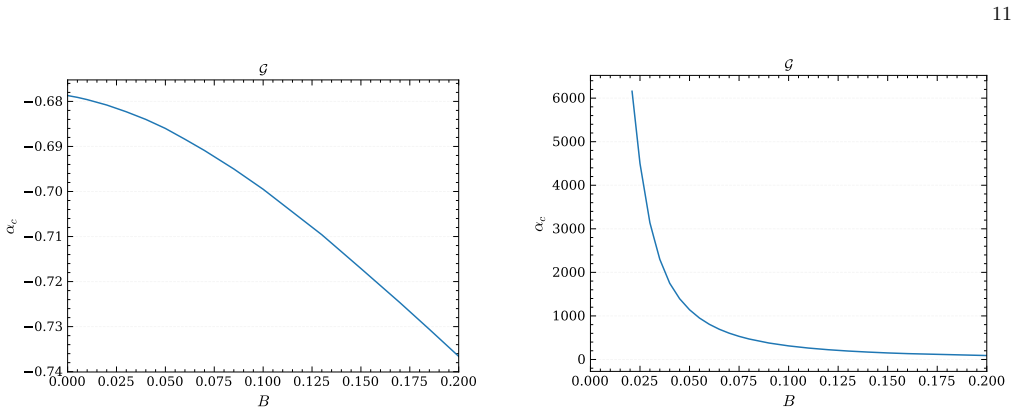
We study spontaneous scalarization of a scalar field in the magnetized Reissner-Nordström spacetime induced by parity-violating and parity-preserving interactions, represented by couplings to the electromagnetic Chern-Simons, gravitational Chern-Simons, and Gauss-Bonnet invariants, respectively. Working in the decoupling limit, we evolve scalar perturbations in the time domain and determine the critical coupling for the onset of tachyonic instability. This allows us to compare, within the same magnetized background, how the external magnetic field affects scalarization induced by parity-violating and parity-preserving interactions. We find that the magnetic field lowers the scalarization t
What carries the argument
Time-domain evolution of scalar perturbations on the fixed magnetized Reissner-Nordström background to extract the critical coupling strengths at which tachyonic instability sets in for each interaction channel.
If this is right
- The magnetic field lowers the scalarization threshold in the electromagnetic and gravitational Chern-Simons channels.
- On the negative-α Gauss-Bonnet branch the magnitude of the critical coupling increases with the magnetic field.
- On the positive-α Gauss-Bonnet branch the critical coupling decreases with the magnetic field but diverges in the limit of vanishing field.
- The magnetic field modifies late-time dynamics and produces Melvin-like modes.
- Nonlinear couplings replace the unbounded growth of the linear theory with bounded oscillatory evolution.
Where Pith is reading between the lines
- The asymmetry between Gauss-Bonnet branches suggests that scalarization may be absent for one sign of the coupling in purely electric charged black holes.
- Melvin-like modes could appear as distinct late-time ringing in gravitational-wave signals from black holes embedded in strong magnetic fields.
- The selective promotion of scalarization in parity-violating channels might produce observable differences in the stability of magnetized versus non-magnetized black holes.
- Including back-reaction of the scalar field on the metric could shift the reported critical couplings and potentially stabilize some of the reported instabilities.
Load-bearing premise
Scalar perturbations evolve independently without back-reacting on the magnetized Reissner-Nordström background metric.
What would settle it
A direct numerical computation of the critical coupling in the positive-α Gauss-Bonnet branch as the magnetic field strength is taken to zero, checking whether it diverges as predicted.
Figures



read the original abstract
We study spontaneous scalarization of a scalar field in the magnetized Reissner--Nordstr\"om spacetime induced by parity-violating and parity-preserving interactions, represented by couplings to the electromagnetic Chern--Simons, gravitational Chern--Simons, and Gauss--Bonnet invariants, respectively. Working in the decoupling limit, we evolve scalar perturbations in the time domain and determine the critical coupling for the onset of tachyonic instability. This allows us to compare, within the same magnetized background, how the external magnetic field affects scalarization induced by parity-violating and parity-preserving interactions. We find that the magnetic field lowers the scalarization threshold in the electromagnetic and gravitational Chern--Simons channels. In the Gauss--Bonnet channel, by contrast, the effect divided into two branches: on the negative-$\alpha$ branch in our convention, corresponding to the standard GB$^{+}$ branch, the magnitude of the critical coupling increases with the magnetic field, whereas on the positive-$\alpha$ branch, corresponding to GB$^{-}$, the critical coupling decreases with the magnetic field but diverges in the limit of vanishing field. The magnetic field also modifies the late-time dynamics and gives rise to Melvin-like modes. When nonlinear couplings are included, the unbounded growth of the linearized theory is replaced by bounded oscillatory evolution. These results show that external magnetic fields affect scalarization induced by parity-violating and parity-preserving interactions in qualitatively different ways, and reveal a pronounced asymmetry between the two Gauss--Bonnet branches.
Editorial analysis
A structured set of objections, weighed in public.
Referee Report
Summary. The manuscript studies spontaneous scalarization of a scalar field around magnetized Reissner-Nordström black holes induced by couplings to the electromagnetic Chern-Simons, gravitational Chern-Simons, and Gauss-Bonnet invariants. Working in the decoupling limit, the authors evolve scalar perturbations in the time domain to extract critical couplings for the onset of tachyonic instability and compare the influence of the external magnetic field across parity-violating and parity-preserving channels. They report that the magnetic field lowers the scalarization threshold in both Chern-Simons channels; in the Gauss-Bonnet channel the effect splits by sign of the coupling parameter α, increasing the magnitude of the critical coupling on the negative-α branch while decreasing it (with divergence at vanishing field) on the positive-α branch. The magnetic field is also shown to modify late-time dynamics via Melvin-like modes, and nonlinear couplings are found to replace unbounded linear growth with bounded oscillations.
Significance. If the numerical thresholds are accurate, the work provides a useful side-by-side comparison of magnetic-field effects on scalarization thresholds within a single background, revealing qualitatively different responses in parity-violating versus parity-preserving interactions and an asymmetry between the two Gauss-Bonnet branches. The time-domain evolution approach is a standard tool for locating tachyonic onsets and additionally captures late-time behavior and the regularizing effect of nonlinear terms. These results could guide further studies of magnetized black-hole environments, though the decoupling approximation limits direct applicability when backreaction is expected to be non-negligible.
major comments (2)
- [Numerical methods section] The time-domain evolution method is standard, yet the manuscript provides no information on grid resolution, convergence tests, or error estimates for the extracted critical couplings. This omission leaves the quantitative accuracy of the reported B-dependent thresholds only moderately supported and is load-bearing for the central claims about how the magnetic field affects each channel.
- [Sec. 2] All thresholds are obtained under the decoupling limit in which the scalar does not back-react on the fixed magnetized RN background. This assumption is particularly delicate for the Gauss-Bonnet branches, where the effective potential depends on the sign of α and any modification of the horizon or magnetic flux could alter the zero-mode crossing and reverse the reported trends; no estimate or test of backreaction effects is provided.
minor comments (3)
- [Abstract] The abstract states that the negative-α branch corresponds to the 'standard GB+ branch' and the positive-α branch to GB-; a brief footnote or sentence clarifying the sign convention for α would aid readers.
- [Results section] The origin and properties of the reported 'Melvin-like modes' are mentioned but not explained; a short reference to the relevant literature or a brief derivation of their dispersion relation would improve clarity.
- [Figure captions] Figure captions for the time-evolution plots should explicitly state the grid parameters and the diagnostic used to identify the critical coupling (e.g., sign of the imaginary part of the frequency or growth rate).
Simulated Author's Rebuttal
We thank the referee for their careful reading of our manuscript and for the constructive comments. We address each major comment below and have revised the manuscript to incorporate additional details and discussion where appropriate.
read point-by-point responses
-
Referee: [Numerical methods section] The time-domain evolution method is standard, yet the manuscript provides no information on grid resolution, convergence tests, or error estimates for the extracted critical couplings. This omission leaves the quantitative accuracy of the reported B-dependent thresholds only moderately supported and is load-bearing for the central claims about how the magnetic field affects each channel.
Authors: We agree that the manuscript would be strengthened by explicit documentation of the numerical parameters and validation. In the revised version we have expanded the numerical methods section to specify the grid resolution used, to report the results of convergence tests in which the resolution was varied and the extracted critical couplings were shown to stabilize, and to provide error estimates based on the variation across those resolutions. These additions directly support the quantitative accuracy of the B-dependent thresholds. revision: yes
-
Referee: [Sec. 2] All thresholds are obtained under the decoupling limit in which the scalar does not back-react on the fixed magnetized RN background. This assumption is particularly delicate for the Gauss-Bonnet branches, where the effective potential depends on the sign of α and any modification of the horizon or magnetic flux could alter the zero-mode crossing and reverse the reported trends; no estimate or test of backreaction effects is provided.
Authors: We acknowledge that the decoupling limit is an approximation whose limitations merit explicit discussion, especially given the sign-dependent behavior in the Gauss-Bonnet sector. We have revised Sec. 2 to include a paragraph explaining that the linear instability threshold is determined while the scalar remains perturbatively small, so that backreaction enters only at higher order. We note that the reported trends concern the onset of instability on the fixed background and argue that the qualitative asymmetry between the two Gauss-Bonnet branches is expected to persist; a quantitative backreaction study lies outside the present scope. revision: partial
Circularity Check
No significant circularity; thresholds obtained from explicit numerical evolution
full rationale
The paper determines critical couplings for the onset of tachyonic instability by direct time-domain numerical evolution of linear scalar perturbations on a fixed magnetized Reissner-Nordström background in the decoupling limit. This procedure is independent of the target thresholds: the background is prescribed, the perturbation equation is solved forward in time, and the critical value is read off from the change in stability behavior. No parameters are fitted to a subset of the same data and then relabeled as predictions, no self-citations supply load-bearing uniqueness theorems, and no ansatz or known result is smuggled in via prior work by the same authors. The derivation chain is therefore self-contained and does not reduce to its inputs by construction.
Axiom & Free-Parameter Ledger
axioms (2)
- domain assumption Decoupling limit: scalar field does not back-react on the metric
- standard math Magnetized Reissner-Nordström metric is an exact solution of Einstein-Maxwell theory
Reference graph
Works this paper leans on
-
[1]
In the standard sGB convention, the corresponding positive coupling−α c therefore increases withB
For the negative-αbranch,α c becomes more negative asBincreases, so|α c|grows with the magnetic field. In the standard sGB convention, the corresponding positive coupling−α c therefore increases withB. This is oppo- site to the parity-violatingF ˜FandR ˜Rchannels, where increasingBlowers the threshold. For the positive-αbranch,α c decreases withBand diver...
2000
-
[2]
D. D. Doneva, F. M. Ramazano˘ glu, H. O. Silva, T. P. Sotiriou and S. S. Yazadjiev, “Spontaneous scalar- ization,” Rev. Mod. Phys.96, no.1, 015004 (2024) [arXiv:2211.01766 [gr-qc]]
-
[3]
Nonperturbative strong field effects in tensor-scalar theories of gravita- tion,
T. Damour and G. Esposito-Farese, “Nonperturbative strong field effects in tensor-scalar theories of gravita- tion,” Phys. Rev. Lett.70, 2220-2223 (1993)
1993
-
[4]
Tensor - scalar gravity and binary pulsar experiments,
T. Damour and G. Esposito-Farese, “Tensor - scalar gravity and binary pulsar experiments,” Phys. Rev. D 54, 1474-1491 (1996) [arXiv:gr-qc/9602056 [gr-qc]]
-
[5]
D. D. Doneva and S. S. Yazadjiev, “Neutron star so- lutions with curvature induced scalarization in the ex- tended Gauss-Bonnet scalar-tensor theories,” JCAP04, 011 (2018) [arXiv:1712.03715 [gr-qc]]
-
[6]
Spontaneous scalarization of black holes and compact stars from a Gauss-Bonnet coupling
H. O. Silva, J. Sakstein, L. Gualtieri, T. P. Sotiriou and E. Berti, “Spontaneous scalarization of black holes and compact stars from a Gauss-Bonnet coupling,” Phys. Rev. Lett.120, no.13, 131104 (2018) [arXiv:1711.02080 [gr-qc]]
work page Pith review arXiv 2018
-
[7]
D. D. Doneva and S. S. Yazadjiev, “New Gauss-Bonnet Black Holes with Curvature-Induced Scalarization in Extended Scalar-Tensor Theories,” Phys. Rev. Lett. 120, no.13, 131103 (2018) [arXiv:1711.01187 [gr-qc]]
work page Pith review arXiv 2018
-
[8]
Spontaneous scalarisation of charged black holes
C. A. R. Herdeiro, E. Radu, N. Sanchis-Gual and J. A. Font, “Spontaneous Scalarization of Charged Black Holes,” Phys. Rev. Lett.121, no.10, 101102 (2018) [arXiv:1806.05190 [gr-qc]]
work page Pith review arXiv 2018
-
[9]
Dynamics of the nonrotating and rotating black hole scalar- ization,
D. D. Doneva and S. S. Yazadjiev, “Dynamics of the nonrotating and rotating black hole scalar- ization,” Phys. Rev. D103, no.6, 064024 (2021) [arXiv:2101.03514 [gr-qc]]
-
[10]
D. D. Doneva and S. S. Yazadjiev, “Spontaneously scalarized black holes in dynamical Chern-Simons grav- ity: dynamics and equilibrium solutions,” Phys. Rev. D 103, no.8, 083007 (2021) [arXiv:2102.03940 [gr-qc]]
-
[11]
Spin-induced black hole spontaneous scalarization,
A. Dima, E. Barausse, N. Franchini and T. P. Sotiriou, “Spin-induced black hole spontaneous scalariza- tion,” Phys. Rev. Lett.125, no.23, 231101 (2020) [arXiv:2006.03095 [gr-qc]]
-
[12]
Scalarized black holes in the presence of the coupling to Gauss-Bonnet gravity,
M. Minamitsuji and T. Ikeda, “Scalarized black holes in the presence of the coupling to Gauss-Bonnet gravity,” Phys. Rev. D99, no.4, 044017 (2019) [arXiv:1812.03551 [gr-qc]]
-
[13]
Radial perturbations of the scalarized Einstein-Gauss-Bonnet black holes,
J. L. Bl´ azquez-Salcedo, D. D. Doneva, J. Kunz and S. S. Yazadjiev, “Radial perturbations of the scalarized Einstein-Gauss-Bonnet black holes,” Phys. Rev. D98, no.8, 084011 (2018) [arXiv:1805.05755 [gr-qc]]
-
[14]
Black holes in Gauss–Bonnet and Chern–Simons-scalar theory,
Y. S. Myung and D. C. Zou, “Black holes in Gauss–Bonnet and Chern–Simons-scalar theory,” Int. J. Mod. Phys. D28, no.09, 1950114 (2019) [arXiv:1903.08312 [gr-qc]]
-
[15]
Spontaneously Scalarized Kerr Black Holes in Extended Scalar-Tensor–Gauss-Bonnet Gravity,
P. V. P. Cunha, C. A. R. Herdeiro and E. Radu, “Spon- taneously Scalarized Kerr Black Holes in Extended Scalar-Tensor–Gauss-Bonnet Gravity,” Phys. Rev. Lett. 123, no.1, 011101 (2019) [arXiv:1904.09997 [gr-qc]]
-
[16]
Axial perturbations of the scalarized Einstein-Gauss-Bonnet black holes,
J. L. Bl´ azquez-Salcedo, D. D. Doneva, S. Kahlen, J. Kunz, P. Nedkova and S. S. Yazadjiev, “Axial perturbations of the scalarized Einstein-Gauss-Bonnet black holes,” Phys. Rev. D101, no.10, 104006 (2020) [arXiv:2003.02862 [gr-qc]]
-
[17]
C. F. B. Macedo, “Scalar modes, spontaneous scalariza- tion and circular null-geodesics of black holes in scalar- Gauss–Bonnet gravity,” Int. J. Mod. Phys. D29, no.11, 2041006 (2020) [arXiv:2002.12719 [gr-qc]]
-
[18]
S. J. Zhang, B. Wang, A. Wang and J. F. Saave- dra, “Object picture of scalar field perturbation on Kerr black hole in scalar-Einstein-Gauss-Bonnet theory,” Phys. Rev. D102, no.12, 124056 (2020) [arXiv:2010.05092 [gr-qc]]
-
[19]
Embed- ding Gauss–Bonnet Scalarization Models in Higher Di- mensional Topological Theories,
C. Herdeiro, E. Radu and D. H. Tchrakian, “Embed- ding Gauss–Bonnet Scalarization Models in Higher Di- mensional Topological Theories,” Symmetry13, no.4, 590 (2021) [arXiv:2104.01547 [gr-qc]]
-
[20]
Spin- induced scalarization and magnetic fields,
L. Annulli, C. A. R. Herdeiro and E. Radu, “Spin- induced scalarization and magnetic fields,” Phys. Lett. B832, 137227 (2022) [arXiv:2203.13267 [gr-qc]]
-
[21]
Curvature induced scalar- ization of Kerr-Newman black hole spacetimes,
M. Zhang and J. Jiang, “Curvature induced scalar- ization of Kerr-Newman black hole spacetimes,” Phys. Rev. D107, no.4, 044002 (2023) [arXiv:2211.03650 [gr- qc]]
-
[22]
G. Antoniou, C. F. B. Macedo, R. McManus and T. P. Sotiriou, “Stable spontaneously-scalarized black holes in generalized scalar-tensor theories,” Phys. Rev. D106, no.2, 024029 (2022) [arXiv:2204.01684 [gr-qc]]
-
[23]
Spontaneous nonlinear scalarization of Kerr black holes,
D. D. Doneva, L. G. Collodel and S. S. Yazadjiev, “Spontaneous nonlinear scalarization of Kerr black holes,” Phys. Rev. D106, no.10, 104027 (2022) [arXiv:2208.02077 [gr-qc]]
-
[24]
Effects of mass and self-interaction on nonlinear scalarization of scalar-Gauss-Bonnet black holes,
A. M. Pombo and D. D. Doneva, “Effects of mass and self-interaction on nonlinear scalarization of scalar- Gauss-Bonnet black holes,” Phys. Rev. D108, no.12, 124068 (2023) [arXiv:2310.08638 [gr-qc]]
-
[25]
Shadows and properties of spin- induced scalarized black holes with and without a Ricci coupling,
P. G. S. Fernandes, C. Burrage, A. Eichhorn and T. P. Sotiriou, “Shadows and properties of spin- induced scalarized black holes with and without a Ricci coupling,” Phys. Rev. D109, no.10, 10 (2024) [arXiv:2403.14596 [gr-qc]]
-
[26]
3+1 nonlinear evolution of Ricci-coupled scalar-Gauss-Bonnet gravity,
D. D. Doneva, L. Arest´ e Sal´ o and S. S. Yazadjiev, “3+1 nonlinear evolution of Ricci-coupled scalar-Gauss- Bonnet gravity,” Phys. Rev. D110, no.2, 024040 (2024) [arXiv:2404.15526 [gr-qc]]
-
[27]
Supermassive black hole scalarization and effective field theory,
F. Thaalba, P. G. S. Fernandes and T. P. Sotiriou, “Supermassive black hole scalarization and effective field theory,” Phys. Rev. D113, no.6, 064005 (2026) doi:10.1103/vtfr-8zxq [arXiv:2506.21434 [gr-qc]]
-
[28]
qOS-induced scalarization of black holes in extended scalar-tensor theories,
L. Chen and S. Jiang, “qOS-induced scalarization of black holes in extended scalar-tensor theories,” Phys. Lett. B866, 139522 (2025)
2025
-
[29]
Gauss- Bonnet scalarization of charged qOS-black holes,
H. Guo, W. Kim and Y. S. Myung, “Gauss- Bonnet scalarization of charged qOS-black holes,” [arXiv:2603.10461 [gr-qc]]
-
[30]
Charged qOS-extremal black hole and its scalarization by entropy function approach,
Y. S. Myung, “Charged qOS-extremal black hole and its scalarization by entropy function approach,” Eur. Phys. J. C86, no.3, 292 (2026) [arXiv:2601.12627 [gr-qc]]
-
[31]
Y. S. Myung, “Quantum parameter-mass in- duced scalarization of qOS-black hole in the Einstein–Gauss–Bonnet-scalar theory,” Eur. Phys. J. C85, no.7, 745 (2025) [arXiv:2505.19450 [gr-qc]]
-
[32]
Scalarizations of qOS-extremal black hole and Aretakis instability,
Y. S. Myung, “Scalarizations of qOS-extremal black hole and Aretakis instability,” Eur. Phys. J. C85, no.11, 1327 (2025) [arXiv:2509.24113 [gr-qc]]. 14
-
[33]
Spontaneous scalariza- tion and dynamical evolution of black holes in scalar- Gauss-Bonnet gravity,
X. Ye, Y. Liu and C. Y. Zhang, “Spontaneous scalariza- tion and dynamical evolution of black holes in scalar- Gauss-Bonnet gravity,” Eur. Phys. J. C86, no.1, 71 (2026)
2026
-
[34]
Non-linearly scalarized supermassive black holes,
S. Liu, Y. Liu, Y. Peng and C. Y. Zhang, “Non-linearly scalarized supermassive black holes,” Eur. Phys. J. C 85, no.12, 1370 (2025) [arXiv:2509.17892 [gr-qc]]
-
[35]
S. Hod, “Spontaneous scalarization of charged Reissner- Nordstr¨ om black holes: Analytic treatment along the existence line,” Phys. Lett. B798, 135025 (2019) [arXiv:2002.01948 [gr-qc]]
-
[36]
Spontaneous Scalarisation of Charged Black Holes: Coupling Dependence and Dynamical Features,
P. G. S. Fernandes, C. A. R. Herdeiro, A. M. Pombo, E. Radu and N. Sanchis-Gual, “Spontaneous Scalarisa- tion of Charged Black Holes: Coupling Dependence and Dynamical Features,” Class. Quant. Grav.36, no.13, 134002 (2019) [erratum: Class. Quant. Grav.37, no.4, 049501 (2020)] [arXiv:1902.05079 [gr-qc]]
-
[37]
R. A. Konoplya and A. Zhidenko, “Analytical represen- tation for metrics of scalarized Einstein-Maxwell black holes and their shadows,” Phys. Rev. D100, no.4, 044015 (2019) [arXiv:1907.05551 [gr-qc]]
-
[38]
Higher dimensional black hole scalarization,
D. Astefanesei, C. Herdeiro, J. Oliveira and E. Radu, “Higher dimensional black hole scalarization,” JHEP 09, 186 (2020) [arXiv:2007.04153 [gr-qc]]
-
[39]
Analytic treatment of near-extremal charged black holes supporting non-minimally coupled massless scalar clouds,
S. Hod, “Analytic treatment of near-extremal charged black holes supporting non-minimally coupled massless scalar clouds,” Eur. Phys. J. C80, no.12, 1150 (2020)
2020
-
[40]
Einstein-Maxwell-scalar black holes: the hot, the cold and the bald,
J. L. Bl´ azquez-Salcedo, C. A. R. Herdeiro, J. Kunz, A. M. Pombo and E. Radu, “Einstein-Maxwell-scalar black holes: the hot, the cold and the bald,” Phys. Lett. B806, 135493 (2020) [arXiv:2002.00963 [gr-qc]]
-
[41]
Photon ring and observational appearance of a hairy black hole,
Q. Gan, P. Wang, H. Wu and H. Yang, “Photon ring and observational appearance of a hairy black hole,” Phys. Rev. D104, no.4, 044049 (2021) [arXiv:2105.11770 [gr- qc]]
-
[42]
Photon spheres and spherical accretion image of a hairy black hole.Phys
Q. Gan, P. Wang, H. Wu and H. Yang, “Pho- ton spheres and spherical accretion image of a hairy black hole,” Phys. Rev. D104, no.2, 024003 (2021) [arXiv:2104.08703 [gr-qc]]
-
[43]
Critical Phenomena in Dynamical Scalariza- tion of Charged Black Holes,
C. Y. Zhang, Q. Chen, Y. Liu, W. K. Luo, Y. Tian and B. Wang, “Critical Phenomena in Dynamical Scalariza- tion of Charged Black Holes,” Phys. Rev. Lett.128, no.16, 161105 (2022) [arXiv:2112.07455 [gr-qc]]
-
[44]
Scalarized black holes in the Einstein-Maxwell-scalar theory with a quasitopo- logical term,
Y. S. Myung and D. C. Zou, “Scalarized black holes in the Einstein-Maxwell-scalar theory with a quasitopo- logical term,” Phys. Rev. D103, no.2, 024010 (2021) [arXiv:2011.09665 [gr-qc]]
-
[45]
Spin-charge induced scalarization of Kerr-Newman black-hole spacetimes,
S. Hod, “Spin-charge induced scalarization of Kerr- Newman black-hole spacetimes,” JHEP08, 272 (2022) [arXiv:2206.12074 [gr-qc]]
-
[46]
Spin-charge induced spontaneous scalarization of Kerr-Newman black holes,
M. Y. Lai, Y. S. Myung, R. H. Yue and D. C. Zou, “Spin-charge induced spontaneous scalarization of Kerr- Newman black holes,” Phys. Rev. D106, no.8, 084043 (2022) [arXiv:2208.11849 [gr-qc]]
-
[47]
Type I critical dynamical scalarization and descalarization in Einstein-Maxwell- scalar theory,
J. Y. Jiang, Q. Chen, Y. Liu, Y. Tian, W. Xiong, C. Y. Zhang and B. Wang, “Type I critical dynamical scalarization and descalarization in Einstein-Maxwell- scalar theory,” Sci. China Phys. Mech. Astron.67, no.2, 220411 (2024) [arXiv:2306.10371 [gr-qc]]
-
[48]
Scalarized Einstein–Maxwell-scalar black holes in anti-de Sitter spacetime,
G. Guo, P. Wang, H. Wu and H. Yang, “Scalarized Einstein–Maxwell-scalar black holes in anti-de Sitter spacetime,” Eur. Phys. J. C81, no.10, 864 (2021) [arXiv:2102.04015 [gr-qc]]
-
[49]
Sponta- neous scalarization of self-gravitating magnetic fields,
Y. Brihaye, R. Capobianco and B. Hartmann, “Sponta- neous scalarization of self-gravitating magnetic fields,” Phys. Rev. D103, 124020 (2021) [arXiv:2103.09307 [gr- qc]]
-
[50]
Y. Peng, “Investigations on the Maxwell electromag- netic invariant in the spinning and charged horizonless star background,” Phys. Lett. B866, 139578 (2025) [arXiv:2401.00990 [gr-qc]]
-
[51]
Observations of orbiting hot spots around scalarized Reissner–Nordstr¨ om black holes,
Y. Chen, P. Wang and H. Yang, “Observations of or- biting hot spots around scalarized Reissner–Nordstr¨ om black holes,” Eur. Phys. J. C84, no.3, 270 (2024) [arXiv:2401.10905 [gr-qc]]
-
[52]
The rotating solutions beyond the spontaneous scalarization in Einstein-Maxwell-scalar theory,
W. Xiong, C. Y. Zhang and P. C. Li, “The rotat- ing solutions beyond the spontaneous scalarization in Einstein-Maxwell-scalar theory,” JCAP09, 031 (2024) [arXiv:2312.11879 [gr-qc]]
-
[53]
Spin-induced scalar clouds around Kerr-Newman black holes,
G. Guo, P. Wang, T. Wu and H. Yang, “Spin-induced scalar clouds around Kerr-Newman black holes,” JCAP 12, 019 (2025) [arXiv:2409.04458 [gr-qc]]
- [54]
-
[55]
Spin-induced Scalarized Black Holes in Einstein-Maxwell-scalar Mod- els,
L. Cheng, G. Guo, P. Wang and H. Yang, “Spin-induced Scalarized Black Holes in Einstein-Maxwell-scalar Mod- els,” [arXiv:2506.01773 [gr-qc]]
-
[56]
Tachyonic instability of Reissner-Nordstr¨ om-Melvin black holes in Einstein- Maxwell-scalar theory,
H. Xu and S. J. Zhang, “Tachyonic instability of Reissner-Nordstr¨ om-Melvin black holes in Einstein- Maxwell-scalar theory,” Nucl. Phys. B987, 116110 (2023) [arXiv:2302.05023 [gr-qc]]
-
[57]
R. Jackiw and S. Y. Pi, “Chern-Simons modification of general relativity,” Phys. Rev. D68, 104012 (2003) [arXiv:gr-qc/0308071 [gr-qc]]
-
[58]
S. Alexander and N. Yunes, “Chern-Simons Modi- fied General Relativity,” Phys. Rept.480, 1-55 (2009) [arXiv:0907.2562 [hep-th]]
-
[59]
Dynamical Chern-Simons Modified Gravity I: Spinning Black Holes in the Slow-Rotation Approximation
N. Yunes and F. Pretorius, “Dynamical Chern-Simons Modified Gravity. I. Spinning Black Holes in the Slow- Rotation Approximation,” Phys. Rev. D79, 084043 (2009) [arXiv:0902.4669 [gr-qc]]
work page Pith review arXiv 2009
-
[60]
L. Amarilla, E. F. Eiroa and G. Giribet, “Null geodesics and shadow of a rotating black hole in extended Chern- Simons modified gravity,” Phys. Rev. D81, 124045 (2010) [arXiv:1005.0607 [gr-qc]]
-
[61]
Extreme and Intermediate-Mass Ratio Inspirals in Dynamical Chern-Simons Modified Gravity,
C. F. Sopuerta and N. Yunes, “Extreme and Intermediate-Mass Ratio Inspirals in Dynamical Chern-Simons Modified Gravity,” Phys. Rev. D 80, 064006 (2009) doi:10.1103/PhysRevD.80.064006 [arXiv:0904.4501 [gr-qc]]
-
[62]
R. McManus, E. Berti, C. F. B. Macedo, M. Kimura, A. Maselli and V. Cardoso, “Parametrized black hole quasinormal ringdown. II. Coupled equations and quadratic corrections for nonrotating black holes,” Phys. Rev. D100, no.4, 044061 (2019) [arXiv:1906.05155 [gr-qc]]
-
[63]
P. Canizares, J. R. Gair and C. F. Sopuerta, “Test- ing Chern-Simons Modified Gravity with Gravitational- Wave Detections of Extreme-Mass-Ratio Binaries,” Phys. Rev. D86, 044010 (2012) [arXiv:1205.1253 [gr- qc]]
-
[64]
How do Black Holes Spin in Chern-Simons Modified Gravity?,
D. Grumiller and N. Yunes, “How do Black Holes Spin in Chern-Simons Modified Gravity?,” Phys. Rev. D77, 044015 (2008) [arXiv:0711.1868 [gr-qc]]
-
[65]
Waveform of gravitational waves in the general parity-violating 15 gravities,
W. Zhao, T. Zhu, J. Qiao and A. Wang, “Waveform of gravitational waves in the general parity-violating 15 gravities,” Phys. Rev. D101, no.2, 024002 (2020) doi:10.1103/PhysRevD.101.024002 [arXiv:1909.10887 [gr-qc]]
-
[66]
Perturbations of Schwarzschild Black Holes in Chern-Simons Mod- ified Gravity,
N. Yunes and C. F. Sopuerta, “Perturbations of Schwarzschild Black Holes in Chern-Simons Mod- ified Gravity,” Phys. Rev. D77, 064007 (2008) doi:10.1103/PhysRevD.77.064007 [arXiv:0712.1028 [gr- qc]]
-
[67]
A Cosmological Bound on the Invisible Axion,
L. F. Abbott and P. Sikivie, “A Cosmological Bound on the Invisible Axion,” Phys. Lett. B120, 133-136 (1983)
1983
-
[68]
Stimulated Axion Decay in Superradiant Clouds around Primor- dial Black Holes,
J. G. Rosa and T. W. Kephart, “Stimulated Axion Decay in Superradiant Clouds around Primor- dial Black Holes,” Phys. Rev. Lett.120, no.23, 231102 (2018) doi:10.1103/PhysRevLett.120.231102 [arXiv:1709.06581 [gr-qc]]
-
[69]
Dark Photon Dark Matter Produced by Axion Oscillations,
R. T. Co, A. Pierce, Z. Zhang and Y. Zhao, “Dark Photon Dark Matter Produced by Axion Oscillations,” Phys. Rev. D99, no.7, 075002 (2019) [arXiv:1810.07196 [hep-ph]]
-
[70]
Axionic instabilities and new black hole solutions,
M. Boskovic, R. Brito, V. Cardoso, T. Ikeda and H. Witek, “Axionic instabilities and new black hole solutions,” Phys. Rev. D99, no.3, 035006 (2019) [arXiv:1811.04945 [gr-qc]]
-
[71]
Axion Dark Matter Detection with CMB Polar- ization,
M. A. Fedderke, P. W. Graham and S. Rajendran, “Axion Dark Matter Detection with CMB Polar- ization,” Phys. Rev. D100, no.1, 015040 (2019) [arXiv:1903.02666 [astro-ph.CO]]
-
[72]
Y. X. Gao, Y. Huang and D. J. Liu, “Scalar pertur- bations on the background of Kerr black holes in the quadratic dynamical Chern-Simons gravity,” Phys. Rev. D99, no.4, 044020 (2019) [arXiv:1808.01433 [gr-qc]]
-
[73]
Onset of rotat- ing scalarized black holes in Einstein-Chern-Simons- Scalar theory,
Y. S. Myung and D. C. Zou, “Onset of rotat- ing scalarized black holes in Einstein-Chern-Simons- Scalar theory,” Phys. Lett. B814, 136081 (2021) [arXiv:2012.02375 [gr-qc]]
-
[74]
Massive scalar field perturbation on Kerr black holes in dynamical Chern–Simons gravity,
S. J. Zhang, “Massive scalar field perturbation on Kerr black holes in dynamical Chern–Simons gravity,” Eur. Phys. J. C81, no.5, 441 (2021) [arXiv:2102.10479 [gr- qc]]
-
[75]
Magnetic-induced Spontaneous Scalar- ization in Dynamcial Chern-Simons Gravity,
S. J. Zhang, B. Wang, E. Papantonopoulos and A. Wang, “Magnetic-induced Spontaneous Scalar- ization in Dynamcial Chern-Simons Gravity,” [arXiv:2209.02268 [gr-qc]]
-
[76]
Scalarization of Kerr–Newman black holes in the Einstein–Chern–Simons-scalar theory,
K. H. Fan, Y. S. Myung, D. C. Zou and M. Y. Lai, “Scalarization of Kerr–Newman black holes in the Einstein–Chern–Simons-scalar theory,” Eur. Phys. J. C 84, no.7, 679 (2024) [arXiv:2401.00144 [gr-qc]]
-
[77]
Black hole scalarizations induced by parity violations,
H. J. Lin, T. Zhu, S. J. Zhang and A. Wang, “Black hole scalarizations induced by parity violations,” Phys. Rev. D108, no.4, 044005 (2023) [arXiv:2305.15733 [gr-qc]]
-
[78]
Black holes in a magnetic universe,
F. J. Ernst, “Black holes in a magnetic universe,” J. Math. Phys.17, no.1, 54-56 (1976)
1976
-
[79]
Ergoregions in Magnetised Black Hole Spacetimes
G. W. Gibbons, A. H. Mujtaba and C. N. Pope, “Er- goregions in Magnetised Black Hole Spacetimes,” Class. Quant. Grav.30, no.12, 125008 (2013) [arXiv:1301.3927 [gr-qc]]
work page Pith review arXiv 2013
-
[80]
New model of spontaneous scalarization of black holes induced by curvature and matter,
Z. Belkhadria and S. Mignemi, “New model of sponta- neous scalarization of black holes induced by curvature and matter,” Phys. Rev. D112, no.4, 044015 (2025) [arXiv:2506.12137 [gr-qc]]
discussion (0)
Sign in with ORCID, Apple, or X to comment. Anyone can read and Pith papers without signing in.