Recognition: unknown
Reachability Constraints in Variational Quantum Circuits: Optimization within Polynomial Group Module
Pith reviewed 2026-05-10 13:57 UTC · model grok-4.3
The pith
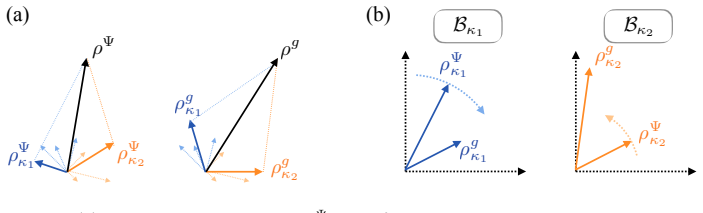
Variational quantum circuits reach the exact ground state only if the norms of projections onto each group module match between input and target states.
A machine-rendered reading of the paper's core claim, the machinery that carries it, and where it could break.
Core claim
This work identifies a necessary condition for any variational quantum approach to reach the exact ground state: the norms of the projections of the input and the ground state onto each group module must match, implying that module weights of the solution state have to be known in advance in order to reach the exact ground state. An exemplary case is provided by matchgate circuits applied to problems whose solutions are classical bit strings, since all computational basis states share the same module-wise weights. Combined with the known classical simulability of quantum circuits for which observables lie in a small linear subspace, this implies that certain problems admit a classical surro
What carries the argument
Group-module decomposition of the Hilbert space, which imposes that the projection norms of the input state and ground state onto each module must coincide for the variational circuit to be able to reach the target state.
Load-bearing premise
The variational quantum circuit and the problem Hamiltonian admit a decomposition into the same group-module structure used to derive the projection-norm condition.
What would settle it
An explicit variational circuit and Hamiltonian pair in which the ground state is reached exactly even though the projection norms onto the modules differ, or a MaxCut instance where the classical O(n^5) surrogate fails to recover the optimal cut.
Figures



read the original abstract
This work identifies a necessary condition for any variational quantum approach to reach the exact ground state. Briefly, the norms of the projections of the input and the ground state onto each group module must match, implying that module weights of the solution state have to be known in advance in order to reach the exact ground state. An exemplary case is provided by matchgate circuits applied to problems whose solutions are classical bit strings, since all computational basis states share the same module-wise weights. Combined with the known classical simulability of quantum circuits for which observables lie in a small linear subspace, this implies that certain problems admit a classical surrogate for exact solution with each step taking $O(n^5)$ time. The Maximum Cut problem serves as an illustrative example.
Editorial analysis
A structured set of objections, weighed in public.
Referee Report
Summary. The manuscript identifies a necessary reachability condition for variational quantum circuits to prepare the exact ground state of a Hamiltonian: the norms of the projections of the input state and the ground state onto each group module in a polynomial group-module decomposition must match. This implies that the module weights of the target state must be known in advance. The condition is illustrated for matchgate circuits on problems whose solutions are classical bit strings (all computational-basis states share identical module weights). Combined with known classical simulability results for circuits whose observables lie in a low-dimensional linear subspace, the approach yields a classical surrogate for exact optimization with O(n^5) time per step, using MaxCut as an illustrative example.
Significance. If the group-module decomposition and projection-norm condition are rigorously justified and independent of prior simulability results, the work would establish a concrete expressivity limitation for restricted VQCs and demonstrate that certain classically simulable ansatze admit efficient classical surrogates for exact ground-state search. The MaxCut example, if fully derived, would provide a concrete polynomial-time classical benchmark against which variational quantum performance can be compared.
major comments (2)
- [Abstract] The O(n^5) complexity claim for the classical surrogate (abstract) requires an explicit derivation showing how the low-dimensional observable subspace dimension, the number of group modules, and the matchgate structure combine to produce this scaling; without it, the per-step cost cannot be verified as polynomial and independent of the specific MaxCut instance size.
- [Abstract] The central projection-norm condition (abstract) is presented as necessary for any VQC, but the manuscript must demonstrate that the chosen group-module decomposition is preserved by the circuit evolution and applies uniformly to both the variational ansatz and the problem Hamiltonian; otherwise the reachability implication does not hold for arbitrary VQCs.
minor comments (2)
- Clarify whether the classical-simulability result invoked is independent of the group-module construction or whether it is applied post-hoc; an explicit citation and statement of the subspace dimension for the MaxCut observables would strengthen the argument.
- Ensure consistent use of terminology between the title ('Polynomial Group Module') and the abstract ('group module'); define the module decomposition formally at first use.
Simulated Author's Rebuttal
We thank the referee for their careful reading of the manuscript and for the constructive comments. We have revised the paper to provide the requested explicit derivation of the complexity and to clarify the preservation and applicability of the group-module decomposition. Below we respond point by point to the major comments.
read point-by-point responses
-
Referee: [Abstract] The O(n^5) complexity claim for the classical surrogate (abstract) requires an explicit derivation showing how the low-dimensional observable subspace dimension, the number of group modules, and the matchgate structure combine to produce this scaling; without it, the per-step cost cannot be verified as polynomial and independent of the specific MaxCut instance size.
Authors: We agree that an explicit derivation is needed for verifiability. In the revised manuscript we have added a dedicated paragraph (new Section 4.2) that derives the O(n^5) per-step cost: the observable subspace for matchgate circuits has dimension O(n^2), the number of group modules is O(n), and each classical surrogate step (projection-norm matching plus low-dimensional linear algebra) therefore scales as O(n^5) using standard matrix operations. The scaling depends only on qubit number n and is independent of any particular MaxCut instance. revision: yes
-
Referee: [Abstract] The central projection-norm condition (abstract) is presented as necessary for any VQC, but the manuscript must demonstrate that the chosen group-module decomposition is preserved by the circuit evolution and applies uniformly to both the variational ansatz and the problem Hamiltonian; otherwise the reachability implication does not hold for arbitrary VQCs.
Authors: We thank the referee for highlighting this point. The group-module decomposition is defined relative to the polynomial group generated by the variational circuit family; by construction the modules are invariant under the group action, so the decomposition is preserved under circuit evolution. We have expanded the text (revised Section 3) to show explicitly that the same decomposition applies to the input state, all states reachable by the ansatz, and the Hamiltonian observables (which lie in the low-dimensional subspace). While the concrete modules are circuit-class dependent, the necessary projection-norm matching condition holds for any VQC once its associated group-module decomposition is identified. This clarification keeps the claim within the paper's scope of restricted VQCs. revision: yes
Circularity Check
No significant circularity detected in the derivation
full rationale
The central derivation establishes a necessary reachability condition by equating projection norms of the input state and target ground state onto each group module; this follows algebraically from the assumed shared decomposition into the polynomial group module and does not reduce to a fitted parameter or self-definition. The specialization to matchgate circuits uses the independent structural fact that all computational-basis states carry identical module weights, which is a property of the circuit class rather than a constructed prediction. Invocation of classical simulability for observables in a low-dimensional subspace is presented as a 'known' external result rather than a self-citation whose validity depends on the present paper. No load-bearing step collapses to its own inputs by construction, and the MaxCut illustration remains non-essential to the general claim. The argument is therefore self-contained against external benchmarks.
Axiom & Free-Parameter Ledger
axioms (2)
- domain assumption Variational quantum circuits and the target Hamiltonian admit a common decomposition into group modules whose projections determine reachability.
- standard math Observables lying in a small linear subspace of the circuit algebra are classically simulable.
Reference graph
Works this paper leans on
-
[1]
Chapman and hall/CRC (2021)
d’ Alessandro, D.: Introduction to quantum control and dynamics. Chapman and hall/CRC (2021)
2021
-
[2]
org/10.1038/s41467-022-35364-5
Anschuetz, E.R., Kiani, B.T.: Quantum variational algorithms are swamped with traps. Nature Communications 13(1), 7760 (Dec 2022). https://doi.org/10. 1038/s41467-022-35364-5 , https://doi.org/10.1038/s41467-022-35364-5
-
[3]
https://doi.org/10.1038/ s41467-025-63099-6 , https://doi.org/10.1038/s41467-025-63099-6
Cerezo, M., Larocca, M., García-Martín, D., Diaz, N.L., Braccia, P., Fontana, E., Rudolph, M.S., Bermejo, P., Ijaz, A., Thanasilp, S., Anschuetz, E.R., Holmes, Z.: Does provable absence of barren plateaus imply classical simulability? Na- ture Communications 16(1), 7907 (Aug 2025). https://doi.org/10.1038/ s41467-025-63099-6 , https://doi.org/10.1038/s414...
-
[4]
Diaz, N.L., García-Martín, D., Kazi, S., Larocca, M., Cerezo, M.: Showcasing a barren plateau theory beyond the dynamical Lie algebra (2023), https://arxiv. org/abs/2310.11505
-
[5]
Farhi, E., Goldstone, J., Gutmann, S.: A auantum approximate optimization al- gorithm (2014), https://arxiv.org/abs/1411.4028
work page internal anchor Pith review Pith/arXiv arXiv 2014
-
[6]
Farhi, E., Neven, H.: Classification with Quantum Neural Networks on Near Term Processors (2018), https://arxiv.org/abs/1802.06002
work page Pith review arXiv 2018
-
[7]
Characterizing barren plateaus in quantum ans ¨atze with the adjoint representation,
Fontana, E., Herman, D., Chakrabarti, S., Kumar, N., Yalovetzky, R., Heredge, J., Sureshbabu, S.H., Pistoia, M.: Characterizing barren plateaus in quantum ansätze with the adjoint representation. Nature Communications 15(1), 7171 (Aug 2024). https://doi.org/10.1038/s41467-024-49910-w , https://doi.org/ 10.1038/s41467-024-49910-w
-
[8]
Goh, M.L., Larocca, M., Cincio, L., Cerezo, M., Sauvage, F.: Lie-algebraic classical simulations for quantum computing. Phys. Rev. Res. 7, 033266 (Sep 2025). https://doi.org/10.1103/3y65-f5w6, https://link.aps.org/doi/10. 1103/3y65-f5w6
-
[9]
Supervised Learning with Quantum-Enhanced Feature Spaces
Havlicek, V., Córcoles, A.D., Temme, K., Harrow, A.W., andala, A., Chow, J.M., Gambetta, J.M.: Supervised learning with quantum-enhanced feature spaces. Nature 567(7747), 209–212 (Mar 2019). https://doi.org/10.1038/ s41586-019-0980-2 , https://doi.org/10.1038/s41586-019-0980-2
- [10]
-
[11]
Jozsa, R., Miyake, A.: Matchgates and classical simulation of quantum circuits. Proceedings of the Royal Society A: Mathematical, Physical and Engineering Sciences 464(2100), 3089–3106 (07 2008). https://doi.org/10.1098/rspa.2008. 0189, https://doi.org/10.1098/rspa.2008.0189
-
[12]
Kingma, D.P., Ba, J.: Adam: A Method for Stochastic Optimization (2017), https: //arxiv.org/abs/1412.6980
work page internal anchor Pith review Pith/arXiv arXiv 2017
-
[13]
Nature Computational Science 3(6), 542–551 (2023)
Larocca, M., Ju, N., García-Martín, D., Coles, P.J., Cerezo, M.: Theory of over- parametrization in quantum neural networks. Nature Computational Science 3(6), 542–551 (2023)
2023
-
[14]
Larocca, M., Thanasilp, S., Wang, S., Sharma, K., Biamonte, J., Coles, P.J., Cincio, L., McClean, J.R., Holmes, Z., Cerezo, M.: Barren plateaus in variational quantum computing. Nature Reviews Physics 7(4), 174–189 (Apr 2025). https://doi.org/ 10.1038/s42254-025-00813-9 , https://doi.org/10.1038/s42254-025-00813-9
-
[15]
Nature Communications9(1) (2018) https:// doi.org/10.1038/s41467-018-07090-4
McClean, J.R., Boixo, S., Smelyanskiy, V.N., Babbush, R., Neven, H.: Barren plateaus in quantum neural network training landscapes. Nature Communications 9(1), 4812 (Nov 2018). https://doi.org/10.1038/s41467-018-07090-4 , https: //doi.org/10.1038/s41467-018-07090-4 12
-
[16]
Mitarai, K., Negoro, M., Kitagawa, M., Fujii, K.: Quantum circuit learning. Phys. Rev. A 98, 032309 (Sep 2018). https://doi.org/10.1103/PhysRevA.98.032309, https://link.aps.org/doi/10.1103/PhysRevA.98.032309
-
[17]
Cambridge University Press, Cambridge (2010)
Nielsen, M.A., Chuang, I.L.: Quantum computation and quantum information: 10th anniversary edition. Cambridge University Press (2010). https://doi.org/ 10.1017/CBO9780511976667
-
[18]
Nature Communications5(1), 4213 (2014) https://doi.org/ 10.1038/ncomms5213
Peruzzo, A., McClean, J., Shadbolt, P., Yung, M.H., Zhou, X.Q., Love, P.J., Aspuru-Guzik, A., O’Brien, J.L.: A variational eigenvalue solver on a photonic quantum processor. Nature Communications 5(1), 4213 (Jul 2014). https://doi. org/10.1038/ncomms5213, https://doi.org/10.1038/ncomms5213
-
[19]
Bakalov, Frédéric Sauvage, Alexander F
Ragone, M., Bakalov, B.N., Sauvage, F., Kemper, A.F., Ortiz Marrero, C., Larocca, M., Cerezo, M.: A Lie algebraic theory of barren plateaus for deep parameterized quantum circuits. Nature Communications 15(1), 7172 (Aug 2024). https://doi.org/10.1038/s41467-024-49909-3 , https://doi.org/10. 1038/s41467-024-49909-3
-
[20]
SIAM Journal on Computing 31(4), 1229–1254 (2002)
Valiant, L.G.: Quantum circuits that can be simulated classically in polynomial time. SIAM Journal on Computing 31(4), 1229–1254 (2002). https://doi.org/ 10.1137/S0097539700377025, https://doi.org/10.1137/S0097539700377025
-
[21]
https://biqmac.aau.at/biqmaclib.html (2007), accessed: 2026-04-02
Wiegele, A.: Biq mac library – a collection of max-cut and quadratic 0-1 program- ming instances of medium size. https://biqmac.aau.at/biqmaclib.html (2007), accessed: 2026-04-02
2007
-
[22]
edLTcGZ+D3dLw9irIggMDtAxcYo=
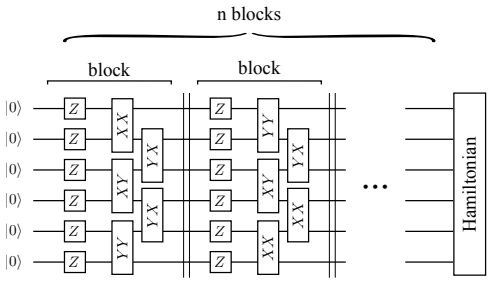
Zeier, R., Schulte-Herbr’́uggen, T.: Symmetry principles in quantum system theory. Journal of mathematical physics 52(11) (2011) A Matchgate quantum circuit and group module A.1 Matchgate circuit structure The variational ansatz depicted in Fig. 3 comprises O(n) circuit blocks. Each block contains three successive layers of quantum gates. We denote a gate...
2011
-
[23]
State initialization : Construct the initial state jψ0i (either all-zero j0i⊗n or single-qubit flipped X1j0i⊗n) and compute its representation in the Ma- jorana basis. 19
-
[24]
F orward pass: Apply the matchgate circuit U (θ) =Q q U (θq) to the initial state by sequentially applying each gate’s effective matrix M(θq) to the coefficient vector
-
[25]
Expectation value : Compute the inner product hHi =hψ(θ)jHjψ(θ)i us- ing the evolved state coefficients and the Hamiltonian representation
-
[26]
Backward pass : Perform automatic differentiation to compute gradients rθhHi, with optional gradient checkpointing
-
[27]
Parameter update: Apply Adam optimizer to update θ θη Adam(rθhHi)
-
[28]
A.8 Convergence curves 61 211 261 311 361 .71 .51 .31 1 .83 Ovncfs pg jufsbujpot Dptu Fig
Check convergence: Evaluate the improvement criterion; trigger learning rate decay or termination if conditions are met. A.8 Convergence curves 61 211 261 311 361 .71 .51 .31 1 .83 Ovncfs pg jufsbujpot Dptu Fig. 4. Convergence of the cost for an n = 60 instance that the projected method reached the exact ground state. The lowest eigenvalue of the instance...
2025
discussion (0)
Sign in with ORCID, Apple, or X to comment. Anyone can read and Pith papers without signing in.