Recognition: 1 theorem link
· Lean TheoremHUOZIIME: An On-Device LLM-enhanced Input Method for Deep Personalization
Pith reviewed 2026-05-15 01:17 UTC · model grok-4.3
The pith
HUOZIIME post-trains a base LLM on synthesized data and adds hierarchical memory to deliver personalized on-device text input.
A machine-rendered reading of the paper's core claim, the machinery that carries it, and where it could break.
Core claim
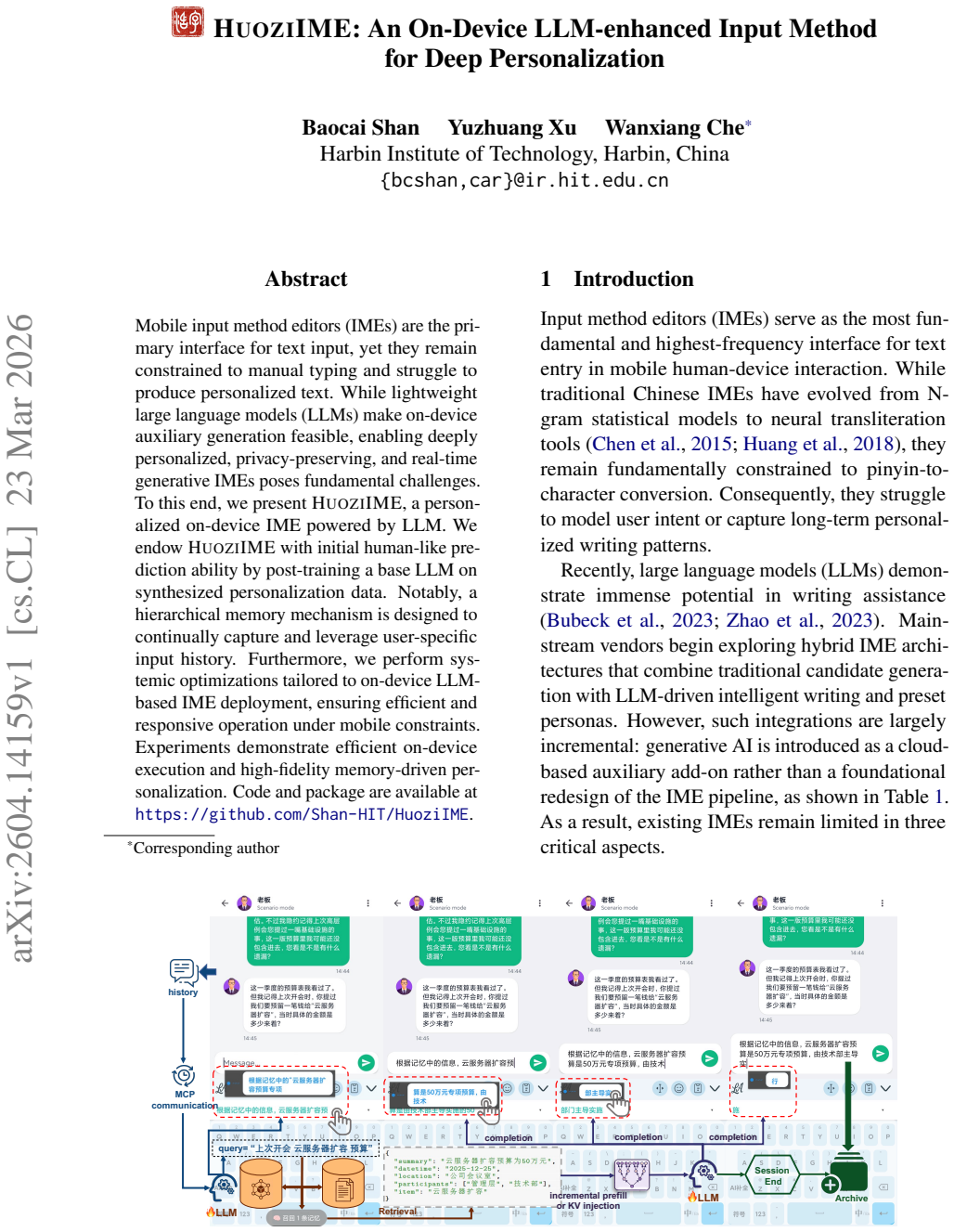
HUOZIIME endows an on-device IME with initial human-like prediction ability by post-training a base LLM on synthesized personalization data, then augments it with a hierarchical memory mechanism that continually captures and leverages user-specific input history, all while applying systemic optimizations that ensure efficient and responsive operation under mobile constraints.
What carries the argument
The hierarchical memory mechanism that records user input history at multiple levels and retrieves relevant entries to condition the LLM's next-token predictions.
If this is right
- Mobile keyboards can generate full phrases or sentences that reflect a user's past writing style without sending data off-device.
- Typing effort drops because the model continually updates its view of the user's preferences from ongoing input.
- The same architecture can support multiple languages or input modalities once the post-training and memory layers are in place.
- On-device execution removes the latency and connectivity requirements that currently limit cloud-based generative keyboards.
Where Pith is reading between the lines
- The same memory structure could be reused to personalize other on-device language tasks such as autocorrect or emoji suggestion.
- If the synthesized data closely matches real usage distributions, the system may generalize to new users faster than training from scratch.
- Longer-term user histories stored in the hierarchy might surface stable writing patterns that could inform accessibility features for users with motor or cognitive differences.
Load-bearing premise
Post-training a base LLM on synthesized personalization data plus the hierarchical memory mechanism will produce accurate deep personalization for real users on phones without losing speed or raising privacy problems.
What would settle it
Run the system on a group of real users for several weeks and measure whether the fraction of accepted suggestions exceeds that of an identical model without the memory component by a statistically clear margin; if it does not, the personalization claim fails.
Figures


read the original abstract
Mobile input method editors (IMEs) are the primary interface for text input, yet they remain constrained to manual typing and struggle to produce personalized text. While lightweight large language models (LLMs) make on-device auxiliary generation feasible, enabling deeply personalized, privacy-preserving, and real-time generative IMEs poses fundamental challenges.To this end, we present HUOZIIME, a personalized on-device IME powered by LLM. We endow HUOZIIME with initial human-like prediction ability by post-training a base LLM on synthesized personalization data. Notably, a hierarchical memory mechanism is designed to continually capture and leverage user-specific input history. Furthermore, we perform systemic optimizations tailored to on-device LLMbased IME deployment, ensuring efficient and responsive operation under mobile constraints.Experiments demonstrate efficient on-device execution and high-fidelity memory-driven personalization. Code and package are available at https://github.com/Shan-HIT/HuoziIME.
Editorial analysis
A structured set of objections, weighed in public.
Referee Report
Summary. The manuscript presents HUOZIIME, a system for an on-device LLM-enhanced input method editor (IME) that enables deep personalization. It post-trains a base LLM on synthesized personalization data to initialize human-like prediction, incorporates a hierarchical memory mechanism to capture user-specific input history, and applies systemic optimizations for efficient mobile deployment. The authors claim that experiments demonstrate efficient on-device execution and high-fidelity memory-driven personalization.
Significance. If the experimental claims hold, this work could significantly advance privacy-preserving, personalized text input on mobile devices by leveraging lightweight LLMs and memory mechanisms. It contributes to the field of on-device AI by addressing real-time constraints and personalization without cloud dependency. The availability of code on GitHub is a positive aspect for reproducibility.
major comments (2)
- [Experiments] The abstract and experiments section assert positive results on efficiency and personalization fidelity but supply no specific metrics, baselines, datasets, or evaluation details, making it impossible to verify the support for the central claims.
- [Hierarchical memory mechanism] The personalization fidelity claim relies on post-training with synthesized data; however, there is no quantitative validation (e.g., distribution similarity measures like KL divergence or perplexity on real held-out user logs) showing that the synthetic data distribution matches real user typing histories, which is necessary for the transfer to real users under mobile constraints.
minor comments (1)
- [Abstract] The abstract mentions 'systemic optimizations' but does not specify what they are; consider adding a brief description or reference to the relevant section.
Simulated Author's Rebuttal
We thank the referee for the detailed and constructive feedback. We agree that additional quantitative details are needed to fully support the claims and will revise the manuscript accordingly. Below we respond to each major comment.
read point-by-point responses
-
Referee: [Experiments] The abstract and experiments section assert positive results on efficiency and personalization fidelity but supply no specific metrics, baselines, datasets, or evaluation details, making it impossible to verify the support for the central claims.
Authors: We acknowledge that the abstract is high-level and that the experiments section would benefit from more explicit reporting. The full manuscript does include on-device benchmarks (latency, memory footprint, and throughput) and personalization metrics, but we agree these are not presented with sufficient clarity, baselines (e.g., non-personalized LLM and n-gram models), or dataset descriptions. In the revision we will expand the abstract with key numbers, add a summary table of all metrics, explicitly list the synthesized datasets and evaluation protocols, and clarify how fidelity is quantified. revision: yes
-
Referee: [Hierarchical memory mechanism] The personalization fidelity claim relies on post-training with synthesized data; however, there is no quantitative validation (e.g., distribution similarity measures like KL divergence or perplexity on real held-out user logs) showing that the synthetic data distribution matches real user typing histories, which is necessary for the transfer to real users under mobile constraints.
Authors: This is a fair observation. Our synthetic data is generated from public corpora to emulate personalization patterns, but we did not report direct distributional comparisons to real user logs (due to privacy constraints on real logs). We will add quantitative validation in the revision, including KL divergence and perplexity comparisons against held-out public typing datasets, to strengthen the justification for transfer to real mobile users. revision: yes
Circularity Check
No significant circularity in system implementation
full rationale
The paper describes an engineering system for on-device LLM-based IME personalization via post-training on synthesized data and a hierarchical memory module, followed by mobile optimizations and experiments. No mathematical derivations, equations, fitted parameters presented as predictions, or self-citations appear in the provided text. The central claims rest on experimental measurements of the implemented system rather than any reduction of outputs to inputs by construction, satisfying the criteria for a self-contained non-circular description.
Axiom & Free-Parameter Ledger
invented entities (1)
-
hierarchical memory mechanism
no independent evidence
Reference graph
Works this paper leans on
-
[1]
Qwen technical report.arXiv preprint, abs/2309.16609. Sébastien Bubeck, Varun Chandrasekaran, Ronen El- dan, Johannes Gehrke, Eric Horvitz, Ece Kamar, Pe- ter Lee, Yin Tat Lee, Yuanzhi Li, Scott Lundberg, Harsha Nori, Hamid Palangi, Marco Tulio Ribeiro, and Yi Zhang
work page internal anchor Pith review Pith/arXiv arXiv
-
[2]
Sparks of Artificial General Intelligence: Early experiments with GPT-4
Sparks of artificial general in- telligence: Early experiments with GPT-4.arXiv preprint, abs/2303.12712. Shenyuan Chen, Hai Zhao, and Rui Wang
work page internal anchor Pith review Pith/arXiv arXiv
-
[3]
InProceedings of the 7th Conference on Machine Learning and Systems (MLSys)
Prompt- Cache: Modular attention reuse for low-latency in- ference. InProceedings of the 7th Conference on Machine Learning and Systems (MLSys). Dan Gusfield. 1997.Algorithms on Strings, Trees, and Sequences: Computer Science and Computational Biology. Cambridge University Press, Cambridge, UK. Andrew Hard, Kanishka Rao, Rajiv Mathews, Françoise Beaufays,...
work page 1997
-
[4]
Federated Learning for Mobile Keyboard Prediction
Federated learn- ing for mobile keyboard prediction.arXiv preprint, abs/1811.03604. Yafang Huang, Zuchao Li, Zhuosheng Zhang, and Hai Zhao
work page internal anchor Pith review Pith/arXiv arXiv
-
[5]
Proximal Policy Optimization Algorithms
Proxi- mal policy optimization algorithms.arXiv preprint, abs/1707.06347. Zhihong Shao, Peiyi Wang, Qihao Zhu, Runxin Xu, Junxiao Song, Xiao Bi, Haowei Zhang, Mingchuan Zhang, Y . K. Li, Y . Wu, and Daya Guo
work page internal anchor Pith review Pith/arXiv arXiv
-
[6]
DeepSeekMath: Pushing the Limits of Mathematical Reasoning in Open Language Models
DeepSeekMath: Pushing the limits of mathematical reasoning in open language models.arXiv preprint, abs/2402.03300. Jianlin Su, Yu Lu, Shengfeng Pan, Ahmed Murtadha, Bo Wen, and Yunfeng Liu
work page internal anchor Pith review Pith/arXiv arXiv
-
[7]
KVLink: Accelerating large language models via efficient KV cache reuse.arXiv preprint, abs/2502.16002. Jiayi Yao, Hanchen Li, Yuhan Liu, Siddhant Ray, Yi- hua Cheng, Qizheng Zhang, Kuntai Du, Shan Lu, and Junchen Jiang
-
[8]
Privacy- preserving large language models: Mechanisms, ap- plications, and future directions.arXiv preprint, abs/2412.06113. Wayne Xin Zhao, Kun Zhou, Junyi Li, Tianyi Tang, Xiaolei Wang, Yupeng Hou, Yingqian Min, Beichen Zhang, Junjie Zhang, Zican Dong, Yifan Du, Chen Yang, Yushuo Chen, Zhipeng Chen, Jinhao Jiang, Ruiyang Ren, Yifan Li, Xinyu Tang, Zikan...
-
[9]
A Survey of Large Language Models
A survey of large language models. arXiv preprint, abs/2303.18223. Lianmin Zheng, Liangsheng Yin, Zhiqiang Xie, Chuyue Sun, Jeff Huang, Cody Hao Yu, Shiyi Cao, Christos Kozyrakis, Ion Stoica, Joseph E. Gonzalez, Clark W. Barrett, and Ying Sheng
work page internal anchor Pith review Pith/arXiv arXiv
-
[10]
Advances in Neural Information Processing Systems (NeurIPS)
SGLang: Efficient execution of structured language model programs. Advances in Neural Information Processing Systems (NeurIPS). A Appendix A.1 Reward in the GRPO Algorithm The GRPO algorithm optimizes the trainable policy πθ by sampling a group of G outputs for each input prompt x from the behavior policy and estimating their relative advantages via in-gr...
work page 2017
discussion (0)
Sign in with ORCID, Apple, or X to comment. Anyone can read and Pith papers without signing in.