Tracking the Temporal Dynamics of News Coverage of Catastrophic and Violent Events
Pith reviewed 2026-05-10 13:55 UTC · model grok-4.3
The pith
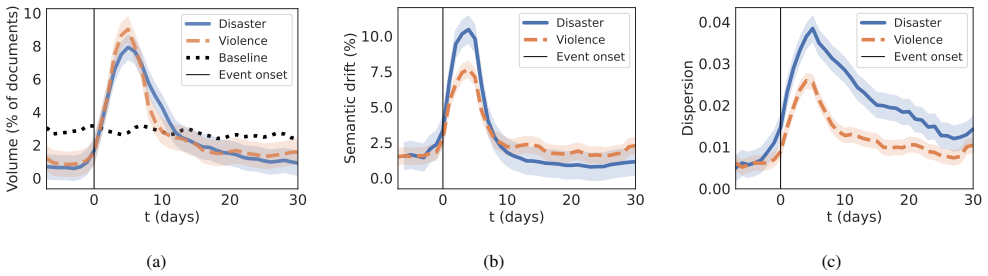
Sudden catastrophic and violent events produce structured news cycles with rapid coverage surges, early semantic drift, and gradual decline to baseline.
A machine-rendered reading of the paper's core claim, the machinery that carries it, and where it could break.
Core claim
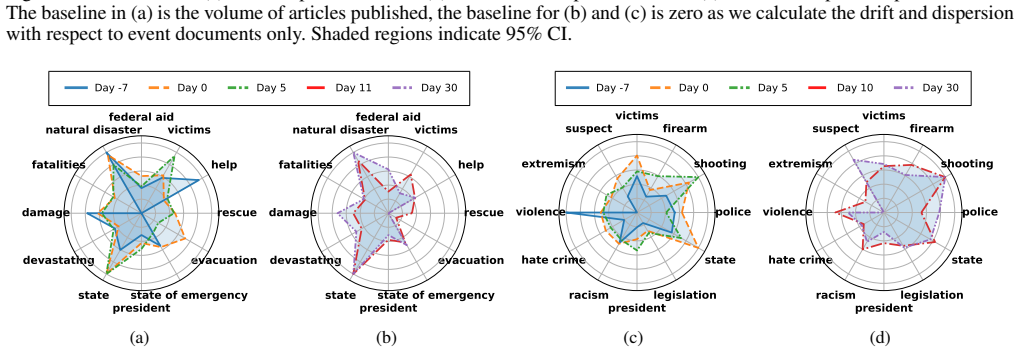
Sudden events of impact exhibit structured and predictable news-cycle patterns characterized by rapid surges in coverage, early semantic drift, and gradual declines toward the baseline, quantified through publication volume, semantic drift, semantic dispersion, and term relevance across 126,602 news articles, with specific terms identified as driving the temporal patterns.
What carries the argument
Quantification of narrative change via publication volume, semantic drift, semantic dispersion, and term relevance applied to a corpus of news articles on violent and catastrophic events.
If this is right
- News coverage of sudden events rises sharply within a short initial period.
- The meaning and framing of terms in articles shifts early after the event.
- Coverage volume and semantic measures return toward pre-event levels over time.
- Particular terms can be isolated as the main drivers of the observed temporal patterns.
- These patterns hold across multiple violent and catastrophic events in the studied corpus.
Where Pith is reading between the lines
- The patterns could support real-time systems that flag when a crisis narrative is entering its drift phase.
- Similar metric tracking might reveal whether non-violent sudden events like economic shocks follow the same cycle structure.
- Term relevance analysis could be tested as a way to detect when coverage begins incorporating new sources or angles.
- Extending the approach to social media alongside news articles would test if the same surges and drifts appear in public discussion.
Load-bearing premise
The collected corpus of 126,602 articles from online publishers is representative of broader news dynamics and the chosen metrics accurately capture narrative evolution without selection bias or measurement artifacts.
What would settle it
A sudden high-impact event whose news coverage shows no rapid surge in volume, lacks early semantic drift, or fails to decline gradually back to baseline levels.
Figures
read the original abstract
The modern news cycle has been fundamentally reshaped by the rapid exchange of information online. As a result, media framing shifts dynamically as new information, political responses, and social reactions emerge. Understanding how these narratives form, propagate, and evolve is essential for interpreting public discourse during moments of crisis. In this study, we examine the temporal and semantic dynamics of reporting for violent and catastrophic events using a large-scale corpus of 126,602 news articles collected from online publishers. We quantify narrative change through publication volume, semantic drift, semantic dispersion, and term relevance. Our results show that sudden events of impact exhibit structured and predictable news-cycle patterns characterized by rapid surges in coverage, early semantic drift, and gradual declines toward the baseline. In addition, our results indicate the terms that are driving the temporal patterns.
Editorial analysis
A structured set of objections, weighed in public.
Referee Report
Summary. The manuscript analyzes temporal and semantic dynamics in news coverage of violent and catastrophic events using a corpus of 126,602 articles. It applies metrics of publication volume, semantic drift (via embeddings), semantic dispersion, and term relevance to identify patterns, claiming that sudden-impact events exhibit rapid coverage surges, early semantic drift, and gradual declines toward baseline, while also identifying driving terms.
Significance. If the claimed patterns can be shown to be distinctive rather than generic to attention spikes, the large-scale corpus analysis and embedding-based metrics could contribute to computational studies of media framing and crisis discourse. The scale of the data collection is a strength, but the absence of controls limits the ability to draw specific conclusions about catastrophic events.
major comments (2)
- Abstract: the central claim of 'structured and predictable news-cycle patterns' is stated without any quantitative results, error bars, statistical tests, or validation against held-out events; the evidence for rapid surges, early drift, and gradual decline is not shown in the provided summary of findings.
- Section 4 (results): the metrics are applied only to the selected catastrophic/violent events with no comparison to matched control corpora of other high-volume topics (e.g., elections or sports finals). This leaves the specificity of the temporal structure untested, as only within-event trajectories are described and no cross-condition contrasts are reported.
Simulated Author's Rebuttal
We are grateful to the referee for their thoughtful comments, which have helped us identify areas for improvement in our manuscript. We respond to each major comment below and indicate the revisions we plan to make.
read point-by-point responses
-
Referee: Abstract: the central claim of 'structured and predictable news-cycle patterns' is stated without any quantitative results, error bars, statistical tests, or validation against held-out events; the evidence for rapid surges, early drift, and gradual decline is not shown in the provided summary of findings.
Authors: We agree that the abstract would be strengthened by including quantitative support for the claims. In the revised manuscript, we will update the abstract to reference key quantitative findings from our analyses, such as the magnitude of coverage surges, timelines for semantic drift, and any statistical measures used. This will better convey the evidence base for the described patterns without exceeding length constraints. revision: yes
-
Referee: Section 4 (results): the metrics are applied only to the selected catastrophic/violent events with no comparison to matched control corpora of other high-volume topics (e.g., elections or sports finals). This leaves the specificity of the temporal structure untested, as only within-event trajectories are described and no cross-condition contrasts are reported.
Authors: The manuscript is specifically focused on characterizing the temporal and semantic dynamics in news coverage of catastrophic and violent events. We describe the observed patterns for these events but do not assert that they are unique to them. To address the concern about specificity, we will revise the discussion section to explicitly note the scope of our claims and suggest that comparative analyses with control topics could be a valuable direction for future work. We will also clarify in the results that the trajectories are event-specific. revision: partial
Circularity Check
No significant circularity detected
full rationale
The paper is an empirical corpus study that collects 126602 articles and applies externally defined NLP metrics (publication volume, embedding-based semantic drift, dispersion, term relevance) to describe observed temporal patterns in catastrophic events. No equations, models, or derivations are presented that reduce claims to fitted parameters or self-referential definitions; the reported patterns are direct outputs of the data processing pipeline rather than predictions constructed from the same inputs. No self-citation chains, uniqueness theorems, or ansatzes are invoked as load-bearing steps. The analysis remains self-contained as descriptive observation without circular reductions.
Axiom & Free-Parameter Ledger
Reference graph
Works this paper leans on
-
[1]
Would answering this research question advance science without violating social contracts, such as violating pri- vacy norms, perpetuating unfair profiling, exacerbating the socio-economic divide, or implying disrespect to so- cieties or cultures?Yes
-
[2]
Do your main claims in the abstract and introduction ac- curately reflect the paper’s contributions and scope?Yes
-
[3]
Do you clarify how the proposed methodological ap- proach is appropriate for the claims made?Yes
-
[4]
Do you clarify what are possible artifacts in the data used, given population-specific distributions?N/A
-
[5]
Limitations and Ethical Considerations
Did you describe the limitations of your work?Yes, lim- itations are discussed in the “Limitations and Ethical Considerations” section
-
[6]
Limitations and Ethical Considerations
Did you discuss any potential negative societal impacts of your work?Yes, in the “Limitations and Ethical Considerations” section
-
[7]
Did you discuss any potential misuse of your work?N/A
-
[8]
Did you describe steps taken to prevent or mitigate po- tential negative outcomes of the research, such as data and model documentation, data anonymization, respon- sible release, access control, and the reproducibility of findings?Yes
-
[9]
Have you read the ethics review guidelines and ensured that your paper conforms to them?Yes Additionally, if your study involves hypotheses testing
-
[10]
Did you clearly state the assumptions underlying all the- oretical results?N/A
-
[11]
Have you provided justifications for all theoretical re- sults?N/A
-
[12]
Did you discuss competing hypotheses or theories that might challenge or complement your theoretical results? N/A
-
[13]
Have you considered alternative mechanisms or explana- tions that might account for the same outcomes observed in your study?N/A
-
[14]
Did you address potential biases or limitations in your theoretical framework?N/A
-
[15]
Have you related your theoretical results to the existing literature in social science?N/A
-
[16]
Did you discuss the implications of your theoretical re- sults for policy, practice, or further research in the social science domain?N/A Additionally, if you are including theoretical proofs
-
[17]
Did you state the full set of assumptions of all theoretical results?N/A
-
[18]
Did you include complete proofs of all theoretical re- sults?N/A Additionally, if you ran machine learning experiments
-
[19]
Did you include the code, data, and instructions needed to reproduce the main experimental results (either in the supplemental material or as a URL)?Yes, in supplemen- tal material
-
[20]
Did you specify all the training details (e.g., data splits, hyperparameters, how they were chosen)?N/A, we did not train a model
-
[21]
Did you report error bars (e.g., with respect to the random seed after running experiments multiple times)?Yes, er- ror bars are shown in figures
-
[22]
Did you include the total amount of compute and the type of resources used (e.g., type of GPUs, internal cluster, or cloud provider)?No, we did not use any external computer resources
-
[23]
Do you justify how the proposed evaluation is sufficient and appropriate to the claims made?Yes
-
[24]
Do you discuss what is “the cost“ of misclassification and fault (in)tolerance?N/A Additionally, if you are using existing assets (e.g., code, data, models) or curating/releasing new assets,without compromising anonymity
-
[25]
If your work uses existing assets, did you cite the cre- ators?Yes, GDELT database was referenced
-
[26]
Did you mention the license of the assets?N/A
-
[27]
Did you include any new assets in the supplemental ma- terial or as a URL?N/A
-
[28]
Did you discuss whether and how consent was obtained from people whose data you’re using/curating?N/A
-
[29]
Did you discuss whether the data you are using/curating contains personally identifiable information or offensive content?N/A
-
[30]
If you are curating or releasing new datasets, did you dis- cuss how you intend to make your datasets FAIR?N/A
-
[31]
If you are curating or releasing new datasets, did you cre- ate a Datasheet for the Dataset?N/A Additionally, if you used crowdsourcing or conducted research with human subjects,without compromising anonymity
-
[32]
Did you include the full text of instructions given to par- ticipants and screenshots?N/A
-
[33]
Did you describe any potential participant risks, with mentions of Institutional Review Board (IRB) approvals? N/A
-
[34]
Did you include the estimated hourly wage paid to par- ticipants and the total amount spent on participant com- pensation?N/A
-
[35]
Did you discuss how data is stored, shared, and deidenti- fied?N/A
discussion (0)
Sign in with ORCID, Apple, or X to comment. Anyone can read and Pith papers without signing in.