Recognition: unknown
The Agentification of Scientific Research: A Physicist's Perspective
Pith reviewed 2026-05-10 11:09 UTC · model grok-4.3
The pith
AI's core impact on science is a shift in how knowledge is carried and shared, making AI a collaborator rather than a tool
A machine-rendered reading of the paper's core claim, the machinery that carries it, and where it could break.
Core claim
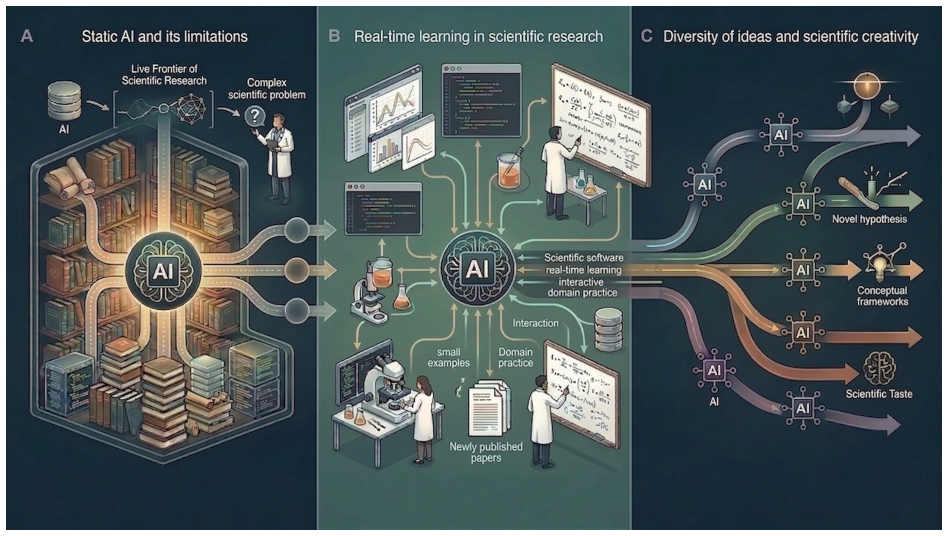
The most important significance of the AI revolution, especially the rise of large language models, lies not simply in automation, but in a fundamental change in how complex information and human know-how are carried, replicated, and shared. From this perspective, AI for Science is especially important because it may transform not only the efficiency of research, but also the structure of scientific collaboration, discovery, publishing, and evaluation. The article outlines a gradual path from AI as a research tool to AI as a scientific collaborator, and discusses how AI is likely to fundamentally reshape scientific publication. It also argues that continuous learning and diversity of ideas 0
What carries the argument
Agentification of research, the process turning AI into scientific collaborators that carry and replicate know-how
If this is right
- The structure of scientific collaboration will incorporate AI agents as active participants.
- Scientific publishing will be fundamentally reshaped to account for AI involvement in content creation and review.
- Research evaluation methods will evolve to assess contributions from both humans and AI systems.
- Original scientific discovery will depend on AI maintaining continuous learning and idea diversity.
Where Pith is reading between the lines
- Researchers may develop new practices for interacting with AI to maximize collaborative output.
- Fields could see faster integration of knowledge across disciplines through AI's ability to replicate diverse expertise.
- Pilot projects using AI agents in controlled research settings could verify their capacity for independent idea generation.
Load-bearing premise
That AI systems can acquire continuous learning abilities and sustain diversity of ideas to make original discoveries, with the shift to collaborator status occurring without major barriers.
What would settle it
Evidence that AI systems, despite extensive data exposure, repeatedly fail to produce or validate any novel, verifiable scientific insights without constant human guidance at key steps.
Figures


read the original abstract
This article argues that the most important significance of the AI revolution, especially the rise of large language models, lies not simply in automation, but in a fundamental change in how complex information and human know-how are carried, replicated, and shared. From this perspective, AI for Science is especially important because it may transform not only the efficiency of research, but also the structure of scientific collaboration, discovery, publishing, and evaluation. The article outlines a gradual path from AI as a research tool to AI as a scientific collaborator, and discusses how AI is likely to fundamentally reshape scientific publication. It also argues that continuous learning and diversity of ideas are essential if AI is to play a meaningful role in original scientific discovery.
Editorial analysis
A structured set of objections, weighed in public.
Referee Report
Summary. The manuscript is a perspective article arguing that the primary significance of the AI revolution, especially large language models, is not automation but a fundamental shift in how complex information and human know-how are carried, replicated, and shared. It claims this will transform the structure of scientific collaboration, discovery, publishing, and evaluation, outlining a gradual path from AI as a research tool to AI as a collaborator. The paper emphasizes that continuous learning and diversity of ideas are essential for AI to contribute to original scientific discovery.
Significance. If the perspective holds, it offers a timely interpretive framework for physicists and AI researchers on the structural implications of AI for science, moving beyond efficiency gains to changes in knowledge replication and institutional practices. The argument draws on historical patterns and current trends to highlight potential shifts in collaboration and evaluation, providing a coherent narrative that could inform discussions on AI for Science.
minor comments (2)
- The transition from tool to collaborator is described qualitatively; adding a brief timeline or milestone examples in the relevant section would strengthen readability without altering the perspective nature.
- The abstract and introduction both state the core thesis on know-how replication; consider consolidating to avoid minor repetition.
Simulated Author's Rebuttal
We thank the referee for their positive assessment of the manuscript and for recommending acceptance. The referee's summary accurately captures the central thesis that the significance of AI, particularly large language models, lies in reshaping how complex information and expertise are replicated and shared, with implications for scientific collaboration, discovery, publishing, and evaluation.
Circularity Check
No significant circularity in perspective article
full rationale
The manuscript is a perspective article advancing interpretive opinions on AI's impact on scientific processes. It contains no formal derivation chain, equations, quantitative predictions, or fitted parameters. Claims rest on general historical observations and forward-looking speculation without reducing any result to self-defined inputs, self-citations as load-bearing premises, or renaming of known results. The central argument about AI transforming know-how replication is presented as opinion, not a derived proposition requiring validation against its own premises.
Axiom & Free-Parameter Ledger
axioms (2)
- domain assumption AI can progress from tool to collaborator through gradual development.
- domain assumption Continuous learning and diversity of ideas are required for AI to enable original discovery.
Reference graph
Works this paper leans on
- [1]
-
[2]
Andres M. Bran, Sam Cox, Oliver Schilter, et al. Augmenting large language models with chemistry tools. Nature Machine Intelligence , 6(5):525–535, 2024. doi: 10.1038/s42256-024- 00832-8. URL https://doi.org/10.1038/s42256-024-00832-8
-
[3]
Accelerating clinical evidence synthesis with large language models
Zifeng Wang, Lang Cao, Benjamin Danek, et al. Accelerating clinical evidence synthesis with large language models. npj Digital Medicine , 8:509, 2025. doi: 10.1038/s41746-025-01840-7. URL https://doi.org/10.1038/s41746-025-01840-7
-
[4]
Michael Y. Li, Emily B. Fox, and Noah D. Goodman. Automated statistical model discovery with language models, 2024. URL https://arxiv.org/abs/2402.17879
-
[5]
Single-minus graviton tree am- plitudes are nonzero, 2026
Alfredo Guevara, Alexandru Lupsasca, David Skinner, et al. Single-minus graviton tree am- plitudes are nonzero, 2026. URL https://cdn.openai.com/pdf/graviton.pdf. OpenAI preprint PDF
2026
-
[6]
Michael P. Brenner, Vincent Cohen-Addad, and David Woodruff. Solving an open problem in theoretical physics using AI-assisted discovery, 2026. URL https://arxiv.org/abs/2603.04735
-
[7]
Sirui Lu, Zhijing Jin, Terry Jingchen Zhang, et al. Can theoretical physics research benefit from language agents?, 2025. URL https://arxiv.org/abs/2506.06214
-
[8]
Agent laboratory: Using LLM agents as research assistants
Samuel Schmidgall, Yusheng Su, Ze Wang, et al. Agent laboratory: Using LLM agents as research assistants. In Findings of the Association for Computational Linguistics: EMNLP 2025, 2025. URL https://aclanthology.org/2025.findings-emnlp.320/
2025
-
[9]
SciSciGPT: Advancing human-AI collaboration in the science of science
Erzhuo Shao, Yifang Wang, Yifan Qian, et al. SciSciGPT: Advancing human-AI collaboration in the science of science. Nature Computational Science, 2025. doi: 10.1038/s43588-025-00906-
-
[10]
URL https://doi.org/10.1038/s43588-025-00906-6
-
[11]
Yi Zhou. From paper to program: A multi-stage LLM-assisted workflow for accelerating quantum many-body algorithm development, 2026. URL https://arxiv.org/abs/2604.04089
work page internal anchor Pith review Pith/arXiv arXiv 2026
-
[13]
V ASPilot: MCP-Facilitated Multi-Agent Intelligence for Autonomous V ASP Simulations, August 2025
Jiaxuan Liu, Tiannian Zhu, Caiyuan Ye, et al. V ASPilot: MCP-facilitated multi-agent intelli- gence for autonomous V ASP simulations, 2025. URL https://arxiv.org/abs/2508.07035
-
[14]
Materialsgalaxy: A plat- form fusing experimental and theoretical data in condensed matter physics
Tiannian Zhu, Zhong Fang, Quansheng Wu, and Hongming Weng. Materialsgalaxy: A plat- form fusing experimental and theoretical data in condensed matter physics. Chinese Physics B, 34(12):120702, 2025
2025
-
[15]
Juraj Gottweis, Wei-Hung Weng, Alexander Daryin, Tao Tu, Anil Palepu, Petar Sirkovic, et al. Towards an AI co-scientist, 2025. URL https://arxiv.org/abs/2502.18864. 12
work page internal anchor Pith review arXiv 2025
- [16]
-
[17]
Scimaster: Towards general-purpose scientific ai agents, part i
Jingyi Chai, Shuo Tang, Rui Ye, Yuwen Du, Xinyu Zhu, Mengcheng Zhou, Yanfeng Wang, Yuzhi Zhang, Linfeng Zhang, Siheng Chen, et al. Scimaster: Towards general-purpose scientific ai agents, part i. x-master as foundation: Can we lead on humanity’s last exam? arXiv preprint arXiv:2507.05241, 2025
-
[18]
The AI Scientist: Towards Fully Automated Open-Ended Scientific Discovery
Chris Lu, Cong Lu, Robert Tjarko Lange, et al. The AI scientist: Towards fully automated open-ended scientific discovery, 2024. URL https://arxiv.org/abs/2408.06292
work page internal anchor Pith review arXiv 2024
-
[19]
Exploring the use of AI authors and reviewers at Agents4Science
Federico Bianchi, Owen Queen, Nitya Thakkar, Eric Sun, James Zou, et al. Exploring the use of AI authors and reviewers at Agents4Science. Nature Biotechnology, 44:11–14, 2026. doi: 10.1038/s41587-025-02963-8. URL https://doi.org/10.1038/s41587-025-02963-8
-
[20]
Riccardo Bertolo and Alessandro Antonelli. Generative AI in scientific publishing: Disruptive or destructive? Nature Reviews Urology , 21:1–2, 2024. doi: 10.1038/s41585-023-00836-w. URL https://doi.org/10.1038/s41585-023-00836-w
-
[21]
Scientific production in the era of large language models.Science, 390(6779):1240–1243, 2025
Keigo Kusumegi, Xinyu Yang, Paul Ginsparg, et al. Scientific production in the era of large language models. Science, 390(6779):1240–1243, 2025. doi: 10.1126/science.adw3000. URL https://doi.org/10.1126/science.adw3000
-
[22]
Quantifying large language model usage in scientific papers
Weixin Liang, Yaohui Zhang, Zhengxuan Wu, et al. Quantifying large language model usage in scientific papers. Nature Human Behaviour , 9:2599–2609, 2025. doi: 10.1038/s41562-025- 02273-8. URL https://doi.org/10.1038/s41562-025-02273-8
-
[23]
Model context protocol, 2024
Anthropic. Model context protocol, 2024. URL https://modelcontextprotocol.io/docs/getting- started/intro
2024
-
[24]
Agent skills protocol, 2025
Anthropic. Agent skills protocol, 2025. URL https://agentskills.io/home
2025
-
[25]
Hao Cui, Zahra Shamsi, Gowoon Cheon, et al. CURIE: Evaluating LLMs on multitask scientific long context understanding and reasoning, 2025. URL https://arxiv.org/abs/2503.13517
-
[26]
Roggeveen, Erez Berg, et al
Haining Pan, James V. Roggeveen, Erez Berg, et al. CMT-benchmark: A benchmark for condensed matter theory built by expert researchers, 2025. URL https://arxiv.org/abs/2510 .05228
2025
-
[27]
Expert evaluation of LLM world models: A high- 𝑡𝑐 superconductivity case study, 2025
Haoyu Guo, Maria Tikhanovskaya, Paul Raccuglia, et al. Expert evaluation of LLM world models: A high- 𝑡𝑐 superconductivity case study, 2025. URL https://arxiv.org/abs/2511.03782
-
[28]
Qmbench: A research level benchmark for quantum materials research
Yanzhen Wang, Yiyang Jiang, Diana Golovanova, Kamal Das, Hyeonhu Bae, Yufei Zhao, Huu- Thong Le, Abhinava Chatterjee, Yunzhe Liu, Chao-Xing Liu, et al. Qmbench: A research level benchmark for quantum materials research. arXiv preprint arXiv:2512.19753 , 2025
-
[29]
Weida Wang, Dongchen Huang, Jiatong Li, Tengchao Yang, Ziyang Zheng, Di Zhang, Dong Han, Benteng Chen, Binzhao Luo, Zhiyu Liu, et al. Cmphysbench: A benchmark for evaluating large language models in condensed matter physics. arXiv preprint arXiv:2508.18124 , 2025
-
[30]
Towards verifiable and self-correcting ai physicists for quantum many-body simulations
Ken Deng, Xiangfei Wang, Guijing Duan, Chen Mo, Junkun Huang, Runqing Zhang, Ling Qian, Zhiguo Huang, Jize Han, and Di Luo. Towards verifiable and self-correcting ai physicists for quantum many-body simulations. arXiv preprint arXiv:2604.00149 , 2026. 13
work page internal anchor Pith review arXiv 2026
-
[31]
Tongtong Wu, Linhao Luo, Yuan-Fang Li, et al. Continual learning for large language models: A survey, 2024. URL https://arxiv.org/abs/2402.01364
-
[32]
A large-scale comparison of divergent creativity in humans and large language models
Dawei Wang, Difang Huang, Haipeng Shen, and Brian Uzzi. A large-scale comparison of divergent creativity in humans and large language models. Nature Human Behaviour , 2025. doi: 10.1038/s41562-025-02331-1. URL https://doi.org/10.1038/s41562-025-02331-1
-
[33]
doi:10.1038/s4 1586-025-09527-5
Qianyue Hao, Fengli Xu, Yong Li, James Evans, et al. Artificial intelligence tools expand scientists’ impact but contract science’s focus. Nature, 649:1237–1243, 2026. doi: 10.1038/s4 1586-025-09922-y. URL https://doi.org/10.1038/s41586-025-09922-y
work page doi:10.1038/s4 2026
-
[34]
Time, information and artificial intelligence
Xiao-Liang Qi. Time, information and artificial intelligence. Physics, 2024. doi: 10.7693/wl 20240601. URL https://wuli.iphy.ac.cn/cn/article/doi/10.7693/wl20240601 . Chinese article; page title also gives the English title “Time, information and artificial intelligence”
work page doi:10.7693/wl 2024
-
[35]
Teaching and mentoring the ai scientists, April 2025
Xiao-Liang Qi. Teaching and mentoring the ai scientists, April 2025. URL https://pirsa.org/ 25040066. PIRSA:25040066
2025
-
[36]
Teaching and mentoring the ai scientists
Xiao-Liang Qi. Teaching and mentoring the ai scientists. YouTube video, October 2025. URL https://www.youtube.com/watch?v=vYkYT1aBlVo . Title inferred from the corresponding PIRSA lecture link supplied by the author
2025
-
[37]
A brief perspective on the artificial intelligence revolution
Xiao-Liang Qi. A brief perspective on the artificial intelligence revolution. ai4.science discussion forum post, January 2026. URL https://forum.ai4.science/t/a-brief-perspective-on-the- artificial-intelligence-revolution/65. Posted January 19, 2026. 14
2026
discussion (0)
Sign in with ORCID, Apple, or X to comment. Anyone can read and Pith papers without signing in.