Recognition: unknown
CoTEvol: Self-Evolving Chain-of-Thoughts for Data Synthesis in Mathematical Reasoning
Pith reviewed 2026-05-10 10:54 UTC · model grok-4.3
The pith
CoTEvol evolves populations of reasoning trajectories through crossover and mutation to synthesize higher-quality Chain-of-Thought data for mathematical reasoning.
A machine-rendered reading of the paper's core claim, the machinery that carries it, and where it could break.
Core claim
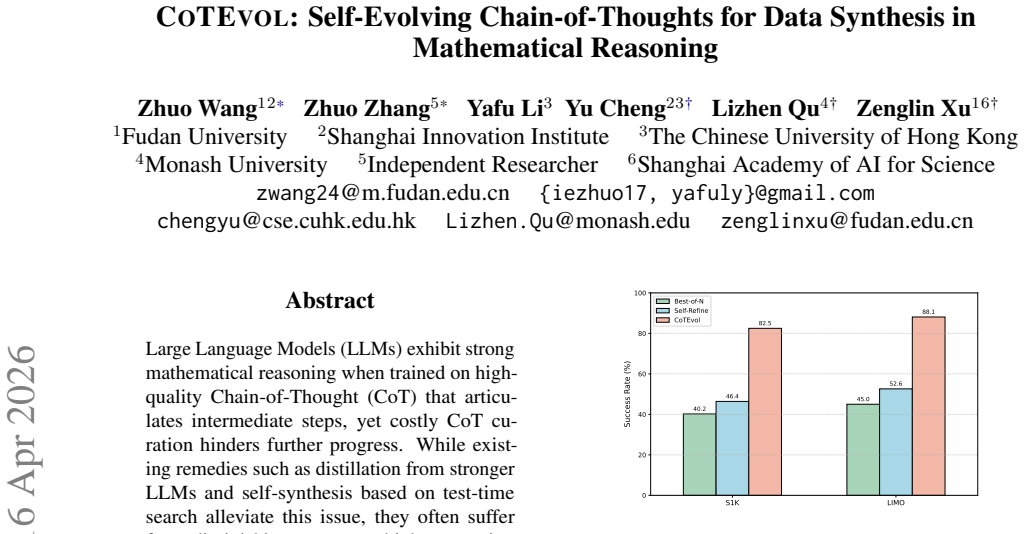
CoTEvol casts CoT generation as an iterative evolutionary search over reasoning trajectories. It applies reflective global crossover at the trajectory level and uncertainty-guided local mutation at the step level, steered by task-aware fitness functions that promote both correctness and structural variety. The process improves the success rate of producing correct CoTs by more than 30 percent while increasing diversity and reducing computational overhead relative to prior approaches.
What carries the argument
The population-based evolutionary search that recombines full reasoning trajectories via global crossover and refines individual steps via uncertainty-guided mutation, directed by lightweight task-aware fitness functions.
If this is right
- Correct CoT synthesis success rate rises by more than 30 percent compared with prior methods.
- Generated reasoning paths exhibit greater structural diversity.
- Models trained on the evolved data achieve an average 6.6 percent gain across eight math benchmarks.
- The synthesis process requires lower computational overhead than distillation from stronger models or test-time search.
Where Pith is reading between the lines
- The same evolutionary operators could be applied to generate training data for other reasoning-heavy domains such as programming or scientific problem solving.
- Internal evolution loops might reduce dependence on external teacher models for creating high-quality synthetic data.
- Repeated cycles of evolution on newly generated data could produce compounding improvements in model capabilities over multiple training rounds.
Load-bearing premise
The lightweight task-aware fitness functions accurately measure reasoning quality and diversity without introducing bias or requiring expensive verification.
What would settle it
Language models trained on CoTEvol-generated data show no average performance gain over models trained on standard distillation or self-synthesis data when evaluated on the same eight math benchmarks.
Figures


read the original abstract
Large Language Models (LLMs) exhibit strong mathematical reasoning when trained on high-quality Chain-of-Thought (CoT) that articulates intermediate steps, yet costly CoT curation hinders further progress. While existing remedies such as distillation from stronger LLMs and self-synthesis based on test-time search alleviate this issue, they often suffer from diminishing returns or high computing overhead.In this work, we propose CoTEvol, a genetic evolutionary framework that casts CoT generation as a population-based search over reasoning trajectories.Candidate trajectories are iteratively evolved through reflective global crossover at the trajectory level and local mutation guided by uncertainty at the step level, enabling holistic recombination and fine-grained refinement. Lightweight, task-aware fitness functions are designed to guide the evolutionary process toward accurate and diverse reasoning. Empirically, CoTEvol improves correct-CoT synthesis success by over 30% and enhances structural diversity, with markedly improved efficiency. LLMs trained on these evolutionary CoT data achieve an average gain of 6.6% across eight math benchmarks, outperforming previous distillation and self-synthesis approaches. These results underscore the promise of evolutionary CoT synthesis as a scalable and effective method for mathematical reasoning tasks.
Editorial analysis
A structured set of objections, weighed in public.
Referee Report
Summary. The manuscript introduces CoTEvol, a genetic evolutionary framework for synthesizing Chain-of-Thought (CoT) data for mathematical reasoning. Candidate trajectories are evolved via reflective global crossover at the trajectory level and uncertainty-guided local mutation at the step level, directed by lightweight task-aware fitness functions that target accuracy and diversity. The authors report over 30% improvement in correct-CoT synthesis success, enhanced structural diversity, and an average 6.6% gain across eight math benchmarks when LLMs are trained on the resulting data, outperforming prior distillation and self-synthesis baselines.
Significance. If the empirical results hold under rigorous controls, the work would be significant as it reframes CoT data synthesis as a population-based search rather than one-shot distillation or expensive test-time search. This could offer a more scalable path to high-quality reasoning data, with potential to reduce dependence on stronger teacher models while improving both correctness and diversity of generated trajectories.
major comments (2)
- [Abstract] Abstract: The central claims of 30% higher correct-CoT synthesis success and 6.6% average benchmark gains rest on the evolutionary process producing superior data, yet the abstract (and by extension the methods) provides no details on experimental controls, number of runs, statistical significance testing, or exact definitions of the fitness functions. Without these, it is impossible to rule out that gains arise from data volume, selection effects, or evaluation choices rather than the proposed crossover/mutation operators.
- [Methods (fitness functions)] Methods (fitness functions section): The lightweight task-aware fitness functions are load-bearing for the claim that the search yields higher-quality and more diverse CoTs. If these rely on surface heuristics (step count, model uncertainty, or similar) that correlate only weakly with actual reasoning correctness or generalization, the evolutionary process risks amplifying flawed trajectories. The manuscript must include validation (e.g., correlation with human judgments or downstream ablation) showing the fitness scores predict training gains; absent this, the outperformance over baselines cannot be confidently attributed to the evolutionary mechanism.
minor comments (2)
- [Experiments] Ensure all tables reporting benchmark gains include standard deviations across multiple seeds or runs to support the reported average improvement.
- [Methods] Clarify the exact implementation of 'reflective global crossover' and 'uncertainty-guided mutation' with pseudocode or equations if not already present, to aid reproducibility.
Simulated Author's Rebuttal
We thank the referee for the constructive and detailed feedback, which helps strengthen the clarity and rigor of our presentation. We address each major comment point by point below.
read point-by-point responses
-
Referee: [Abstract] Abstract: The central claims of 30% higher correct-CoT synthesis success and 6.6% average benchmark gains rest on the evolutionary process producing superior data, yet the abstract (and by extension the methods) provides no details on experimental controls, number of runs, statistical significance testing, or exact definitions of the fitness functions. Without these, it is impossible to rule out that gains arise from data volume, selection effects, or evaluation choices rather than the proposed crossover/mutation operators.
Authors: We agree that the abstract should better convey key experimental details for immediate credibility. The methods section already specifies that all experiments use 5 independent runs with different random seeds, reporting mean performance and standard deviation, along with paired t-tests for statistical significance (p < 0.05 threshold). Fitness functions are defined as a linear combination of execution-verified accuracy and embedding-based diversity. We also include volume-matched baseline comparisons to isolate the effect of the evolutionary operators. We will revise the abstract to briefly note these controls and point readers to the relevant sections, and we will expand the methods to include the precise mathematical formulations of the fitness functions. revision: yes
-
Referee: [Methods (fitness functions)] Methods (fitness functions section): The lightweight task-aware fitness functions are load-bearing for the claim that the search yields higher-quality and more diverse CoTs. If these rely on surface heuristics (step count, model uncertainty, or similar) that correlate only weakly with actual reasoning correctness or generalization, the evolutionary process risks amplifying flawed trajectories. The manuscript must include validation (e.g., correlation with human judgments or downstream ablation) showing the fitness scores predict training gains; absent this, the outperformance over baselines cannot be confidently attributed to the evolutionary mechanism.
Authors: The fitness functions prioritize execution-based accuracy (final answer verification) over surface features such as step count, with uncertainty used only for step-level mutation guidance. We acknowledge the value of explicit validation to attribute gains specifically to the evolutionary operators. In the revised manuscript we will add a dedicated ablation subsection comparing fitness-guided evolution against random selection, demonstrating degraded performance without the fitness component. We will also report a correlation analysis between fitness scores and human expert ratings on a held-out sample of 150 trajectories (Spearman correlation reported). These additions will directly address the concern about whether fitness predicts downstream training gains. revision: yes
Circularity Check
No circularity: empirical synthesis and benchmark evaluation remain independent of inputs
full rationale
The paper describes an evolutionary CoT synthesis pipeline whose outputs (synthesized trajectories) are produced by applying designed fitness functions, then used to train separate LLMs whose performance is measured on eight external math benchmarks. No equations, predictions, or first-principles claims are advanced that reduce by construction to the fitness definitions or evolutionary operators. Reported gains (30% synthesis success, 6.6% average benchmark improvement) are presented strictly as measured empirical outcomes after training and evaluation, with no self-referential loop or fitted parameter renamed as a prediction. The derivation chain is therefore self-contained against external benchmarks.
Axiom & Free-Parameter Ledger
axioms (1)
- domain assumption LLMs can be improved by fine-tuning on high-quality synthetic CoT data
Reference graph
Works this paper leans on
-
[1]
arXiv preprint arXiv:2501.04519 , year=
rstar-math: Small llms can master math reason- ing with self-evolved deep thinking.arXiv preprint arXiv:2501.04519. Daya Guo, Dejian Yang, Haowei Zhang, Junxiao Song, Ruoyu Zhang, Runxin Xu, Qihao Zhu, Shi- rong Ma, Peiyi Wang, Xiao Bi, and 1 others. 2025. Deepseek-r1: Incentivizing reasoning capability in llms via reinforcement learning.arXiv preprint ar...
-
[2]
Improve Mathematical Reasoning in Language Models by Automated Process Supervision
Let’s verify step by step. InThe Twelfth Inter- national Conference on Learning Representations. Chin-Yew Lin. 2004. Rouge: A package for automatic evaluation of summaries. InText summarization branches out, pages 74–81. Liangchen Luo, Yinxiao Liu, Rosanne Liu, Samrat Phatale, Meiqi Guo, Harsh Lara, Yunxuan Li, Lei Shu, Yun Zhu, Lei Meng, and 1 others. 20...
work page internal anchor Pith review arXiv 2004
-
[3]
Openmathinstruct-2: Accelerating ai for math with massive open-source instruction data.arXiv preprint arXiv:2410.01560. Pablo Villalobos, Jaime Sevilla, Lennart Heim, Tamay Besiroglu, Marius Hobbhahn, and Anson Ho. 2022. Will we run out of data? an analysis of the limits of scaling datasets in machine learning.arXiv preprint arXiv:2211.04325, 1:1. Jason W...
-
[4]
h=5" or
IntermediateResult (Knowledge Convergence State): Analyze the reasoning processes of S1 and S2 to locate the critical intermediate state where they are most stable and aligned. Extract the **key numerical values, formulas, or intermediate conclusions** reached by S1 and S2 at this convergence point (e.g., "h=5" or "Eigenvalues of Matrix A are 1, 2")
-
[5]
IntermediateResult
GuidanceSummary (Excellent Gene Fusion): Summarize the **unique, clever mathematical principles, formulas, or techniques** used by S1 and S2. Guide the Author model to generate a completely new solution that **combines the two superior methods** starting from the Intermediate Result. Required Output Format: "IntermediateResult": "Provide the key intermedi...
-
[6]
This result must serve as the foundational knowledge state for the new solution
IntermediateResult (Knowledge Convergence State): Extract the **key intermediate result** reached by SC at the **most stable/accurate** convergence point. This result must serve as the foundational knowledge state for the new solution
-
[7]
IntermediateResult
GuidanceSummary (Error Diagnosis and Path Correction): Diagnose the **specific error step** in SW (e.g., calculation error, formula misuse, logical flaw) and summarize the **core correct formula or logic** from SC. Guide the Author model to **avoid** SW’s error and **adopt** SC’s correct logic, continuing from the Intermediate Result. Required Output Form...
-
[8]
**Correctness Check**: For each solution, state whether the final answer is correct or not, and whether there are any logical/math errors
-
[9]
**Step Quality Comparison**: Evaluate the clarity, logical flow, mathematical soundness, and efficiency of the steps in each solution
-
[10]
**Overall Comparison**: Decide which solution is better based on correctness, clarity, and reasoning quality
-
[11]
Please Note: Do not explain your reasoning
**Preference Reasoning**: Clearly consider the main reasons why one solution is preferred over the other. Please Note: Do not explain your reasoning. Only output in the following format: Better Solution: A or Better Solution: B or Better Solution: Tie Response: Figure 14: GPT4.1 judge prompt. Case Study: Our Evolutionary Solution vs Distilled Solution fro...
-
[12]
- The normal forceNfrom the scale acting upward
**Identify the forces acting on the student:** - The gravitational force acting downward ismg. - The normal forceNfrom the scale acting upward
-
[13]
- When the elevator is accelerating, the scale reading changes
**Set up the equations of motion:** - When the elevator is stationary or moving at a constant speed, the scale reading is equal to the student’s weight, N=mg. - When the elevator is accelerating, the scale reading changes. If the elevator is accelerating downward, the scale reading will be less thanmg. If the elevator is accelerating upward, the scale rea...
-
[14]
Let’s assume the scale reading att= 0 seconds is mg (when the elevator is stationary)
**Analyze the given data:** - The student records the scale reading as a function of time. Let’s assume the scale reading att= 0 seconds is mg (when the elevator is stationary). - At some point, the scale reading increases to1.2mg. This indicates that the elevator is accelerating upward. - At some point, the scale reading decreases to 0.8mg. This indicate...
-
[15]
According to Newton’s second law,F=ma, so0.2mg=ma
**Determine the acceleration of the elevator:** - When the scale reading is 1.2mg, the net force on the student is 1.2mg−mg= 0.2mg . According to Newton’s second law,F=ma, so0.2mg=ma. Solving fora, we geta= 0.2g. - When the scale reading is 0.8mg, the net force on the student is 0.8mg−mg=−0.2mg . According to Newton’s second law,F=ma, so−0.2mg=ma. Solving...
-
[16]
- The total time for the trip isT= 2t 1
**Calculate the height of the building:** - The elevator starts from rest and accelerates upward at 0.2g for some time t1, then decelerates at 0.2g for the same timet 1 to come to rest at the bottom. - The total time for the trip isT= 2t 1. - The distance traveled during the acceleration phase isd 1 = 1 2 at2 1 = 1 2(0.2g)t2 1 = 0.1gt2 1. - The distance t...
-
[17]
- The time t1 can be found by considering the total time T= 2t 1
**Determinet 1:** - The maximum speed of the elevator occurs at the end of the acceleration phase, which isv=at 1 = 0.2gt1. - The time t1 can be found by considering the total time T= 2t 1. Since the elevator starts and ends at rest, the total time is the time it takes to reach the maximum speed and then return to rest. Therefore,t 1 = T 2
-
[18]
- Since the total time T is not given directly, we need to use the information that the scale reading changes at specific times
**Calculate the height of the building:** - The height of the building ish=d= 0.2gt 2 1. - Since the total time T is not given directly, we need to use the information that the scale reading changes at specific times. However, we can use the fact that the maximum speed is the same for both the acceleration and deceleration phases. - The height of the buil...
-
[19]
- Therefore, 50 = 0.2gt 2
**Given the correct answer is 50 meters:** - We need to findt 1 such thath= 50meters. - Therefore, 50 = 0.2gt 2
-
[20]
- t1 ≈ √ 25.51≈5.05 seconds
- Solving for t1, we get t2 1 = 50 0.2g = 50 0.2×9.8 = 50 1.96 ≈25.51 . - t1 ≈ √ 25.51≈5.05 seconds
-
[21]
Therefore, the height of the building is50 meters
**Verify the height:** - The height of the building ish= 2× 1 2(0.2g)t2 1 = 0.2gt2 1 = 0.2×9.8×25.51≈50meters. Therefore, the height of the building is50 meters. Case Study: Our Evolutionary Solution vs Distilled Solution from Deepseek R1 Distilled Solution from Deepseek R1: Let the mass of the student bem. The weight of the student ismg= 700N, som= 700/9...
discussion (0)
Sign in with ORCID, Apple, or X to comment. Anyone can read and Pith papers without signing in.