Recognition: unknown
Euclid. Populating a dark universe with galaxies using SciPIC
Pith reviewed 2026-05-10 10:18 UTC · model grok-4.3
The pith
An automated calibration pipeline improves galaxy clustering predictions in Euclid mocks by about 50 percent while matching observations within 15 percent.
A machine-rendered reading of the paper's core claim, the machinery that carries it, and where it could break.
Core claim
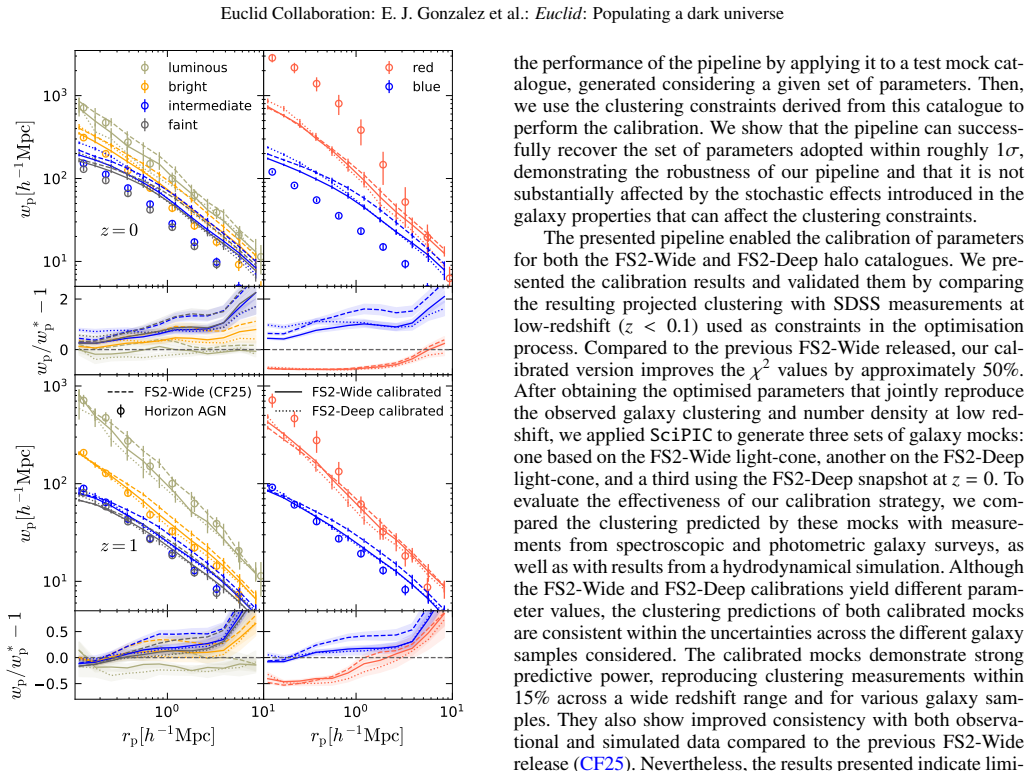
The central claim is that SciPICal calibration applied to the Flagship 2 halo catalogs yields galaxy mocks whose clustering statistics improve by roughly 50 percent over the prior release and stay within 15 percent of observed values for most galaxy samples drawn from spectroscopic and photometric surveys. This agreement, together with consistency checks against a hydrodynamical simulation, validates the chosen functional forms for number density, luminosity, colour and position assignment and confirms the mocks' usefulness for both the wide and deep Euclid fields up to high redshift.
What carries the argument
SciPICal, the automated calibration pipeline that adjusts the parameters controlling number density, luminosities, colours and spatial positions when populating dark-matter halos with galaxies.
If this is right
- The improved mocks provide a more reliable tool for validating the analysis pipelines that will be used on real Euclid data.
- The calibration procedure can be rerun whenever new observational constraints become available, keeping the mocks current.
- The deep mock catalog extending to redshift 10 supplies a resource for testing high-redshift galaxy studies within the Euclid deep fields.
- Agreement with both observational surveys and hydrodynamical simulations indicates the halo-based assignment carries predictive power for clustering statistics.
Where Pith is reading between the lines
- The same calibration approach could be tested on halo catalogs from other simulations to check whether the resulting mocks remain consistent across different underlying dark-matter models.
- If the 15 percent agreement persists when smaller-scale clustering or additional galaxy properties are examined, the method could reduce the need for full hydrodynamic simulations in survey preparation.
- Applying the pipeline to mock catalogs that include known baryonic effects would provide a direct test of how much the current assumption misses.
Load-bearing premise
The chosen functional forms and free parameters for linking galaxy properties to halo properties capture the dominant connections across the full redshift and luminosity range without important missing effects from baryonic physics that would change clustering on the scales Euclid will measure.
What would settle it
Independent measurements of galaxy clustering from new or deeper surveys that show systematic deviations larger than 15 percent from the mock predictions on the scales probed would demonstrate that the calibration is incomplete.
Figures


read the original abstract
High-fidelity galaxy mocks are crucial for validating analysis pipelines and for cosmological inference. In this context, the Science Pipeline at PIC (SciPIC) is a pipeline specifically designed for the fast generation of synthetic galaxy catalogues from the halo properties identified in cosmological simulations. SciPIC delivers galaxy catalogues that aim to reproduce the observed luminosity function and clustering above a given flux detection limit over a wide redshift range. In this work, we introduce SciPICal, an automated pipeline that calibrates the parameters that set the main mock galaxy properties, namely number density, luminosities, colours, and positions. The pipeline is applied to the Euclid Flagship 2 Wide and Deep halo catalogues, specifically built to support the \textit{Euclid} wide and deep surveys. Compared to the recently released Flagship 2 Wide mock, our calibrated version improves the clustering predictions by approximately 50\% based on chi-squared values. Furthermore, we produce the Euclid Deep mock catalogue, which reaches up to $z = 10$ by populating a light-cone and a complementary snapshot at $z = 0$. We validate these catalogues using measurements from spectroscopic and photometric galaxy surveys, as well as with results from a hydrodynamical simulation. The obtained good agreement (within $15\%$ for most of the samples) in the clustering predictions across the different galaxy samples considered, validates our calibration strategy and demonstrates the strong predictive power of the generated mocks. This pipeline will allow us to improve the methodology applied in assigning the galaxy properties and ensures that the galaxy mocks remain up-to-date by incorporating constraints from upcoming observational data in the calibration procedure.
Editorial analysis
A structured set of objections, weighed in public.
Referee Report
Summary. The manuscript introduces SciPICal, an automated calibration pipeline for the SciPIC framework that populates halo catalogs from cosmological simulations with galaxies by fitting parameters controlling number density, luminosities, colors, and positions to match observed luminosity functions and clustering above flux limits. Applied to the Euclid Flagship 2 Wide and Deep halo catalogs, it reports an approximately 50% improvement in clustering predictions (via chi-squared) relative to the existing Flagship 2 Wide mock and achieves agreement within 15% with clustering measurements from spectroscopic/photometric surveys plus hydrodynamical simulation results, thereby validating the calibration strategy and claiming strong predictive power for Euclid mock catalogs up to z=10.
Significance. If the reported agreements reflect genuine predictive power on independent data, the work supplies a practical, updatable tool for generating high-fidelity galaxy mocks tailored to Euclid's wide and deep surveys, directly supporting pipeline validation and cosmological analyses. The automated calibration procedure is a clear strength, as it permits straightforward incorporation of future observational constraints without manual retuning.
major comments (3)
- [Abstract] Abstract: The central claim that the <15% agreement 'validates our calibration strategy and demonstrates the strong predictive power' requires that the spectroscopic and photometric survey clustering measurements used for validation are disjoint from the luminosity-function and clustering data employed during calibration of the number-density, luminosity, colour, and position parameters. The manuscript does not state the precise data split or overlap, leaving open the possibility that some quoted agreements test model flexibility rather than out-of-sample prediction.
- [Abstract] Abstract: The reported ~50% improvement in clustering predictions (chi-squared) versus the Flagship 2 Wide mock is load-bearing for the paper's contribution, yet the abstract provides no details on the chi-squared definition, covariance treatment, error propagation from the mock generation process, or whether the comparison holds after fixing all calibration choices without post-hoc adjustments.
- [Validation] Validation section (implied by abstract): The assumption that the chosen functional forms for galaxy property assignment capture the dominant halo-galaxy connection across the full redshift and luminosity range is tested only via the quoted 15% agreement with hydro results; a more quantitative assessment of residual baryonic effects on clustering at the scales relevant to Euclid would strengthen the predictive-power claim.
minor comments (1)
- [Abstract] The abstract would benefit from an explicit statement of the redshift range and flux limits over which the 15% agreement holds, to allow readers to assess applicability to specific Euclid samples.
Simulated Author's Rebuttal
We thank the referee for their careful reading of the manuscript and for the constructive comments, which highlight important points for improving clarity and strengthening the claims regarding predictive power. We respond to each major comment below and indicate the revisions we will implement.
read point-by-point responses
-
Referee: [Abstract] Abstract: The central claim that the <15% agreement 'validates our calibration strategy and demonstrates the strong predictive power' requires that the spectroscopic and photometric survey clustering measurements used for validation are disjoint from the luminosity-function and clustering data employed during calibration of the number-density, luminosity, colour, and position parameters. The manuscript does not state the precise data split or overlap, leaving open the possibility that some quoted agreements test model flexibility rather than out-of-sample prediction.
Authors: We agree that the abstract does not explicitly describe the data split between calibration and validation, which is necessary to substantiate the predictive-power claim. The calibration fits the SciPIC parameters to reproduce luminosity functions and clustering above specified flux limits drawn from a reference set of observational constraints. Validation then proceeds by comparing the resulting mocks against clustering statistics from additional spectroscopic and photometric surveys plus hydrodynamical simulations. While the manuscript implies that validation samples extend beyond the exact calibration constraints, we acknowledge that potential overlaps are not quantified. We will revise the abstract to moderate the language and add a dedicated paragraph in the Validation section that lists the precise datasets used for each step, notes any shared surveys or scales, and explains why the validation still provides a meaningful test of extrapolation. This change will allow readers to evaluate the degree of out-of-sample testing directly. revision: yes
-
Referee: [Abstract] Abstract: The reported ~50% improvement in clustering predictions (chi-squared) versus the Flagship 2 Wide mock is load-bearing for the paper's contribution, yet the abstract provides no details on the chi-squared definition, covariance treatment, error propagation from the mock generation process, or whether the comparison holds after fixing all calibration choices without post-hoc adjustments.
Authors: We accept that the abstract omits essential technical details supporting the reported improvement. The chi-squared comparison is performed on the clustering statistics (projected correlation functions or power spectra) between the calibrated SciPIC mock and the original Flagship 2 Wide mock, using a covariance matrix derived from the mock realizations. The parameters are held fixed at their calibrated values with no subsequent tuning. In the revised manuscript we will expand the relevant Methods and Results sections to give the explicit chi-squared definition, describe the covariance estimation procedure, outline error propagation from the halo catalog and galaxy assignment steps, and confirm that the comparison uses the fixed calibration solution. We will also insert a brief clause in the abstract summarizing that the improvement is obtained under these conditions. revision: yes
-
Referee: [Validation] Validation section (implied by abstract): The assumption that the chosen functional forms for galaxy property assignment capture the dominant halo-galaxy connection across the full redshift and luminosity range is tested only via the quoted 15% agreement with hydro results; a more quantitative assessment of residual baryonic effects on clustering at the scales relevant to Euclid would strengthen the predictive-power claim.
Authors: The 15% agreement with hydrodynamical simulation clustering is presented as supporting evidence that the adopted functional forms capture the dominant halo-galaxy relations, including baryonic contributions, across the redshift and luminosity range of interest. We recognize, however, that a more granular, scale-dependent quantification of residuals would provide a stronger test. In the revision we will augment the Validation section with a quantitative comparison of the SciPIC and hydro clustering measurements on scales from approximately 0.1 to 20 Mpc/h, reporting the fractional residuals separately in the one-halo and two-halo regimes. We will also discuss the implications for residual baryonic effects at the scales most relevant to Euclid analyses. If the existing hydro run permits, we will add a brief comparison against a dark-matter-only counterpart to isolate baryonic contributions. These additions will be included without requiring new simulations. revision: partial
Circularity Check
Calibration to observed LF and clustering followed by validation on survey clustering measurements without demonstrated data independence
specific steps
-
fitted input called prediction
[Abstract]
"SciPIC delivers galaxy catalogues that aim to reproduce the observed luminosity function and clustering above a given flux detection limit over a wide redshift range. ... we introduce SciPICal, an automated pipeline that calibrates the parameters that set the main mock galaxy properties, namely number density, luminosities, colours, and positions. ... Compared to the recently released Flagship 2 Wide mock, our calibrated version improves the clustering predictions by approximately 50% based on chi-squared values. ... We validate these catalogues using measurements from spectroscopic and phot"
Parameters are explicitly calibrated to match observed LF and clustering; the subsequent 'validation' reports agreement (within 15%) on clustering predictions from spectroscopic and photometric surveys as evidence of predictive power. Without a documented disjoint split, the validation agreements are statistically forced by the calibration step rather than testing extrapolation to unseen data.
full rationale
The paper's central claim is that SciPICal calibration improves clustering chi-squared by ~50% over prior Flagship mock and that <15% agreement with spectroscopic/photometric surveys plus hydro results validates the strategy and demonstrates predictive power. However, the abstract states the mocks are calibrated to reproduce observed luminosity function and clustering above flux limits, then validated on clustering from the same class of surveys. No explicit split between calibration targets and validation datasets is provided in the given text, so the reported agreements may reduce to measures of fit flexibility rather than independent predictions. This matches the fitted-input-called-prediction pattern at the load-bearing validation step.
Axiom & Free-Parameter Ledger
free parameters (1)
- parameters controlling number density, luminosities, colours and positions
axioms (1)
- domain assumption Halo properties identified in cosmological simulations are sufficient to determine galaxy properties once calibrated parameters are applied
Reference graph
Works this paper leans on
-
[1]
, " * write output.state after.block = add.period write newline
ENTRY address archiveprefix author booktitle chapter edition editor howpublished institution eprint journal key month note number organization pages publisher school series title type volume year label extra.label sort.label short.list INTEGERS output.state before.all mid.sentence after.sentence after.block FUNCTION init.state.consts #0 'before.all := #1 ...
-
[2]
write newline
" write newline "" before.all 'output.state := FUNCTION n.dashify 't := "" t empty not t #1 #1 substring "-" = t #1 #2 substring "--" = not "--" * t #2 global.max substring 't := t #1 #1 substring "-" = "-" * t #2 global.max substring 't := while if t #1 #1 substring * t #2 global.max substring 't := if while FUNCTION word.in bbl.in " " * FUNCTION format....
-
[3]
N., Adelman-McCarthy , J
Abazajian , K. N., Adelman-McCarthy , J. K., Ag \"u eros , M. A., et al. 2009, , 182, 543
2009
-
[4]
G., et al
Avila , S., Gonzalez-Perez , V., Mohammad , F. G., et al. 2020, , 499, 5486
2020
-
[5]
H., Hearin , A
Behroozi , P., Wechsler , R. H., Hearin , A. P., & Conroy , C. 2019, , 488, 3143
2019
-
[6]
S., Wechsler , R
Behroozi , P. S., Wechsler , R. H., & Wu , H.-Y. 2013, , 762, 109
2013
-
[7]
R., Hogg , D
Blanton , M. R., Hogg , D. W., Bahcall , N. A., et al. 2003, , 592, 819
2003
-
[8]
R., Lupton , R
Blanton , M. R., Lupton , R. H., Schlegel , D. J., et al. 2005, , 631, 208
2005
-
[9]
J., Hernquist , L., et al
Bose , S., Eisenstein , D. J., Hernquist , L., et al. 2019, , 490, 5693
2019
-
[10]
J., Gazta \ n aga , E., Crocce , M., & Fosalba , P
Carretero , J., Castander , F. J., Gazta \ n aga , E., Crocce , M., & Fosalba , P. 2015, , 447, 646
2015
-
[11]
2017, in Proceedings of the European Physical Society Conference on High Energy Physics
Carretero , J., Tallada , P., Casals , J., et al. 2017, in Proceedings of the European Physical Society Conference on High Energy Physics. 5-12 July, 488
2017
-
[12]
2019, , 484, 1133
Contreras , S., Zehavi , I., Padilla , N., et al. 2019, , 484, 1133
2019
-
[13]
S., et al
Dahlen , T., Mobasher , B., Somerville , R. S., et al. 2005, , 631, 126
2005
-
[14]
2025, , 702, A155
d'Assignies , W., Manera , M., Padilla , C., et al. 2025, , 702, A155
2025
-
[15]
2022, , 164, 207
DESI Collaboration: Abareshi , Abareshi , B., Aguilar , J., et al. 2022, , 164, 207
2022
-
[16]
The DESI Experiment Part I: Science,Targeting, and Survey Design
DESI Collaboration: Aghamousa , Aghamousa , A., Aguilar , J., et al. 2016, arXiv:1611.00036
work page internal anchor Pith review arXiv 2016
-
[17]
E., et al
Despali , G., Giocoli , C., Angulo , R. E., et al. 2016, , 456, 2486
2016
-
[18]
2018, , 239, 35
Diemer , B. 2018, , 239, 35
2018
-
[19]
& Joyce , M
Diemer , B. & Joyce , M. 2019, , 871, 168
2019
-
[20]
2014, , 444, 1453
Dubois , Y., Pichon , C., Welker , C., et al. 2014, , 444, 1453
2014
-
[21]
2013, , 433, 2545
Erben , T., Hildebrandt , H., Miller , L., et al. 2013, , 433, 2545
2013
- [22]
-
[23]
2025, , 697, A5
Euclid Collaboration: Castander , F., Fosalba , P., Stadel , J., et al. 2025, , 697, A5
2025
-
[24]
, Paviot , R., Joachimi , B., et al
Euclid Collaboration: Hoffman, K. , Paviot , R., Joachimi , B., et al. 2026, arXiv e-prints, arXiv:2601.07785
-
[25]
A., et al
Euclid Collaboration: Mellier , Abdurro'uf , Acevedo Barroso , J. A., et al. 2025, , 697, A1
2025
-
[26]
, Parimbelli , G., Elkhashab , M
Euclid Collaboration: Monaco, P. , Parimbelli , G., Elkhashab , M. Y., et al. 2025, arXiv:2507.12116
-
[27]
, Tutusaus , I., Castander , F
Euclid Collaboration: Pocino, A. , Tutusaus , I., Castander , F. J., et al. 2021, , 655, A44
2021
-
[28]
, Amiaux , J., Mellier , Y., et al
Euclid Collaboration: Scaramella, R. , Amiaux , J., Mellier , Y., et al. 2022, , 662, A112
2022
-
[29]
2024, , 690, A103
Euclid Collaboration: Serrano , S., Hudelot , P., Seidel , G., et al. 2024, , 690, A103
2024
-
[30]
W., Lang , D., & Goodman , J
Foreman-Mackey , D., Hogg , D. W., Lang , D., & Goodman , J. 2013, , 125, 306
2013
-
[31]
A., Rajan , A., Donley , J
Grogin , N. A., Rajan , A., Donley , J. L., et al. 2012, in American Astronomical Society Meeting Abstracts, Vol. 220, American Astronomical Society Meeting Abstracts \#220, 335.23
2012
-
[32]
& VIPERS Team
Guzzo , L. & VIPERS Team . 2013, The Messenger, 151, 41
2013
-
[33]
2022, , 925, 183
Haslbauer , M., Banik , I., Kroupa , P., Wittenburg , N., & Javanmardi , B. 2022, , 925, 183
2022
-
[34]
W., Laigle , C., Jarvis , M
Hatfield , P. W., Laigle , C., Jarvis , M. J., et al. 2019, , 490, 5043
2019
-
[35]
P., Zentner , A
Hearin , A. P., Zentner , A. R., van den Bosch , F. C., Campbell , D., & Tollerud , E. 2016, , 460, 2552
2016
-
[36]
M., Tyson , J
Ivezi \'c , Z ., Kahn , S. M., Tyson , J. A., et al. 2019, , 873, 111
2019
-
[37]
J., H \"a u ler , B., & McAlpine , K
Jarvis , M. J., H \"a u ler , B., & McAlpine , K. 2013, The Messenger, 154, 26
2013
-
[38]
Jing , Y. P. & Suto , Y. 2002, , 574, 538
2002
-
[39]
2019, , 624, A30
Johnston , H., Georgiou , C., Joachimi , B., et al. 2019, , 624, A30
2019
-
[40]
2017, , 467, 4739
Kaviraj , S., Laigle , C., Kimm , T., et al. 2017, , 467, 4739
2017
-
[41]
Kerscher , M., Szapudi , I., & Szalay , A. S. 2000, , 535, L13
2000
-
[42]
2016, , 833, 202
Kim , J.-h., Agertz , O., Teyssier , R., et al. 2016, , 833, 202
2016
-
[43]
M., Faber , S
Koekemoer , A. M., Faber , S. M., Ferguson , H. C., et al. 2011, , 197, 36
2011
-
[44]
M., Dunkley , J., et al
Komatsu , E., Smith , K. M., Dunkley , J., et al. 2011, , 192, 18
2011
-
[45]
V., Berlind , A
Kravtsov , A. V., Berlind , A. A., Wechsler , R. H., et al. 2004, , 609, 35
2004
-
[46]
Landy , S. D. & Szalay , A. S. 1993, , 412, 64
1993
-
[47]
Euclid Definition Study Report
Laureijs , R., Amiaux , J., Arduini , S., et al. 2011, arXiv:1110.3193
work page internal anchor Pith review Pith/arXiv arXiv 2011
-
[48]
LSST Science Book, Version 2.0
LSST Science Collaboration: Abell , Abell , P. A., Allison , J., et al. 2009, arXiv:0912.0201
work page Pith review arXiv 2009
-
[49]
H., Somerville , R
Lu , Y., Wechsler , R. H., Somerville , R. S., et al. 2014, , 795, 123
2014
- [50]
-
[51]
A., Cava , A., Biviano , A., et al
Mamon , G. A., Cava , A., Biviano , A., et al. 2019, , 631, A131
2019
-
[52]
2013, , 557, A17
Marulli , F., Bolzonella , M., Branchini , E., et al. 2013, , 557, A17
2013
-
[53]
F., Frenk , C
Navarro , J. F., Frenk , C. S., & White , S. D. M. 1997, , 490, 493
1997
-
[54]
2024, , 686, A157
Nelson , D., Pillepich , A., Ayromlou , M., et al. 2024, , 686, A157
2024
-
[55]
Peacock , J. A. & Smith , R. E. 2000, , 318, 1144
2000
-
[56]
Peebles , P. J. E. & Hauser , M. G. 1974, , 28, 19
1974
-
[57]
R., Pereyra , L
Perez , N. R., Pereyra , L. A., Coldwell , G., et al. 2024, , 528, 3186
2024
-
[58]
2021, , 103, 043503
Porredon , A., Crocce , M., Fosalba , P., et al. 2021, , 103, 043503
2021
-
[59]
& Stadel , J
Potter , D. & Stadel , J. 2016, PKDGRAV3: Parallel gravity code , Astrophysics Source Code Library, record ascl:1609.016
2016
-
[60]
Ramakrishnan , S., Castander , F. J., Gonzalez , E. J., et al. 2025 a , arXiv:2512.13801
-
[61]
2025 b , , 697, A70
Ramakrishnan , S., Gonzalez-Perez , V., Parimbelli , G., & Yepes , G. 2025 b , , 697, A70
2025
-
[62]
A., Seo , H.-J., Leauthaud , A., Tinker , J
Reid , B. A., Seo , H.-J., Leauthaud , A., Tinker , J. L., & White , M. 2014, , 444, 476
2014
-
[63]
2022, , 511, 2665
Rodr \' guez-Monroy , M., Weaverdyck , N., Elvin-Poole , J., et al. 2022, , 511, 2665
2022
-
[64]
H., Hildebrandt , H., et al
Roster , W., Wright , A. H., Hildebrandt , H., et al. 2026, , 707, A277
2026
-
[65]
1976, , 203, 297
Schechter , P. 1976, , 203, 297
1976
-
[66]
Wide-Field InfrarRed Survey Telescope-Astrophysics Focused Telescope Assets WFIRST-AFTA 2015 Report
Spergel , D., Gehrels , N., Baltay , C., et al. 2015, arXiv:1503.03757
work page internal anchor Pith review Pith/arXiv arXiv 2015
-
[67]
2024, in Astronomical Society of the Pacific Conference Series, Vol
Tallada-Crespi , P., Carretero , J., Serrano , S., et al. 2024, in Astronomical Society of the Pacific Conference Series, Vol. 535, Astromical Data Analysis Software and Systems XXXI, ed. B. V. Hugo , R. Van Rooyen , & O. M. Smirnov , 381
2024
-
[68]
2002, , 385, 337
Teyssier , R. 2002, , 385, 337
2002
-
[69]
The Dark Energy Survey Collaboration . 2005, arXiv:astro-ph/0510346
-
[70]
V., Klypin , A., et al
Tinker , J., Kravtsov , A. V., Klypin , A., et al. 2008, , 688, 709
2008
-
[71]
Tutusaus , I., Fosalba , P., Blot , L., et al. 2025, arXiv:2507.23451
-
[72]
& Ostriker , J
Vale , A. & Ostriker , J. P. 2004, , 353, 189
2004
-
[73]
2021, , 915, 71
Villaescusa-Navarro , F., Angl \'e s-Alc \'a zar , D., Genel , S., et al. 2021, , 915, 71
2021
-
[74]
2020, Nature Reviews Physics, 2, 42
Vogelsberger , M., Marinacci , F., Torrey , P., & Puchwein , E. 2020, Nature Reviews Physics, 2, 42
2020
-
[75]
A., Iliev , I
Watson , W. A., Iliev , I. T., D'Aloisio , A., et al. 2013, , 433, 1230
2013
-
[76]
R., Kauffmann , O
Weaver , J. R., Kauffmann , O. B., Ilbert , O., et al. 2022, , 258, 11
2022
-
[77]
G., Adelman , J., Anderson , John E., J., et al
York , D. G., Adelman , J., Anderson , John E., J., et al. 2000, , 120, 1579
2000
-
[78]
H., Eisenstein , D
Yuan , S., Garrison , L. H., Eisenstein , D. J., & Wechsler , R. H. 2022, , 515, 871
2022
-
[79]
H., et al
Zehavi , I., Zheng , Z., Weinberg , D. H., et al. 2011, , 736, 59
2011
-
[80]
L., Becker , M
Zhai , Z., Tinker , J. L., Becker , M. R., et al. 2019, , 874, 95
2019
discussion (0)
Sign in with ORCID, Apple, or X to comment. Anyone can read and Pith papers without signing in.