Recognition: unknown
From Boundaries to Semantics: Prompt-Guided Multi-Task Learning for Petrographic Thin-section Segmentation
Pith reviewed 2026-05-10 10:55 UTC · model grok-4.3
The pith
Petro-SAM merges seven polarized views in a modified SAM to jointly segment grain edges and lithology semantics in thin-section images.
A machine-rendered reading of the paper's core claim, the machinery that carries it, and where it could break.
Core claim
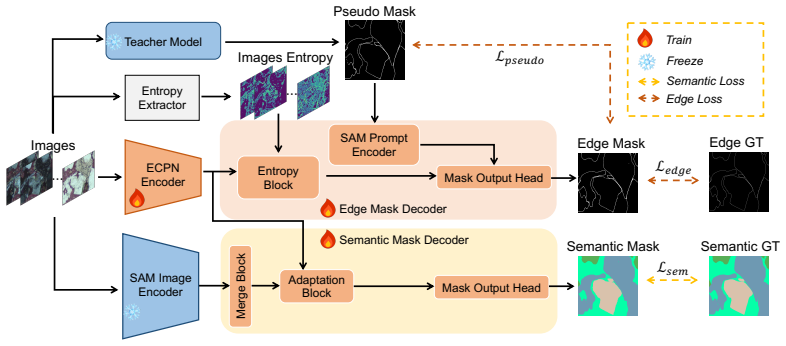
Petro-SAM is a novel two-stage multi-task framework based on SAM that achieves high-quality joint grain-edge segmentation and lithology semantic segmentation on petrographic images by introducing a Merge Block to integrate seven polarized views, thereby addressing the extinction issue, along with multi-scale feature fusion and color-entropy priors to refine detection.
What carries the argument
The Merge Block integrates seven polarized views into the SAM backbone to resolve extinction-dependent color variations while multi-scale feature fusion and color-entropy priors refine boundaries and semantic labels.
If this is right
- Joint GES and LSS become feasible from the same petrographic image stack, enabling direct quantification of both fabric and composition.
- The framework reduces the need for task-specific expert annotations by leveraging prompt-guided adaptation of a foundation model.
- Multi-view polarized input can be processed in a single forward pass rather than running separate models for each view.
- Detection of ultra-fine grains improves when color-entropy priors are combined with the merged polarized features.
Where Pith is reading between the lines
- The same merge-and-prior strategy could extend to other multi-angle imaging problems where extinction or contrast varies across views.
- If the priors generalize, they might reduce annotation costs in related domains such as mineral identification from microscopy stacks.
- Real-time field deployment would require checking whether the two-stage pipeline runs fast enough on portable hardware.
Load-bearing premise
The Merge Block together with the added fusion and priors can overcome the domain shift from polarized-light color changes and fine grain boundaries without needing extensive new expert annotations or full retraining.
What would settle it
On a held-out set of thin-section images with pronounced extinction effects and sub-micron boundaries, measure whether Petro-SAM's joint segmentation accuracy falls below that of separately trained standard SAM or U-Net baselines by more than a few percent in boundary F1 and semantic IoU.
Figures






read the original abstract
Grain-edge segmentation (GES) and lithology semantic segmentation (LSS) are two pivotal tasks for quantifying rock fabric and composition. However, these two tasks are often treated separately, and the segmentation quality is implausible albeit expensive, time-consuming, and expert-annotated datasets have been used. Recently, foundation models, especially the Segment Anything Model (SAM), have demonstrated impressive robustness for boundary alignment. However, directly adapting SAM to joint GES and LSS is nontrivial due to 1) severe domain gap induced by extinction-dependent color variations and ultra-fine grain boundaries, and 2) lacking novel modules for joint learning on multi-angle petrographic image stacks. In this paper, we propose Petro-SAM, a novel two-stage, multi-task framework that can achieve high-quality joint GES and LSS on petrographic images. Specifically, based on SAM, we introduce a Merge Block to integrate seven polarized views, effectively solving the extinction issue. Moreover, we introduce multi-scale feature fusion and color-entropy priors to refine the detection.
Editorial analysis
A structured set of objections, weighed in public.
Referee Report
Summary. The paper proposes Petro-SAM, a novel two-stage multi-task framework extending the Segment Anything Model (SAM) for joint grain-edge segmentation (GES) and lithology semantic segmentation (LSS) on petrographic thin-section images. It introduces a Merge Block to integrate seven polarized views to address extinction issues, along with multi-scale feature fusion and color-entropy priors to handle domain gaps from extinction-dependent color variations and ultra-fine grain boundaries, claiming high-quality results without requiring large new expert-annotated datasets.
Significance. If the proposed Merge Block, fusion mechanisms, and priors are shown to effectively close the domain gap, the work could meaningfully advance automated petrographic analysis by adapting foundation models to specialized scientific imaging, reducing annotation burdens and improving reproducibility in rock fabric and composition quantification.
major comments (2)
- [Abstract] Abstract: the claim that the framework 'can achieve high-quality joint GES and LSS' is unsupported by any quantitative metrics, error bars, baseline comparisons (e.g., against plain SAM), or ablation studies on the Merge Block, multi-scale fusion, or color-entropy priors.
- [Methods] Framework description: no architectural equations, fusion mechanism details, loss formulations, or diagrams are provided for the Merge Block integration of seven polarized views or the color-entropy priors, preventing verification that these additions overcome the stated domain gap without new annotations.
minor comments (1)
- [Abstract] Abstract: the phrasing 'segmentation quality is implausible albeit expensive, time-consuming, and expert-annotated datasets have been used' is grammatically unclear and should be revised.
Simulated Author's Rebuttal
We thank the referee for the constructive comments on our manuscript. We address the major concerns point-by-point below and will revise the paper to strengthen the abstract and methods sections.
read point-by-point responses
-
Referee: [Abstract] Abstract: the claim that the framework 'can achieve high-quality joint GES and LSS' is unsupported by any quantitative metrics, error bars, baseline comparisons (e.g., against plain SAM), or ablation studies on the Merge Block, multi-scale fusion, or color-entropy priors.
Authors: We agree that the abstract claim would benefit from explicit quantitative support. In the revised version we will update the abstract to concisely report key metrics (e.g., IoU and Dice scores for GES and LSS), include baseline comparisons against plain SAM, and summarize the ablation results on the Merge Block, multi-scale fusion, and color-entropy priors. Error bars from multiple runs will also be noted. These results already appear in the experimental section and will be distilled into the abstract without altering the overall narrative. revision: yes
-
Referee: [Methods] Framework description: no architectural equations, fusion mechanism details, loss formulations, or diagrams are provided for the Merge Block integration of seven polarized views or the color-entropy priors, preventing verification that these additions overcome the stated domain gap without new annotations.
Authors: We acknowledge that the current methods description is insufficiently detailed for independent verification. We will expand the methods section to include (1) the mathematical formulation and equations of the Merge Block for integrating the seven polarized views, (2) explicit descriptions and equations for the multi-scale feature fusion and color-entropy prior modules, (3) the complete loss function used for joint training, and (4) additional schematic diagrams. These additions will demonstrate how the components mitigate extinction-induced domain gaps while relying on the pre-trained SAM weights and limited petrographic data, without requiring large new expert annotations. revision: yes
Circularity Check
No significant circularity; novel modules proposed atop external SAM
full rationale
The paper proposes Petro-SAM as a two-stage multi-task framework that adds a Merge Block for integrating seven polarized views, plus multi-scale feature fusion and color-entropy priors, to adapt the external Segment Anything Model (SAM) for joint GES and LSS on petrographic images. No equations, loss formulations, or derivations are shown that reduce any claimed prediction or result to fitted inputs or self-definitions by construction. The approach is presented as building on an independent foundation model with new components whose performance requires separate validation, not as a renaming or self-referential fit. No self-citation chains, uniqueness theorems, or ansatzes smuggled via prior work are evident. This is a standard architectural proposal whose central claims remain open to external falsification.
Axiom & Free-Parameter Ledger
axioms (1)
- domain assumption SAM can be effectively adapted to petrographic images despite domain gap via added modules
invented entities (2)
-
Merge Block
no independent evidence
-
color-entropy priors
no independent evidence
Reference graph
Works this paper leans on
-
[1]
The edge segmentation of grains in thin-section petrographic images utilising extinction consistency perception network,
P. Zhang, J. Zhou, W. Zhao, X. Li, and L. Pu, “The edge segmentation of grains in thin-section petrographic images utilising extinction consistency perception network,”Complex & Intelligent Systems, vol. 10, no. 1, pp. 1231–1245, 2024
2024
-
[2]
Holistically-nested edge detection,
S. Xie and Z. Tu, “Holistically-nested edge detection,” inProceedings of the IEEE international conference on computer vision, 2015, pp. 1395–1403
2015
-
[3]
Bi-directional cascade network for perceptual edge detection,
J. He, S. Zhang, M. Yang, Y . Shan, and T. Huang, “Bi-directional cascade network for perceptual edge detection,” inProceedings of the IEEE/CVF conference on computer vision and pattern recognition, 2019, pp. 3828– 3837
2019
-
[4]
U-Net: Convolutional Networks for Biomedical Image Segmentation
O. Ronneberger, P. Fischer, and T. Brox, “U-net: Convolutional networks for biomedical image segmentation,” 2015. [Online]. Available: https://arxiv.org/abs/1505.04597
work page internal anchor Pith review Pith/arXiv arXiv 2015
-
[5]
Deep high-resolution representation learning for visual recognition,
J. Wang, K. Sun, T. Cheng, B. Jiang, C. Deng, Y . Zhao, D. Liu, Y . Mu, M. Tan, X. Wang, W. Liu, and B. Xiao, “Deep high-resolution representation learning for visual recognition,” 2020. [Online]. Available: https://arxiv.org/abs/1908.07919
-
[6]
A. Kirillov, E. Mintun, N. Ravi, H. Mao, C. Rolland, L. Gustafson, T. Xiao, S. Whitehead, A. C. Berg, W.-Y . Loet al., “Segment anything,”arXiv preprint arXiv:2304.02643, 2023
work page internal anchor Pith review arXiv 2023
-
[7]
Automatic grain boundary detection and grain size analysis using polarization micrographs or orientation images,
R. Heilbronner, “Automatic grain boundary detection and grain size analysis using polarization micrographs or orientation images,”Journal of Structural Geology, vol. 22, no. 7, pp. 969–981, 2000. [Online]. Available: https://www.sciencedirect.com/science/article/pii/S0191814100000146
2000
-
[8]
Segmentation of thin section images for grain size analysis using region competition and edge-weighted region merging,
M. Jungmann, H. Pape, P. Wißkirchen, C. Clauser, and T. Berlage, “Segmentation of thin section images for grain size analysis using region competition and edge-weighted region merging,”Computers & Geosciences, vol. 72, pp. 33–48, 2014. [Online]. Available: https: //www.sciencedirect.com/science/article/pii/S0098300414001599
2014
-
[9]
A method for automatic grain segmentation of multi-angle cross-polarized microscopic 26 images of sandstone,
F. Jiang, Q. Gu, H. Hao, N. Li, B. Wang, and X. Hu, “A method for automatic grain segmentation of multi-angle cross-polarized microscopic 26 images of sandstone,”Computers & Geosciences, vol. 115, pp. 143–153,
-
[10]
Available: https://www.sciencedirect.com/science/article/ pii/S0098300417308178
[Online]. Available: https://www.sciencedirect.com/science/article/ pii/S0098300417308178
-
[11]
An artificial neural net assisted approach to editing edges in petrographic images collected with the rotating polarizer stage,
F. Fueten and J. Mason, “An artificial neural net assisted approach to editing edges in petrographic images collected with the rotating polarizer stage,”Computers & Geosciences, vol. 33, no. 9, pp. 1176–1188,
-
[12]
Available: https://www.sciencedirect.com/science/article/ pii/S0098300407000738
[Online]. Available: https://www.sciencedirect.com/science/article/ pii/S0098300407000738
-
[13]
A new intelligent method for minerals segmentation in thin sections based on a novel incremental color clustering,
H. Izadi, J. Sadri, and N.-A. Mehran, “A new intelligent method for minerals segmentation in thin sections based on a novel incremental color clustering,” Computers & Geosciences, vol. 81, pp. 38–52, 2015. [Online]. Available: https://www.sciencedirect.com/science/article/pii/S0098300415000916
2015
-
[14]
Automatic grain segmenta- tion in cross-polarized photomicrographs of sedimentary rocks using psy- chophysics inspired models,
R. Das, B. U. Shankar, T. Chakrabortyet al., “Automatic grain segmenta- tion in cross-polarized photomicrographs of sedimentary rocks using psy- chophysics inspired models,”Innovations in Systems and Software Engi- neering, vol. 17, pp. 167–183, 2021
2021
-
[15]
Very Deep Convolutional Networks for Large-Scale Image Recognition
K. Simonyan and A. Zisserman, “Very deep convolutional networks for large-scale image recognition,” 2015. [Online]. Available: https: //arxiv.org/abs/1409.1556
work page internal anchor Pith review Pith/arXiv arXiv 2015
-
[16]
Deep residual learning for image recognition,
K. He, X. Zhang, S. Ren, and J. Sun, “Deep residual learning for image recognition,” in2016 IEEE Conference on Computer Vision and Pattern Recognition (CVPR), 2016, pp. 770–778
2016
-
[17]
Richer convolutional features for edge detection,
Y . Liu, M.-M. Cheng, X. Hu, K. Wang, and X. Bai, “Richer convolutional features for edge detection,” inProceedings of the IEEE conference on com- puter vision and pattern recognition, 2017, pp. 3000–3009
2017
-
[18]
Pixel difference networks for efficient edge detection,
Z. Su, W. Liu, Z. Yu, D. Hu, Q. Liao, Q. Tian, M. Pietikäinen, and L. Liu, “Pixel difference networks for efficient edge detection,” inProceedings of the IEEE/CVF international conference on computer vision, 2021, pp. 5117– 5127
2021
-
[19]
Sauge: Taming sam for uncertainty-aligned multi-granularity edge detection,
X. Liufu, C. Tan, X. Lin, Y . Qi, J. Li, and J.-F. Hu, “Sauge: Taming sam for uncertainty-aligned multi-granularity edge detection,” inProceedings of the AAAI Conference on Artificial Intelligence, vol. 39, no. 6, 2025, pp. 5766– 5774. 27
2025
-
[20]
Fully convolutional networks for semantic segmentation,
J. Long, E. Shelhamer, and T. Darrell, “Fully convolutional networks for semantic segmentation,” inProceedings of the IEEE conference on computer vision and pattern recognition, 2015, pp. 3431–3440
2015
-
[21]
Rethinking Atrous Convolution for Semantic Image Segmentation
L.-C. Chen, G. Papandreou, F. Schroff, and H. Adam, “Rethinking atrous convolution for semantic image segmentation,” 2017. [Online]. Available: https://arxiv.org/abs/1706.05587
work page internal anchor Pith review arXiv 2017
-
[22]
CoRR abs/2105.15203(2021),https://arxiv.org/abs/2105.15203
E. Xie, W. Wang, Z. Yu, A. Anandkumar, J. M. Alvarez, and P. Luo, “Segformer: Simple and efficient design for semantic segmentation with transformers,” 2021. [Online]. Available: https://arxiv.org/abs/2105.15203
-
[23]
Intelligent evaluation of sandstone rock structure based on a visual large model,
Y . Ren, C. Zeng, X. Li, X. Liu, Y . Hu, Q. Su, X. Wang, Z. Lin, Y . Zhou, Z. Zheng, H. Hu, Y . Yang, and F. Hui, “Intelligent evaluation of sandstone rock structure based on a visual large model,”Petroleum Exploration and Development, vol. 52, no. 2, pp. 548–558, 2025
2025
-
[24]
Ccnet: Criss- cross attention for semantic segmentation,
Z. Huang, X. Wang, L. Huang, C. Huang, Y . Wei, and W. Liu, “Ccnet: Criss- cross attention for semantic segmentation,” inProceedings of the IEEE/CVF international conference on computer vision, 2019, pp. 603–612
2019
-
[25]
Swin-unet: Unet-like pure transformer for medical image segmentation,
H. Cao, Y . Wang, J. Chen, D. Jiang, X. Zhang, Q. Tian, and M. Wang, “Swin-unet: Unet-like pure transformer for medical image segmentation,” inEuropean conference on computer vision. Springer, 2022, pp. 205–218
2022
-
[26]
Masked- attention mask transformer for universal image segmentation,
B. Cheng, I. Misra, A. G. Schwing, A. Kirillov, and R. Girdhar, “Masked- attention mask transformer for universal image segmentation,” inProceed- ings of the IEEE/CVF conference on computer vision and pattern recogni- tion, 2022, pp. 1290–1299
2022
-
[27]
Dlow: Domain flow for adaptation and generalization,
R. Gong, W. Li, Y . Chen, and L. V . Gool, “Dlow: Domain flow for adaptation and generalization,” 2019. [Online]. Available: https://arxiv.org/abs/1812.05418
-
[28]
Domain adaptation for structured output via discriminative patch representations,
Y .-H. Tsai, K. Sohn, S. Schulter, and M. Chandraker, “Domain adaptation for structured output via discriminative patch representations,” 2019. [Online]. Available: https://arxiv.org/abs/1901.05427
-
[29]
P. Zhang, B. Zhang, T. Zhang, D. Chen, Y . Wang, and F. Wen, “Prototypical pseudo label denoising and target structure learning for 28 domain adaptive semantic segmentation,” 2021. [Online]. Available: https://arxiv.org/abs/2101.10979
-
[30]
Semi-supervised semantic segmentation with prototype-based consistency regularization,
H.-M. Xu, L. Liu, Q. Bian, and Z. Yang, “Semi-supervised semantic segmentation with prototype-based consistency regularization,” 2022. [Online]. Available: https://arxiv.org/abs/2210.04388
-
[31]
Efficient inference in fully connected crfs with gaussian edge potentials,
P. Krähenbühl and V . Koltun, “Efficient inference in fully connected crfs with gaussian edge potentials,” 2012. [Online]. Available: https: //arxiv.org/abs/1210.5644
-
[32]
Serra,Image analysis and mathematical morphology
J. Serra,Image analysis and mathematical morphology. Academic Press, Inc., 1983
1983
-
[33]
Boundary loss for highly unbalanced segmentation,
H. Kervadec, J. Bouchtiba, C. Desrosiers, E. Granger, J. Dolz, and I. B. Ayed, “Boundary loss for highly unbalanced segmentation,” inInternational conference on medical imaging with deep learning. PMLR, 2019, pp. 285– 296
2019
-
[34]
Sam-adapter: Adapting segment anything in underperformed scenes,
T. Chen, L. Zhu, C. Deng, R. Cao, Y . Wang, S. Zhang, Z. Li, L. Sun, Y . Zang, and P. Mao, “Sam-adapter: Adapting segment anything in underperformed scenes,” inProceedings of the IEEE/CVF International Conference on Com- puter Vision, 2023, pp. 3367–3375
2023
-
[35]
Lisa: Reasoning segmentation via large language model,
X. Lai, Z. Tian, Y . Chen, Y . Li, Y . Yuan, S. Liu, and J. Jia, “Lisa: Reasoning segmentation via large language model,” inProceedings of the IEEE/CVF Conference on Computer Vision and Pattern Recognition, 2024, pp. 9579– 9589
2024
-
[36]
Prompt-tuning sam: From generalist to specialist with only 2048 parameters and 16 training images,
T. Piater, B. Barz, and A. Freytag, “Prompt-tuning sam: From generalist to specialist with only 2048 parameters and 16 training images,” inProceed- ings of the Computer Vision and Pattern Recognition Conference, 2025, pp. 4688–4698
2048
-
[37]
arXiv preprint arXiv:2311.11969
J. Ye, J. Cheng, J. Chen, Z. Deng, T. Li, H. Wang, Y . Su, Z. Huang, J. Chen, L. Jianget al., “Sa-med2d-20m dataset: Segment anything in 2d medical imaging with 20 million masks,”arXiv preprint arXiv:2311.11969, 2023
-
[38]
Edgesam: Prompt-in-the-loop distil- lation for sam,
C. Zhou, X. Li, C. C. Loy, and B. Dai, “Edgesam: Prompt-in-the-loop distil- lation for sam,”International Journal of Computer Vision, pp. 1–17, 2025. 29
2025
-
[39]
Identification of rock fragments after blasting by using deep learning-based segment anything model,
J. Zhao, D. Li, and Y . Yu, “Identification of rock fragments after blasting by using deep learning-based segment anything model,”Minerals, vol. 14, no. 7, p. 654, 2024
2024
-
[40]
Few-shot intelli- gent identification of rock thin sections based on sam,
Z. Zhang, Q. Li, Z. Wei, Q. Du, X. Li, and Y . Zhou, “Few-shot intelli- gent identification of rock thin sections based on sam,”Available at SSRN 5158450
-
[41]
Enhancing sam-based digital rock image segmentation via edge-semantics fusion,
Z. Wang, Z. Hou, and D. Cao, “Enhancing sam-based digital rock image segmentation via edge-semantics fusion,”Applied Computing and Geosciences, vol. 28, p. 100292, 2025. [Online]. Available: https://www.sciencedirect.com/science/article/pii/S2590197425000746
2025
-
[42]
An Overview of Multi-Task Learning in Deep Neural Networks
S. Ruder, “An overview of multi-task learning in deep neural networks,” arXiv preprint arXiv:1706.05098, 2017
work page internal anchor Pith review arXiv 2017
-
[43]
Sluice networks: Learning what to share between loosely related tasks
S. Ruder, J. Bingel, I. Augenstein, and A. Søgaard, “Sluice networks: Learning what to share between loosely related tasks,”arXiv preprint arXiv:1705.08142, vol. 2, no. 1, 2017
-
[44]
End-to-end multi-task learning with attention,
S. Liu, E. Johns, and A. J. Davison, “End-to-end multi-task learning with attention,” inProceedings of the IEEE/CVF conference on computer vision and pattern recognition, 2019, pp. 1871–1880
2019
-
[45]
Mtlora: Low-rank adaptation approach for efficient multi-task learning,
A. Agiza, M. Neseem, and S. Reda, “Mtlora: Low-rank adaptation approach for efficient multi-task learning,” inProceedings of the IEEE/CVF confer- ence on computer vision and pattern recognition, 2024, pp. 16 196–16 205
2024
-
[46]
Towards consistent multi-task learning: Un- locking the potential of task-specific parameters,
X. Qin, X. Wang, and J. Yan, “Towards consistent multi-task learning: Un- locking the potential of task-specific parameters,” inProceedings of the Computer Vision and Pattern Recognition Conference, 2025, pp. 10 067– 10 076
2025
-
[47]
Learning conflict-noticed architecture for multi-task learning,
Z. Yue, Y . Zhang, and J. Liang, “Learning conflict-noticed architecture for multi-task learning,” inProceedings of the AAAI Conference on Artificial Intelligence, vol. 37, no. 9, 2023, pp. 11 078–11 086
2023
-
[48]
Boundary-aware multitask learn- ing for remote sensing imagery,
Y . Wang, W. Ding, R. Zhang, and H. Li, “Boundary-aware multitask learn- ing for remote sensing imagery,”IEEE Journal of selected topics in applied earth observations and remote sensing, vol. 14, pp. 951–963, 2020. 30
2020
-
[49]
Dis- tance map loss penalty term for semantic segmentation,
F. Caliva, C. Iriondo, A. M. Martinez, S. Majumdar, and V . Pedoia, “Dis- tance map loss penalty term for semantic segmentation,”arXiv preprint arXiv:1908.03679, 2019
-
[50]
Zeiss axio scan . z 1 a reference list for automated slide scanning,
Z. A. Scan.Z, T. Heupel, and C. Zeiss, “Zeiss axio scan . z 1 a reference list for automated slide scanning,” 2018. [Online]. Available: https://api.semanticscholar.org/CorpusID:49565229
2018
-
[51]
An Image is Worth 16x16 Words: Transformers for Image Recognition at Scale
A. Dosovitskiy, L. Beyer, A. Kolesnikov, D. Weissenborn, X. Zhai, T. Un- terthiner, M. Dehghani, M. Minderer, G. Heigold, S. Gellyet al., “An image is worth 16x16 words: Transformers for image recognition at scale,”arXiv preprint arXiv:2010.11929, 2020
work page internal anchor Pith review Pith/arXiv arXiv 2010
-
[52]
Dn-splatter: Depth and normal priors for gaussian splatting and meshing
X. Soria, E. Riba, and A. Sappa, “Dense extreme inception network: Towards a robust cnn model for edge detection,” in2020 IEEE Winter Conference on Applications of Computer Vision (WACV). Los Alamitos, CA, USA: IEEE Computer Society, mar 2020, pp. 1912–1921. [Online]. Available: https://doi.ieeecomputersociety.org/10.1109/W ACV45572.2020. 9093290
work page doi:10.1109/w 2020
-
[53]
Deep structural contour detection,
R. Deng and S. Liu, “Deep structural contour detection,”Proceedings of the 28th ACM International Conference on Multimedia, 2020. [Online]. Available: https://api.semanticscholar.org/CorpusID:222278473
2020
-
[54]
Efficientnetv2: Smaller models and faster training,
M. Tan and Q. V . Le, “Efficientnetv2: Smaller models and faster training,” in International Conference on Machine Learning, 2021. [Online]. Available: https://api.semanticscholar.org/CorpusID:232478903
2021
-
[55]
Xdog: advanced image stylization with ex- tended difference-of-gaussians,
H. Winnemöller, “Xdog: advanced image stylization with ex- tended difference-of-gaussians,” inProceedings of the ACM SIG- GRAPH/Eurographics Symposium on Non-Photorealistic Animation and Rendering, ser. NPAR ’11. New York, NY , USA: Association for Computing Machinery, 2011, p. 147–156. [Online]. Available: https://doi.org/10.1145/2024676.2024700
-
[56]
Fast edge detection using structured forests,
P. Dollár and C. L. Zitnick, “Fast edge detection using structured forests,” IEEE transactions on pattern analysis and machine intelligence, vol. 37, no. 8, pp. 1558–1570, 2014. 31
2014
-
[57]
Pyramid scene parsing net- work,
H. Zhao, J. Shi, X. Qi, X. Wang, and J. Jia, “Pyramid scene parsing net- work,” inProceedings of the IEEE conference on computer vision and pat- tern recognition, 2017, pp. 2881–2890. 32
2017
discussion (0)
Sign in with ORCID, Apple, or X to comment. Anyone can read and Pith papers without signing in.