Recognition: unknown
Cooperate to Compete: Strategic Data Generation and Incentivization Framework for Coopetitive Cross-Silo Federated Learning
Pith reviewed 2026-05-10 11:29 UTC · model grok-4.3
The pith
Organizations in cross-silo federated learning strategically choose synthetic data volumes by modeling each round as a weighted potential game that balances model gains against competitive losses.
A machine-rendered reading of the paper's core claim, the machinery that carries it, and where it could break.
Core claim
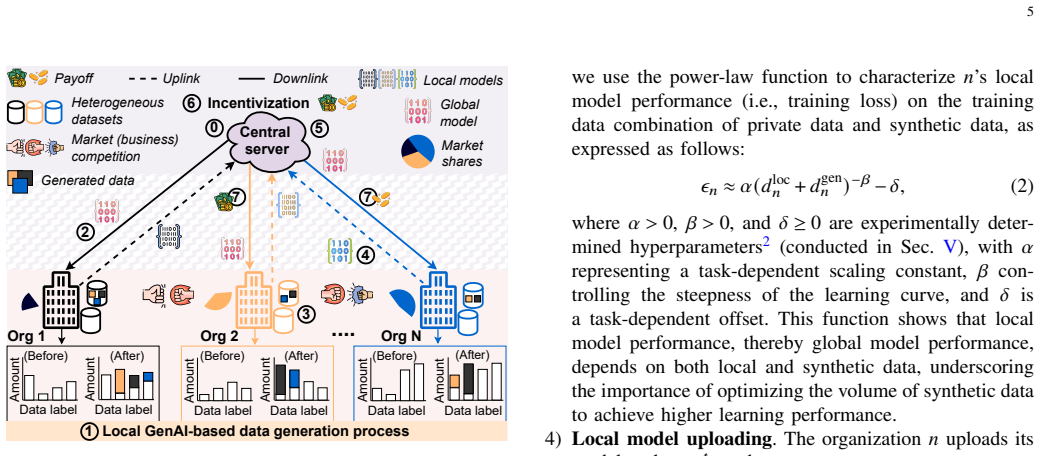
CoCoGen+ formulates each training round as a weighted potential game in which organizations endogenously decide synthetic data generation volumes to optimize their individual utilities, incorporating performance gains from the improved global model, computational costs, and competition-caused utility degradation; the paper derives a tractable equilibrium characterization and implementable generation strategies that maximize social welfare, then integrates a payoff redistribution incentive to compensate organizations for both their contributions and the competitive harms they incur.
What carries the argument
The weighted potential game formulation that lets each organization treat synthetic data volume as a continuous strategic variable whose marginal effect on global model quality and rival utility determines equilibrium generation levels.
If this is right
- Equilibrium data-generation levels are reached when each organization accounts for how its choices alter both the global model and competitors' downstream utilities.
- Social welfare is increased by implementing the characterized equilibrium strategies rather than independent or uniform generation policies.
- Payoff redistribution offsets the utility degradation organizations suffer from strengthening rivals, thereby supporting continued participation.
- Asymmetric learning gains caused by non-IID data are mitigated through the joint optimization of generation volumes and incentives.
Where Pith is reading between the lines
- The same game structure could be adapted to other settings where agents jointly improve a shared resource while still competing over its downstream uses, such as collaborative robotics or shared supply-chain optimization.
- If organizations cannot reliably estimate rivals' utility losses, the equilibrium may need to be approximated through repeated interaction or partial information sharing.
- Higher competition intensity is predicted to reduce synthetic data generation, which could slow global model convergence unless offset by stronger redistribution incentives.
Load-bearing premise
That organizations can accurately quantify the marginal impact of their synthetic data volume on both the shared model and rivals' utilities, and that the resulting game admits a tractable equilibrium that remains stable under realistic non-IID distributions and changing competition intensities.
What would settle it
A controlled deployment in which organizations follow the derived equilibrium strategies yet exhibit lower overall participation rates or reduced social welfare compared with non-strategic baselines when data heterogeneity and market competition are high.
Figures



read the original abstract
In data-sensitive domains such as healthcare, cross-silo federated learning (CFL) allows organizations to collaboratively train AI models without sharing raw data. However, practical CFL deployments are inherently coopetitive, in which organizations cooperate during model training while competing in downstream markets. In such settings, training contributions, including data volume, quality, and diversity, can improve the global model yet inadvertently strengthen rivals. This dilemma is amplified by non-IID data, which leads to asymmetric learning gains and undermines sustained participation. While existing competition-aware CFL and incentive-design approaches reward organizations based on marginal training contributions, they fail to account for the costs of strengthening competitors. In this paper, we introduce CoCoGen+, a coopetition-compatible data generation and incentivization framework that jointly models non-IID data and inter-organizational competition while endogenizing GenAI-based synthetic data generation as a strategic decision. Specifically, CoCoGen+ formulates each training round as a weighted potential game, where organizations strategically decide how much synthetic data to generate by balancing learning performance gains against computational costs and competition-caused utility losses. We then provide a tractable equilibrium characterization and derive implementable generation strategies to maximize social welfare. To promote long-term collaboration, we integrate a payoff redistribution-based incentive mechanism to compensate organizations for their contributions and competition-caused utility degradation. Experiments on varying learning tasks validate the feasibility of CoCoGen+. The results show how non-IID data, competition intensity, and incentives shape organizational strategies and social welfare, while CoCoGen+ outperforms baselines in efficiency.
Editorial analysis
A structured set of objections, weighed in public.
Referee Report
Summary. The manuscript introduces CoCoGen+, a coopetition-compatible framework for cross-silo federated learning that endogenizes GenAI-based synthetic data generation as a strategic decision. It formulates each training round as a weighted potential game in which organizations choose synthetic data volumes to balance global model performance gains against computational costs and competition-induced utility losses from strengthening rivals. The paper provides a tractable equilibrium characterization, derives implementable generation strategies that maximize social welfare, and integrates a payoff redistribution incentive mechanism to sustain long-term participation. Experiments on varying learning tasks are reported to validate feasibility, illustrate effects of non-IID data and competition intensity, and demonstrate outperformance over baselines.
Significance. If the weighted potential game property and equilibrium characterization hold for general non-IID distributions, the framework would offer a principled game-theoretic method for aligning individual incentives with collective welfare in competitive FL settings, addressing a key barrier to sustained participation in data-sensitive domains such as healthcare.
major comments (2)
- [Weighted potential game formulation and equilibrium characterization] The modeling section on the weighted potential game: the utilities (performance gain minus cost minus rival-utility loss) must satisfy the defining condition that there exists a potential function Φ and fixed weights w_i such that any unilateral change in an organization's synthetic data volume produces Δu_i = w_i ΔΦ. The competition-loss term depends on asymmetric model improvements under non-IID partitions, yet no explicit construction of Φ or proof that the differential condition holds for arbitrary competition intensities is provided; this assumption is load-bearing for the tractable equilibrium characterization and the derived welfare-maximizing strategies.
- [Experiments] The experimental validation section: no details are given on the steps used to derive or compute the equilibria, the specific numerical values or sensitivity ranges chosen for the free parameters (competition intensity coefficient, synthetic data cost weight, welfare redistribution weights), statistical significance of performance differences, or controls against post-hoc strategy tuning; without these, the claims of outperformance and welfare maximization cannot be independently verified.
minor comments (1)
- [Abstract] The abstract could more explicitly separate the theoretical claims (potential-game formulation and equilibrium derivation) from the empirical observations.
Simulated Author's Rebuttal
We thank the referee for the careful reading and constructive comments on our manuscript. We address each major comment below and outline the revisions we will make to strengthen the paper.
read point-by-point responses
-
Referee: The modeling section on the weighted potential game: the utilities (performance gain minus cost minus rival-utility loss) must satisfy the defining condition that there exists a potential function Φ and fixed weights w_i such that any unilateral change in an organization's synthetic data volume produces Δu_i = w_i ΔΦ. The competition-loss term depends on asymmetric model improvements under non-IID partitions, yet no explicit construction of Φ or proof that the differential condition holds for arbitrary competition intensities is provided; this assumption is load-bearing for the tractable equilibrium characterization and the derived welfare-maximizing strategies.
Authors: We agree that an explicit construction of the potential function Φ and a rigorous proof of the weighted potential game property are required to substantiate the equilibrium characterization. The manuscript states that the utilities admit a weighted potential but omits the full derivation for space reasons. In the revision we will add the explicit form of Φ (a weighted sum of global performance, individual generation costs, and competition-induced losses) together with a complete proof that Δu_i = w_i ΔΦ holds for arbitrary non-IID partitions and competition intensities. This addition will be placed in the modeling section immediately after the utility definition. revision: yes
-
Referee: no details are given on the steps used to derive or compute the equilibria, the specific numerical values or sensitivity ranges chosen for the free parameters (competition intensity coefficient, synthetic data cost weight, welfare redistribution weights), statistical significance of performance differences, or controls against post-hoc strategy tuning; without these, the claims of outperformance and welfare maximization cannot be independently verified.
Authors: We acknowledge that the experimental section currently lacks the implementation details needed for reproducibility. In the revised manuscript we will expand the experimental setup subsection to describe: (i) the exact algorithm and convergence criteria used to compute the Nash equilibria of the weighted potential game; (ii) the concrete numerical values and tested ranges for the competition intensity coefficient, synthetic-data cost weight, and redistribution weights; (iii) statistical significance results (paired t-tests or Wilcoxon signed-rank tests with p-values) computed over at least ten independent runs with different random seeds; and (iv) the controls employed, including pre-specified parameter grids and ablation studies, to guard against post-hoc tuning. These additions will allow independent verification of the reported performance gains and welfare improvements. revision: yes
Circularity Check
No significant circularity in derivation chain
full rationale
The paper claims to formulate each training round as a weighted potential game and derive tractable equilibrium strategies from balancing performance gains, costs, and competition losses. No quoted equations or sections in the provided text reduce the equilibrium characterization or welfare-maximizing strategies to fitted parameters by construction, self-definition of utilities, or self-citation chains. The formulation is presented as an independent modeling choice, with experiments serving as validation rather than input to the derivation. The central claim remains self-contained against external game-theoretic benchmarks and does not exhibit the required reduction for circularity flags.
Axiom & Free-Parameter Ledger
free parameters (3)
- competition intensity coefficient
- synthetic data cost weight
- welfare redistribution weights
axioms (2)
- domain assumption Organizations are rational utility maximizers who internalize both learning gains and competitor-strengthening losses.
- ad hoc to paper Synthetic data volume can be treated as a continuous, costed decision variable whose marginal contribution to the global model is quantifiable.
invented entities (1)
-
CoCoGen+ weighted potential game formulation
no independent evidence
Reference graph
Works this paper leans on
-
[1]
A coopetitive-compatible data generation framework for cross-silo federated learning,
T. L. Nguyen and Q.-V . Pham, “A coopetitive-compatible data generation framework for cross-silo federated learning,” inIEEE Global Commu- nications Conference, 2025, pp. 1950–1955
2025
-
[2]
Revisiting neural scaling laws in language and vision,
I. M. Alabdulmohsin, B. Neyshabur, and X. Zhai, “Revisiting neural scaling laws in language and vision,”Advances in Neural Information Processing Systems, vol. 35, pp. 22 300–22 312, 2022
2022
-
[3]
Regulation (EU) 2016/679 of the European Parliament and of the Council,
P. Regulation, “Regulation (EU) 2016/679 of the European Parliament and of the Council,”Regulation (EU), vol. 679, p. 2016, 2016
2016
-
[4]
Co-opetition and technological inno- vation in small and medium-sized enterprises: A multilevel conceptual model,
D. R. Gnyawali and B.-J. Park, “Co-opetition and technological inno- vation in small and medium-sized enterprises: A multilevel conceptual model,”Journal of small business management, vol. 47, no. 3, pp. 308– 330, 2009
2009
-
[5]
OpenFedLLM: Training large language models on decen- tralized private data via federated learning,
R. Yeet al., “OpenFedLLM: Training large language models on decen- tralized private data via federated learning,” inACM SIGKDD Confer- ence on Knowledge Discovery and Data Mining, 2024, p. 6137–6147
2024
-
[6]
Intellectual property issues in artificial intelligence trained on scraped data,
OECD, “Intellectual property issues in artificial intelligence trained on scraped data,”OECD Artificial Intelligence Papers, no. 33, 2025
2025
-
[7]
Diffusion federated dataset,
S.-J. Hahn and J. Lee, “Diffusion federated dataset,” inThe Thirty-ninth Annual Conference on Neural Information Processing Systems, 2025
2025
-
[8]
Advances and open problems in federated learning,
P. Kairouzet al., “Advances and open problems in federated learning,” Foundations and Trends in Machine Learning, vol. 14, no. 1–2, pp. 1– 210, 2021
2021
-
[9]
Duopoly business competition in cross- silo federated learning,
C. Huang, S. Ke, and X. Liu, “Duopoly business competition in cross- silo federated learning,”IEEE Transactions on Network Science and Engineering, vol. 11, no. 1, pp. 340–351, 2024
2024
-
[10]
A market for accuracy: Classification under competition,
O. Einav and N. Rosenfeld, “A market for accuracy: Classification under competition,” inProceedings of the 42nd International Conference on Machine Learning, vol. 267, 2025, pp. 15 079–15 104
2025
-
[11]
An incentive mechanism for cross-silo federated learning: A public goods perspective,
M. Tang and V . W. Wong, “An incentive mechanism for cross-silo federated learning: A public goods perspective,” inIEEE INFOCOM, 2021, pp. 1–10
2021
-
[12]
Incentives in federated learning: Equilibria, dynamics, and mechanisms for welfare maximization,
A. Murhekar, Z. Yuan, B. Ray Chaudhury, B. Li, and R. Mehta, “Incentives in federated learning: Equilibria, dynamics, and mechanisms for welfare maximization,”Advances in Neural Information Processing Systems, vol. 36, pp. 17 811–17 831, 2023
2023
-
[13]
Unleashing the power of edge-cloud generative AI in mobile networks: A survey of AIGC services,
M. Xuet al., “Unleashing the power of edge-cloud generative AI in mobile networks: A survey of AIGC services,”IEEE Communications Surveys & Tutorials, vol. 26, no. 2, pp. 1127–1170, 2024
2024
-
[14]
GPT-FL: Generative pre-trained model- assisted federated learning,
T. Zhang, T. Feng, S. Alam, D. Dimitriadis, S. Lee, M. Zhang, S. S. Narayanan, and S. Avestimehr, “GPT-FL: Generative pre-trained model- assisted federated learning,” inProceedings of the Computer Vision and Pattern Recognition Conference, 2025, pp. 1761–1770
2025
-
[15]
Bridging generalization gap of hetero- geneous federated clients using generative models,
Z. Niu, H. Dong, and A. K. Qin, “Bridging generalization gap of hetero- geneous federated clients using generative models,” inThe Fourteenth International Conference on Learning Representations, 2026
2026
-
[16]
Potential game theory,
Q. D. La, Y . H. Chew, and B.-H. Soong, “Potential game theory,”Cham: Springer International Publishing, 2016. 13
2016
-
[17]
When federated learning meets oligopoly competition: Stability and model differentiation,
C. Huang, J. Dachille, and X. Liu, “When federated learning meets oligopoly competition: Stability and model differentiation,”IEEE Inter- net of Things Journal, vol. 11, no. 16, pp. 27 409–27 420, 2024
2024
-
[18]
MarS-FL: Enabling competitors to collaborate in federated learning,
X. Wu and H. Yu, “MarS-FL: Enabling competitors to collaborate in federated learning,”IEEE Transactions on Big Data, vol. 10, no. 6, pp. 801–811, 2024
2024
-
[19]
FedCompetitors: Harmonious collaboration in federated learning with competing participants,
S. Tanet al., “FedCompetitors: Harmonious collaboration in federated learning with competing participants,” inAAAI Conference on Artificial Intelligence, vol. 38, no. 14, 2024, pp. 15 231–15 239
2024
-
[20]
Free-rider and conflict aware collaboration formation for cross- silo federated learning,
M. Chen, X. Wu, X. Tang, T. He, Y .-S. Ong, Q. Liu, Q. Lao, and H. Yu, “Free-rider and conflict aware collaboration formation for cross- silo federated learning,”Advances in Neural Information Processing Systems, 2024
2024
-
[21]
A blockchain-empowered incentive mechanism for cross-silo federated learning,
M. Tang, F. Peng, and V . W. Wong, “A blockchain-empowered incentive mechanism for cross-silo federated learning,”IEEE Transactions on Mobile Computing, vol. 23, no. 10, pp. 9240–9253, 2024
2024
-
[22]
Game analysis and incentive mechanism design for differentially private cross-silo federated learn- ing,
W. Mao, Q. Ma, G. Liao, and X. Chen, “Game analysis and incentive mechanism design for differentially private cross-silo federated learn- ing,”IEEE Transactions on Mobile Computing, vol. 23, no. 10, pp. 9337–9351, 2024
2024
-
[23]
FedUP: Bridging fairness and efficiency in cross-silo federated learning,
H. Liu, J. Lu, X. Wang, C. Wang, R. Jia, and M. Li, “FedUP: Bridging fairness and efficiency in cross-silo federated learning,”IEEE Transactions on Services Computing, vol. 17, no. 6, pp. 3672–3684, 2024
2024
-
[24]
Filling the missing: Exploring generative AI for enhanced federated learning over heterogeneous mobile edge devices,
P. Li, H. Zhang, Y . Wu, L. Qian, R. Yu, D. Niyato, and X. Shen, “Filling the missing: Exploring generative AI for enhanced federated learning over heterogeneous mobile edge devices,”IEEE Transactions on Mobile Computing, vol. 23, no. 10, pp. 10 001–10 015, 2024
2024
-
[25]
Efficient federated learn- ing with quality-aware generated models: An incentive mechanism,
H. Zhang, P. Li, M. Dai, Y . Wu, and L. Qian, “Efficient federated learn- ing with quality-aware generated models: An incentive mechanism,” IEEE Internet of Things Journal, vol. 12, no. 2, pp. 1628–1642, 2025
2025
-
[26]
IMFL-AIGC: Incentive mecha- nism design for federated learning empowered by artificial intelligence generated content,
G. Huang, Q. Wu, J. Li, and X. Chen, “IMFL-AIGC: Incentive mecha- nism design for federated learning empowered by artificial intelligence generated content,”IEEE Transactions on Mobile Computing, vol. 23, no. 12, pp. 12 603–12 620, 2024
2024
-
[27]
TradeFL: A trading mechanism for cross-silo federated learning,
S. Yuanet al., “TradeFL: A trading mechanism for cross-silo federated learning,” inIEEE ICDCS, 2023, pp. 920–930
2023
-
[28]
You Get What You Give: Reciprocally fair federated learning,
A. Murhekar, J. Song, P. Shahkar, B. R. Chaudhury, and R. Mehta, “You Get What You Give: Reciprocally fair federated learning,” inForty- second International Conference on Machine Learning, 2025
2025
-
[29]
Two concepts of external economies,
T. Scitovsky, “Two concepts of external economies,”Journal of Political Economy, vol. 62, no. 2, pp. 143–151, 1954
1954
-
[30]
Communication-efficient learning of deep networks from decentralized data,
B. McMahan, E. Moore, D. Ramage, S. Hampson, and B. A. y Arcas, “Communication-efficient learning of deep networks from decentralized data,” inArtificial Intelligence and Statistics, 2017, pp. 1273–1282
2017
-
[31]
Deep Learning Scaling is Predictable, Empirically
J. Hestness, S. Narang, N. Ardalani, G. Diamos, H. Jun, H. Kianinejad, M. M. A. Patwary, Y . Yang, and Y . Zhou, “Deep learning scaling is predictable, empirically,”arXiv:1712.00409, 2017
work page internal anchor Pith review arXiv 2017
-
[32]
Machine intelligence at the edge with learning centric power allocation,
S. Wang, Y .-C. Wu, M. Xia, R. Wang, and H. V . Poor, “Machine intelligence at the edge with learning centric power allocation,”IEEE Transactions on Wireless Communications, vol. 19, no. 11, pp. 7293– 7308, 2020
2020
-
[33]
(Mis)Fitting Scaling Laws: A survey of scaling law fitting techniques in deep learning,
M. Li, S. Kudugunta, and L. Zettlemoyer, “(Mis)Fitting Scaling Laws: A survey of scaling law fitting techniques in deep learning,” inInterna- tional Conference on Learning Representations, 2025
2025
-
[34]
Energy efficient federated learning over wireless communication networks,
Z. Yang, M. Chen, W. Saad, C. S. Hong, and M. Shikh-Bahaei, “Energy efficient federated learning over wireless communication networks,” IEEE Transactions on Wireless Communications, vol. 20, no. 3, pp. 1935–1949, 2020
1935
-
[35]
Understanding how consistency works in federated learning via stage-wise relaxed initialization,
Y . Sun, L. Shen, and D. Tao, “Understanding how consistency works in federated learning via stage-wise relaxed initialization,”Advances in Neural Information Processing Systems, vol. 36, pp. 80 543–80 574, 2023
2023
-
[36]
Exact and linear convergence for federated learning under arbitrary client participation is attainable,
B. Ying, Z. Li, and H. Yang, “Exact and linear convergence for federated learning under arbitrary client participation is attainable,” inThe Thirty- ninth Annual Conference on Neural Information Processing Systems, 2025
2025
-
[37]
A crowdsourcing framework for on-device federated learning,
S. R. Pandey, N. H. Tran, M. Bennis, Y . K. Tun, A. Manzoor, and C. S. Hong, “A crowdsourcing framework for on-device federated learning,” IEEE Transactions on Wireless Communications, vol. 19, no. 5, pp. 3241–3256, 2020
2020
-
[38]
A simple mechanism for the efficient provision of public goods: Experimental evidence,
J. Falkinger, E. Fehr, S. Gächter, and R. Winter-Ebmer, “A simple mechanism for the efficient provision of public goods: Experimental evidence,”American Economic Review, vol. 91, no. 1, pp. 247–264, 2000
2000
-
[39]
Facebook buying WhatsApp for $19b, will keep the messaging service independent,
M. Panzarino, “Facebook buying WhatsApp for $19b, will keep the messaging service independent,” 2014, (Accessed Apr. 07, 2026). [Online]. Available: https://techcrunch.com/2014/02/19/ facebook-buying-whatsapp-for-16b-in-cash-and-stock-plus-3b-in-rsus
2014
-
[40]
Royalty rates and licensing strategies for essential patents on 5G telecommunication standards: What to expect,
E. Stasik and D. L. Cohen, “Royalty rates and licensing strategies for essential patents on 5G telecommunication standards: What to expect,” les Nouvelles-Journal of the Licensing Executives Society, vol. 55, no. 3, 2020
2020
-
[41]
Google News Spain to close in response to story links ’tax’,
T. Guardian, “Google News Spain to close in response to story links ’tax’,” 2014, (Accessed Apr. 07, 2026). [Online]. Available: https://www.theguardian.com/technology/2014/dec/ 11/google-news-spain-to-close-in-response-to-tax-on-story-links
2014
-
[42]
Non-cooperative games,
J. Nash, “Non-cooperative games,”The Annals of Mathematics, vol. 54, no. 2, pp. 286–295, 1951
1951
-
[43]
Potential games,
D. Monderer and L. S. Shapley, “Potential games,”Games and economic behavior, vol. 14, no. 1, pp. 124–143, 1996
1996
-
[44]
Fashion-MNIST: a Novel Image Dataset for Benchmarking Machine Learning Algorithms
H. Xiao, K. Rasul, and R. V ollgraf, “Fashion-MNIST: A novel image dataset for benchmarking machine learning algorithms,” arXiv:1708.07747, 2017
work page internal anchor Pith review arXiv 2017
-
[45]
Learning multiple layers of features from tiny images,
A. Krizhevsky, G. Hintonet al., “Learning multiple layers of features from tiny images,” 2009
2009
-
[46]
FedAPEN: Personalized cross- silo federated learning with adaptability to statistical heterogeneity,
Z. Qin, S. Deng, M. Zhao, and X. Yan, “FedAPEN: Personalized cross- silo federated learning with adaptability to statistical heterogeneity,” inProceedings of the 29th ACM SIGKDD conference on knowledge discovery and data mining, 2023, pp. 1954–1964
2023
-
[47]
Flower: A friendly federated learning research framework.arXiv preprint arXiv:2007.14390,
D. J. Beutelet al., “Flower: A friendly federated learning research framework,”arXiv preprint arXiv:2007.14390, 2020
-
[48]
Searching for mobilenetv3,
A. Howardet al., “Searching for mobilenetv3,” inProceedings of the IEEE/CVF international conference on computer vision, 2019, pp. 1314– 1324
2019
-
[49]
Mobilenetv2: Inverted residuals and linear bottlenecks,
M. Sandler, A. Howard, M. Zhu, A. Zhmoginov, and L.-C. Chen, “Mobilenetv2: Inverted residuals and linear bottlenecks,” inProceedings of the IEEE conference on computer vision and pattern recognition, 2018, pp. 4510–4520
2018
-
[50]
Deep residual learning for image recognition,
K. He, X. Zhang, S. Ren, and J. Sun, “Deep residual learning for image recognition,” inProceedings of the IEEE conference on computer vision and pattern recognition, 2016, pp. 770–778
2016
-
[51]
Federated learning over wireless networks: Optimization model design and analysis,
N. H. Tran, W. Bao, A. Zomaya, M. N. Nguyen, and C. S. Hong, “Federated learning over wireless networks: Optimization model design and analysis,” inIEEE INFOCOM, 2019, pp. 1387–1395
2019
-
[52]
Tournament as a motivational strategy: Extension to dynamic situations with uncertain duration,
K.-k. Tong and K. Leung, “Tournament as a motivational strategy: Extension to dynamic situations with uncertain duration,”Journal of Economic Psychology, vol. 23, no. 3, pp. 399–420, 2002
2002
-
[53]
A framework for uplink power control in cellular radio systems,
R. D. Yates, “A framework for uplink power control in cellular radio systems,”IEEE Journal on Selected Areas in Communications, vol. 13, no. 7, pp. 1341–1347, 2002. APPENDIX A. Proof of Theorem 1 Proof.We adopt the forward method [16], where we consider the case where an organization𝑛can deviate from strategy {𝑑gen 𝑛 } to {𝑑 ′,gen 𝑛 }, while other organiz...
2002
discussion (0)
Sign in with ORCID, Apple, or X to comment. Anyone can read and Pith papers without signing in.