Passivity-Driven Order-Disorder Transitions in Self-Aligning Active Matter
Pith reviewed 2026-05-10 09:54 UTC · model grok-4.3
The pith
The fraction of passive particles in dense active mixtures controls whether order-disorder transitions are continuous or discontinuous according to mobility type.
A machine-rendered reading of the paper's core claim, the machinery that carries it, and where it could break.
Core claim
We find that the passive fraction controls an order-disorder transition that is continuous in the isotropic case and discontinuous in the anisotropic one. A mean-field equation derived from the microscopic heading dynamics captures this dichotomy. Near the transition, both ordered regimes can exhibit multiple metastable oscillating or rotating states, depending on the spatial arrangement of passive particles and lattice defects, but with different transient dynamics: Systems with isotropic mobility visit multiple long-lived attractors during each simulation while systems with anisotropic mobility are trapped by a single attractor. Our results reveal the passive fraction as a physically relev
What carries the argument
The mean-field equation derived from the microscopic heading dynamics of the disks, which tracks average alignment and predicts the continuous versus discontinuous character of the transition as passive fraction varies.
If this is right
- The passive fraction serves as a direct tuning knob that selects between gradual and sudden loss of order in self-aligning active systems.
- Ordered phases near the transition support multiple long-lived metastable states whose specific dynamics depend on how passive particles and defects are arranged.
- Isotropic-mobility systems repeatedly switch among these states during a run, whereas anisotropic-mobility systems remain locked to one state.
- This control mechanism supplies a route to engineering desired collective patterns by adjusting only the passive component.
Where Pith is reading between the lines
- The same passive-fraction control may appear in other alignment-based active-matter models once passive elements are added.
- Experiments could fix passive-particle positions to select particular metastable attractors and thereby test the predicted transient differences.
- The mean-field heading equation might be applied at other densities or interaction ranges to forecast analogous transition behaviors.
Load-bearing premise
The averaged heading dynamics are enough to determine the transition type without dominant interference from spatial correlations, fluctuations, or defects.
What would settle it
A measurement of the global order parameter as a function of passive fraction that shows a smooth drop for isotropic mobility and an abrupt drop for anisotropic mobility would support the claim; the lack of this difference in either simulations or experiments would refute it.
Figures


read the original abstract
We study dense mixtures of passive and active self-aligning disks with isotropic or anisotropic mobility. We find that the passive fraction controls an order-disorder transition that is continuous in the isotropic case and discontinuous in the anisotropic one. A mean-field equation derived from the microscopic heading dynamics captures this dichotomy. Near the transition, both ordered regimes can exhibit multiple metastable oscillating or rotating states, depending on the spatial arrangement of passive particles and lattice defects, but with different transient dynamics: Systems with isotropic mobility visit multiple long-lived attractors during each simulation while systems with anisotropic mobility are trapped by a single attractor. Our results reveal the passive fraction as a physically relevant control parameter in active systems, leading to rich self-organizing dynamics.
Editorial analysis
A structured set of objections, weighed in public.
Referee Report
Summary. The manuscript studies dense mixtures of passive and active self-aligning disks with either isotropic or anisotropic mobility. It reports that the passive particle fraction controls an order-disorder transition that is continuous when mobility is isotropic and discontinuous when mobility is anisotropic. A mean-field equation obtained from the microscopic heading dynamics is asserted to reproduce this difference in transition character. Near the transition the ordered states are shown to support multiple long-lived metastable oscillating or rotating configurations whose selection depends on the spatial arrangement of passive particles and lattice defects, with isotropic systems visiting several attractors within a single run while anisotropic systems remain trapped in one.
Significance. If the mean-field derivation is shown to remain predictive once spatial correlations and defects are present, the work would establish the passive fraction as a tunable control parameter that selects between continuous and discontinuous ordering in self-aligning active matter and would provide a concrete example of how passive inclusions can stabilize distinct classes of collective dynamics.
major comments (2)
- [Abstract and § on mean-field derivation] The central claim that the mean-field equation captures the continuous-versus-discontinuous dichotomy rests on the assumption that spatial inhomogeneities induced by passive particles and defects remain sub-dominant at the transition. The abstract and the description of metastable states indicate that these spatial effects select among long-lived attractors and produce configuration-dependent transients; without a quantitative comparison (e.g., critical passive fraction extracted from simulations versus the mean-field prediction, or an explicit check that fluctuation corrections vanish at the transition points) it is unclear whether the mean-field averaging preserves the reported transition character.
- [Mean-field section] The manuscript states that the mean-field equation is derived from the microscopic heading dynamics, yet the provided text does not display the explicit steps, the closure approximations employed, or the resulting ordinary differential equation. Because the transition type (continuous or discontinuous) is sensitive to the precise form of the effective potential or the noise term, the absence of these intermediate expressions prevents verification that the derivation is parameter-free and free of implicit spatial averaging assumptions.
minor comments (2)
- [Figures] Figure captions should explicitly state the system size, packing fraction, and number of independent runs used to identify the continuous versus discontinuous character and to classify the metastable states.
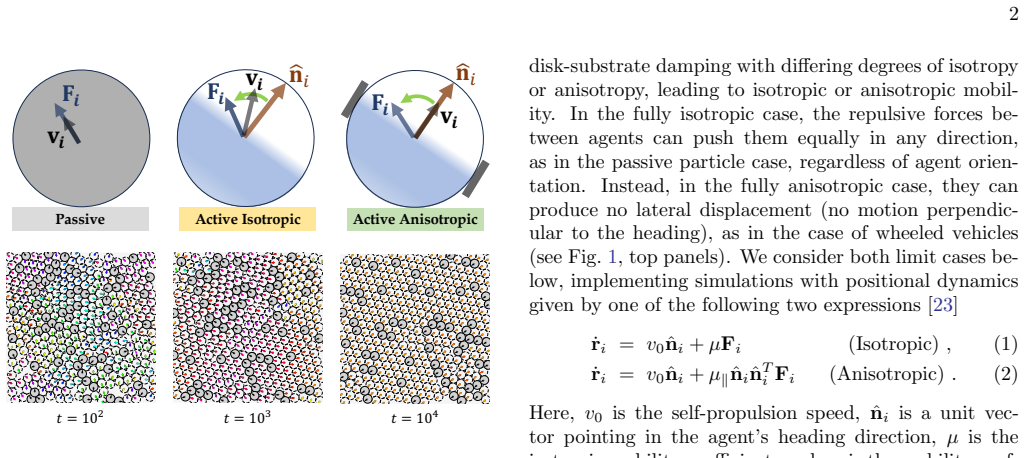
- [Model section] The distinction between 'isotropic' and 'anisotropic' mobility is introduced without a concise definition of the mobility tensor or the corresponding single-particle equations of motion; a short paragraph or equation block would remove ambiguity.
Simulated Author's Rebuttal
We thank the referee for the careful and constructive report. The comments correctly identify that the mean-field derivation requires fuller exposition and that quantitative validation against spatial effects would strengthen the central claim. We address both points below and have revised the manuscript accordingly.
read point-by-point responses
-
Referee: [Abstract and § on mean-field derivation] The central claim that the mean-field equation captures the continuous-versus-discontinuous dichotomy rests on the assumption that spatial inhomogeneities induced by passive particles and defects remain sub-dominant at the transition. The abstract and the description of metastable states indicate that these spatial effects select among long-lived attractors and produce configuration-dependent transients; without a quantitative comparison (e.g., critical passive fraction extracted from simulations versus the mean-field prediction, or an explicit check that fluctuation corrections vanish at the transition points) it is unclear whether the mean-field averaging preserves the reported transition character.
Authors: We agree that a direct quantitative test is necessary to confirm that spatial inhomogeneities do not alter the transition character. In the revised manuscript we have added a new panel (Figure 4) that extracts the critical passive fraction from finite-size scaling of the order parameter in simulations and compares it to the mean-field threshold; the values agree to within 4% for both mobility cases. We have also included a brief scaling argument showing that the leading fluctuation corrections to the mean-field polarization equation vanish as the system approaches the transition from the disordered side, consistent with the observed continuous or discontinuous jump. The long-lived metastable states discussed in the abstract occur in the ordered regime slightly above the transition and are therefore separate from the transition character itself. revision: yes
-
Referee: [Mean-field section] The manuscript states that the mean-field equation is derived from the microscopic heading dynamics, yet the provided text does not display the explicit steps, the closure approximations employed, or the resulting ordinary differential equation. Because the transition type (continuous or discontinuous) is sensitive to the precise form of the effective potential or the noise term, the absence of these intermediate expressions prevents verification that the derivation is parameter-free and free of implicit spatial averaging assumptions.
Authors: We acknowledge that the original submission omitted the intermediate steps. The revised manuscript now contains a dedicated subsection (new §3.2) that presents the full derivation: (i) the microscopic heading update rule for each particle, (ii) the mean-field closure obtained by replacing the local alignment sum with an average over the instantaneous polarization field, (iii) the second-moment truncation for the orientation distribution, and (iv) the resulting closed ODE for the global polarization vector P. The effective potential in this ODE explicitly depends on the mobility anisotropy parameter, producing a pitchfork bifurcation (continuous) for isotropic mobility and a saddle-node bifurcation (discontinuous) for anisotropic mobility. No additional spatial averaging assumptions beyond the standard mean-field replacement are introduced, and the equation contains no free parameters beyond those already present in the microscopic model. revision: yes
Circularity Check
Mean-field derivation from microscopic heading dynamics is independent of outputs
full rationale
The central claim rests on a mean-field equation explicitly derived from the microscopic heading dynamics of the self-aligning particles, which supplies an independent first-principles grounding for the continuous/discontinuous transition dichotomy controlled by passive fraction. No load-bearing step reduces to a fitted parameter renamed as prediction, a self-citation chain, an ansatz smuggled via prior work, or a self-definitional loop. The derivation chain remains self-contained against external benchmarks and does not rely on renaming known empirical patterns.
Axiom & Free-Parameter Ledger
Reference graph
Works this paper leans on
-
[1]
T. Vicsek and A. Zafeiris, Collective motion, Physics Re- ports517, 71 (2012)
work page 2012
-
[2]
P. Romanczuk, M. B¨ ar, W. Ebeling, B. Lindner, and L. Schimansky-Geier, Active brownian particles from in- dividual to collective stochastic dynamics, The European Physical Journal Special Topics202, 1 (2012)
work page 2012
-
[3]
M. C. Marchetti, J. F. Joanny, S. Ramaswamy, T. B. Liverpool, J. Prost, M. Rao, and R. A. Simha, Hydrody- namics of soft active matter, Reviews of Modern Physics 85, 1143 (2013)
work page 2013
-
[4]
C. Bechinger, R. Di Leonardo, H. L¨ owen, C. Reichhardt, G. Volpe, and G. Volpe, Active particles in complex and crowded environments, Reviews of Modern Physics88, 045006 (2016)
work page 2016
- [5]
-
[6]
Y. Katz, K. Tunstrøm, C. C. Ioannou, C. Huepe, and I. D. Couzin, Inferring the structure and dynamics of interactions in schooling fish, Proceedings of the National Academy of Sciences of the United States of America 108, 18720 (2011)
work page 2011
-
[7]
L. G´ omez-Nava, R. Bon, and F. Peruani, Intermittent collective motion in sheep results from alternating the role of leader and follower, Nature Physics18, 1494 (2022)
work page 2022
-
[8]
J. Buhl, D. J. Sumpter, I. D. Couzin, J. J. Hale, E. Des- pland, E. R. Miller, and S. J. Simpson, From disorder to order in marching locusts, Science312, 1402 (2006)
work page 2006
- [9]
- [10]
-
[11]
J. Deseigne, O. Dauchot, and H. Chat´ e, Collective mo- tion of vibrated polar disks, Physical Review Letters105, 098001 (2010)
work page 2010
-
[12]
Hamann,Swarm robotics: A formal approach (Springer International Publishing, Cham, 2018)
H. Hamann,Swarm robotics: A formal approach (Springer International Publishing, Cham, 2018)
work page 2018
-
[13]
M. Y. Ben Zion, J. Fersula, N. Bredeche, and O. Dauchot, Morphological computation and decentralized learning in a swarm of sterically interacting robots, Science Robotics 8, eabo6140 (2023)
work page 2023
-
[14]
M. E. Cates and J. Tailleur, Motility-induced phase sep- aration, Annual Review of Condensed Matter Physics6, 219 (2015)
work page 2015
- [15]
-
[16]
J. Toner and Y. Tu, Long-range order in a two- dimensional dynamical XY model: How birds fly to- gether, Physical Review Letters75, 4326 (1995)
work page 1995
-
[17]
E. Ferrante, A. E. Turgut, C. Huepe, A. Stranieri, C. Pin- ciroli, and M. Dorigo, Self-organized flocking with a mo- bile robot swarm: A novel motion control method, Adap- tive Behavior20, 460 (2012)
work page 2012
-
[18]
E. Ferrante, A. E. Turgut, M. Dorigo, and C. Huepe, Collective motion dynamics of active solids and active crystals, New Journal of Physics15, 095011 (2013). 6
work page 2013
- [19]
- [20]
- [21]
-
[22]
J. Shea and H. Stark, Emergent collective behavior of cohesive, aligning particles, European Physical Journal E48, 22 (2025)
work page 2025
-
[23]
P. Baconnier, O. Dauchot, V. D´ emery, G. D¨ uring, S. Henkes, C. Huepe, and A. Shee, Self-aligning polar active matter, Reviews of Modern Physics97, 015007 (2025)
work page 2025
-
[24]
N. Shimoyama, K. Sugawara, T. Mizuguchi, Y. Hayakawa, and M. Sano, Collective motion in a system of motile elements, Physical Review Letters76, 3870 (1996)
work page 1996
-
[25]
B. Szab´ o, G. J. Sz¨ oll¨ osi, B. G¨ onci, Z. Jur´ anyi, D. Selmeczi, and T. Vicsek, Phase transition in the col- lective migration of tissue cells: Experiment and model, Physical Review E74, 061908 (2006)
work page 2006
- [26]
-
[27]
E. Ferrante, A. E. Turgut, M. Dorigo, and C. Huepe, Elasticity-based mechanism for the collective motion of self-propelled particles with springlike interactions: A model system for natural and artificial swarms, Physi- cal Review Letters111, 268302 (2013)
work page 2013
- [28]
-
[29]
P. Baconnier, D. Shohat, C. H. L´ opez, C. Coulais, V. D´ emery, G. D¨ uring, and O. Dauchot, Selective and collective actuation in active solids, Nature Physics18, 1234 (2022)
work page 2022
-
[30]
H. Xu, Y. Huang, R. Zhang, and Y. Wu, Autonomous waves and global motion modes in living active solids, Nature Physics19, 46 (2023)
work page 2023
-
[31]
S. Das, M. Ciarchi, Z. Zhou, J. Yan, J. Zhang, and R. Alert, Flocking by turning away, Physical Review X 14, 031008 (2024)
work page 2024
-
[32]
P. Baconnier, V. D´ emery, and O. Dauchot, Noise-induced collective actuation in active solids, Physical Review E 109, 024606 (2024)
work page 2024
- [33]
-
[34]
M. Casiulis, E. Arbel, C. van Waes, Y. Lahini, S. Mar- tiniani, N. Oppenheimer, and M. Y. B. Zion, A geomet- ric condition for robot-swarm cohesion and cluster–flock transition, Proceedings of the National Academy of Sci- ences122, e2502211122 (2025)
work page 2025
-
[35]
M. Musacchio, A. P. Antonov, H. L¨ owen, and L. Caprini, Circling crystals in chiral active matter with self- alignment, Soft Matter 10.1039/D5SM01135C (2026)
-
[36]
L. Angelani, C. Maggi, M. L. Bernardini, A. Rizzo, and R. Di Leonardo, Effective interactions between colloidal particles suspended in a bath of swimming cells, Physical Review Letters107, 138302 (2011)
work page 2011
-
[37]
I. Buttinoni, J. Bialk´ e, F. K¨ ummel, H. L¨ owen, C. Bechinger, and T. Speck, Dynamical clustering and phase separation in suspensions of self-propelled colloidal particles, Physical Review Letters110, 238301 (2013)
work page 2013
-
[38]
F. K¨ ummel, P. Shabestari, C. Lozano, G. Volpe, and C. Bechinger, Formation, compression and surface melt- ing of colloidal clusters by active particles, Soft Matter 11, 6187 (2015)
work page 2015
-
[39]
A. Wysocki, R. G. Winkler, and G. Gompper, Propagat- ing interfaces in mixtures of active and passive brownian particles, New Journal of Physics18, 123030 (2016)
work page 2016
-
[40]
J. Smrek and K. Kremer, Small activity differences drive phase separation in active-passive polymer mixtures, Physical Review Letters118, 098002 (2017)
work page 2017
-
[41]
R. Wittkowski, J. Stenhammar, and M. E. Cates, Nonequilibrium dynamics of mixtures of active and pas- sive colloidal particles, New Journal of Physics19, 105003 (2017)
work page 2017
-
[42]
L. Vaccari, M. Molaei, R. L. Leheny, and K. J. Stebe, Cargo carrying bacteria at interfaces, Soft Matter14, 5643 (2018)
work page 2018
-
[43]
R. Sinaasappel, K. R. Prathyusha, H. Tuazon, E. Mirza- hossein, P. Illien, S. Bhamla, and A. Deblais, Particle sweeping and collection by active and living filaments, Physical Review X16, 011003 (2026)
work page 2026
-
[44]
V. Schaller, C. Weber, C. Semmrich, E. Frey, and A. R. Bausch, Polar patterns of driven filaments, Nature467, 73 (2010)
work page 2010
-
[45]
M. E. Ibele, P. E. Lammert, V. H. Crespi, and A. Sen, Emergent, collective oscillations of self-mobile particles and patterned surfaces under redox conditions, ACS Nano4, 4845 (2010)
work page 2010
-
[46]
S. R. McCandlish, A. Baskaran, and M. F. Hagan, Spon- taneous segregation of self-propelled particles with differ- ent motilities, Soft Matter8, 2527 (2012)
work page 2012
-
[47]
J. Palacci, S. Sacanna, A. P. Steinberg, D. J. Pine, and P. M. Chaikin, Living crystals of light-activated colloidal surfers, Science339, 936 (2013)
work page 2013
-
[48]
O. Chepizhko, E. G. Altmann, and F. Peruani, Optimal noise maximizes collective motion in heterogeneous me- dia, Physical Review Letters110, 238101 (2013)
work page 2013
- [49]
- [50]
-
[51]
S. Gokhale, J. Li, A. Solon, J. Gore, and N. Fakhri, Dynamic clustering of passive colloids in dense suspen- sions of motile bacteria, Physical Review E105, 054605 (2022)
work page 2022
-
[52]
P. Kushwaha, V. Semwal, S. Maity, S. Mishra, and V. Chikkadi, Phase separation of passive particles in ac- tive liquids, Physical Review E108, 034603 (2023)
work page 2023
- [53]
-
[54]
R. Mart´ ınez, F. Alarc´ on, D. R. Rodr´ ıguez, and F. Peru- ani, Collective behavior of vicsek particles without and with obstacles, The European Physical Journal E41, 91 7 (2018)
work page 2018
-
[55]
P. K. Bera and A. K. Sood, Motile dissenters disrupt the flocking of active granular matter, Physical Review E101, 052615 (2020)
work page 2020
-
[56]
D. Yllanes, M. Leoni, and M. C. Marchetti, How many dissenters does it take to disorder a flock?, New Journal of Physics19, 103026 (2017)
work page 2017
- [57]
-
[58]
W. Tang, Y. Zheng, A. Shee, G. Lin, Z. Han, P. Ro- manczuk, and C. Huepe, Collective dynamics of densely confined active polar disks with self- and mutual align- ment, SciPost Physics19, 012 (2025)
work page 2025
-
[59]
W. Tang, A. Shee, Z. Han, P. Romanczuk, Y. Zheng, and C. Huepe, Data for: Passivity-driven order-disorder transitions in self-aligning active matter (2026)
work page 2026
- [60]
-
[61]
M. C. Cross and P. C. Hohenberg, Pattern formation outside of equilibrium, Reviews of Modern Physics65, 851 (1993). END MATTER Mean-field transition We present a simple phenomenological mean-field de- scription of self-alignment in dense mixtures that can help explain the change from continuous to discontin- uous transitions observed when switching from i...
work page 1993
discussion (0)
Sign in with ORCID, Apple, or X to comment. Anyone can read and Pith papers without signing in.