REVIEW 2 major objections 2 minor
MinShap adapts Shapley values for feature selection by taking the minimum marginal contribution over permutations to isolate direct effects.
Reviewed by Pith at T0; open to challenge. T0 means a machine referee read the full paper against a public rubric. the ladder, T0–T4 →
T0 review · grok-4.3
2026-05-10 09:51 UTC pith:ROVDH3FB
load-bearing objection MinShap swaps the Shapley average for the minimum marginal contribution to isolate direct effects, with a Type I claim under faithfulness, but the supporting details look thin so far. the 2 major comments →
MinShap: A Shapley-Based Framework for Feature Redundancy
The pith
A machine-rendered reading of the paper's core claim, the machinery that carries it, and where it could break.
Core claim
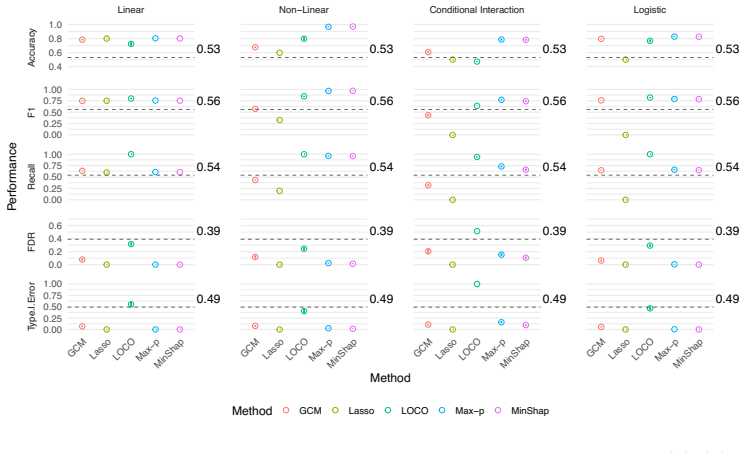
The paper proposes MinShap, a variant of the Shapley value that uses the minimum marginal contribution across feature permutations rather than the average. This is motivated by the faithfulness assumption in directed acyclic graphical models, which ensures that the minimum isolates direct effects. The method comes with a Type I error guarantee and empirical evidence of superior performance in accuracy and stability compared to state-of-the-art alternatives. Additional algorithms based on multiple testing perspectives are introduced to enhance results in lower-sample settings.
What carries the argument
MinShap, defined by replacing the average marginal contribution over permutations with the minimum marginal contribution to focus on direct effects.
Load-bearing premise
The data-generating process satisfies the faithfulness assumption in its directed acyclic graph, so minimum marginal contributions reflect only direct effects.
What would settle it
A controlled simulation on a graph with known indirect paths where MinShap selects features that lack direct effects or misses features that have them.
Editorial analysis
A structured set of objections, weighed in public.
Referee Report
Summary. The manuscript proposes MinShap, a modification of the Shapley value framework for feature selection in which the minimum marginal contribution across feature permutations replaces the conventional average. Motivated by the faithfulness assumption in directed acyclic graphical models, the paper claims a Type I error guarantee that isolates direct effects, introduces a family of related algorithms based on multiple testing and p-values, and reports that MinShap outperforms LOCO, GCM, and Lasso in both accuracy and stability on numerical simulations and real-data experiments.
Significance. If the theoretical guarantees hold under the stated assumptions, MinShap would supply a principled, game-theoretic route to feature selection that separates direct from indirect effects without requiring explicit causal modeling. The accompanying suite of p-value-based variants could be practically useful in low-sample regimes, and the reported gains in accuracy and stability would strengthen the case for adopting modified Shapley methods in high-dimensional settings with dependent features.
major comments (2)
- [§3] §3 (theoretical foundation): The Type I error guarantee is motivated by the faithfulness assumption in DAGs, yet the manuscript does not state the precise condition under which min_marginal(X_i) = 0 if and only if feature i is a direct parent, nor does it quantify how the guarantee degrades under mild faithfulness violations or finite-sample estimation error in the value function. This is load-bearing for the central theoretical claim.
- [§5] §5 (experiments): The claims of superior accuracy and stability rest on numerical simulations and real-data results, but the manuscript provides insufficient detail on the number of permutations used to compute MinShap, the exact data-generation process, the number of Monte Carlo repetitions, and the statistical tests employed to establish outperformance over LOCO, GCM, and Lasso. Without these, the empirical central claim cannot be verified.
minor comments (2)
- [Abstract] Abstract: The sentence describing MinShap contains a grammatical error ('instead of taking the average marginal contributions over permutations of features, considers the minimum...'); rephrasing would improve readability.
- [§2] Notation: The definition of the value function and the precise manner in which marginal contributions are estimated from data should be stated more explicitly to aid reproducibility.
Simulated Author's Rebuttal
We thank the referee for the constructive and detailed feedback. We address each major comment below, agreeing where the manuscript requires clarification or additional detail, and describe the revisions we will implement.
read point-by-point responses
-
Referee: [§3] §3 (theoretical foundation): The Type I error guarantee is motivated by the faithfulness assumption in DAGs, yet the manuscript does not state the precise condition under which min_marginal(X_i) = 0 if and only if feature i is a direct parent, nor does it quantify how the guarantee degrades under mild faithfulness violations or finite-sample estimation error in the value function. This is load-bearing for the central theoretical claim.
Authors: We agree that the original manuscript did not provide an explicit formal statement of the precise condition under which min_marginal(X_i) = 0 if and only if feature i is a direct parent. In the revised version we will add a dedicated theorem (new Theorem 1) that states this equivalence under the faithfulness assumption for the underlying DAG. We will also include a new subsection discussing the sensitivity of the Type I error bound to mild violations of faithfulness and to finite-sample estimation error in the value function, supported by a brief analytic argument and a small simulation study quantifying the degradation. revision: yes
-
Referee: [§5] §5 (experiments): The claims of superior accuracy and stability rest on numerical simulations and real-data results, but the manuscript provides insufficient detail on the number of permutations used to compute MinShap, the exact data-generation process, the number of Monte Carlo repetitions, and the statistical tests employed to establish outperformance over LOCO, GCM, and Lasso. Without these, the empirical central claim cannot be verified.
Authors: We concur that the experimental section lacked sufficient detail for full reproducibility and verification. In the revised manuscript we will expand Section 5 with: the exact number of permutations (1000) used to approximate MinShap; a complete description of the data-generation processes, including the specific DAG structures, edge weights, and noise distributions; the number of Monte Carlo repetitions (100); and the statistical tests (paired t-tests with reported p-values and effect sizes) used to compare accuracy and stability against LOCO, GCM, and Lasso. We will also make the simulation code and data publicly available as supplementary material. revision: yes
Circularity Check
No significant circularity in MinShap derivation or guarantees
full rationale
The paper defines MinShap directly as the minimum (rather than average) marginal contribution over feature permutations, which is an explicit algorithmic modification of the standard Shapley value. The Type I error guarantee and direct-effect isolation claim are derived conditionally from the external faithfulness assumption on DAGs, a standard causal inference condition that is not defined in terms of MinShap itself and does not reduce the result to a tautology or fitted input. No equations or steps in the provided text exhibit self-definition, renaming of known results, or load-bearing self-citations that collapse the central claims by construction. The derivation therefore retains independent content under the stated assumption.
Axiom & Free-Parameter Ledger
axioms (1)
- domain assumption Faithfulness assumption in directed acyclic graphical models
read the original abstract
Shapley values provide a flexible framework for attributing feature contributions to model predictions, but they are not naturally suited for feature selection: a feature may receive a positive attribution even when it is redundant given the remaining variables. In this paper, we introduce \textbf{MinShap}, a general framework for identifying \emph{important} or \emph{non-redundant} features through conditional importance functionals $VI_j^S$. Rather than averaging feature contributions across conditioning sets, MinShap aggregates them using the \emph{minimum}, thereby testing whether a feature remains relevant under every conditioning context. We show that, under a simple \emph{null monotonicity} condition, the minimum aggregation exactly characterizes feature redundancy and yields a principled feature selection criterion. This perspective provides a unified framework for statistical feature selection and representation-based interpretability while retaining the stability advantages of Shapley-style aggregation. We develop scalable algorithms with statistical guarantees, establish connections to multiple-testing procedures, and demonstrate through theory and experiments that MinShap produces more accurate and stable feature selection than existing model-agnostic approaches.
Figures


discussion (0)
Sign in with ORCID, Apple, or X to comment. Anyone can read and Pith papers without signing in.