Recognition: unknown
Assembling Extensive Quantum Fisher Information in Stabilizer Systems
Pith reviewed 2026-05-10 11:26 UTC · model grok-4.3
The pith
A mapping from stabilizer generators to dual Ising spins turns hidden nonlocal order into observables with extensive quantum Fisher information density.
A machine-rendered reading of the paper's core claim, the machinery that carries it, and where it could break.
Core claim
The construction maps stabilizer generators to dual Ising spins whose correlators equal string order parameters, converting hidden nonlocal order into a metrologically accessible observable. Applying this to monitored cluster codes and the toric code, the work identifies transitions in the QFI scaling from an extensive regime, where long-range string order prevails, to an intensive one driven by competing single-site measurements.
What carries the argument
The mapping of stabilizer generators onto dual Ising spins whose correlators are identified with string order parameters.
If this is right
- Long-range string order in monitored cluster codes directly supplies extensive QFI density.
- The toric code exhibits a transition to intensive QFI scaling when single-site measurements dominate.
- String order parameters become concrete, metrologically usable observables inside stabilizer systems.
- Nonlocal observables constructed this way remain accessible for sensing tasks in the extensive regime.
Where Pith is reading between the lines
- The same mapping technique could be tested on other stabilizer codes such as the color code to check whether extensive QFI appears under analogous monitoring.
- If the link between string order and QFI holds, it may guide the design of measurement protocols that preserve metrological advantage in topological codes.
- One could examine whether the framework extends to time-dependent monitoring rates to locate the precise boundary between extensive and intensive QFI regimes.
Load-bearing premise
That the mapping from stabilizer generators to dual Ising spins produces correlators that directly yield extensive QFI density without further assumptions on measurement dynamics or code details.
What would settle it
An explicit computation or measurement in the toric code under competing single-site monitoring that shows the QFI density remains extensive even after the associated string order parameter has decayed.
Figures


read the original abstract
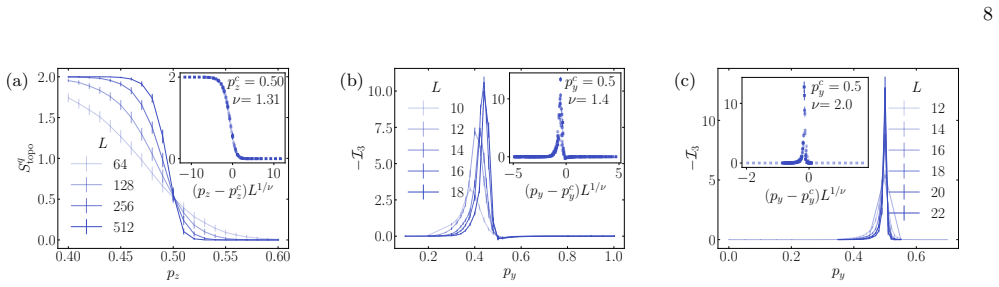
We introduce a systematic framework to construct nonlocal observables with extensive quantum Fisher information (QFI) density in stabilizer codes. The construction maps stabilizer generators to dual Ising spins whose correlators equal string order parameters, converting hidden nonlocal order into a metrologically accessible observable. Applying this to monitored cluster codes and the toric code, we identify transitions in the QFI scaling from an extensive regime, where long-range string order prevails, to an intensive one driven by competing single-site measurements.
Editorial analysis
A structured set of objections, weighed in public.
Referee Report
Summary. The manuscript introduces a systematic framework to construct nonlocal observables with extensive quantum Fisher information (QFI) density in stabilizer codes. The central construction maps stabilizer generators to dual Ising spins whose correlators are identified with string order parameters, thereby converting hidden nonlocal order into a metrologically usable observable. The framework is applied to monitored cluster codes and the toric code, where transitions in QFI scaling are identified: from an extensive regime (long-range string order) to an intensive regime under competing single-site measurements.
Significance. If the mapping and variance scaling are rigorously derived, the work provides a concrete method to engineer metrologically useful observables from stabilizer structure and string order, with direct relevance to quantum sensing in many-body systems and measurement-induced phases. The explicit applications to two codes and the reported scaling transition constitute falsifiable predictions that strengthen the contribution.
minor comments (3)
- [Abstract] Abstract: the central claim of extensive QFI density relies on the variance of the constructed observable scaling linearly with system size; a one-sentence reminder of the pure-state relation QFI = 4 Var(O) would help readers connect the string-order construction to the metrological figure of merit.
- The mapping from stabilizer generators to dual Ising spins is described at a high level; an explicit example (e.g., for the smallest cluster or toric-code plaquette) with the resulting Hamiltonian or correlator would improve reproducibility.
- Notation for the string order parameters and dual spins should be introduced once and used consistently; occasional redefinition of symbols across sections risks confusion.
Simulated Author's Rebuttal
We thank the referee for the careful reading of our manuscript and the positive assessment. We are pleased that the central construction—mapping stabilizer generators to dual Ising spins to convert hidden nonlocal order into observables with extensive QFI density—is recognized as providing a concrete method with relevance to quantum sensing and measurement-induced phases. The applications to monitored cluster codes and the toric code, along with the identified scaling transitions, are highlighted as strengthening the contribution. As no specific major comments were raised in the report, we will implement minor revisions to improve clarity, presentation, and any minor technical details as recommended.
Circularity Check
No significant circularity detected
full rationale
The paper introduces a mapping from stabilizer generators to dual Ising spins with correlators identified as string order parameters, then applies it to monitored cluster and toric codes to observe QFI scaling transitions. This is a constructive framework rather than a derivation that reduces by construction to fitted inputs, self-citations, or tautological definitions. No equations or steps in the provided abstract and description show a prediction that is statistically forced by the inputs themselves or that relies on load-bearing self-citations for its validity. The QFI relation for pure states (QFI = 4 Var(O)) and the properties of long-range string order are standard and independent of the specific mapping chosen here. The derivation chain is self-contained against external benchmarks in stabilizer code theory.
Axiom & Free-Parameter Ledger
axioms (1)
- domain assumption Stabilizer generators map to dual Ising spins such that their correlators equal string order parameters
Reference graph
Works this paper leans on
-
[1]
Gottesman,Stabilizer codes and quantum error cor- rection, Ph.D
D. Gottesman,Stabilizer codes and quantum error cor- rection, Ph.D. thesis, California Institute of Technology (1997)
1997
-
[2]
M. A. Nielsen and I. L. Chuang,Quantum Computation and Quantum Information, 10th ed. (Cambridge Univer- sity Press, 2010)
2010
-
[3]
Preskill, Quantum2, 79 (2018)
J. Preskill, Quantum2, 79 (2018)
2018
-
[4]
Raussendorf and H
R. Raussendorf and H. J. Briegel, Phys. Rev. Lett.86, 5188 (2001)
2001
-
[5]
A. Y. Kitaev, Ann. Phys.303, 2 (2003)
2003
-
[6]
Skinner, J
B. Skinner, J. Ruhman, and A. Nahum, Phys. Rev. X9, 031009 (2019)
2019
-
[7]
Y. Li, X. Chen, and M. P. Fisher, Phys. Rev. B98, 205136 (2018)
2018
-
[8]
Y. Li, X. Chen, and M. P. Fisher, Phys. Rev. B100, 134306 (2019)
2019
-
[9]
M. P. Fisher, V. Khemani, A. Nahum, and S. Vijay, Annu. Rev. Condens. Matter Phys.14, 335 (2023)
2023
-
[10]
A. C. Potter and R. Vasseur, Entanglement dynamics in 6 hybrid quantum circuits, inEntanglement in Spin Chains (Springer International Publishing, 2022) p. 211
2022
-
[11]
Turkeshi and P
X. Turkeshi and P. Sierant, Phys. Rev. Lett.132, 140401 (2024)
2024
-
[12]
Y. Bao, S. Choi, and E. Altman, Phys. Rev. B101, 104301 (2020)
2020
-
[13]
Jian, Y.-Z
C.-M. Jian, Y.-Z. You, R. Vasseur, and A. W. W. Ludwig, Phys. Rev. B101, 104302 (2020)
2020
-
[14]
M. J. Gullans and D. A. Huse, Phys. Rev. X10, 041020 (2020)
2020
-
[15]
Sierant, M
P. Sierant, M. Schir` o, M. Lewenstein, and X. Turkeshi, Phys. Rev. B106, 214316 (2022)
2022
-
[16]
C. Noel, P. Niroula, D. Zhu, A. Risinger, L. Egan, D. Biswas, M. Cetina, A. V. Gorshkov, M. J. Gullans, D. A. Huse, and C. Monroe, Nat. Phys.18, 760 (2022)
2022
-
[17]
J. M. Koh, S.-N. Sun, M. Motta, and A. J. Minnich, Nat. Phys.19, 1314 (2023)
2023
-
[18]
Google AI Quantum and collaborators, Nature622, 481 (2023)
2023
-
[19]
Amico, R
L. Amico, R. Fazio, A. Osterloh, and V. Vedral, Rev. Mod. Phys.80, 517 (2008)
2008
-
[20]
Horodecki, P
R. Horodecki, P. Horodecki, M. Horodecki, and K. Horodecki, Rev. Mod. Phys.81, 865 (2009)
2009
-
[21]
Laflorencie, Phys
N. Laflorencie, Phys. Rep.646, 1 (2016)
2016
-
[22]
S. L. Braunstein and C. M. Caves, Phys. Rev. Lett.72, 3439 (1994)
1994
-
[23]
M. G. Paris, Int. J. Quantum Inf.7, 125 (2009)
2009
-
[24]
Giovannetti, S
V. Giovannetti, S. Lloyd, and L. Maccone, Nat. Photonics 5, 222 (2011)
2011
-
[25]
Pezz` e, A
L. Pezz` e, A. Smerzi, M. K. Oberthaler, R. Schmied, and P. Treutlein, Rev. Mod. Phys.90, 035005 (2018)
2018
-
[26]
Pezz´ e and A
L. Pezz´ e and A. Smerzi, Phys. Rev. Lett.102, 100401 (2009)
2009
-
[27]
T´ oth and I
G. T´ oth and I. Apellaniz, J. Phys. A: Math. Theor.47, 424006 (2014)
2014
- [28]
-
[29]
Hyllus, W
P. Hyllus, W. Laskowski, R. Krischek, C. Schwemmer, W. Wieczorek, H. Weinfurter, L. Pezz´ e, and A. Smerzi, Phys. Rev. A85, 022321 (2012)
2012
-
[30]
T´ oth, Phys
G. T´ oth, Phys. Rev. A85, 022322 (2012)
2012
-
[31]
Lira-Solanilla, X
A. Lira-Solanilla, X. Turkeshi, and S. Pappalardi, Phys. Rev. Lett.135, 080401 (2025)
2025
-
[32]
Pezz` e, M
L. Pezz` e, M. Gabbrielli, L. Lepori, and A. Smerzi, Phys. Rev. Lett.119, 250401 (2017)
2017
-
[33]
Zhang, Y
Y.-R. Zhang, Y. Zeng, H. Fan, J. Q. You, and F. Nori, Phys. Rev. Lett.120, 250501 (2018)
2018
-
[34]
Zhang, Y
Y.-R. Zhang, Y. Zeng, T. Liu, H. Fan, J. Q. You, and F. Nori, Phys. Rev. Res.4, 023144 (2022)
2022
- [35]
-
[36]
Zeng and X.-G
B. Zeng and X.-G. Wen, Phys. Rev. B91, 125121 (2015)
2015
-
[37]
Schuch, D
N. Schuch, D. P´ erez-Garc´ ıa, and I. Cirac, Phys. Rev. B 84, 165139 (2011)
2011
-
[38]
Affleck and F
I. Affleck and F. D. M. Haldane, Phys. Rev. B36, 5291 (1987)
1987
-
[39]
Haldane, Physics Letters A93, 464 (1983)
F. Haldane, Physics Letters A93, 464 (1983)
1983
-
[40]
F. D. M. Haldane, Phys. Rev. Lett.50, 1153 (1983)
1983
-
[41]
Pollmann, E
F. Pollmann, E. Berg, A. M. Turner, and M. Oshikawa, Phys. Rev. B85, 075125 (2012)
2012
-
[42]
This statement corresponds toM j|ψ⟩=|ψ⟩for eachj= 1, . . . , N
-
[43]
Paviglianiti and A
A. Paviglianiti and A. Silva, Phys. Rev. B108, 184302 (2023)
2023
-
[44]
Lang and H
N. Lang and H. P. B¨ uchler, Phys. Rev. B102, 094204 (2020)
2020
-
[45]
Lavasani, Y
A. Lavasani, Y. Alavirad, and M. Barkeshli, Nat. Phys. 17, 342 (2021)
2021
-
[46]
Sang and T
S. Sang and T. H. Hsieh, Phys. Rev. Res.3, 023200 (2021)
2021
-
[47]
Klocke and M
K. Klocke and M. Buchhold, Phys. Rev. B106, 104307 (2022)
2022
-
[48]
Hauke, M
P. Hauke, M. Heyl, L. Tagliacozzo, and P. Zoller, Nat. Phys.12, 778 (2016)
2016
-
[49]
Zabalo, M
A. Zabalo, M. J. Gullans, J. H. Wilson, S. Gopalakrish- nan, D. A. Huse, and J. H. Pixley, Phys. Rev. B101, 060301 (2020)
2020
-
[50]
Zabalo, M
A. Zabalo, M. J. Gullans, J. H. Wilson, R. Vasseur, A. W. W. Ludwig, S. Gopalakrishnan, D. A. Huse, and J. H. Pixley, Phys. Rev. Lett.128, 050602 (2022)
2022
-
[51]
Lavasani, Y
A. Lavasani, Y. Alavirad, and M. Barkeshli, Phys. Rev. Lett.127, 235701 (2021)
2021
-
[52]
An equivalent picture can be done using only plaquette operatorsB p, which shows the potential of this protocol despite this freedom of choice
Such a subset consists of all star operatorsA s with no support on boundary spins. An equivalent picture can be done using only plaquette operatorsB p, which shows the potential of this protocol despite this freedom of choice
-
[53]
P. M. Poggi and M. H. Mu˜ noz-Arias, Quantum8, 1229 (2024)
2024
-
[54]
Sharma and E
V. Sharma and E. J. Mueller, Phys. Rev. A112, 012411 (2025)
2025
-
[55]
Fr´ erot and T
I. Fr´ erot and T. Roscilde, Phys. Rev. Lett.121, 020402 (2018)
2018
-
[56]
Costa de Almeida and P
R. Costa de Almeida and P. Hauke, Phys. Rev. Res.3, L032051 (2021)
2021
-
[57]
Vitale, A
V. Vitale, A. Rath, P. Jurcevic, A. Elben, C. Branciard, and B. Vermersch, PRX Quantum5, 030338 (2024)
2024
-
[58]
Laurell, A
P. Laurell, A. Scheie, C. J. Mukherjee, M. M. Koza, M. Enderle, Z. Tylczynski, S. Okamoto, R. Coldea, D. A. Tennant, and G. Alvarez, Phys. Rev. Lett.127, 037201 (2021)
2021
-
[59]
Scheie, P
A. Scheie, P. Laurell, A. M. Samarakoon, B. Lake, S. E. Nagler, G. E. Granroth, S. Okamoto, G. Alvarez, and D. A. Tennant, Phys. Rev. B103, 224434 (2021)
2021
-
[60]
Klocke and M
K. Klocke and M. Buchhold, Phys. Rev. X13, 041028 (2023)
2023
-
[61]
Passarelli, X
G. Passarelli, X. Turkeshi, A. Russomanno, P. Lucig- nano, M. Schir` o, and R. Fazio, Phys. Rev. Lett.132, 163401 (2024)
2024
-
[62]
Z. Li, A. Delmonte, X. Turkeshi, and R. Fazio, Nature Communications16, 4329 (2025)
2025
-
[63]
M. Yu, Y. Liu, P. Yang, M. Gong, Q. Cao, S. Zhang, H. Liu, M. Heyl, T. Ozawa, N. Goldman, and J. Cai, npj Quantum Info.8, 56 (2022)
2022
-
[64]
M. M. Rams, P. Sierant, O. Dutta, P. Horodecki, and J. Zakrzewski, Phys. Rev. X8, 021022 (2018)
2018
-
[65]
Y. Chu, S. Zhang, B. Yu, and J. Cai, Phys. Rev. Lett. 126, 010502 (2021)
2021
-
[66]
Lira-Solanilla, S
A. Lira-Solanilla, S. Aditya, X. Turkeshi, and S. Pap- palardi, Code and data will be available at publications (2025)
2025
-
[67]
J. W. Essam, Reports on Progress in Physics43, 833 (1980). 7 End matter Scaling analysis of QFI densityTo quantify the transitions in QFI scaling reported in the main text, we extract scaling exponents by fittingf Q as a function of system size at each measurement rate. The results for the 1D cluster model are summarized in Fig. 7a. In the 1D cluster code...
1980
discussion (0)
Sign in with ORCID, Apple, or X to comment. Anyone can read and Pith papers without signing in.