Efficient n-qubit entangling operations via a superconducting quantum router
Pith reviewed 2026-05-10 10:52 UTC · model grok-4.3
The pith
A reconfigurable superconducting router enables direct multi-qubit entangling operations beyond pairwise gates.
A machine-rendered reading of the paper's core claim, the machinery that carries it, and where it could break.
Core claim
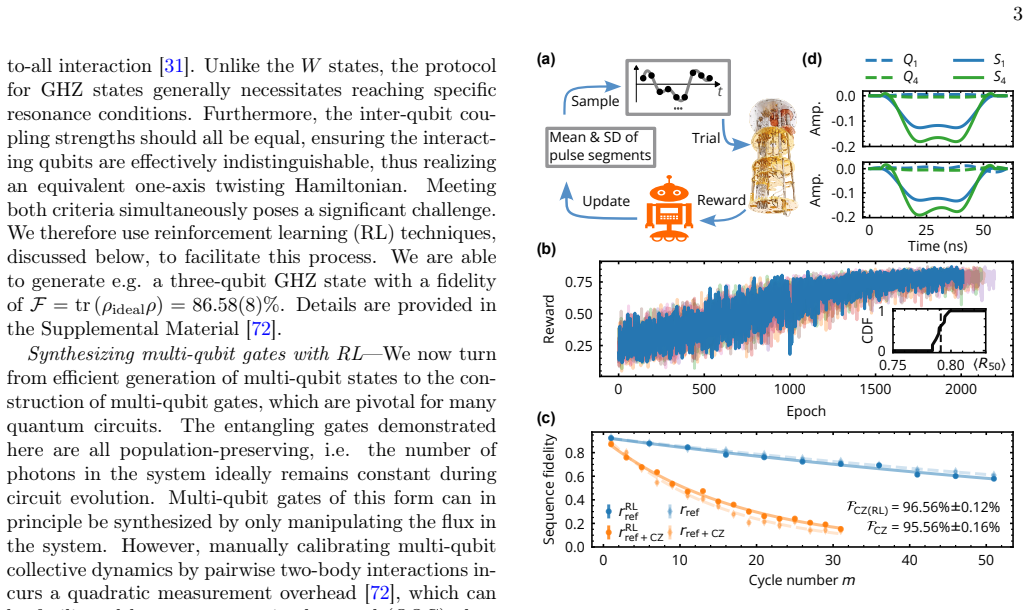
The central claim is that the reconfigurable router architecture realizes programmable and efficient multi-qubit operations involving more than two qubits, resulting in faster preparation of multi-qubit entangled states with good fidelities. Model-free reinforcement learning is applied to implement a two-qubit controlled-Z gate as well as three-qubit controlled-SWAP and controlled-controlled-phase gates. The high-connectivity design of the router suggests that higher n-qubit gates are also feasible, providing a route to more efficient implementations of complex quantum algorithms.
What carries the argument
The reconfigurable router that supplies high-connectivity and user-selectable interactions among multiple superconducting qubits in a single operation.
If this is right
- Multi-qubit entangled states are prepared in fewer steps than required by sequences of two-qubit gates.
- Model-free reinforcement learning successfully calibrates three-qubit gates including Fredkin and Toffoli without an explicit system model.
- The same router hardware supports extension to higher-order n-qubit entangling operations.
- Complex quantum algorithms can be executed with reduced circuit depth and accumulated error.
Where Pith is reading between the lines
- The router approach may reduce the total gate count needed for algorithms whose native interactions involve three or more qubits.
- Reinforcement learning trained on this hardware could discover gate implementations that differ from textbook decompositions.
- If the connectivity scales, the architecture might support native many-body Hamiltonians for quantum simulation tasks.
Load-bearing premise
The router can be scaled to operations on four or more qubits while preserving efficiency and fidelity.
What would settle it
An experiment in which a three-qubit Fredkin gate realized through the router shows lower fidelity or longer duration than the best decomposition using only two-qubit gates.
Figures




read the original abstract
Quantum algorithms on near-term quantum processors are typically executed using shallow quantum circuits composed of one- and two-qubit gates. However, as circuit depth and gate number increase, gate imperfections and qubit decoherence begin to dominate, limiting algorithmic complexity. An alternative approach is to explore gates involving more than two qubits. In previous work (X. Wu et al., Physical Review X 14, 041030 (2024)), we demonstrated a new superconducting qubit architecture with user-selectable two-qubit interactions via a reconfigurable router, used to connect pairs of qubits. Here, we leverage this novel architecture to realize programmable and efficient multi-qubit operations involving more than two qubits, resulting in faster preparation of multi-qubit entangled states with good fidelities. We also successfully apply model-free reinforcement learning to perform multi-qubit gates, including training a two-qubit controlled-Z gate as well as three-qubit controlled-SWAP and controlled-controlled-phase (Fredkin and Toffoli) gates. Higher $n$th-order gates may also be feasible, using our high-connectivity router design. This could provide a more efficient and higher-fidelity implementation of complex quantum algorithms and a more practical approach to quantum computation.
Editorial analysis
A structured set of objections, weighed in public.
Referee Report
Summary. The paper extends a reconfigurable superconducting qubit router architecture (from prior two-qubit work) to implement programmable multi-qubit entangling operations. It demonstrates three-qubit gates (controlled-SWAP, Fredkin, and Toffoli) via model-free reinforcement learning, reports faster preparation of multi-qubit entangled states with good fidelities, and suggests that higher-order n-qubit gates are feasible due to the high-connectivity design.
Significance. If the experimental results hold, this architecture could enable more efficient quantum circuits by replacing sequences of two-qubit gates with native multi-qubit operations, reducing depth and decoherence exposure on near-term hardware. The successful model-free RL application for complex gate synthesis is a concrete strength that provides a data-driven alternative to analytic pulse design.
major comments (2)
- [Abstract] Abstract and title: The framing of 'efficient n-qubit entangling operations' and the claim that 'Higher nth-order gates may also be feasible' rest on an extrapolation from three-qubit demonstrations only. No scaling analysis, fidelity projections, or hardware constraints for n>3 are provided, making the generalization to arbitrary n load-bearing for the central claim but unsupported by data.
- [Results] Results on RL-trained gates: While the manuscript reports successful training of the three-qubit controlled-SWAP, Fredkin, and Toffoli gates, the quantitative efficiency gain (gate time and fidelity relative to decomposed two-qubit implementations) is stated qualitatively as 'faster' and 'good' without tabulated values, error bars, or direct comparisons in the main text or supplementary material.
minor comments (3)
- [Abstract] The abstract refers to 'good fidelities' without numerical values; these should be stated explicitly (with uncertainties) to allow readers to assess the claims.
- [Figures] Figure captions and schematics of the router should include explicit labels for qubit-router connections and control lines to improve readability for readers unfamiliar with the prior two-qubit work.
- [Methods] A brief discussion of how the RL reward function incorporates both gate fidelity and duration would clarify the optimization objective.
Simulated Author's Rebuttal
We thank the referee for their constructive review and for highlighting areas where the manuscript's claims and quantitative reporting can be strengthened. We agree with both major comments and will revise the manuscript to address them directly. Our point-by-point responses follow.
read point-by-point responses
-
Referee: [Abstract] Abstract and title: The framing of 'efficient n-qubit entangling operations' and the claim that 'Higher nth-order gates may also be feasible' rest on an extrapolation from three-qubit demonstrations only. No scaling analysis, fidelity projections, or hardware constraints for n>3 are provided, making the generalization to arbitrary n load-bearing for the central claim but unsupported by data.
Authors: We agree that the generalization to arbitrary n is unsupported by data or analysis in the current manuscript. In the revised version we will change the title to focus on the demonstrated programmable multi-qubit operations (up to three qubits) and will rewrite the abstract to remove the unqualified claim that higher-order gates 'may also be feasible.' We will instead state that the router architecture provides the connectivity needed to explore such gates and note that experimental realization for n>3 remains future work. A brief paragraph discussing the main hardware and control challenges for scaling will be added to the discussion section. revision: yes
-
Referee: [Results] Results on RL-trained gates: While the manuscript reports successful training of the three-qubit controlled-SWAP, Fredkin, and Toffoli gates, the quantitative efficiency gain (gate time and fidelity relative to decomposed two-qubit implementations) is stated qualitatively as 'faster' and 'good' without tabulated values, error bars, or direct comparisons in the main text or supplementary material.
Authors: We accept that the efficiency claims are presented too qualitatively. Although raw numbers appear in the supplementary material, they are not organized for direct comparison. In the revision we will add a compact table (main text or supplementary) that lists, for each RL-trained gate, the optimized gate duration, the measured process fidelity with statistical error bars, and the corresponding values obtained from a standard two-qubit-gate decomposition of the same unitary. This will make the efficiency advantage explicit and allow readers to evaluate the reported gains quantitatively. revision: yes
Circularity Check
No circularity: experimental demonstration with independent measurements
full rationale
The paper reports hardware experiments realizing 3-qubit gates (controlled-SWAP, Fredkin, Toffoli) and RL-trained CZ on a reconfigurable router platform. No mathematical derivation, ansatz, or fitting procedure is presented that reduces any claimed result to its own inputs by construction. The single self-citation to prior work (Wu et al. PRX 2024) describes the base two-qubit router hardware but does not bear the load of the new multi-qubit results, which rest on direct experimental data and fidelities. The statement that higher-n gates 'may also be feasible' is explicitly prospective and not used to support any demonstrated claim. The work is therefore self-contained against external experimental benchmarks.
Axiom & Free-Parameter Ledger
Reference graph
Works this paper leans on
-
[1]
D.Castelvecchi,Ibmreleasesfirst-ever1, 000-qubitquan- tum chip, Nature624, 238–238 (2023)
work page 2023
-
[2]
H. J. Manetsch, G. Nomura, E. Bataille, X. Lv, K. H. Leung,andM.Endres,Atweezerarraywith6, 100highly coherent atomic qubits, Nature647, 60–67 (2025)
work page 2025
- [3]
-
[4]
F. Arute, K. Arya, R. Babbush, D. Bacon, J. C. Bardin, R. Barends, R. Biswas, S. Boixo, F. G. S. L. Brandao, D. A. Buell, B. Burkett, Y. Chen, Z. Chen, B. Chiaro, R. Collins, W. Courtney, A. Dunsworth, E. Farhi, B. Foxen, A. Fowler, C. Gidney, M. Giustina, R. Graff, K. Guerin, S. Habegger, M. P. Harrigan, M. J. Hartmann, A. Ho, M. Hoffmann, T. Huang, T. S...
work page 2019
-
[5]
A. Morvan, B. Villalonga, X. Mi, S. Mandrà, A. Bengts- son, P. V. Klimov, Z. Chen, S. Hong, C. Erickson, I. K. Drozdov, J. Chau, G. Laun, R. Movassagh, A. As- faw, L. T. A. N. Brandão, R. Peralta, D. Abanin, R. Acharya, R. Allen, T. I. Andersen, K. Anderson, M. Ansmann, F. Arute, K. Arya, J. Atalaya, J. C. Bardin, A. Bilmes, G. Bortoli, A. Bourassa, J. Bo...
work page 2024
-
[6]
D. Bluvstein, S. J. Evered, A. A. Geim, S. H. Li, H. Zhou, T. Manovitz, S. Ebadi, M. Cain, M. Kali- nowski, D. Hangleiter, J. P. Bonilla Ataides, N. Maskara, I. Cong, X. Gao, P. Sales Rodriguez, T. Karolyshyn, G. Semeghini, M. J. Gullans, M. Greiner, V. Vuletić, and M. D. Lukin, Logical quantum processor based on reconfigurable atom arrays, Nature626, 58–...
work page 2023
- [7]
-
[8]
R. Acharya, D. A. Abanin, L. Aghababaie-Beni, I. Aleiner, T. I. Andersen, M. Ansmann, F. Arute, K. Arya, A. Asfaw, N. Astrakhantsev, J. Atalaya, R. Babbush, D. Bacon, B. Ballard, J. C. Bardin, J. Bausch, A. Bengtsson, A. Bilmes, S. Blackwell, S. Boixo, G. Bortoli, A. Bourassa, J. Bovaird, L. Brill, M. Broughton, D. A. Browne, B. Buchea, B. B. Buck- ley, D...
work page 2024
-
[9]
K. Wang, Z. Lu, C. Zhang, G. Liu, J. Chen, Y. Wang, Y. Wu, S. Xu, X. Zhu, F. Jin, Y. Gao, Z. Tan, Z. Cui, N. Wang, Y. Zou, A. Zhang, T. Li, F. Shen, J. Zhong, Z. Bao, Z. Zhu, Y. Han, Y. He, J. Shen, H. Wang, J.- N. Yang, Z. Song, J. Deng, H. Dong, Z.-Z. Sun, W. Li, Q. Ye, S. Jiang, Y. Ma, P.-X. Shen, P. Zhang, H. Li, Q. Guo, Z. Wang, C. Song, H. Wang, and...
work page 2026
-
[10]
A. Barenco, C. H. Bennett, R. Cleve, D. P. DiVincenzo, N. Margolus, P. Shor, T. Sleator, J. A. Smolin, and H. Weinfurter, Elementary gates for quantum computa- tion, Physical Review A52, 3457–3467 (1995)
work page 1995
-
[11]
A. W. Cross, L. S. Bishop, S. Sheldon, P. D. Nation, and J. M. Gambetta, Validating quantum computers us- ing randomized model circuits, Physical Review A100, 032328 (2019)
work page 2019
-
[12]
G. González-García, R. Trivedi, and J. I. Cirac, Error propagation in NISQ devices for solving classical opti- mization problems, PRX Quantum3, 040326 (2022)
work page 2022
-
[13]
C. Song, S.-B. Zheng, P. Zhang, K. Xu, L. Zhang, Q. Guo, W. Liu, D. Xu, H. Deng, K. Huang, D. Zheng, X. Zhu, and H. Wang, Continuous-variable geometric phaseanditsmanipulationforquantumcomputationina superconducting circuit, Nature Communications8, 1061 (2017)
work page 2017
-
[14]
W. Feng and D.-w. Wang, Quantum fredkin gate based on synthetic three-body interactions in superconducting circuits, Physical Review A101, 062312 (2020)
work page 2020
-
[15]
T. Roy, S. Hazra, S. Kundu, M. Chand, M. P. Patankar, and R. Vijay, Programmable superconducting processor with native three-qubit gates, Physical Review Applied 14, 014072 (2020)
work page 2020
-
[16]
X. Gu, J. Fernández-Pendás, P. Vikstål, T. Abad, C. Warren, A. Bengtsson, G. Tancredi, V. Shumeiko, J. Bylander, G. Johansson, and A. F. Kockum, Fast mul- tiqubit gates through simultaneous two-qubit gates, PRX Quantum2, 040348 (2021)
work page 2021
-
[17]
Y.Kim, A.Morvan, L.B.Nguyen, R.K.Naik, C.Jünger, L.Chen, J.M.Kreikebaum, D.I.Santiago,andI.Siddiqi, High-fidelity three-qubit itoffoli gate for fixed-frequency superconducting qubits, Nature Physics18, 783–788 (2022)
work page 2022
-
[18]
W. Feng, G.-Q. Zhang, Q.-P. Su, J.-X. Zhang, and C.- P. Yang, Generation of greenberger-horne-zeilinger states on two-dimensional superconducting-qubit lattices via parallel multiqubit-gate operations, Physical Review Ap- plied18, 064036 (2022)
work page 2022
-
[19]
N. J. Glaser, F. Roy, and S. Filipp, Controlled-controlled- phase gates for superconducting qubits mediated by a shared tunable coupler, Physical Review Applied19, 044001 (2023)
work page 2023
- [20]
-
[21]
C.W.Warren, J.Fernández-Pendás, S.Ahmed, T.Abad, A. Bengtsson, J. Biznárová, K. Debnath, X. Gu, C. Križan, A. Osman, A. Fadavi Roudsari, P. Delsing, G. Johansson, A. Frisk Kockum, G. Tancredi, and J. By- lander, Extensive characterization and implementation of a family of three-qubit gates at the coherence limit, npj Quantum Information9, 44 (2023)
work page 2023
-
[22]
C.-K. Hu, J. Yuan, B. A. Veloso, J. Qiu, Y. Zhou, L. Zhang, J. Chu, O. Nurbolat, L. Hu, J. Li, Y. Xu, Y. Zhong, S. Liu, F. Yan, D. Tan, R. Bachelard, A. C. Santos, C. Villas-Boas, and D. Yu, Native conditional iSWAP operation with superconducting artificial atoms, Physical Review Applied20, 034072 (2023)
work page 2023
-
[23]
T.Itoko, M.Malekakhlagh, N.Kanazawa,andM.Takita, Three-qubit parity gate via simultaneous cross-resonance drives, Physical Review Applied21, 034018 (2024)
work page 2024
-
[24]
S. Huai, K. Bu, X. Gu, Z. Zhang, S. An, X. Yang, Y. Li, T. Cai, and Y. Zheng, Fast joint parity measurement via collective interactions induced by stimulated emission, Nature Communications15, 3045 (2024)
work page 2024
-
[25]
S. S. Pratapsi, D. Cruz, and P. André, Native multi-qubit gates in transmon qubits via synchronous driving, Scien- tific Reports14, 26042 (2024)
work page 2024
-
[26]
H.-T. Liu, B.-J. Chen, J.-C. Zhang, Y.-X. Xiao, T.-M. Li, K. Huang, Z. Wang, H. Li, K. Zhao, Y. Xu, C.-L. Deng, G.-H. Liang, Z.-H. Liu, S.-Y. Zhou, C.-P. Fang, X. Song, Z. Xiang, D. Zheng, Y.-H. Shi, K. Xu, and H. Fan, Direct implementation of high-fidelity three-qubit gates for su- perconducting processor with tunable couplers, Physical Review Letters135...
work page 2025
-
[27]
K. Zhao, W.-G. Ma, Z. Wang, H. Li, K. Huang, Y.-H. Shi, K.Xu,andH.Fan,Microwave-activatedhigh-fidelity three-qubit gate scheme for fixed-frequency supercon- ducting qubits, Physical Review Applied24, 034064 (2025)
work page 2025
- [28]
-
[29]
M. Neeley, R. C. Bialczak, M. Lenander, E. Lucero, M. Mariantoni, A. D. O’Connell, D. Sank, H. Wang, M. Weides, J. Wenner, Y. Yin, T. Yamamoto, A. N. Cleland, and J. M. Martinis, Generation of three-qubit entangled states using superconducting phase qubits, Na- ture467, 570–573 (2010)
work page 2010
-
[30]
Y.-H. Kang, Y.-H. Chen, Q.-C. Wu, B.-H. Huang, J. Song, and Y. Xia, Fast generation of W states of super- conducting qubits with multiple Schrödinger dynamics, Scientific Reports6, 36737 (2016)
work page 2016
-
[31]
C. Song, K. Xu, H. Li, Y.-R. Zhang, X. Zhang, W. Liu, Q. Guo, Z. Wang, W. Ren, J. Hao, H. Feng, H. Fan, D. Zheng, D.-W. Wang, H. Wang, and S.-Y. Zhu, Gen- eration of multicomponent atomic Schrödinger cat states of up to 20 qubits, Science365, 574 (2019)
work page 2019
-
[32]
W. Liu, W. Feng, W. Ren, D.-W. Wang, and H. Wang, Synthesizing three-body interaction of spin chirality with superconducting qubits, Applied Physics Letters116, 114001 (2020)
work page 2020
-
[33]
D. V. Babukhin, A. A. Zhukov, and W. V. Pogosov, Hybrid digital-analog simulation of many-body dynam- ics with superconducting qubits, Physical Review A101, 052337 (2020)
work page 2020
-
[34]
T. Gonzalez-Raya, R. Asensio-Perea, A. Martin, L. C. Céleri, M. Sanz, P. Lougovski, and E. F. Dumitrescu, Digital-analog quantum simulations using the cross- resonance effect, PRX Quantum2, 020328 (2021)
work page 2021
-
[35]
S. Yarkoni, E. Raponi, T. Bäck, and S. Schmitt, Quan- tum annealing for industry applications: introduction and review, Reports on Progress in Physics85, 104001 (2022)
work page 2022
-
[36]
T. Menke, W. P. Banner, T. R. Bergamaschi, A. Di Paolo, A. Vepsäläinen, S. J. Weber, R. Winik, A. Melville, B. M. Niedzielski, D. Rosenberg, K. Ser- niak, M. E. Schwartz, J. L. Yoder, A. Aspuru-Guzik, S. Gustavsson, J. A. Grover, C. F. Hirjibehedin, A. J. Kerman, and W. D. Oliver, Demonstration of tunable three-body interactions between superconducting qu...
work page 2022
-
[37]
L. B. Nguyen, Y. Kim, A. Hashim, N. Goss, B. Marinelli, B. Bhandari, D. Das, R. K. Naik, J. M. Kreike- 8 baum, A. N. Jordan, D. I. Santiago, and I. Siddiqi, Programmable Heisenberg interactions between floquet qubits, Nature Physics20, 240–246 (2024)
work page 2024
-
[38]
Y. Liang, W. Huang, L. Zhang, Z. Tao, K. Tang, J. Chu, J. Qiu, X. Sun, Y. Zhou, J. Zhang, J. Zhang, W. Guo, Y. Liu, Y. Chen, S. Liu, Y. Zhong, J. Niu, and D. Yu, Floquet engineering of anisotropic transverse interac- tions in superconducting qubits, arXiv preprint (2024), arXiv:2410.10208 [quant-ph]
-
[39]
I. T. Rosen, S. Muschinske, C. N. Barrett, A. Chatter- jee, M. Hays, M. A. DeMarco, A. H. Karamlou, D. A. Rower, R. Das, D. K. Kim, B. M. Niedzielski, M. Schuldt, K. Serniak, M. E. Schwartz, J. L. Yoder, J. A. Grover, and W. D. Oliver, A synthetic magnetic vector potential in a 2d superconducting qubit array, Nature Physics20, 1881–1887 (2024)
work page 2024
-
[40]
P. Zhang, Y. Gao, X. Xu, N. Wang, H. Dong, C. Guo, J. Deng, X. Zhang, J. Chen, S. Xu, K. Wang, Y. Wu, C. Zhang, F. Jin, X. Zhu, A. Zhang, Y. Zou, Z. Tan, Z. Cui, Z. Zhu, F. Shen, T. Li, J. Zhong, Z. Bao, L. Zhao, J. Hao, H. Li, Z. Wang, C. Song, Q. Guo, H. Wang, and D. Poletti, Emergence of steady quantum transport in a superconducting processor, Nature C...
work page 2024
-
[41]
S. Li, Y. Fan, X. Li, X. Ruan, Q. Zhao, Z. Peng, R.- B. Wu, J. Zhang, and P. Song, Robust quantum con- trol using reinforcement learning from demonstration, npj Quantum Information11, 124 (2025)
work page 2025
-
[42]
K. Zhao, Z. Wang, Y. Liu, G.-H. Liang, C.-P. Fang, Y.- H. Shi, L. Zhang, J.-C. Zhang, T.-M. Li, H. Li, Y. Xu, W.-G. Ma, H.-T. Liu, J.-C. Song, Z.-T. Bao, Y.-X. Xiao, B.-J. Chen, C.-L. Deng, Z.-H. Liu, Y. He, S.-Y. Zhou, X. Song, Z. Xiang, D. Zheng, K. Huang, K. Xu, and H. Fan, Microwave engineering of tunable spin interac- tions with superconducting qubit...
work page 2025
- [43]
-
[44]
W.Huang, X.Sun, J.Zhang, Z.Guo, P.Huang, Y.Liang, Y. Liu, D. Sun, Z. Wang, Y. Xiong, X. Yang, J. Zhang, L. Zhang, J. Chu, W. Guo, J. Jiang, S. Liu, J. Niu, J. Qiu, Z. Tao, Y. Zhou, X. Linpeng, Y. Zhong, and D. Yu, Logical multi-qubit entanglement with dual-rail superconducting qubits, Nature Physics 10.1038/s41567- 026-03211-9 (2026)
- [45]
-
[46]
P. Magnard, S. Storz, P. Kurpiers, J. Schär, F. Marxer, J. Lütolf, T. Walter, J.-C. Besse, M. Gabureac, K. Reuer, A. Akin, B. Royer, A. Blais, and A. Wallraff, Microwave quantum link between superconducting circuits housed in spatially separated cryogenic systems, Phys. Rev. Lett. 125, 260502 (2020)
work page 2020
-
[47]
Y. Zhong, H.-S. Chang, A. Bienfait, É. Dumur, M.-H. Chou, C. R. Conner, J. Grebel, R. G. Povey, H. Yan, D. I. Schuster, and A. N. Cleland, Deterministic multi- qubit entanglement in a quantum network, Nature590, 571 (2021)
work page 2021
-
[48]
J. Niu, L. Zhang, Y. Liu, J. Qiu, W. Huang, J. Huang, H. Jia, J. Liu, Z. Tao, W. Wei, Y. Zhou, W. Zou, Y. Chen, X. Deng, X. Deng, C. Hu, L. Hu, J. Li, D. Tan, Y. Xu, F. Yan, T. Yan, S. Liu, Y. Zhong, A. N. Cleland, and D. Yu, Low-loss interconnects for modular supercon- ducting quantum processors, Nature Electronics6, 235 (2023)
work page 2023
-
[49]
S. Storz, J. Schär, A. Kulikov, P. Magnard, P. Kurpiers, J. Lütolf, T. Walter, A. Copetudo, K. Reuer, A. Akin, J.- C. Besse, M. Gabureac, G. J. Norris, A. Rosario, F. Mar- tin, J. Martinez, W. Amaya, M. W. Mitchell, C. Abel- lan, J.-D. Bancal, N. Sangouard, B. Royer, A. Blais, and A. Wallraff, Loophole-free bell inequality violation with superconducting c...
work page 2023
-
[50]
C. Zhou, P. Lu, M. Praquin, T.-C. Chien, R. Kaufman, X. Cao, M. Xia, R. S. K. Mong, W. Pfaff, D. Pekker, and M. Hatridge, Realizing all-to-all couplings among detach- able quantum modules using a microwave quantum state router, npj Quantum Information9, 54 (2023)
work page 2023
-
[51]
Field, A.Q.Chen, B.Scharmann, E.A.Sete, F.Oruc, K
M. Field, A.Q.Chen, B.Scharmann, E.A.Sete, F.Oruc, K. Vu, V. Kosenko, J. Y. Mutus, S. Poletto, and A. Best- wick, Modular superconducting-qubit architecture with a multichip tunable coupler, Physical Review Applied21, 054063 (2024)
work page 2024
-
[52]
X. Wu, H. Yan, G. Andersson, A. Anferov, M.-H. Chou, C. R. Conner, J. Grebel, Y. J. Joshi, S. Li, J. M. Miller, R. G. Povey, H. Qiao, and A. N. Cleland, Modular quan- tum processor with an all-to-all reconfigurable router, Physical Review X14, 041030 (2024)
work page 2024
-
[53]
M. Mollenhauer, A. Irfan, X. Cao, S. Mandal, and W. Pfaff, A high-efficiency elementary network of inter- changeable superconducting qubit devices, Nature Elec- tronics8, 610–619 (2025)
work page 2025
-
[54]
J. Song, S. Yang, P. Liu, H.-L. Zhang, G.-M. Xue, Z.- Y. Mi, W.-G. Zhang, F. Yan, Y.-R. Jin, and H.-F. Yu, Realization of high-fidelity perfect entanglers between re- mote superconducting quantum processors, Physical Re- view Letters135, 050603 (2025)
work page 2025
- [55]
-
[56]
M. Y. Niu, S. Boixo, V. N. Smelyanskiy, and H. Neven, Universal quantum control through deep reinforcement learning, npj Quantum Information5, 33 (2019)
work page 2019
- [57]
-
[58]
F. Metz and M. Bukov, Self-correcting quantum many- body control using reinforcement learning with tensor networks,NatureMachineIntelligence5,780–791(2023)
work page 2023
-
[59]
Y. Baum, M. Amico, S. Howell, M. Hush, M. Liuzzi, P. Mundada, T. Merkh, A. R. Carvalho, and M. J. Bier- cuk, Experimental deep reinforcement learning for error- robust gate-set design on a superconducting quantum computer, PRX Quantum2, 040324 (2021)
work page 2021
-
[60]
V.V.Sivak, A.Eickbusch, H.Liu, B.Royer, I.Tsioutsios, and M. H. Devoret, Model-free quantum control with reinforcement learning, Physical Review X12, 011059 (2022)
work page 2022
-
[61]
V. V. Sivak, A. Eickbusch, B. Royer, S. Singh, I. Tsiout- sios, S. Ganjam, A. Miano, B. L. Brock, A. Z. Ding, L. Frunzio, S. M. Girvin, R. J. Schoelkopf, and M. H. De- voret, Real-time quantum error correction beyond break- 9 even, Nature616, 50–55 (2023)
work page 2023
-
[62]
L. Ding, M. Hays, Y. Sung, B. Kannan, J. An, A. Di Paolo, A. H. Karamlou, T. M. Hazard, K. Azar, D. K. Kim, B. M. Niedzielski, A. Melville, M. E. Schwartz, J. L. Yoder, T. P. Orlando, S. Gustavsson, J. A. Grover, K. Serniak, and W. D. Oliver, High- fidelity, frequency-flexible two-qubit fluxonium gates with a transmon coupler, Physical Review X13, 031035 (2023)
work page 2023
-
[63]
K.Reuer, J.Landgraf, T.Fösel, J.O’Sullivan, L.Beltrán, A. Akin, G. J. Norris, A. Remm, M. Kerschbaum, J.-C. Besse, F. Marquardt, A. Wallraff, and C. Eichler, Real- izing a deep reinforcement learning agent for real-time quantum feedback, Nature Communications14, 7138 (2023)
work page 2023
-
[64]
E. Wright and R. De Sousa, Fast quantum gate design with deep reinforcement learning using real-time feed- back on readout signals, 2023 IEEE International Con- ference on Quantum Computing and Engineering (QCE) , 1295–1303 (2023)
work page 2023
-
[65]
M. Reinschmidt, J. Fortágh, A. Günther, and V. V. Volchkov, Reinforcement learning in cold atom experi- ments, Nature Communications15, 8532 (2024)
work page 2024
-
[66]
A. Chatterjee, J. Schwinger, and Y. Y. Gao, Enhanced qubit readout via reinforcement learning, Physical Re- view Applied23, 054057 (2025)
work page 2025
-
[67]
A. Almanakly, B. Yankelevich, M. Hays, B. Kannan, R. Assouly, A. Greene, M. Gingras, B. M. Niedzielski, H. Stickler, M. E. Schwartz, K. Serniak, J. Î.-j. Wang, T. P. Orlando, S. Gustavsson, J. A. Grover, and W. D. Oliver, Deterministic remote entanglement using a chiral quantum interconnect, Nature Physics21, 825 (2025)
work page 2025
-
[68]
How to Build a Quantum Supercomputer: Scaling from Hundreds to Millions of Qubits
M. Mohseni, A. Scherer, K. G. Johnson, O. Wertheim, M. Otten, N. A. Aadit, K. M. Bresniker, K. Y. Cam- sari, B. Chapman, S. Chatterjee, G. A. Dagnew, A. Es- posito, F. Fahim, M. Fiorentino, A. Khalid, X. Kong, B. Kulchytskyy, R. Li, P. A. Lott, I. L. Markov, R. F. McDermott, G. Pedretti, A. Gajjar, A. Silva, J. Sorebo, P.Spentzouris, Z.Steiner, B.Torosov,...
work page internal anchor Pith review arXiv 2024
-
[69]
J. Bausch, A. W. Senior, F. J. H. Heras, T. Edlich, A. Davies, M. Newman, C. Jones, K. Satzinger, M. Y. Niu, S. Blackwell, G. Holland, D. Kafri, J. Atalaya, C.Gidney, D.Hassabis, S.Boixo, H. Neven,and P. Kohli, Learning high-accuracy error decoding for quantum pro- cessors, Nature635, 834–840 (2024)
work page 2024
-
[70]
Y.Alexeev, M.H.Farag, T.L.Patti, M.E.Wolf, N.Ares, A. Aspuru-Guzik, S. C. Benjamin, Z. Cai, S. Cao, C. Chamberland, Z. Chandani, F. Fedele, I. Hama- mura, N. Harrigan, J.-S. Kim, E. Kyoseva, J. G. Li- etz, T. Lubowe, A. McCaskey, R. G. Melko, K. Nakaji, A. Peruzzo, P. Rao, B. Schmitt, S. Stanwyck, N. M. Tub- man, H. Wang, and T. Costa, Artificial intellig...
work page 2025
-
[71]
R. B. Patel, J. Ho, F. Ferreyrol, T. C. Ralph, and G. J. Pryde, A quantum fredkin gate, Science Advances2, 1501531 (2016)
work page 2016
-
[72]
Supplemental material, (2026)
work page 2026
-
[73]
H. Häffner, W. Hänsel, C. F. Roos, J. Benhelm, D. Chek- al kar, M. Chwalla, T. Körber, U. D. Rapol, M. Riebe, P. O. Schmidt, C. Becher, O. Gühne, W. Dür, and R. Blatt, Scalable multiparticle entanglement of trapped ions, Nature438, 643 (2005)
work page 2005
- [74]
-
[75]
N. Khaneja, T. Reiss, C. Kehlet, T. Schulte-Herbrüggen, and S. J. Glaser, Optimal control of coupled spin dynam- ics: design of nmr pulse sequences by gradient ascent al- gorithms, Journal of Magnetic Resonance172, 296–305 (2005)
work page 2005
-
[76]
J. Kelly, R. Barends, B. Campbell, Y. Chen, Z. Chen, B. Chiaro, A. Dunsworth, A. G. Fowler, I.-C. Hoi, E. Jef- frey, A. Megrant, J. Mutus, C. Neill, P. J. J. O’Malley, C. Quintana, P. Roushan, D. Sank, A. Vainsencher, J. Wenner, T. C. White, A. N. Cleland, and J. M. Marti- nis, Optimal quantum control using randomized bench- marking, Phys. Rev. Lett.112, ...
work page 2014
-
[77]
C. E. Granade, C. Ferrie, N. Wiebe, and D. G. Cory, Ro- bust online hamiltonian learning, New Journal of Physics 14, 103013 (2012)
work page 2012
-
[79]
Y. Sung, L. Ding, J. Braumüller, A. Vepsäläinen, B. Kan- nan, M. Kjaergaard, A. Greene, G. O. Samach, C. Mc- Nally, D. Kim, A. Melville, B. M. Niedzielski, M. E. Schwartz, J. L. Yoder, T. P. Orlando, S. Gustavsson, and W. D. Oliver, Realization of high-fidelity CZ andZZ-free iSWAP gates with a tunable coupler, Physical Review X 11, 021058 (2021)
work page 2021
-
[80]
T. Abad, J. Fernández-Pendás, A. Frisk Kockum, and G. Johansson, Universal fidelity reduction of quantum operations from weak dissipation, Physical Review Let- ters129, 150504 (2022)
work page 2022
-
[81]
P. M. Q. Cruz and B. Murta, Shallow unitary de- compositions of quantum fredkin and toffoli gates for connectivity-aware equivalent circuit averaging, APL Quantum1, 016105 (2024). Supplemental Material: Efficientn-qubit entangling operations via a superconducting quantum router Xuntao Wu,1 Haoxiong Yan,1,∗ Gustav Andersson,1 Alexander Anferov,1,† Christop...
work page 2024
discussion (0)
Sign in with ORCID, Apple, or X to comment. Anyone can read and Pith papers without signing in.