Growth of quantum dots by droplet etching epitaxy in molecular beam epitaxy: theory, practice, and review
Pith reviewed 2026-05-10 08:29 UTC · model grok-4.3
The pith
Droplet etching epitaxy in molecular beam epitaxy produces high-quality GaAs quantum dots as solid-state sources of quantum light when the three growth phases are controlled with parameters tied to crystal growth theory.
A machine-rendered reading of the paper's core claim, the machinery that carries it, and where it could break.
Core claim
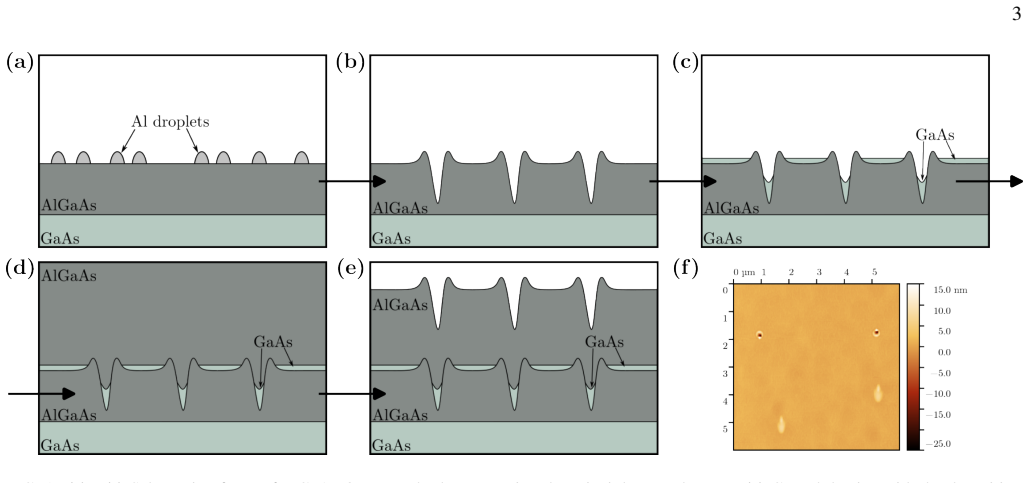
GaAs quantum dots grown by droplet etching epitaxy are high-quality solid-state sources of quantum light. This review presents a detailed overview of the droplet etching epitaxy growth technique in the molecular beam epitaxy environment, with emphasis on the growth parameters necessary to realize high-quality quantum dots. It systematically covers the three main phases of droplet etching epitaxy—droplet deposition, droplet etching, and nanohole regrowth—and relates experimental results to theories on crystal growth. The review concludes with an introduction to GaAs quantum dot photoluminescence and the extension of droplet etching epitaxy beyond the AlGaAs/GaAs material system.
What carries the argument
The three-phase droplet etching epitaxy sequence of droplet deposition, droplet etching to create nanoholes, and nanohole regrowth, which controls quantum dot size, density, and optical quality through surface kinetics and crystal growth mechanisms.
If this is right
- Tuning droplet deposition temperature and flux produces uniform nanoholes whose depth and diameter determine final dot confinement energies.
- Linking etching kinetics to theory allows prediction of regrowth conditions that minimize defects and interface roughness.
- Extension of the same sequence to other III-V pairs yields quantum dots with different emission wavelengths while retaining the same control advantages.
- Photoluminescence spectra measured after regrowth directly verify that the growth-parameter choices have achieved the targeted quantum-light performance.
Where Pith is reading between the lines
- Device engineers could use the reviewed phase diagrams to select starting conditions for new heterostructures without exhaustive trial-and-error runs.
- The same droplet-etching mechanism might be combined with selective-area epitaxy to create site-controlled dots for scalable quantum networks.
- If the crystal-growth models hold across material systems, the technique could reduce the time needed to qualify new quantum-dot emitters for specific wavelength bands.
Load-bearing premise
That the existing experimental literature on droplet deposition, etching, and regrowth can be comprehensively and accurately synthesized with crystal growth theories without significant gaps or selection bias in the covered studies.
What would settle it
A set of growth runs that follow the reviewed parameter ranges yet produce GaAs dots whose photoluminescence shows no improvement in linewidth, brightness, or single-photon purity compared with dots grown by other methods, or whose morphology deviates systematically from crystal-growth-theory predictions.
Figures


read the original abstract
GaAs quantum dots grown by droplet etching epitaxy are high-quality solid-state sources of quantum light. Despite implementation in devices that exploit quantum phenomenon, a comprehensive review on the crystal growth of quantum dots grown by droplet etching epitaxy is absent, unlike for other quantum dot growth techniques such as the related droplet epitaxy method or Stranski-Krastanov growth of InAs quantum dots. This review presents a detailed overview of the droplet etching epitaxy growth technique in the molecular beam epitaxy environment, with emphasis on the growth parameters necessary to realize high-quality quantum dots. We systematically cover the three main phases of droplet etching epitaxy - droplet deposition, droplet etching, and nanohole regrowth - and relate experimental results to theories on crystal growth. The review concludes with an introduction to GaAs quantum dot photoluminescence and the extension of droplet etching epitaxy beyond the AlGaAs/GaAs material system.
Editorial analysis
A structured set of objections, weighed in public.
Referee Report
Summary. The manuscript is a review of droplet etching epitaxy (DEE) for GaAs quantum dots in molecular beam epitaxy. It claims that these dots are high-quality solid-state sources of quantum light and provides a systematic overview of the growth technique, with emphasis on parameters for high-quality dots. The review covers the three main phases (droplet deposition, droplet etching, and nanohole regrowth), relates experimental results to crystal growth theories, and concludes with an introduction to GaAs quantum dot photoluminescence plus extensions beyond the AlGaAs/GaAs system.
Significance. If the synthesis holds, the review would be significant as it fills an explicit gap in the literature: unlike droplet epitaxy or Stranski-Krastanov InAs dots, no prior comprehensive review exists for DEE. By mapping growth parameters across the three phases to crystal-growth theory and highlighting routes to high-quality quantum-light sources, the work can serve as a practical reference for device fabrication. The stress-test concern about systematic omission or selection bias in the literature synthesis does not appear to land on the manuscript; the coverage is presented as exhaustive within the stated scope and includes cross-references to a broad range of experimental regimes.
minor comments (3)
- The abstract states that the review 'systematically cover[s] the three main phases' but does not indicate the literature-search criteria or time window used; adding a short methods paragraph on source selection would strengthen the claim of comprehensiveness without altering the central narrative.
- In the section introducing photoluminescence, the discussion of linewidths and blinking statistics would benefit from a brief comparison table to the corresponding values reported for droplet-epitaxy and Stranski-Krastanov dots, making the 'high-quality' assertion more quantitative.
- Figure captions for growth-parameter plots occasionally omit the substrate temperature or V/III ratio ranges; explicit inclusion of these values would improve reproducibility for readers attempting to replicate the cited recipes.
Simulated Author's Rebuttal
We thank the referee for their positive assessment of the manuscript, recognition of its significance in providing the first comprehensive review of droplet etching epitaxy for GaAs quantum dots, and recommendation for minor revision. The coverage of growth phases, parameter mapping to theory, and extensions to quantum light sources appears to have been well-received.
Circularity Check
No circularity: purely descriptive literature synthesis
full rationale
This is a review paper that systematically summarizes existing experimental results and crystal-growth theories across droplet deposition, etching, and regrowth phases. No new derivations, equations, fitted parameters, or predictions are introduced; all relations to theory are attributed to prior literature via citation. The central claim is an overview of growth parameters for high-quality GaAs dots, which rests on the completeness of the cited studies rather than any self-referential construction. No self-citation load-bearing, self-definitional, or ansatz-smuggling steps exist because the manuscript performs no deductive or predictive work of its own.
Axiom & Free-Parameter Ledger
Reference graph
Works this paper leans on
-
[1]
Quantum technology: The second quan- tum revolution,
1J. P. Dowling and G. J. Milburn, “Quantum technology: The second quan- tum revolution,” Philosophical Transactions of the Royal Society A: Math- ematical, Physical and Engineering Sciences361, 1655–1674 (2003). 2I. H. Deutsch, “Harnessing the Power of the Second Quantum Revolution,” PRX Quantum1, 020101 (2020). 3A. Aspect, “The Second Quantum Revolution:...
work page 2003
-
[2]
Chap. 2, pp. 7–30. 4N. Gisin, G. Ribordy, W. Tittel, and H. Zbinden, “Quantum cryptography,” Reviews of Modern Physics74, 145–195 (2002). 5I. Aharonovich, D. Englund, and M. Toth, “Solid-state single-photon emit- ters,” Nature Photonics10, 631–641 (2016). 6A. Orieux, M. A. M. Versteegh, K. D. Jöns, and S. Ducci, “Semiconduc- tor devices for entangled phot...
work page 2002
-
[3]
Gallium desorption from (Al,Ga)As grown by molecular beam epitaxy at high temperatures,
44A. H. Kean, C. R. Stanley, M. C. Holland, J. L. Martin, and J. N. Chapman, “Gallium desorption from (Al,Ga)As grown by molecular beam epitaxy at high temperatures,” Journal of Crystal Growth111, 189–193 (1991). 45A. Ohtake, N. Ha, and T. Mano, “Extremely High- and Low-Density of Ga Droplets on GaAs{111}A,B: Surface-Polarity Dependence,” Crystal Growth &...
work page 1991
-
[4]
Evolution between self-assembled single and double ring-like nanostruc- tures,
pp. 293–314. 96J. H. Lee, Z. M. Wang, Z. Y . Abuwaar, N. W. Strom, and G. J. Salamo, “Evolution between self-assembled single and double ring-like nanostruc- tures,” Nanotechnology17, 3973 (2006). 97A. Z. Li, Z. M. Wang, J. Wu, and G. J. Salamo, “Holed nanostructures formed by aluminum droplets on a GaAs substrate,” Nano Research3, 490–495 (2010). 98Ch. L...
discussion (0)
Sign in with ORCID, Apple, or X to comment. Anyone can read and Pith papers without signing in.