Charge radii of Sn isotopes in the relativistic mean field approximation
Pith reviewed 2026-05-10 07:51 UTC · model grok-4.3
The pith
Small components of neutron Dirac spinors form the kink in tin charge radii around N=82.
A machine-rendered reading of the paper's core claim, the machinery that carries it, and where it could break.
Core claim
The kink in the charge radii of Sn isotopes at N = 82 is formed in the RMF framework because the small components of the Dirac spinors for neutron single-particle states near the Fermi level contribute to the proton central potential. The significant differences in the radial parts of the small components for spin-orbit partners make neutrons with j = l - 1/2 more efficient in increasing the nuclear charge radius than those with j = l + 1/2. The effect from the small components alone does not fully account for the magnitude of the observed kink.
What carries the argument
The small components of the Dirac spinors of neutrons near the Fermi level and their contribution to the proton central potential in the RMF model.
Load-bearing premise
The RMF model using the NL3* parameter set captures the single-particle Dirac spinor contributions to the proton central potential without requiring additional many-body correlations to reach the full observed kink magnitude.
What would settle it
Measuring charge radii for Sn isotopes with selective occupation of specific j = l - 1/2 versus j = l + 1/2 neutron states or performing RMF calculations where small components are artificially suppressed to check if the kink vanishes.
Figures


read the original abstract
The kink observed in the nuclear charge radius of Sn isotopes around neutron number $N = 82$ is investigated within the relativistic mean-field (RMF) framework using the NL3$^*$ parameter set. It is shown that the small components of the Dirac spinors for the neutron single-particle states near the Fermi level play a crucial role in forming the kink through their contribution to the proton central potential. In particular, the significant differences between the radial parts of the small components of spin-orbit partner states make neutrons with $j = l - 1/2$ more efficient in increasing the nuclear charge radius than those with $j = l + 1/2$. However, the effect induced by the small components alone does not fully account for the magnitude of the kink observed in Sn isotopes.
Editorial analysis
A structured set of objections, weighed in public.
Referee Report
Summary. The manuscript investigates the kink in charge radii of Sn isotopes at N=82 using the relativistic mean-field model with the NL3* parametrization. It argues that the small components of the Dirac spinors for neutron single-particle states near the Fermi level make an important contribution to the proton central potential, with neutrons in j = l - 1/2 orbits being more effective than their j = l + 1/2 partners because of differences in the radial form of their small components; however, this mechanism alone does not reproduce the full experimental kink magnitude.
Significance. If the quantitative role of the small Dirac components is confirmed by the calculations, the work identifies a relativistic mechanism that can generate kinks in charge radii without additional parameters, offering a testable explanation that could be applied to other isotopic chains and that strengthens the case for retaining full Dirac structure in mean-field models of nuclear radii.
major comments (2)
- [Abstract] Abstract: the statement that the small-component contribution 'does not fully account for the magnitude of the kink' is presented without accompanying numerical values for the calculated versus experimental kink size (e.g., the change in rms radius across N=82). This leaves the 'crucial role' claim only partially supported and requires an explicit decomposition or comparison (with/without small components) in the results to establish how large the contribution actually is.
- [Introduction and Results] The NL3* set is constructed by fitting coupling constants to bulk nuclear properties that include radii; using the same set to interpret a radius anomaly therefore carries a circularity risk. The manuscript should demonstrate that the kink emerges as a genuine prediction (for example by showing results with an alternative parametrization or by isolating the small-component term before fitting) rather than an artifact of the fit.
minor comments (2)
- Notation for the small-component radial functions and the decomposition of the proton potential should be defined once and used consistently; at present the connection between the Dirac spinor components and the central potential is described only qualitatively.
- A table or figure directly comparing the calculated charge radii (with and without the small-component contribution) to experimental data for the Sn chain would make the partial success of the mechanism immediately visible.
Simulated Author's Rebuttal
We thank the referee for the careful and constructive review of our manuscript. The comments highlight important aspects that can strengthen the presentation of our results. We address each major comment point by point below, indicating where revisions will be made.
read point-by-point responses
-
Referee: [Abstract] Abstract: the statement that the small-component contribution 'does not fully account for the magnitude of the kink' is presented without accompanying numerical values for the calculated versus experimental kink size (e.g., the change in rms radius across N=82). This leaves the 'crucial role' claim only partially supported and requires an explicit decomposition or comparison (with/without small components) in the results to establish how large the contribution actually is.
Authors: We agree that explicit numerical values and a clearer decomposition would better support the abstract's claims. In the revised manuscript we will add the calculated change in the rms charge radius across N=82 (specifically the difference between 132Sn and 134Sn) together with the corresponding experimental value. We will also include a quantitative comparison of the proton central potential and resulting charge radii obtained with and without the small-component contributions from the neutron states near the Fermi surface, thereby making the magnitude of the effect explicit. revision: yes
-
Referee: [Introduction and Results] The NL3* set is constructed by fitting coupling constants to bulk nuclear properties that include radii; using the same set to interpret a radius anomaly therefore carries a circularity risk. The manuscript should demonstrate that the kink emerges as a genuine prediction (for example by showing results with an alternative parametrization or by isolating the small-component term before fitting) rather than an artifact of the fit.
Authors: We acknowledge the referee's concern about possible circularity. However, the NL3* parameters were determined from a broad set of nuclear observables (binding energies, radii, and deformation properties) across many nuclei; the specific kink at N=82 was not an input to the fit. The mechanism we identify originates from the relativistic Dirac structure itself and is therefore expected to appear in other RMF parametrizations. To address the suggestion directly, we will add results obtained with an alternative parametrization (NL1) in the revised manuscript, confirming that the kink and the dominant role of the j = l - 1/2 small components persist independently of the particular parameter set chosen. revision: partial
Circularity Check
No significant circularity in the derivation chain
full rationale
The paper applies the established relativistic mean-field model with the pre-existing NL3* parameter set to compute the contributions of small components of neutron Dirac spinors to the proton central potential and thereby to the charge-radius kink at N=82 in Sn isotopes. This is a direct numerical evaluation within the fixed model rather than a redefinition of inputs, a refitting of parameters to the target kink data, or a renaming of an empirical pattern. The abstract explicitly notes that the small-component effect alone does not reproduce the full observed magnitude, confirming that the analysis does not claim to derive the kink by construction from the fitted parameters. No load-bearing step reduces to self-definition, fitted-input prediction, or self-citation chains; the derivation remains self-contained as an application of the RMF framework.
Axiom & Free-Parameter Ledger
free parameters (1)
- NL3* parameter set
axioms (1)
- domain assumption The relativistic mean-field approximation adequately describes the nuclear many-body problem for Sn isotopes near N=82.
Reference graph
Works this paper leans on
-
[1]
Charge radii of Sn isotopes in the relativistic mean field approximation
and isoscalar (W0) components of the spin–orbit interaction in order match closely the one employed in the RMF A. However, as shown in Refs. [12, 18], a reasonable repro- duction of the kink can also be achieved while retain- ing the standard condition W ′ 0 =W0, provided that the value of W0 is chosen to ensure a high occupancy of the neutron 1i11/ 2 orb...
work page internal anchor Pith review Pith/arXiv arXiv 2026
-
[2]
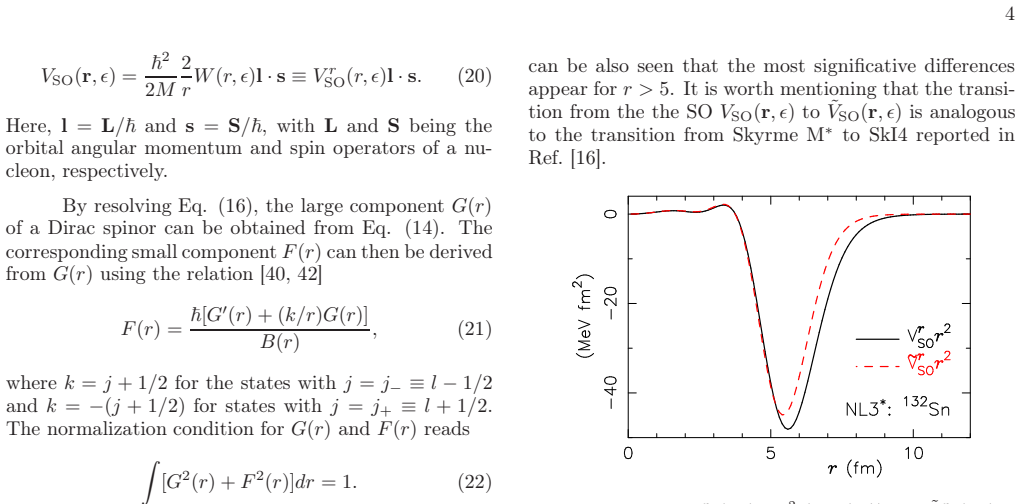
Modified spin–orbit interaction Various studies indicate that a density-dependent spin–orbit (SO) interaction can significantly affect charge radii [12, 14, 27]. To investigate if this is also the case in the RMF A, in addition to the standard SO interactionVSO(r,ǫ ) given by Eq. (20), we also consider the following density-dependent SO interaction ˜VSO(r,ǫ ...
-
[3]
We begin with the charge radii of the nodeless sp proton states shown in Fig
Nodeless proton orbitals To better understand the evolution of charge radii with atomic mass number A, we now examine the vari- ation of the charge radii of individual proton sp states for different neutron configurations. We begin with the charge radii of the nodeless sp proton states shown in Fig. 7. FIG. 7. The rms charge radii, ⟨rca2⟩1/ 2, of the nodele...
-
[4]
For A > 132, the charge radii of proton states are considerably larger in the 1hj− -conf
vary significantly with the neutron configuration. For A > 132, the charge radii of proton states are considerably larger in the 1hj− -conf. than in the others. The effects of valence neutrons occupying the 2fj+ and 2fj− orbitals on the charge radii of sp states differ significantly only for proton states with angular momentuml ≤ 1
-
[5]
Their dependence on various neutron configurations is shown in Fig
Proton orbitals with nodes We now discuss the charge radii of the nodal pro- ton orbitals 2s1/ 2 and 2p1/ 2, 3/ 2. Their dependence on various neutron configurations is shown in Fig. 8. FIG. 8. Same as Fig. 7 (including also the results for the 3s1h2d-conf.) but for proton orbital with nodes. Note that for the 2p proton orbitals, the contribution to ⟨rca 2...
-
[6]
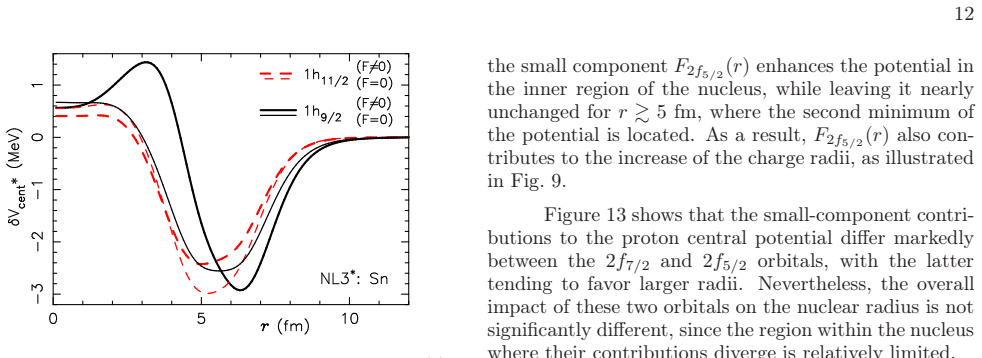
Effect of neutron 1h orbitals on the charge radius We begin with the case in which four neutrons are added to the orbital 1h9/ 2. The variation of the proton central potential induced by these four neutrons, relative to 132Sn, in which the orbit h9/ 2 is empty, is given by δVcent∗ (r) = 4 A1 − A2 [ [Vcent∗ (r)]A1 Sn − [Vcent∗ (r)]A2 Sn ] , (28) with A1 = 1...
-
[7]
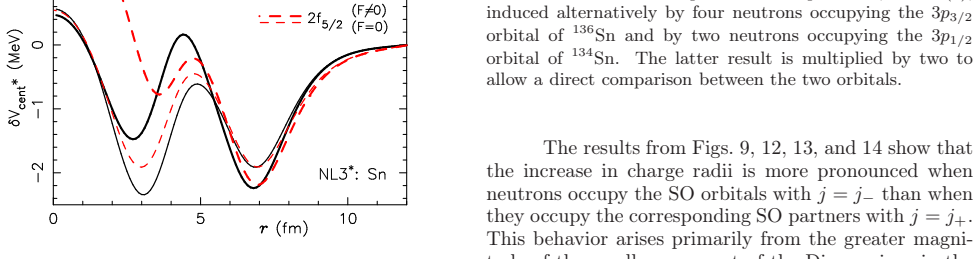
Effect of neutron 2f orbitals on the charge radius Figure 13 shows the contribution to Vcent∗ (r) from four neutrons in 136Sn occupying either the 2f7/ 2 or 2f5/ 2 orbital. It can be seen that the small component F2f7/ 2 (r) increases the proton central potential in the re- gion 2 ≲ r ≲ 5 fm, thereby making the first minimum shallower, and decreases it arou...
-
[8]
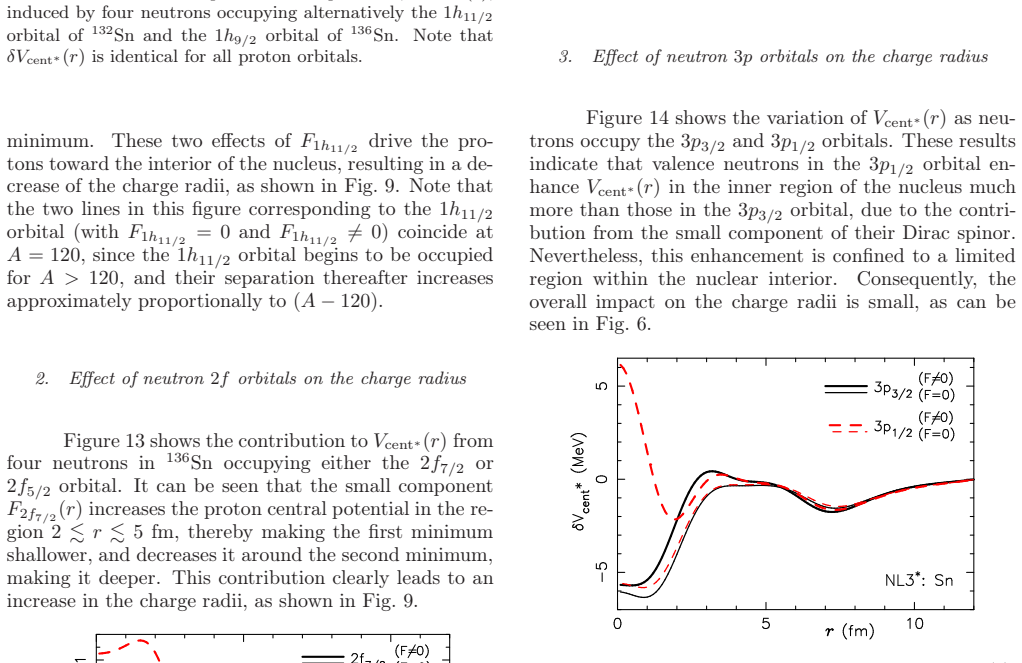
Effect of neutron 3p orbitals on the charge radius Figure 14 shows the variation of Vcent∗ (r) as neu- trons occupy the 3p3/ 2 and 3p1/ 2 orbitals. These results indicate that valence neutrons in the 3p1/ 2 orbital en- hance Vcent∗ (r) in the inner region of the nucleus much more than those in the 3p3/ 2 orbital, due to the contri- bution from the small co...
-
[9]
I. Angeli, and K. P. Marinova, At. Data Nucl. Data Ta- bles 99, 69 (2013)
work page 2013
-
[10]
P. Campbell, I. Moore, and M. Pearson, Prog. Part. Nucl. Phys. 86 127 (2016)
work page 2016
-
[11]
A. F. Garcia-Ruiz et al. , Nat. Phys. 12 594 (2016)
work page 2016
-
[12]
A. F. Garcia-Ruiz, A. R. Vernon, Eur. Phys. J. A 56 136 (2020)
work page 2020
-
[13]
M. M. Sharma, G. A. Lalazissis, and P. Ring, Phys. Lett. B 317, 9 (1993)
work page 1993
- [14]
- [15]
- [16]
-
[17]
R. Niembro, S. Marcos, M. López-Quelle, and L. N. Savushkin, Physics of Atomic Nuclei 75, 269 (2012)
work page 2012
-
[18]
S. E. Agbemava, A. V. Afanasjev, D. Ray, and P. Ring, Phys. Rev. C 89, 054320 (2014)
work page 2014
-
[19]
U. C. Perera, A. V. Afanasjev, and P. Ring, Phys. Rev. C 104, 064313 (2021)
work page 2021
- [20]
- [21]
- [22]
-
[23]
Z. Wang, T. Naito, and H. Liang, Phys. Rev. C 103, 064326 (2021)
work page 2021
- [24]
-
[25]
M. M. Sharma, G. A. Lalazissis, J. König, and P. Ring, Phys. Rev. Lett. 74, 3744 (1995)
work page 1995
-
[26]
M. Goddard, P. D. Stevenson, and A. Rios, Phys. Rev. Lett. 110, 032503 (2013)
work page 2013
-
[27]
S. A. Fayans and S. V. Tolokonnikov, E. L. Trykov, and D.Zawischa, Phys. Lett. B 338, 1 (1994)
work page 1994
-
[28]
S. A. Fayans and D. Zawischa, Phys. Lett. B 383, 19 (1996)
work page 1996
-
[29]
S. A. Fayans and S. V. Tolokonnikov, E. L. Trykov, and D. Zawischa, Nucl. Phys. A 676, 49 (2000)
work page 2000
- [30]
-
[31]
E. P. Gustafsson et al. , Phys. Rev. Lett. 135, 222501 (2025)
work page 2025
- [32]
- [33]
- [34]
-
[35]
Nakada, International Journal of Modern Physics E 29, 1930008 (2020)
H. Nakada, International Journal of Modern Physics E 29, 1930008 (2020)
work page 2020
-
[36]
R. Rodríguez-Guzmán, P. Sarriguren, L. M. Robledo, and S. Pérez-Martín, Phys. Lett. B 691, 202 (2010)
work page 2010
- [37]
- [38]
- [39]
-
[40]
U. C. Perera, A. V. Afanasjev, Phys. Rev. C 107, 064321 (2023)
work page 2023
- [41]
- [42]
- [43]
-
[44]
M. Rufa, P.-G. Reinhard, J. A. Maruhn, W. Greiner, and M. R. Strayer, Phys. Rev. C 38 (1988) 390
work page 1988
- [45]
-
[46]
G. A. Lalazissis, S. Karatzikos, R. Fossion, D. Pena Arteaga, A. V. Afanasjev, P. Ring, Phys. Lett. B 671, 36 (2009)
work page 2009
-
[47]
A. Bouyssy, J. F. Mathiot, Nguyen Van Giai, and S. Marcos, Phys. Rev. C 36, 380 (1987)
work page 1987
- [48]
-
[49]
L. N. Savushkin, H. Toki, The Atomic Nucleus as a Rel- ativistic System , Springer, Berlin (2004)
work page 2004
-
[50]
J. J. Sakurai, Advanced Quantum Mechanics , Addison- Wesley, New York (1967)
work page 1967
-
[51]
P. Ring, P. Schuck, The Nuclear Many-Body Problem , Springer, Berlin (1980)
work page 1980
- [52]
-
[53]
W.-H. Long, N. Van Giai, and J. Meng, Phys. Lett. B 640 (2006) 150
work page 2006
- [54]
-
[55]
V. I. Isakov, Phys. Part. Nucl. 38, 269 (2007)
work page 2007
-
[56]
G. A. Lalazissis, S. Raman, and P. Ring, At. Data and Nucl. Data Tables 71, 1-40 (1999)
work page 1999
- [57]
-
[58]
Bernard and Nguyen Van Giai, Nucl
V. Bernard and Nguyen Van Giai, Nucl. Phys. A 348 (1980) 75
work page 1980
- [59]
- [60]
- [61]
-
[62]
J. N. Ginocchio, D. G. Madland, Phys. Rev. C 57, 1167 (1998)
work page 1998
- [63]
- [64]
discussion (0)
Sign in with ORCID, Apple, or X to comment. Anyone can read and Pith papers without signing in.