Driving Assistance System for Ambulances to Minimise the Vibrations in Patient Cabin
Pith reviewed 2026-05-10 08:11 UTC · model grok-4.3
The pith
An ambulance system recommends the lower-vibration route when time differences between options stay below 6 percent but takes the shortest route above 20 percent.
A machine-rendered reading of the paper's core claim, the machinery that carries it, and where it could break.
Core claim
The system classifies vibration levels along candidate routes using an artificial neural network trained on accelerometer data, then applies a weighted index to pick the route that minimizes patient-cabin vibrations unless the time difference exceeds 20 percent, in which case the shortest route is selected regardless of vibration levels.
What carries the argument
The ANN vibration classifier that labels segments low-medium-high to feed into a route-scoring index balancing time and vibration exposure.
If this is right
- When travel times are nearly equal the system steers ambulances onto smoother roads to limit cabin vibrations.
- Real-time sensor data plus the trained model produces route scores that can be shown on the vehicle display.
- Validation across regions indicates the approach works for areas sharing similar road vibration profiles.
- Current time-vibration weights make any route more than 20 percent faster win even if vibrations are higher.
Where Pith is reading between the lines
- Linking the system to existing ambulance navigation software would let drivers receive vibration-aware guidance without manual route planning.
- Retraining the classifier on local road data could maintain accuracy when moving between cities with different pavement types.
- The same sensor-plus-index logic might help other vehicles carrying vibration-sensitive equipment such as blood supplies or lab samples.
Load-bearing premise
Vibration patterns and weighting factors learned from the training region will transfer to new cities while preserving the 97 percent classification accuracy without extra calibration.
What would settle it
Running the deployed system in a city with markedly different road surfaces and measuring whether accuracy on fresh accelerometer data falls below 90 percent or the route choices stop reducing measured vibrations as predicted.
Figures



read the original abstract
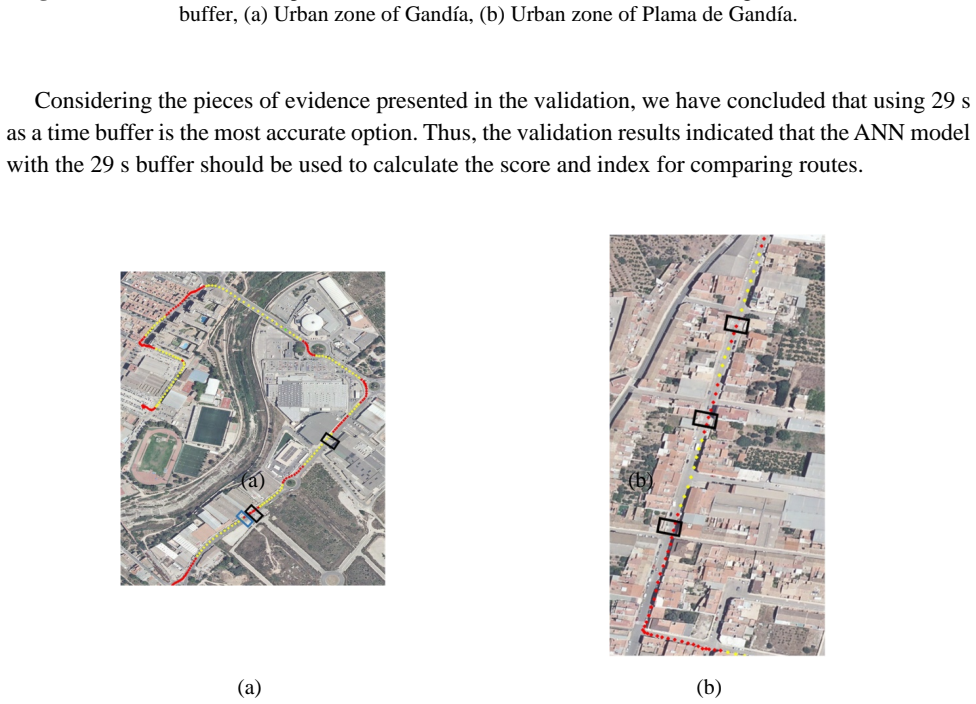
The ambulance service is the main transport for diseased or injured people which suffers the same acceleration forces as regular vehicles. These accelerations, caused by the movement of the vehicle, impact the performance of tasks executed by sanitary personnel, which can affect patient survival or recovery time. In this paper, we have trained, validated, and tested a system to assess driving in ambulance services. The proposed system is composed of a sensor node which measures the vehicle vibrations using an accelerometer. It also includes a GPS sensor, a battery, a display, and a speaker. When two possible routes reach the same destination point, the system compares the two routes based on previously classified data and calculates an index and a score. Thus, the index balances the possible routes in terms of time to reach the destination and the vibrations suffered in the patient cabin to recommend the route that minimises those vibrations. Three datasets are used to train, validate, and test the system. Based on an Artificial Neural network (ANN), the classification model is trained with tagged data classified as low, medium, and high vibrations, and 97% accuracy is achieved. Then, the obtained model is validated using data from three routes of another region. Finally, the system is tested in two new scenarios with two possible routes to reach the destination. The results indicate that the route with less vibration is preferred when there are low time differences (less than 6%) between the two possible routes. Nonetheless, with the current weighting factors, the shortest route is preferred when time differences between routes are higher than 20%, regardless of the higher vibrations in the shortest route.
Editorial analysis
A structured set of objections, weighed in public.
Referee Report
Summary. The paper proposes a sensor-based driving assistance system for ambulances consisting of an accelerometer, GPS, battery, display and speaker. An ANN classifies measured vibrations into low/medium/high categories (97% accuracy on training data) and an index is computed to select between two routes to the same destination, balancing travel time against patient-cabin vibrations. The system is trained on three datasets, validated on routes from a second region, and tested in two scenarios; the authors conclude that the lower-vibration route is preferred when time differences are below 6% while the shortest route is chosen for differences above 20% under the current weighting factors.
Significance. If the reported accuracy and route-selection behavior generalize, the work could meaningfully reduce vibration exposure during ambulance transport and thereby improve patient outcomes in emergency medical services. The approach combines readily available sensors with a trained classifier and a practical decision index, offering a deployable prototype that is grounded in real accelerometer data rather than purely simulated conditions.
major comments (3)
- [Route index and score calculation (results and methods)] The manuscript never states the exact mathematical definition of the route index or the numerical values of the weighting factors that balance time and vibration. Because the reported preference thresholds (<6% time difference favors lower vibration; >20% favors shortest route) are produced by this index, the central empirical claim cannot be reproduced or tested for robustness without those parameters.
- [Validation on second-region routes] No accuracy, confusion matrix, or other performance metric is supplied for the ANN when it is applied to the three routes of the second region, even though the text states that the model is validated on that data. This leaves the generalization claim unsupported by quantitative evidence.
- [Training, validation and test datasets] Dataset sizes, number of samples per class, cross-validation procedure, and any error bars or statistical tests accompanying the 97% accuracy figure are omitted. Without these details the reliability of the classifier and the subsequent route recommendations cannot be assessed.
minor comments (1)
- [Data labeling] The abstract and text refer to 'three datasets' and 'tagged data' without clarifying how the vibration labels were obtained or whether the tagging was performed by multiple annotators.
Simulated Author's Rebuttal
We thank the referee for the detailed and constructive review of our manuscript. The comments highlight important aspects for improving clarity and reproducibility. We address each major comment below and commit to revising the manuscript to incorporate the necessary details.
read point-by-point responses
-
Referee: [Route index and score calculation (results and methods)] The manuscript never states the exact mathematical definition of the route index or the numerical values of the weighting factors that balance time and vibration. Because the reported preference thresholds (<6% time difference favors lower vibration; >20% favors shortest route) are produced by this index, the central empirical claim cannot be reproduced or tested for robustness without those parameters.
Authors: We agree that the manuscript does not provide the exact mathematical definition of the route index or the numerical values of the weighting factors. This was an oversight that affects reproducibility. In the revised manuscript, we will explicitly state the formula for the route index (which combines normalized travel time and vibration score) and report the specific weighting factors used to generate the observed thresholds of less than 6% and greater than 20%. revision: yes
-
Referee: [Validation on second-region routes] No accuracy, confusion matrix, or other performance metric is supplied for the ANN when it is applied to the three routes of the second region, even though the text states that the model is validated on that data. This leaves the generalization claim unsupported by quantitative evidence.
Authors: We acknowledge that while the manuscript describes validation on three routes from a second region, no quantitative metrics (accuracy, confusion matrix, or similar) were reported for this step. We will add these performance measures in the revised version to provide quantitative support for the generalization claim. revision: yes
-
Referee: [Training, validation and test datasets] Dataset sizes, number of samples per class, cross-validation procedure, and any error bars or statistical tests accompanying the 97% accuracy figure are omitted. Without these details the reliability of the classifier and the subsequent route recommendations cannot be assessed.
Authors: We recognize that essential details on dataset composition and evaluation were omitted. The revised manuscript will include the sizes of the training, validation, and test sets, the number of samples per vibration class, the cross-validation procedure, and any error bars or statistical tests associated with the 97% accuracy figure. revision: yes
Circularity Check
No significant circularity; empirical ML system with independent validation
full rationale
The paper trains an ANN classifier on tagged vibration data (97% accuracy), validates the model on routes from a second region, and applies it in two test scenarios to compute an index balancing measured time and classified vibration levels. The reported preference thresholds emerge directly from the outcomes of those specific test runs rather than from any self-referential definition, fitted parameter renamed as prediction, or self-citation chain. No equations are presented that reduce the index or thresholds to the inputs by construction, and the derivation chain relies on external sensor data and cross-region validation instead of internal tautology.
Axiom & Free-Parameter Ledger
free parameters (1)
- weighting factors between time and vibration
axioms (2)
- domain assumption Vibrations measured by accelerometer in the patient cabin directly affect the performance of sanitary personnel and patient recovery
- domain assumption Vibration patterns learned in one region transfer to routes in another region
Reference graph
Works this paper leans on
-
[1]
Muhammad, K.; Ullah, A.; Lloret, J.; Del Ser, J. VHC de Albuquerque, Deep learning for safe autonomous driving: Current challenges and future directions. IEEE Trans. Intell. Transp. Syst. 2020, 22, 4316–4336
work page 2020
-
[2]
An empirical investigation of forecasting methods for ambulance calls -a case study
Al-Azzani, M.A.; Davari, S.; England, T.J. An empirical investigation of forecasting methods for ambulance calls -a case study. Health Syst. 2021, 10, 268–285
work page 2021
-
[3]
Predicting emergency medical service call demand: A modern spatiotemporal machine learning approach
Martin, R.J.; Mousavi, R.; Saydam, C. Predicting emergency medical service call demand: A modern spatiotemporal machine learning approach. Oper. Res. Health Care. 2021, 28, 100285
work page 2021
-
[4]
Helicopter air ambulance services
Ruskin, K.J. Helicopter air ambulance services. Curr. Opin. Anaesthesiol. 2019, 32, 252–256
work page 2019
-
[5]
Causes of delay during interfacility transports of injured patients transported by air ambulance
Nolan, B.; Haas, B.; Tien, H.; Saskin, R.; Nathens, A. Causes of delay during interfacility transports of injured patients transported by air ambulance. Prehosp. Emerg. Care 2020, 24, 625–633
work page 2020
-
[6]
Advanced Air Mobility: Opportunities and Challenges Deploying eVTOLs for Air Ambulance Service
Goyal, R.; Cohen, A. Advanced Air Mobility: Opportunities and Challenges Deploying eVTOLs for Air Ambulance Service. Appl. Sci. 2022, 12, 1183
work page 2022
-
[7]
Acuna, J.A.; Zayas -Castro, J.L.; Charkhgard, H. Ambulance allocation optimization model for the overcrowding problem in US emergency departments: A case study in Florida. Socio-Econ. Plan. Sci. 2020, 71, 100747
work page 2020
-
[8]
Ambulance allocation considering the spatial randomness of demand
Yang, W.; Su, Q.; Zhou, M.; Qin, X. Ambulance allocation considering the spatial randomness of demand. Comput. Ind. Eng. 2020, 139, 106202
work page 2020
-
[9]
Predicting an Avoidable Conveyance to the Emergency Department for Ambulance Patients on Scene
Miles, J. Predicting an Avoidable Conveyance to the Emergency Department for Ambulance Patients on Scene. Ph.D. Thesis, University of Sheffield, Sheffield, UK, 2022
work page 2022
-
[10]
Whole-Body Vibration Exposure from Incubators in the Neonatal Care Setting: A Review
McCallig, M.; Pakrashi, V . Whole-Body Vibration Exposure from Incubators in the Neonatal Care Setting: A Review. J. Environ. Occup. Health 2021, 11, 37–46
work page 2021
-
[11]
Serin, S.; Çağlar, B. Effectivity comparison between mechanical chest compression and manual chest compression in real urban traffic. Fırat Üniversitesi Sağlık Bilim. Tıp Derg. 2020, 34, 193–197
work page 2020
-
[12]
Beom, J.H.; Kim, M.J.; You, J.S.; Lee, H.S.; Kim, J.H.; Park, Y .S.; Shin, D.M.; Chung, H.S. Evaluation of the quality of cardiopulmonary resuscitation according to vehicle driving pattern, using a virtual reality ambulance driving system: A prospective, cross-over, randomised study. BMJ Open 2018, 8, e023784
work page 2018
-
[13]
Acceleration during neonatal transport and its impact on mechanical ventilation
Lantos, L.; Széll, A.; Chong, D.; Somogyvári, Z.; Belteki, G. Acceleration during neonatal transport and its impact on mechanical ventilation. Arch. Dis. Child. Fetal Neonatal Ed. 2022
work page 2022
-
[14]
The effect on video laryngoscope on intubation process during ambulance transport
Caglar, B.; Serin, S. The effect on video laryngoscope on intubation process during ambulance transport. J. Coll. Physicians Surg. Pak. JCPSP 2020, 30, 351–354
work page 2020
-
[15]
Modeling of the Heart Rate Variation Caused by Acceleration and Deceleration of an Ambulance
Kanatani, M.; Ono, T. Modeling of the Heart Rate Variation Caused by Acceleration and Deceleration of an Ambulance. In Proceedings of the 2021 IEEE 60th Annual Conference of the Society of Instrument and Control Engineers of Japan (SICE) 2021, Tokyo, Japan, 8–10 September 2021; pp. 1420–1425
work page 2021
-
[16]
Thézard, F.; McDonald, N.; Kriellaars, D.; Giesbrecht, G.; Weldon, E.; Pryce, R.T. Effects of spinal immobilization and spinal motion restriction on head-neck kinematics during ambulance transport. Prehosp. Emerg. Care 2019, 23, 811–819
work page 2019
-
[17]
A new vibration isolation bed stage with magnetorheological dampers for ambulance vehicles
Chae, H.D.; Choi, S.B. A new vibration isolation bed stage with magnetorheological dampers for ambulance vehicles. Smart Mater. Struct. 2014, 24, 017001
work page 2014
-
[18]
Prohn, M.J.; Herbig, B. Evaluating the effects of a simulator -based training on knowledge, attitudes and driving profiles of German ambulance drivers. Accid. Anal. Prev. 2020, 138, 105466
work page 2020
-
[19]
Jha, R.K.; Chattopadhyay, M.; Gajpal, Y . Reducing Response Time of Ambulance Service by Utilizing the Knowledge of Service Location of Ambulance Drivers using Self -Organizing Map. Int. J. Oper. Quant. Manag. 2021, 27, 219–235
work page 2021
-
[20]
Jeong, J.H.; Jo, H.; Ditzler, G. Convolutional neural networks for pavement roughness assessment using calibration- free vehicle dynamics. Comput.-Aided. Civ. Infrastruct. Eng. 2020, 35, 1209–1229
work page 2020
-
[21]
Zhang, Z.; Zhang, H.; Xu, S.; Lv, W. Pavement roughness evaluation method based on the theoretical relationship between acceleration measured by smartphone and IRI. Int. J. Pavement Eng. 2022, 23, 3082–3098
work page 2022
-
[22]
Development of pavement roughness models using Artificial Neural Network (ANN)
Alatoom, Y .I.; Al-Suleiman, T.I. Development of pavement roughness models using Artificial Neural Network (ANN). Int. J. Pavement Eng. 2022, 1–16
work page 2022
-
[23]
Pavement roughness index estimation and anomaly detection using smartphones
Y u, Q.; Fang, Y .; Wix, R. Pavement roughness index estimation and anomaly detection using smartphones. Autom. Constr. 2022, 141, 104409
work page 2022
-
[24]
Road condition monitoring using smart sensing and artificial intelligence: A review
Ranyal, E.; Sadhu, A.; Jain, K. Road condition monitoring using smart sensing and artificial intelligence: A review. Sensors 2022, 22, 3044
work page 2022
-
[25]
Study on passenger comfort based on human–bus–road coupled vibration
Wang, G.; Zhang, J.; Kong, X. Study on passenger comfort based on human–bus–road coupled vibration. Appl. Sci. 2020, 10, 3254
work page 2020
-
[26]
International roughness index thresholds based on whole-body vibration in passenger cars
Múčka, P . International roughness index thresholds based on whole-body vibration in passenger cars. Transp. Res. Rec. 2021, 2675, 305–320
work page 2021
-
[27]
Marques, L.; Malvezzi, F.; Stavropoulos, K.D. Analysis of movements and degrees of freedom required for a vibration attenuation system on ambulance stretchers. Vibroeng. Procedia 2020, 32, 81–86
work page 2020
-
[28]
Parameter optimization for a vibration attenuation system on ambulance stretchers
Malvezzi, F.; Maia Matarazzo Orsino, R.; Dimitriou Stavropoulos, K. Parameter optimization for a vibration attenuation system on ambulance stretchers. Vibroeng. Procedia 2021, 37, 36–41
work page 2021
-
[29]
Duarte, M.L.M.; de Melo, G.C. Influence of pavement type and speed on whole body vibration (WBV) levels measured on passenger vehicles. J. Braz. Soc. Mech. Sci. 2018, 40, 1–12
work page 2018
-
[30]
Development of a GIS -Based Methodology for the Management of Stone Pavements Using Low-Cost Sensors
Bruno, S.; Vita, L.; Loprencipe, G. Development of a GIS -Based Methodology for the Management of Stone Pavements Using Low-Cost Sensors. Sensors 2022, 22, 6560
work page 2022
-
[31]
Vibration Profiles of a Road Ambulance Using Equivalent Acceleration
Kehoe, P.; Gibb, K.; Hurley, J.; Chan, A.; Green, J.; Langlois, R.; Greenwood, K.; Aubertin, C.; Ibey, A.; Redpath, S. Vibration Profiles of a Road Ambulance Using Equivalent Acceleration. In Proceedings of the Canadian Society for Mechanical Engineering International Congress 2022, Edmonton, AB, Canada, 5–8 June 2022
work page 2022
-
[32]
Romero, O.; Miura, A.S.; Parra, L.; Lloret, J. Low -Cost System for Automatic Recognition of Driving Pattern in Assessing Interurban Mobility using Geo-Information. ISPRS Int. J. Geo-Inf. 2022, 11, 597
work page 2022
-
[33]
GY-521 MPU-6050 Datasheet https://invensense.tdk.com/wp-content/uploads/2015/02/MPU-6000-Datasheet1.pdf
work page 2015
-
[34]
PS GY -NEO6MV2 Datashee t https://www.openimpulse.com/blog/wp-content/uploads/wpsc/downloadables/GY- NEO6MV2-GPS-Module-Datasheet.pdf
-
[35]
Raspberry Pi 3 Datasheet https://static.raspberrypi.org/files/product-briefs/Raspberry-Pi-Model-Bplus-Product- Brief.pdf
-
[36]
V ANETs cloud: Architecture, applications, challenges, and issues
Sharma, S.; Kaul, A. V ANETs cloud: Architecture, applications, challenges, and issues. Arch. Comput. Method 2021, 28, 2081–2102
work page 2021
-
[37]
Suresh Kumar, K.; Radha Mani, A.S.; Sundaresan, S.; Ananth Kumar, T. Modeling of V ANET for future generation transportation system through Edge/Fog/Cloud computing powered by 6G. Cloud IoT -Based Veh. Ad Hoc Netw. 2021, 105–124
work page 2021
-
[38]
Dutta, C.; Singhal, D. A hybridization of artificial neural network and support vector machine for prevention of road accidents in V ANET. Int. J. Comput. Sci. Eng. Technol. 2019, 10, 110–116
work page 2019
-
[39]
An overview of traffic congestion detection and classification techniques in V ANET
Ramli, N.I.; MOHAMED RAWI, M.I. An overview of traffic congestion detection and classification techniques in V ANET. Indones. J. Electr. Eng. Comput. Sci. 2020, 20, 437–444
work page 2020
-
[40]
A hyperspectral image classification method using multifeature vectors and optimized KELM
Chen, H.; Miao, F.; Chen, Y .; Xiong, Y .; Chen, T. A hyperspectral image classification method using multifeature vectors and optimized KELM. IEEE J. Sel. Top. Appl. Earth Obs. Remote Sens. 2021, 14, 2781–2795
work page 2021
-
[41]
Optimal search mapping among sensors in heterogeneous smart homes
Yu, Y .; Hao, Z.; Li, G.; Liu, Y .; Yang, R.; Liu, H. Optimal search mapping among sensors in heterogeneous smart homes. Math. Biosci. Eng 2023, 2023, 1960–1980
work page 2023
-
[42]
Data-driven simultaneous identification of the 6DOF dynamic model and wave load for a ship in waves
Ren, Z.; Han, X.; Yu, X.; Skjetne, R.; Leira, B.J.; Sævik, S.; Zhu, M. Data-driven simultaneous identification of the 6DOF dynamic model and wave load for a ship in waves. Mech. Syst. Signal. Process. 2023, 184, 109422
work page 2023
-
[43]
Huang, C.; Zhou, X.; Ran, X.; Liu, Y .; Deng, W.; Deng, W. Co-evolutionary competitive swarm optimizer with three- phase for large-scale complex optimization problem. Inf. Sci. 2022, 619, 2–18
work page 2022
-
[44]
Intelligent beaconless geographical forwarding for urban vehicular environments
Ghafoor, K.Z.; Abu Bakar, K.; Lloret, L.; Khokhar, R.H.; Lee, K.C. Intelligent beaconless geographical forwarding for urban vehicular environments. Wirel. Netw. 2013, 19, 345–362
work page 2013
discussion (0)
Sign in with ORCID, Apple, or X to comment. Anyone can read and Pith papers without signing in.