Recognition: unknown
Sentiment Analysis of German Sign Language Fairy Tales
Pith reviewed 2026-05-10 08:14 UTC · model grok-4.3
The pith
Sentiment in German sign language fairy tales can be detected from video motion features at 0.631 balanced accuracy, with body movements contributing as much as facial ones.
A machine-rendered reading of the paper's core claim, the machinery that carries it, and where it could break.
Core claim
The authors establish a pipeline that transfers valence labels from fairy-tale text to aligned German Sign Language videos, extracts face and body motion features via MediaPipe, and trains an explainable XGBoost model that classifies negative, neutral, or positive sentiment at 0.631 balanced accuracy. Feature-importance analysis reveals that hip, elbow, and shoulder motion contribute substantially to discrimination, supporting the claim that face and body play equal roles in conveying sentiment in sign language.
What carries the argument
XGBoost classifier trained on MediaPipe-extracted motion features from face and body landmarks, followed by feature-importance ranking
If this is right
- Sentiment recognition systems for sign language must incorporate full-body tracking rather than face-only analysis.
- Text-based labeling via majority vote of language models can serve as a scalable proxy when direct video annotation is expensive.
- The same feature-extraction and classification approach can be applied to additional stories or genres in German Sign Language.
- Linguistic descriptions of sign language should treat torso and limb dynamics as primary channels for emotional expression.
Where Pith is reading between the lines
- The pipeline could be ported to other sign languages once comparable video-text alignments are available.
- Real-time applications such as sentiment-aware captioning or translation tools would benefit from full-body rather than head-only capture.
- If body landmarks remain important across larger and more varied datasets, curriculum design for sign-language interpreters may need to emphasize whole-body expressivity.
Load-bearing premise
The valence labels produced by large-language-model analysis of the written fairy-tale texts match the sentiments actually expressed in the corresponding sign-language video performances.
What would settle it
Independent ratings collected from fluent signers who watch only the videos and assign negative, neutral, or positive labels; if agreement with the text-derived labels falls well below the model's 0.631 accuracy, the training signal is shown to be misaligned.
Figures


read the original abstract
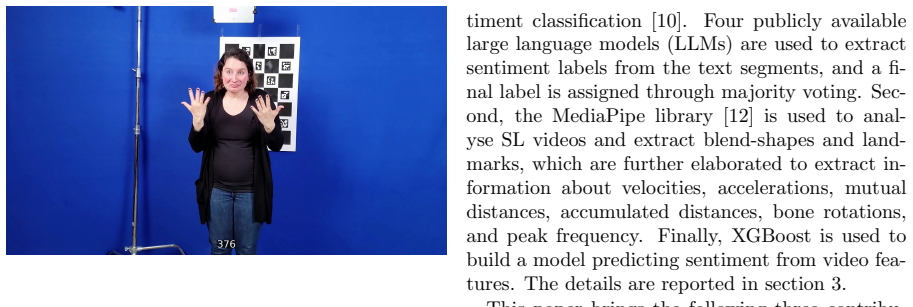
We present a dataset and a model for sentiment analysis of German sign language (DGS) fairy tales. First, we perform sentiment analysis for three levels of valence (negative, neutral, positive) on German fairy tales text segments using four large language models (LLMs) and majority voting, reaching an inter-annotator agreement of 0.781 Krippendorff's alpha. Second, we extract face and body motion features from each corresponding DGS video segment using MediaPipe. Finally, we train an explainable model (based on XGBoost) to predict negative, neutral or positive sentiment from video features. Results show an average balanced accuracy of 0.631. A thorough analysis of the most important features reveal that, in addition to eyebrows and mouth motion on the face, also the motion of hips, elbows, and shoulders considerably contribute in the discrimination of the conveyed sentiment, indicating an equal importance of face and body for sentiment communication in sign language.
Editorial analysis
A structured set of objections, weighed in public.
Referee Report
Summary. The manuscript introduces a dataset of German fairy tale texts paired with DGS video performances and proposes a pipeline for sentiment analysis. Text segments are annotated for negative/neutral/positive valence using four LLMs with majority voting, yielding a Krippendorff's alpha of 0.781. Face and body features are extracted from videos via MediaPipe, and an XGBoost classifier is trained to predict the text-derived labels from these features, achieving 0.631 balanced accuracy. Feature analysis concludes that body motions (hips, elbows, shoulders) contribute comparably to facial motions (eyebrows, mouth) in conveying sentiment.
Significance. Should the text labels prove to be reliable indicators of the sentiments performed in the videos, the work would offer a novel dataset and baseline for DGS sentiment analysis, an area with limited prior research. The emphasis on explainable AI to identify key body and face features is a positive aspect, potentially informing future sign language understanding systems. The empirical approach using standard tools provides a reproducible starting point, though the unvalidated proxy assumption caps its current significance.
major comments (3)
- Sentiment Labeling section: The sentiment labels are generated exclusively from text using LLMs without any reported validation against the actual sentiments expressed in the corresponding DGS video segments. This is a load-bearing issue for the central claim, as sign language performances can alter textual sentiment through non-manual signals and body dynamics; no human video annotation or alignment study is described.
- Results and Evaluation section: The reported balanced accuracy of 0.631 lacks supporting details such as the total number of segments in the dataset, class balance, the specific train/validation/test split used, or the cross-validation strategy. Without these, the performance metric is difficult to interpret or compare.
- Feature Importance Analysis section: The conclusion that hips, elbows, and shoulders are equally important to eyebrows and mouth for sentiment discrimination rests on the unvalidated text labels. If the labels do not accurately reflect video content, the feature rankings may not generalize to true sign language sentiment cues.
minor comments (2)
- Abstract: The abstract states 'an average balanced accuracy of 0.631' but does not clarify whether this is averaged over classes, folds, or runs, or provide confidence intervals.
- Dataset Description: No information is given on the source of the fairy tales, the number of tales, or how video segments were aligned to text segments.
Simulated Author's Rebuttal
We thank the referee for the detailed and constructive comments. We address each major point below, acknowledging limitations where they exist and outlining planned revisions to improve clarity and transparency.
read point-by-point responses
-
Referee: Sentiment Labeling section: The sentiment labels are generated exclusively from text using LLMs without any reported validation against the actual sentiments expressed in the corresponding DGS video segments. This is a load-bearing issue for the central claim, as sign language performances can alter textual sentiment through non-manual signals and body dynamics; no human video annotation or alignment study is described.
Authors: We agree this is a core limitation of the work. The labels are derived solely from the German fairy tale texts via LLM majority voting as a proxy for the sentiment expressed in the paired DGS video performances. While the high Krippendorff's alpha of 0.781 indicates consistency in the text annotations, we recognize that sign language performances may modify valence through body dynamics and non-manual signals, and no human validation or alignment study on the videos was conducted. This was due to the substantial resources needed for expert DGS annotators. In the revised manuscript, we will add an explicit limitations subsection discussing the proxy assumption, its potential impact on results, and recommendations for future human-annotated validation studies. We will also frame the contribution more clearly as an initial baseline rather than a direct video sentiment analysis. revision: partial
-
Referee: Results and Evaluation section: The reported balanced accuracy of 0.631 lacks supporting details such as the total number of segments in the dataset, class balance, the specific train/validation/test split used, or the cross-validation strategy. Without these, the performance metric is difficult to interpret or compare.
Authors: We accept that these experimental details are essential for proper interpretation and reproducibility. The revised Results and Evaluation section will report the total number of text-video segments, the class distribution across negative/neutral/positive labels, the train/validation/test split proportions, and the cross-validation strategy (including number of folds) used for the XGBoost classifier. These additions will enable readers to contextualize the 0.631 balanced accuracy and facilitate comparisons with future work. revision: yes
-
Referee: Feature Importance Analysis section: The conclusion that hips, elbows, and shoulders are equally important to eyebrows and mouth for sentiment discrimination rests on the unvalidated text labels. If the labels do not accurately reflect video content, the feature rankings may not generalize to true sign language sentiment cues.
Authors: We concur that the feature importance rankings and the claim of comparable contribution from body (hips, elbows, shoulders) and facial (eyebrows, mouth) features are conditional on the proxy text labels being representative of the video content. In the revised Feature Importance Analysis section, we will qualify all conclusions accordingly, explicitly noting the dependence on the unvalidated labels and cautioning that the observed equal importance may not fully generalize without direct video-based sentiment annotations. The emphasis on explainability will be retained but framed with these caveats. revision: partial
- Direct human validation or alignment study of the text-derived sentiment labels against the actual sentiments performed in the DGS video segments (no such annotations were collected in the original study).
Circularity Check
No circularity: standard empirical ML pipeline with independent components
full rationale
The paper's chain consists of three independent stages: (1) LLM-based majority-vote labeling of text segments (Krippendorff α reported on text only), (2) MediaPipe extraction of face+body keypoints from the corresponding videos, and (3) training an XGBoost classifier to predict the text-derived labels from the video features, followed by post-hoc feature-importance analysis. The balanced accuracy of 0.631 and the relative importance of hips/elbows/shoulders versus eyebrows/mouth are direct empirical outputs of this supervised learning setup; they are not obtained by fitting a parameter to a subset and renaming it a prediction, nor by any self-referential definition or self-citation that bears the central claim. No equation or derivation reduces to its own inputs by construction. The assumption that text labels faithfully proxy video sentiment is a validity issue external to the reported pipeline and does not constitute circularity under the specified criteria.
Axiom & Free-Parameter Ledger
axioms (2)
- domain assumption Majority voting across four LLMs produces reliable three-class sentiment labels for fairy tale text segments.
- domain assumption MediaPipe extracts motion features from face and body that are sufficient to discriminate sentiment in sign language videos.
Reference graph
Works this paper leans on
-
[1]
Emotion Anal- ysis as a Regression Problem - Dimensional Models and Their Implications on Emotion Representation and Metrical Evaluation
Buechel Sven and Hahn Udo. Emotion Anal- ysis as a Regression Problem - Dimensional Models and Their Implications on Emotion Representation and Metrical Evaluation. In Frontiers in Artificial Intelligence and Appli- cations. IOS Press, 2016
2016
-
[2]
Neural Sign Language Translation
Necati Cihan Camgoz, Simon Hadfield, Oscar Koller, Hermann Ney, and Richard Bowden. Neural Sign Language Translation. InProceed- ings of the IEEE Conference on Computer Vi- sion and Pattern Recognition (CVPR), June 2018
2018
-
[3]
Fast Krippendorff: Fast com- putation of Krippendorff’s alpha agreement measure, 2017
Santiago Castro. Fast Krippendorff: Fast com- putation of Krippendorff’s alpha agreement measure, 2017. Publication Title: GitHub repository
2017
-
[4]
XGBoost: A Scalable Tree Boosting System
Tianqi Chen and Carlos Guestrin. XGBoost: A Scalable Tree Boosting System. InProceed- ings of the 22nd ACM SIGKDD International Conference on Knowledge Discovery and Data Mining, pages 785–794, San Francisco Califor- nia USA, August 2016. ACM
2016
-
[5]
EmoSign: A Multimodal Dataset for Understanding Emo- tions in American Sign Language, 2025
Phoebe Chua, Cathy Mengying Fang, Take- hiko Ohkawa, Raja Kushalnagar, Suranga Nanayakkara, and Pattie Maes. EmoSign: A Multimodal Dataset for Understanding Emo- tions in American Sign Language, 2025. Ver- sion Number: 1. 10 Table 4: List of the 96 prediction features sorted by importance. Part 1: 1-64. F eature Importance mouthSmileRight mean 0.02707 mou...
2025
-
[6]
Eberhard, Gary F
David M. Eberhard, Gary F. Simons, and Charles D. Fennig.Ethnologue: Languages of the World. SIL International, 28 edition, 2025
2025
-
[7]
Train- ing a Broad-Coverage German Sentiment Clas- sification Model for Dialog Systems
Oliver Guhr, Anne-Kathrin Schumann, Frank Bahrmann, and Hans Joachim B¨ ohme. Train- ing a Broad-Coverage German Sentiment Clas- sification Model for Dialog Systems. In Nicoletta Calzolari, Fr´ ed´ eric B´ echet, Philippe Blache, Khalid Choukri, Christopher Cieri, Thierry Declerck, Sara Goggi, Hitoshi Isa- hara, Bente Maegaard, Joseph Mariani, H´ el` ene ...
2020
-
[8]
Expressing Emotions in Sign Languages (ExEmSiLa 2024), July 2024
Annika Herrmann, Sarah Schwarzenberg, Thomas Finkbeiner, Nina-Kristin Meister, and Markus Steinbach. Expressing Emotions in Sign Languages (ExEmSiLa 2024), July 2024
2024
-
[9]
A Fairy Tale Gold Standard
Berenike Herrmann and Jana L¨ udtke. A Fairy Tale Gold Standard. Annotation and Analysis of Emotions in the Children’s and Household Tales by the Brothers Grimm. 2023. Medium: HTML ,XML ,PDF Version Number: 1.0
2023
-
[10]
From dictionaries to LLMs – an evaluation of sentiment analysis tech- niques for German language data.Computa- tional Humanities Research, 1:e4, 2025
Jannis Kl¨ ahn, Janos Borst-Graetz, and Manuel Burghardt. From dictionaries to LLMs – an evaluation of sentiment analysis tech- niques for German language data.Computa- tional Humanities Research, 1:e4, 2025
2025
-
[11]
SAGE, Los Angeles London New Delhi Singapore Wash- ington DC Melbourne, fourth edition edition, 2019
Klaus Krippendorff.Content analysis: an introduction to its methodology. SAGE, Los Angeles London New Delhi Singapore Wash- ington DC Melbourne, fourth edition edition, 2019
2019
-
[12]
MediaPipe: A Framework for Building Perception Pipelines
Camillo Lugaresi, Jiuqiang Tang, Hadon Nash, Chris McClanahan, Esha Uboweja, Michael Hays, Fan Zhang, Chuo-Ling Chang, Ming Guang Yong, Juhyun Lee, Wan-Teh Chang, Wei Hua, Manfred Georg, and Matthias Grundmann. MediaPipe: A Framework for Building Perception Pipelines. arXiv:1906.08172 [cs], June 2019. arXiv: 1906.08172
work page internal anchor Pith review arXiv 1906
-
[13]
Pleasure-arousal- dominance: A general framework for de- scribing and measuring individual differences in Temperament.Current Psychology, 14(4):261–292, December 1996
Albert Mehrabian. Pleasure-arousal- dominance: A general framework for de- scribing and measuring individual differences in Temperament.Current Psychology, 14(4):261–292, December 1996
1996
-
[14]
From Once Upon a Time to Happily Ever After: Tracking Emotions in Novels and Fairy Tales
Saif Mohammad. From Once Upon a Time to Happily Ever After: Tracking Emotions in Novels and Fairy Tales. In Kalliopi Zer- vanou and Piroska Lendvai, editors,Proceed- ings of the 5th ACL-HLT Workshop on Lan- guage Technology for Cultural Heritage, So- cial Sciences, and Humanities, pages 105–114, Portland, OR, USA, June 2011. Association for Computational ...
2011
-
[15]
DGS-Fabeln-1, July 2024
Fabrizio Nunnari, Eleftherios Avramidis, and Cristina Espa˜ na-Bonet. DGS-Fabeln-1, July 2024
2024
-
[16]
DGS- Fabeln-1: A Multi-Angle Parallel Corpus of Fairy Tales between German Sign Language and German Text
Fabrizio Nunnari, Eleftherios Avramidis, Cristina Espa˜ na-Bonet, Marco Gonz´ alez, Anna Hennes, and Patrick Gebhard. DGS- Fabeln-1: A Multi-Angle Parallel Corpus of Fairy Tales between German Sign Language and German Text. InProceedings of the 2024 Joint International Conference on Com- putational Linguistics, Language Resources and Evaluation (LREC-COLI...
2024
-
[17]
Using Deep Learning Models for Multimodal Sen- tence Level Sentiment Analysis of Sign Lan- guage.Forum for Linguistic Studies, April 2025
Osondu Oguike and Mpho Primus. Using Deep Learning Models for Multimodal Sen- tence Level Sentiment Analysis of Sign Lan- guage.Forum for Linguistic Studies, April 2025
2025
-
[18]
Pedregosa, G
F. Pedregosa, G. Varoquaux, A. Gramfort, V. Michel, B. Thirion, O. Grisel, M. Blon- del, P. Prettenhofer, R. Weiss, V. Dubourg, J. Vanderplas, A. Passos, D. Cournapeau, M. Brucher, M. Perrot, and E. Duches- nay. Scikit-learn: Machine Learning in Python.Journal of Machine Learning Re- search, 12:2825–2830, 2011
2011
-
[19]
Andrew Schwartz, Gregory Park, Johannes Eichstaedt, Margaret Kern, Lyle Ungar, and Elisabeth Shulman
Daniel Preot ¸iuc-Pietro, H. Andrew Schwartz, Gregory Park, Johannes Eichstaedt, Margaret Kern, Lyle Ungar, and Elisabeth Shulman. Modelling Valence and Arousal in Facebook posts. In Alexandra Balahur, Erik van der 12 Goot, Piek Vossen, and Andres Montoyo, edi- tors,Proceedings of the 7th Workshop on Com- putational Approaches to Subjectivity, Senti- ment...
2016
-
[20]
ICWSM, US, June 2024
Viktor Suter and Miriam Meckel.Using GPT- 4 for Text Analysis: Insights from English and German Language News Classification Tasks. ICWSM, US, June 2024
2024
-
[21]
Sentiment analysis in sign language.Sig- nal, Image and Video Processing, 19(3):223, March 2025
S ¸eyma Takır, Barı¸ s Bilen, and Do˘ gukan Ar- slan. Sentiment analysis in sign language.Sig- nal, Image and Video Processing, 19(3):223, March 2025
2025
-
[22]
Volkova, Betty Mohler, Detmar Meurers, Dale Gerdemann, and Heinrich H
Ekaterina P. Volkova, Betty Mohler, Detmar Meurers, Dale Gerdemann, and Heinrich H. B¨ ulthoff. Emotional Perception of Fairy Tales: Achieving Agreement in Emotion Annotation of Text. In Diana Inkpen and Carlo Strap- parava, editors,Proceedings of the NAACL HLT 2010 Workshop on Computational Ap- proaches to Analysis and Generation of Emo- tion in Text, pa...
2010
-
[23]
Towards Realizing Sign Language to Emotional Speech Conversion by Deep Learning
Weizhe Wang and Hongwu Yang. Towards Realizing Sign Language to Emotional Speech Conversion by Deep Learning. In2021 12th International Symposium on Chinese Spoken Language Processing (ISCSLP), pages 1–5, Hong Kong, January 2021. IEEE
2021
-
[24]
U-Shaped Distribution Guided Sign Language Emotion Recognition With Semantic and Movement Features.IEEE Transactions on Affective Computing, 15(4):2180–2191, October 2024
Jiangtao Zhang, Qingshan Wang, and Qi Wang. U-Shaped Distribution Guided Sign Language Emotion Recognition With Semantic and Movement Features.IEEE Transactions on Affective Computing, 15(4):2180–2191, October 2024. 13
2024
discussion (0)
Sign in with ORCID, Apple, or X to comment. Anyone can read and Pith papers without signing in.