Quantum-Inspired Simulation of 2D Turbulent Rayleigh-B\'enard Convection
Pith reviewed 2026-05-10 07:03 UTC · model grok-4.3
The pith
Dynamical MPS simulations of 2D Rayleigh-Bénard convection recover accurate Nusselt numbers at Ra=10^10 with far fewer degrees of freedom than snapshot complexity predicts.
A machine-rendered reading of the paper's core claim, the machinery that carries it, and where it could break.
Core claim
Evolving the Boussinesq equations inside the compressed MPS representation preserves the essential statistical properties of the turbulence, including boundary-layer structure and plume dynamics that control heat transport, so that the bond dimension required for accurate Nusselt numbers scales far more favorably with Rayleigh number than the a priori representational complexity would suggest.
What carries the argument
Matrix Product State (MPS) representation of the velocity and temperature fields, with fixed bond dimension χ, inside which the governing equations are integrated dynamically rather than post-processed.
If this is right
- Spectral content of the flow is recovered progressively with rising χ, confirming that the compression selectively retains the energetically relevant modes.
- The computational savings demonstrated at Ra=10^10 suggest the approach remains practical for exploring the ultimate regime at still higher Rayleigh numbers.
- Statistical quantities tied to large-scale circulation and heat transport converge faster than pointwise field accuracy under MPS truncation.
Where Pith is reading between the lines
- Similar compression benefits might appear in other buoyancy-driven flows once the same dynamical evolution inside the MPS manifold is tested.
- The favorable scaling could reduce the barrier to parameter sweeps that map the transition between soft and ultimate turbulence regimes.
- Tensor-network methods of this type may eventually allow direct simulation of three-dimensional convection at Rayleigh numbers currently accessible only through heavily parameterized models.
Load-bearing premise
That truncating the MPS manifold and evolving the equations inside it does not systematically distort the boundary layers or plume statistics that determine the Nusselt number.
What would settle it
A high-resolution DNS at the same Ra showing that the time-averaged Nusselt number from the fixed-χ MPS run remains offset by more than the reported error even after χ is increased enough to capture all observed spatial and temporal scales.
Figures



read the original abstract
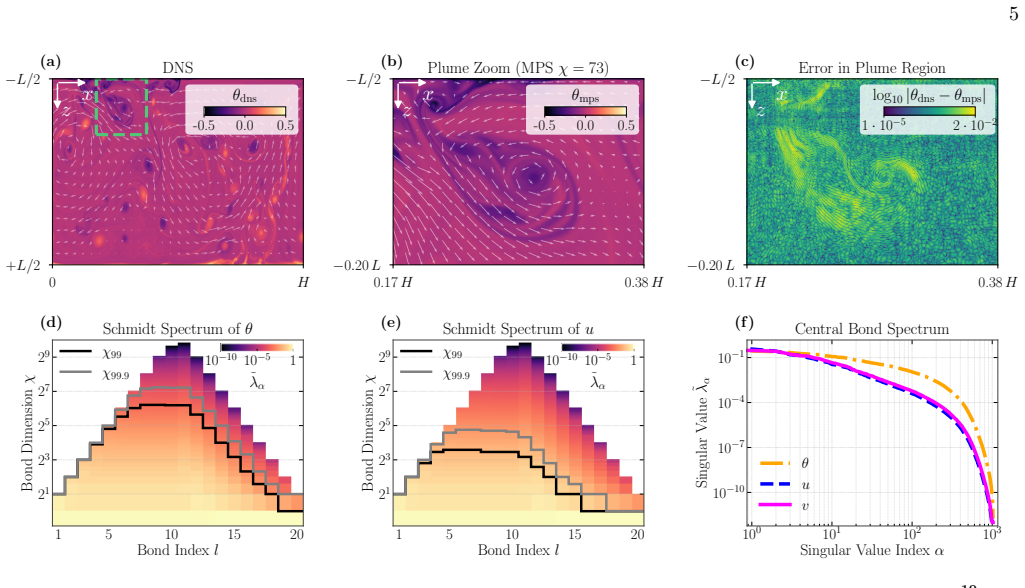
Turbulent thermal convection governs heat transport in systems ranging from stellar interiors to industrial heat exchangers. Two-dimensional Rayleigh-B\'enard convection serves as a paradigm for these flows, reproducing key features such as thin boundary layers, large-scale circulation, and sustained plume dynamics. While Matrix Product State (MPS) methods have demonstrated significant compression of isothermal turbulent fields, their application to buoyancy-driven flows with active thermal coupling has remained unexplored. We apply MPS to two-dimensional Rayleigh-B\'enard convection with dynamical simulations up to $\mathrm{Ra} = 10^{10}$. An a priori decomposition of DNS snapshots up to $\mathrm{Ra} = 10^{11}$ shows that the bond dimension $\chi$ required to represent the flow fields grows without saturation, in contrast to the plateauing of $\chi$ reported for velocity fields in isothermal 2D turbulence. Crucially, however, dynamical simulations solving the governing equations directly in the compressed MPS format at fixed $\chi$ show that the $\chi$ required to recover statistical observables, such as the Nusselt number, scales significantly more favorably with $\mathrm{Ra}$ than the a priori complexity suggests. At $\mathrm{Ra} = 10^{10}$, a relative error of $1.8\%$ in the mean Nusselt number is achieved with a nearly 9-fold reduction in degrees of freedom, using a $\chi$ comparable to that required at $\mathrm{Ra} = 10^{9}$. Spectral analysis confirms the progressive recovery of spatial and temporal scales with increasing $\chi$. These findings establish MPS as a scalable tool for simulating thermally driven turbulence, suggesting the method may remain viable for investigations of the ultimate regime at substantially higher $\mathrm{Ra}$.
Editorial analysis
A structured set of objections, weighed in public.
Referee Report
Summary. The manuscript applies Matrix Product State (MPS) compression to two-dimensional Rayleigh-Bénard convection. An a priori analysis of DNS snapshots up to Ra=10^11 shows that the required bond dimension χ grows without saturation. Dynamical simulations evolved directly inside the χ-truncated MPS manifold, however, recover statistical observables such as the mean Nusselt number with substantially milder χ scaling; at Ra=10^10 a 1.8% relative error is reported together with a roughly nine-fold reduction in degrees of freedom using a χ comparable to that needed at Ra=10^9. Spectral recovery of spatial and temporal scales is also shown, and the authors conclude that MPS may remain viable for ultimate-regime studies at higher Ra.
Significance. If the central claim holds, the work would demonstrate that tensor-network compression can exploit the structure of thermally driven turbulence more efficiently than snapshot-based estimates suggest, offering a potential route to simulations at Rayleigh numbers inaccessible to conventional DNS. The explicit comparison between a priori and dynamical χ requirements, together with the concrete error metric on Nu, is a clear strength.
major comments (2)
- [Abstract and §4] Abstract and §4 (dynamical results): the 1.8% relative error on the mean Nusselt number at Ra=10^10 is the primary quantitative support for the claim of favorable scaling. However, no direct comparison of boundary-layer profiles, plume detachment statistics, or velocity-temperature cross-correlations is reported. Because the Nusselt number is an integral quantity controlled by precisely these structures, the absence of such diagnostics leaves open the possibility that truncation-induced bias in local dissipation or coherence is masked by the global metric.
- [§3 and §4] §3 (a priori decomposition) and §4 (dynamical runs): χ is chosen as the value that recovers the target Nusselt number to within the stated tolerance. While the a priori versus dynamical comparison itself is not tautological, this selection procedure means the performance metric used to judge success is also used to fix the compression level; an independent, a priori criterion for acceptable χ (e.g., based on energy or enstrophy spectra alone) would strengthen the claim that the manifold preserves essential dynamics without post-hoc tuning.
minor comments (2)
- [Abstract] The abstract states that error bars are absent from the reported metrics; inclusion of statistical uncertainty estimates on Nu and on the spectral quantities would improve reproducibility.
- [Abstract] Notation for the bond dimension is introduced as χ but the precise truncation scheme (e.g., singular-value cutoff or fixed-rank) is not stated in the abstract; a short clarifying sentence would help readers unfamiliar with MPS.
Simulated Author's Rebuttal
We thank the referee for the constructive comments and the positive assessment of the potential impact of our work. We address each major comment below.
read point-by-point responses
-
Referee: [Abstract and §4] Abstract and §4 (dynamical results): the 1.8% relative error on the mean Nusselt number at Ra=10^10 is the primary quantitative support for the claim of favorable scaling. However, no direct comparison of boundary-layer profiles, plume detachment statistics, or velocity-temperature cross-correlations is reported. Because the Nusselt number is an integral quantity controlled by precisely these structures, the absence of such diagnostics leaves open the possibility that truncation-induced bias in local dissipation or coherence is masked by the global metric.
Authors: We agree that the mean Nusselt number is a global integral and that direct local diagnostics would strengthen validation against possible truncation bias. The spectral analysis already presented in §4 shows progressive recovery of spatial and temporal scales, which provides indirect support for structure preservation. To address the concern explicitly, we will add boundary-layer profiles and velocity-temperature cross-correlations to the revised manuscript. revision: yes
-
Referee: [§3 and §4] §3 (a priori decomposition) and §4 (dynamical runs): χ is chosen as the value that recovers the target Nusselt number to within the stated tolerance. While the a priori versus dynamical comparison itself is not tautological, this selection procedure means the performance metric used to judge success is also used to fix the compression level; an independent, a priori criterion for acceptable χ (e.g., based on energy or enstrophy spectra alone) would strengthen the claim that the manifold preserves essential dynamics without post-hoc tuning.
Authors: The χ values employed in the dynamical runs are taken directly from the a priori analysis in §3, which measures the truncation error required to represent the full DNS fields. The dynamical simulations then test whether these χ suffice for statistical observables. We concur that an independent a priori metric would clarify the procedure. In the revision we will state explicitly that χ is fixed by the a priori field reconstruction error and will report the corresponding energy and enstrophy spectra to furnish an independent check. revision: yes
Circularity Check
No significant circularity; a priori field compression and dynamical MPS evolution remain distinct.
full rationale
The paper separates an a priori singular-value decomposition of DNS snapshots (determining χ needed for field reconstruction error) from dynamical evolution of the Boussinesq equations inside the fixed-χ MPS manifold, with the latter validated by comparing resulting Nusselt number and spectra against independent full DNS runs. No equation or procedure reduces the reported scaling advantage to a fit of the same observable used for truncation selection; the 1.8% Nu error at Ra=10^10 is an external benchmark, not a self-referential definition. No self-citations are load-bearing for the central claim, and no ansatz or uniqueness theorem is imported from prior author work.
Axiom & Free-Parameter Ledger
free parameters (1)
- bond dimension χ
axioms (1)
- domain assumption The 2D Rayleigh-Bénard equations can be evolved accurately inside the truncated MPS representation for the chosen χ values.
Reference graph
Works this paper leans on
-
[1]
Quantencomputing mit neu- tralen Atomen
[50], significantly improving efficiency for high-Ra sim- ulations. C. Nusselt Number The Nusselt number, denoted asNuin the following, serves as our most important system response quantify- ing the efficiency of convective heat transport relative to pure conduction [51]. Physically, it is defined as the ratio of total vertical heat flux to the conductive...
2021
-
[2]
Fonds of the Hamburg Ministry of Science, Research, Equalities and Districts (BWFGB)
and the Hamburg Quantum Computing Initiative (HQIC) project EFRE. The EFRE project is co-financed by ERDF of the European Union and by “Fonds of the Hamburg Ministry of Science, Research, Equalities and Districts (BWFGB)”. TH and DJ are partly funded by the Cluster of Excellence ‘Advanced Imaging of Mat- ter’oftheDeutscheForschungsgemeinschaft(DFG)|EXC 20...
2056
-
[3]
C. A. Jones, Planetary Magnetic Fields and Fluid Dy- namos, Annual Review of Fluid Mechanics43, 583 (2011)
2011
-
[4]
Kuhlbrodt, A
T. Kuhlbrodt, A. Griesel, M. Montoya, A. Levermann, M. Hofmann, and S. Rahmstorf, On the driving processes of the Atlantic meridional overturning circulation, Re- views of Geophysics45, RG2001 (2007)
2007
-
[5]
Vallis,Atmospheric and Oceanic Fluid Dynamics (2006) p
G. Vallis,Atmospheric and Oceanic Fluid Dynamics (2006) p. 745
2006
-
[6]
Rayleigh, On convection currents in a horizontal layer of fluid, when the higher temperature is on the under side, The Philosophical Magazine32, 529 (1916)
L. Rayleigh, On convection currents in a horizontal layer of fluid, when the higher temperature is on the under side, The Philosophical Magazine32, 529 (1916)
1916
-
[7]
Bénard, Les tourbillons cellulaires dans une nappe liq- uide transportant de la chaleur par convection en régime permanent, Annales de Chimie et de Physique23, 62 (1900)
H. Bénard, Les tourbillons cellulaires dans une nappe liq- uide transportant de la chaleur par convection en régime permanent, Annales de Chimie et de Physique23, 62 (1900)
1900
-
[8]
Oberbeck, Über die wärmeleitung der flüssigkeiten bei berücksichtigungderströmungeninfolgevontemperatur- differenzen, Annalen der Physik243, 271 (1879)
A. Oberbeck, Über die wärmeleitung der flüssigkeiten bei berücksichtigungderströmungeninfolgevontemperatur- differenzen, Annalen der Physik243, 271 (1879)
-
[9]
Boussinesq,Théorie Analytique De La Chaleur: Mise En Harmonie Avec La Thermodynamique Et Avec La Théorie Mécanique De La Lumière(Gauthier-Villars, 1903)
J. Boussinesq,Théorie Analytique De La Chaleur: Mise En Harmonie Avec La Thermodynamique Et Avec La Théorie Mécanique De La Lumière(Gauthier-Villars, 1903)
1903
-
[10]
W. P. E. Bodenschatz and G. Ahlers, Recent develop- ments in rayleigh-bénard convection, Annual Review of Fluid Mechanics32, 709 (2000)
2000
-
[11]
M. C. Cross and P. C. Hohenberg, Pattern formation outside of equilibrium, Rev. Mod. Phys.65, 851 (1993)
1993
-
[12]
Ahlers, S
G. Ahlers, S. Grossmann, and D. Lohse, Heat transfer and large scale dynamics in turbulent rayleigh-bénard convection, Rev. Mod. Phys.81, 503 (2009)
2009
-
[13]
E. P. van der Poel, R. Ostilla-Mónico, J. Donners, and R. Verzicco, A pencil distributed finite difference code for strongly turbulent wall-bounded flows, Computers & Fluids116, 10 (2015)
2015
-
[14]
X. Zhu, V. Mathai, R. J. A. M. Stevens, R. Verzicco, and D. Lohse, Transition to the ultimate regime in two- dimensional rayleigh-bénard convection, Phys. Rev. Lett. 120, 144502 (2018)
2018
-
[15]
Zhang, Q
Y. Zhang, Q. Zhou, and C. Sun, Statistics of kinetic and thermal energy dissipation rates in two-dimensional tur- bulent rayleigh–bénard convection, Journal of Fluid Me- chanics814, 165–184 (2017)
2017
-
[16]
R. H. Kraichnan, Turbulent thermal convection at ar- bitrary prandtl number, The Physics of Fluids5, 1374 (1962)
1962
-
[17]
Grossmann and D
S. Grossmann and D. Lohse, Scaling in thermal convec- tion: a unifying theory, Journal of Fluid Mechanics407, 27–56 (2000)
2000
-
[18]
Grossmann and D
S. Grossmann and D. Lohse, Multiple scaling in the ulti- mate regime of thermal convection, Physics of Fluids23, 045108 (2011)
2011
-
[19]
Shishkina and D
O. Shishkina and D. Lohse, Ultimate regime of rayleigh- bénard turbulence: Subregimes and their scaling rela- tions for the nusselt vs rayleigh and prandtl numbers, Phys. Rev. Lett.133, 144001 (2024)
2024
-
[20]
D.LohseandO.Shishkina,Ultimaterayleigh-bénardtur- bulence, Rev. Mod. Phys.96, 035001 (2024)
2024
-
[21]
Chavanne, F
X. Chavanne, F. Chillà, B. Castaing, B. Hébral, B. Chabaud, and J. Chaussy, Observation of the ulti- mate regime in rayleigh-bénard convection, Phys. Rev. Lett.79, 3648 (1997)
1997
-
[22]
J. D. Scheel and J. Schumacher, Local boundary layer scales in turbulent rayleigh–bénard convection, Journal of Fluid Mechanics758, 344 (2014)
2014
-
[23]
Moin and K
P. Moin and K. Mahesh, Direct numerical simulation: A tool in turbulence research, Annual Review of Fluid Mechanics30, 539 (1998)
1998
-
[24]
S. B. Pope,Turbulent Flows(Cambridge University Press, 2000)
2000
-
[25]
Chandrasekhar,Hydrodynamic and Hydromagnetic Stability(Oxford University Press, 1961)
S. Chandrasekhar,Hydrodynamic and Hydromagnetic Stability(Oxford University Press, 1961)
1961
-
[26]
F. H. Busse, Non-linear properties of thermal convection, Reports on Progress in Physics41, 1929 (1978)
1929
-
[27]
M. M. Rai and P. Moin, Direct simulations of turbulent flow using finite-difference schemes, Journal of Compu- tational Physics96, 15 (1991)
1991
-
[28]
I. V. Oseledets, Tensor-train decomposition, SIAM Jour- nal on Scientific Computing33, 2295 (2011)
2011
-
[29]
V. A. Kazeev and B. N. Khoromskij, Low-rank explicit qtt representation of the laplace operator and its inverse, SIAM Journal on Matrix Analysis and Applications33, 742 (2012)
2012
-
[30]
L. Arenstein, M. Mikkelsen, and M. Kastoryano, Fast and flexible quantum-inspired differential equation solvers with data integration (2025), arXiv:2505.17046 [math.NA]
-
[31]
S. R. White, Density matrix formulation for quantum renormalization groups, Physical Review Letters69, 2863 (1992)
1992
-
[32]
V. M. F. Verstraete and J. I. Cirac, Matrix product states, projected entangled pair states, and variational renormalization group methods for quantum spin sys- tems, Advances in Physics57, 143 (2008)
2008
-
[33]
U.Schollwöck,Thedensity-matrixrenormalizationgroup in the age of matrix product states, Annals of Physics 326, 96–192 (2011)
2011
-
[34]
Orús, A practical introduction to tensor networks: Matrix product states and projected entangled pair states, Annals of Physics349, 117 (2014)
R. Orús, A practical introduction to tensor networks: Matrix product states and projected entangled pair states, Annals of Physics349, 117 (2014)
2014
-
[35]
Gourianov, M
N. Gourianov, M. Lubasch, S. Dolgov, Q. Y. van den Berg, H. Babaee, P. Givi, M. Kiffner, and D. Jaksch, A quantum-inspired approach to exploit turbulence struc- tures, Nature Computational Science2, 30 (2022)
2022
-
[36]
Gourianov,Exploiting the Structure of Turbulence with Tensor Networks, Phd thesis, University of Oxford, Oxford, UK (2022)
N. Gourianov,Exploiting the Structure of Turbulence with Tensor Networks, Phd thesis, University of Oxford, Oxford, UK (2022)
2022
-
[37]
Gourianov, P
N. Gourianov, P. Givi, D. Jaksch, and S. B. Pope, Tensor networks enable the calculation of turbulence probability distributions, Science Advances11, eads5990 (2025)
2025
-
[38]
Hölscher, P
L. Hölscher, P. Rao, L. Müller, J. Klepsch, A. Luckow, T. Stollenwerk, and F. K. Wilhelm, Quantum-inspired fluid simulation of two-dimensional turbulence with GPU acceleration, Phys. Rev. Res.7, 013112 (2025)
2025
- [39]
-
[40]
R. Pinkston, N. Gourianov, H. Alipanah, P. Givi, D. Jaksch, and J. J. Mendoza-Arenas, Matrix prod- uct state simulation of reacting shear flows (2025), arXiv:2512.13661 [physics.flu-dyn]. 12
- [41]
-
[42]
F. Gómez-Lozada, N. Perico-García, N. Gourianov, H. Salman, and J. J. Mendoza-Arenas, Simulating quan- tum turbulence with matrix product states (2025), arXiv:2508.12191 [quant-ph]
-
[43]
Ye and N
E. Ye and N. F. G. Loureiro, Quantum-inspired method for solving the vlasov-poisson equations, Phys. Rev. E 106, 035208 (2022)
2022
-
[44]
Ameri, E
A. Ameri, E. Ye, P. Cappellaro, H. Krovi, and N. F. Loureiro, Quantum algorithm for the linear vlasov equa- tion with collisions, Phys. Rev. A107, 062412 (2023)
2023
-
[45]
Quantized tensor networks for solving the Vlasov-Maxwell equations
E. Ye and N. Loureiro, Quantized tensor net- works for solving the vlasov-maxwell equations (2024), arXiv:2311.07756 [physics.comp-ph]
work page internal anchor Pith review arXiv 2024
- [46]
-
[47]
F. H. Harlow and J. E. Welch, Numerical Calculation of Time-Dependent Viscous Incompressible Flow of Fluid with Free Surface, The Physics of Fluids8, 2182 (1965)
1965
-
[48]
J. H. Ferziger and M. Perić,Computational Methods for Fluid Dynamics, 3rd ed. (Springer, Berlin, 2002)
2002
-
[49]
R. J. LeVeque,Finite Difference Methods for Ordinary and Partial Differential Equations: Steady-State and Time-Dependent Problems(SIAM, 2007)
2007
-
[50]
U. M. A. S. J. Ruuth and R. J. Spiteri, Implicit-explicit runge-kutta methods for time-dependent partial differen- tial equations, Applied Numerical Mathematics25, 151 (1997)
1997
-
[51]
A. J. Chorin, Numerical solution of the navier-stokes equations, Mathematics of Computation22, 745 (1968)
1968
-
[52]
Courant, K
R. Courant, K. Friedrichs, and H. Lewy, Über die partiellen differenzengleichungen der mathematischen physik, Mathematische Annalen100, 32 (1928)
1928
-
[53]
Y. A. Çengel, J. M. Cimbala, and R. H. Turner,Funda- mentals of Thermal-Fluid Sciences,5thed.(McGraw-Hill Education, 2017)
2017
-
[54]
S. S. Vallender, Calculation of the wasserstein dis- tance between probability distributions on the line, The- ory of Probability & Its Applications18, 784 (1974), https://doi.org/10.1137/1118101
-
[55]
C. R. Givens and R. M. Shortt, A class of wasserstein metrics for probability distributions., Michigan Mathe- matical Journal31, 231 (1984)
1984
-
[56]
Vidal, Efficient classical simulation of slightly entan- gled quantum computations, Physical Review Letters91, 147902 (2003)
G. Vidal, Efficient classical simulation of slightly entan- gled quantum computations, Physical Review Letters91, 147902 (2003)
2003
-
[57]
N.-L. van Hülst, P. Siegl, P. Over, S. Ben- goechea, T. Hashizume, M. G. Cecile, T. Rung, and D. Jaksch, Quantum-inspired tensor-network fractional- step method for incompressible flow in curvilinear coor- dinates (2025), arXiv:2507.05222 [physics.flu-dyn]
work page internal anchor Pith review arXiv 2025
-
[58]
N.-L. van Hülst, T. Panagos, G. S. Reese, S. Panahiyan, and T. Hashizume, Quantum solvers: Predic- tive aeroacoustic & aerodynamic modeling (2025), arXiv:2507.21683 [quant-ph]
-
[59]
Holtz, T
S. Holtz, T. Rohwedder, and R. Schneider, The alternat- ing linear scheme for tensor optimization in the tensor train format, SIAM Journal on Scientific Computing34, A683 (2012)
2012
-
[60]
S. V. Dolgov, B. N. Khoromskij, and I. V. Oseledets, Fast solution of parabolic problems in the tensor train/quan- tized tensor train format with initial application to the Fokker–Planck equation, SIAM Journal on Scientific Computing34, A3016 (2012)
2012
-
[61]
S.V.DolgovandD.V.Savostyanov,Alternatingminimal energy methods for linear systems in higher dimensions, SIAM J. Sci. Comput.36(2013)
2013
-
[62]
J. Chen, E. Stoudenmire, and S. R. White, Quantum fouriertransformhassmallentanglement,PRXQuantum 4, 040318 (2023)
2023
-
[63]
Y. N. Fernández, M. K. Ritter, M. Jeannin, J.-W. Li, T. Kloss, T. Louvet, S. Terasaki, O. Parcollet, J. von Delft, H. Shinaoka, and X. Waintal, Learning tensor net- works with tensor cross interpolation: New algorithms and libraries, SciPost Phys.18, 104 (2025)
2025
-
[64]
Bolgiano Jr., Turbulent spectra in a stably strati- fied atmosphere, Journal of Geophysical Research (1896- 1977)64, 2226 (1959)
R. Bolgiano Jr., Turbulent spectra in a stably strati- fied atmosphere, Journal of Geophysical Research (1896- 1977)64, 2226 (1959)
1977
-
[65]
R.SamuelandM.K.Verma,Bolgiano-obukhovscalingin two-dimensional rayleigh-bénard convection at extreme rayleigh numbers, Phys. Rev. Fluids9, 023502 (2024)
2024
-
[66]
J. A. Vastano and R. D. Moser, Short-time lyapunov exponent analysis and the transition to chaos in tay- lor–couette flow, Journal of Fluid Mechanics233, 83–118 (1991)
1991
-
[67]
A. Xu, X. Chen, F. Wang, and H.-D. Xi, Correlation of internal flow structure with heat transfer efficiency in turbulent Rayleigh-Bénard convection, Physics of Fluids 32, 105112 (2020)
2020
-
[68]
P. Welch, The use of fast fourier transform for the estima- tion of power spectra: A method based on time averaging overshort, modifiedperiodograms,IEEETransactionson Audio and Electroacoustics15, 70 (1967)
1967
-
[69]
J. P. Boyd,Chebyshev and Fourier Spectral Methods, 2nd ed. (Dover Publications, Mineola, NY, 2001)
2001
-
[70]
A. A. Michailidis, C. Fenton, and M. Kiffner, Element-wise multiplication of tensor trains, SIAM Journal on Scientific Computing47, B1158 (2025), https://doi.org/10.1137/24M1714149
- [71]
-
[72]
E. M. Stoudenmire and S. R. White, Real-space parallel density matrix renormalization group, Phys. Rev. B87, 155137 (2013)
2013
-
[73]
Secular, N
P. Secular, N. Gourianov, M. Lubasch, S. Dolgov, S. R. Clark,andD.Jaksch,Paralleltime-dependentvariational principle algorithm for matrix product states, Phys. Rev. B101, 235123 (2020)
2020
-
[74]
Lubasch, J
M. Lubasch, J. Joo, P. Moinier, M. Kiffner, and D. Jaksch, Variational quantum algorithms for nonlinear problems, Phys. Rev. A101, 010301 (2020)
2020
-
[75]
Jaksch, P
D. Jaksch, P. Givi, A. J. Daley, and T. Rung, Variational quantum algorithms for computational fluid dynamics, AIAA Journal61, 1885 (2023)
2023
-
[76]
Siegl, G
P. Siegl, G. S. Reese, T. Hashizume, N.-L. van Hülst, and D. Jaksch, Tensor-programmable quantum circuits for solving differential equations, Phys. Rev. Res.8, 013052 (2026). 13 101 102 103 χ 10−5 10−4 10−3 10−2 10−1 100 Rel. Error ϵℓ2 (a) Ra = 10 8 Ra = 10 9 Ra = 10 10 Ra = 10 11 θ u v θ u v 108 109 1010 1011 Ra 20 100 400 χ (b) θ u v Figure 9. Relativeℓ...
2026
discussion (0)
Sign in with ORCID, Apple, or X to comment. Anyone can read and Pith papers without signing in.