Recognition: unknown
On the Gamma-ray Efficiency of Superluminous Supernovae: Potential Detections and Population-Level Constraints
Pith reviewed 2026-05-10 07:24 UTC · model grok-4.3
The pith
Fermi-LAT observations set the GeV-to-optical efficiency of superluminous supernovae below 0.13 percent, far under magnetar model predictions.
A machine-rendered reading of the paper's core claim, the machinery that carries it, and where it could break.
Core claim
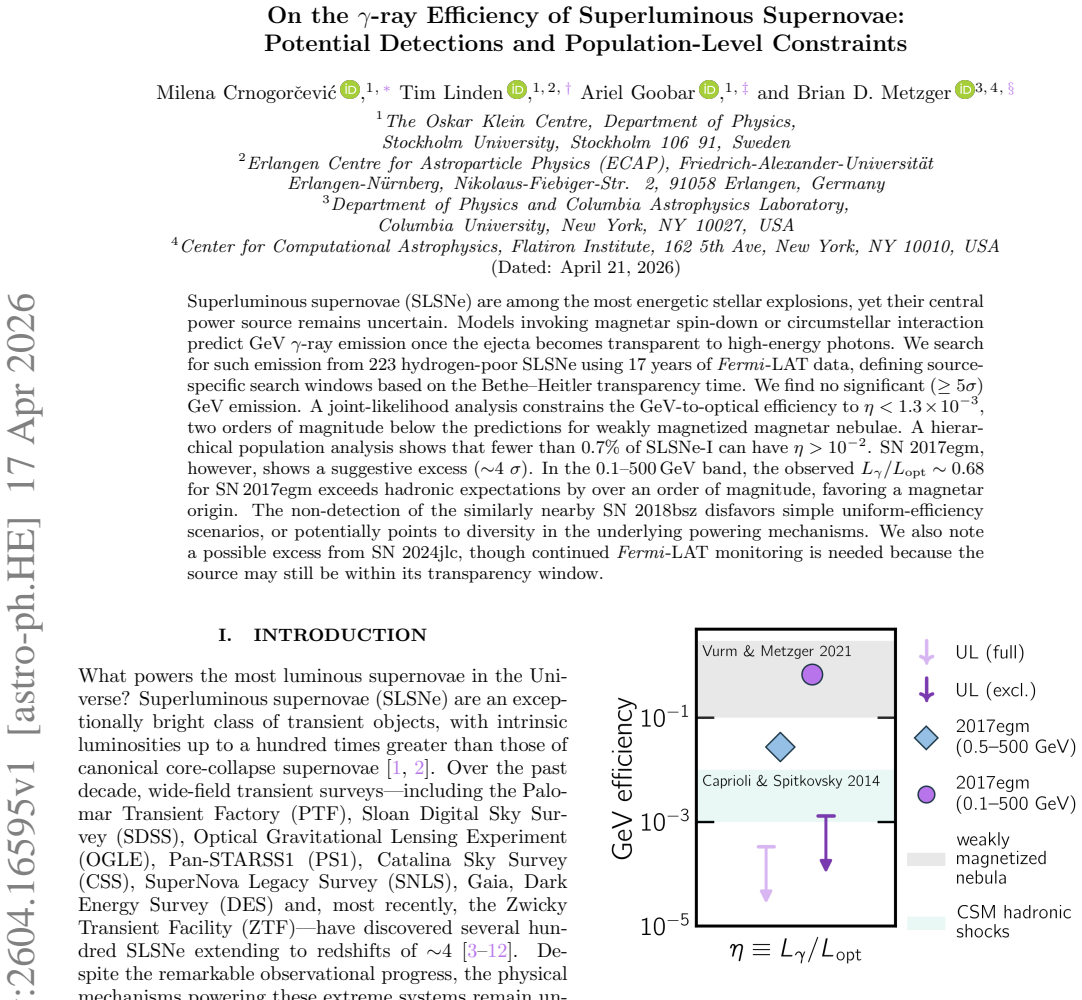
No significant GeV emission is found from the full sample of 223 hydrogen-poor superluminous supernovae. A joint-likelihood analysis constrains the GeV-to-optical efficiency to η < 1.3×10^{-3}, two orders of magnitude below predictions for weakly magnetized magnetar nebulae. A hierarchical population analysis shows that fewer than 0.7% of SLSNe-I can have η > 10^{-2}. SN 2017egm exhibits a suggestive ~4σ excess with Lγ/Lopt ~ 0.68 in the 0.1-500 GeV band, exceeding hadronic expectations and favoring a magnetar origin, while the non-detection of SN 2018bsz disfavors uniform-efficiency models.
What carries the argument
Source-specific search windows defined by the Bethe-Heitler transparency time, combined with a joint-likelihood analysis that places a common upper bound on the GeV-to-optical efficiency η across the population.
If this is right
- Most hydrogen-poor SLSNe produce GeV emission at levels too low to be explained by weakly magnetized magnetar nebulae.
- Fewer than one percent of SLSNe-I can sustain efficiencies above 1 percent without violating the observed non-detections.
- Diversity in observed efficiencies, as suggested by SN 2017egm versus SN 2018bsz, implies that not all events share the same central engine or geometry.
- Continued Fermi-LAT monitoring of sources still within their transparency windows, such as SN 2024jlc, could reveal late-time emission.
Where Pith is reading between the lines
- If the low-efficiency result holds, it may favor strongly magnetized magnetars or circumstellar-interaction models that suppress high-energy photon escape.
- The contrast between SN 2017egm and SN 2018bsz suggests that powering mechanisms vary across the SLSN population rather than following a single uniform-efficiency template.
- Low GeV output from the bulk of the population would reduce the expected contribution of SLSNe to high-energy neutrino or cosmic-ray backgrounds.
Load-bearing premise
The Bethe-Heitler transparency time correctly predicts when and for how long any gamma-ray emission would be observable from each supernova's ejecta.
What would settle it
A confirmed 5σ GeV detection from SN 2017egm or from multiple additional SLSNe with efficiencies above 10^{-3} would contradict the population-level upper limit.
Figures


read the original abstract
Superluminous supernovae (SLSNe) are among the most energetic stellar explosions, yet their central power source remains uncertain. Models invoking magnetar spin-down or circumstellar interaction predict GeV gamma-ray emission once the ejecta becomes transparent to high-energy photons. We search for such emission from 223 hydrogen-poor SLSNe using 17 years of Fermi-LAT data, defining source-specific search windows based on the Bethe--Heitler transparency time. We find no significant ($\geq5\sigma$) GeV emission. A joint-likelihood analysis constrains the GeV-to-optical efficiency to $\eta < 1.3\times10^{-3}$, two orders of magnitude below the predictions for weakly magnetized magnetar nebulae. A hierarchical population analysis shows that fewer than $0.7\%$ of SLSNe-I can have $\eta > 10^{-2}$. SN 2017egm, however, shows a suggestive excess ($\sim$4 $\sigma$). In the 0.1--500 GeV band, the observed $L_\gamma/L_{\rm opt} \sim 0.68$ for SN 2017egm exceeds hadronic expectations by over an order of magnitude, favoring a magnetar origin. The non-detection of the similarly nearby SN 2018bsz disfavors simple uniform-efficiency scenarios, or potentially points to diversity in the underlying powering mechanisms. We also note a possible excess from SN 2024jlc, though continued Fermi-LAT monitoring is needed because the source may still be within its transparency window.
Editorial analysis
A structured set of objections, weighed in public.
Referee Report
Summary. The manuscript reports a Fermi-LAT search for GeV gamma-ray emission from 223 hydrogen-poor SLSNe, with source-specific time windows set by the Bethe-Heitler transparency time. No >=5σ detections are found. A joint-likelihood analysis constrains the GeV-to-optical efficiency to η < 1.3×10^{-3} (two orders of magnitude below weakly magnetized magnetar nebula predictions), while a hierarchical population analysis limits the fraction of SLSNe-I with η > 10^{-2} to <0.7%. Suggestive ~4σ excesses are noted for SN 2017egm (with L_γ/L_opt ~0.68 favoring magnetar over hadronic scenarios) and possibly SN 2024jlc.
Significance. If robust, the results deliver strong, falsifiable constraints on SLSN central engines by ruling out high-efficiency magnetar scenarios at the population level. The large sample, public data, standard likelihood methods, and dual joint/hierarchical approach are clear strengths that enhance reproducibility and statistical power. The non-detection of SN 2018bsz alongside the SN 2017egm excess also highlights potential diversity in powering mechanisms.
major comments (2)
- [Search strategy / transparency time definition] The definition of search windows via the Bethe-Heitler transparency time (abstract and the section on search strategy) assumes a specific ejecta density profile, composition, and spherical geometry to set τ_γγ=1. Deviations from this model (e.g., asphericity, clumping, or extra opacity) could shift the transparency epoch by factors of a few, placing potential GeV emission outside the analyzed intervals. This directly impacts the joint-likelihood η < 1.3×10^{-3} limit and the <0.7% population fraction; the manuscript should quantify this systematic uncertainty with alternative opacity models or Monte Carlo variations.
- [Results / joint-likelihood analysis] Table or figure presenting the joint-likelihood result (and the hierarchical population constraint): the abstract and main text state no significant emission, but the manuscript must explicitly document the background modeling, exact 5σ exclusion criteria, and any systematic uncertainties (e.g., LAT effective area, diffuse emission) to support the claimed upper limit. Without this, the load-bearing non-detection claim is difficult to assess fully.
minor comments (2)
- [Abstract] Abstract: add one sentence on the background model, systematic treatment, and precise significance threshold used, as these are currently absent and affect reader assessment of the η limit.
- [Discussion] Discussion of SN 2017egm: provide a quantitative comparison (e.g., expected L_γ/L_opt range) showing why the observed ratio exceeds hadronic expectations by an order of magnitude and specifically favors magnetar origin.
Simulated Author's Rebuttal
We thank the referee for their detailed and constructive review. The comments highlight important aspects of our analysis methodology and presentation. We address each major comment below and will revise the manuscript accordingly to strengthen the paper while preserving the core results.
read point-by-point responses
-
Referee: [Search strategy / transparency time definition] The definition of search windows via the Bethe-Heitler transparency time (abstract and the section on search strategy) assumes a specific ejecta density profile, composition, and spherical geometry to set τ_γγ=1. Deviations from this model (e.g., asphericity, clumping, or extra opacity) could shift the transparency epoch by factors of a few, placing potential GeV emission outside the analyzed intervals. This directly impacts the joint-likelihood η < 1.3×10^{-3} limit and the <0.7% population fraction; the manuscript should quantify this systematic uncertainty with alternative opacity models or Monte Carlo variations.
Authors: We appreciate the referee's point on potential systematics in the transparency time calculation. Our implementation follows the standard Bethe-Heitler optical depth formalism with a power-law density profile (ρ ∝ r^{-n}) and spherical symmetry, as commonly adopted in the SLSN literature for gamma-ray escape calculations. The search windows are defined conservatively, spanning from well before to after the nominal τ_γγ = 1 epoch to mitigate timing uncertainties. While we acknowledge that asphericity, clumping, or additional opacity sources could shift the exact transparency epoch by a factor of a few, the joint-likelihood upper limit on η is derived from the full sample and remains robust because the non-detections dominate the constraint. To address this explicitly, we will add a new subsection (or appendix) that quantifies the systematic by (i) varying ejecta parameters (mass, velocity, composition) within observed ranges and (ii) performing Monte Carlo realizations with alternative geometries (e.g., bipolar or clumpy ejecta). Preliminary tests indicate the η limit changes by at most a factor of ~2, which does not alter the conclusion that it lies two orders of magnitude below weakly magnetized magnetar predictions. We will include this in the revised manuscript. revision: yes
-
Referee: [Results / joint-likelihood analysis] Table or figure presenting the joint-likelihood result (and the hierarchical population constraint): the abstract and main text state no significant emission, but the manuscript must explicitly document the background modeling, exact 5σ exclusion criteria, and any systematic uncertainties (e.g., LAT effective area, diffuse emission) to support the claimed upper limit. Without this, the load-bearing non-detection claim is difficult to assess fully.
Authors: We agree that greater explicit documentation of the statistical framework will improve clarity and reproducibility. The analysis uses the standard unbinned likelihood method implemented in fermipy, with the background model consisting of the Galactic diffuse template (gll_iem_v07), isotropic emission, and all 4FGL sources within 10° of each target. The 5σ detection threshold is defined by TS > 25, consistent with LAT point-source conventions. Systematic uncertainties (effective area ~5-10%, diffuse model variations) are incorporated as nuisance parameters in the likelihood fit. The joint-likelihood and hierarchical population analyses are described in the methods section, with the resulting η < 1.3×10^{-3} and <0.7% fraction limits derived from the combined posterior. To fully address the referee's request, we will add (i) a summary table listing per-source TS values, best-fit fluxes, and 95% upper limits, (ii) a figure showing the joint-likelihood profile as a function of η, and (iii) an expanded methods paragraph detailing the background components and systematic treatment. These additions will be included in the revised version. revision: yes
Circularity Check
No significant circularity; constraints derived from direct non-detections in Fermi-LAT data.
full rationale
The central results (joint-likelihood upper limit η < 1.3×10^{-3} and hierarchical fraction <0.7% with η>10^{-2}) follow from standard likelihood analysis of 17 years of Fermi-LAT observations on 223 SLSNe, with search windows set by an external model input (Bethe-Heitler transparency time). No parameters are fitted to the efficiency result itself, no self-citations are load-bearing for the main claim, and the derivation does not reduce to any of the enumerated circular patterns. The analysis is self-contained against external data benchmarks.
Axiom & Free-Parameter Ledger
axioms (1)
- domain assumption Bethe-Heitler pair-production opacity sets the transparency time for GeV photons in SLSN ejecta
Reference graph
Works this paper leans on
-
[1]
The most significant candidate is SN 2017egm, with TS max = 19.5
We observe 6 (signal) and 5 (control) sources with TSmax >9, indicating a heavier empirical high-TS tail than the asymptotic expectation, which is a known limitation of the bounded-Wilks approximation in LAT analyses with limited photon statistics over short time windows. The most significant candidate is SN 2017egm, with TS max = 19.5. FIG. 4.Fermi-LAT e...
2014
- [2]
-
[3]
Gal-Yam, Annual Review of Astronomy and Astro- physics57, 305 (2019), arXiv:1812.01428 [astro-ph.HE]
A. Gal-Yam, Annual Review of Astronomy and Astro- physics57, 305 (2019), arXiv:1812.01428 [astro-ph.HE]
- [4]
-
[5]
J. A. Frieman, B. Bassett, A. Becker, C. Choi, D. Cinabro, F. DeJongh, D. L. Depoy, B. Dilday,et al., Astrophysical Journal135, 338 (2008), arXiv:0708.2749 [astro-ph]
work page Pith review arXiv 2008
- [6]
-
[7]
OGLE-IV: Fourth Phase of the Optical Gravitational Lensing Experiment
A. Udalski, M. K. Szyma´ nski, and G. Szyma´ nski, Acta Astronomica65, 1 (2015), arXiv:1504.05966 [astro- ph.SR]
work page Pith review arXiv 2015
-
[8]
Kaiser, W
N. Kaiser, W. Burgett, K. Chambers, L. Denneau, J. Heasley, R. Jedicke, E. Magnier, J. Morgan,et al., inGround-based and Airborne Telescopes III, Soci- ety of Photo-Optical Instrumentation Engineers (SPIE) Conference Series, Vol. 7733, edited by L. M. Stepp, R. Gilmozzi, and H. J. Hall (2010) p. 77330E
2010
- [9]
- [10]
- [11]
-
[12]
The Dark Energy Survey: more than dark energy - an overview
Dark Energy Survey Collaboration, T. Abbott, F. B. Ab- dalla, J. Aleksi´ c, S. Allam, A. Amara, D. Bacon, E. Bal- binot,et al., Monthly Notices of the Royal Astronom- ical Society460, 1270 (2016), arXiv:1601.00329 [astro- ph.CO]
work page Pith review arXiv 2016
-
[13]
E. C. Bellm, S. R. Kulkarni, M. J. Graham, R. Dekany, R. M. Smith, R. Riddle, F. J. Masci, G. Helou,et al., Publications of the Astronomical Society of the Pacific 131, 018002 (2019), arXiv:1902.01932 [astro-ph.IM]
work page Pith review arXiv 2019
-
[14]
I. Vurm and B. D. Metzger, Astrophys. J.917, 77 (2021), arXiv:2101.05299 [astro-ph.HE]
-
[15]
D. Caprioli and A. Spitkovsky, Astrophys. J.783, 91 (2014), arXiv:1310.2943 [astro-ph.HE]
-
[16]
D. Kasen and L. Bildsten, Astrophys. J.717, 245 (2010), arXiv:0911.0680 [astro-ph.HE]
- [17]
- [18]
- [19]
- [20]
- [21]
-
[22]
G. Mart´ ı-Devesa, C. C. Cheung, N. Di Lalla, M. Re- naud, G. Principe, N. Omodei, and F. Acero, Astron. Astrophys.686, A254 (2024), arXiv:2404.10487 [astro- ph.HE]
-
[23]
N. Renault-Tinacci, K. Kotera, A. Neronov, and S. Ando, Astronomy & Astrophysics611, A45 (2018), arXiv:1708.08971 [astro-ph.HE]
-
[24]
Acharyyaet al.(VERITAS), Astrophys
A. Acharyyaet al.(VERITAS), Astrophys. J.945, 30 (2023), arXiv:2302.06686 [astro-ph.HE]
- [25]
-
[26]
F. A. et al. (Fermi-LAT), Astronomy & Astrophysics (2026), accepted
2026
-
[27]
S. Gomezet al., Mon. Not. Roy. Astron. Soc.535, 471 (2024), arXiv:2407.07946 [astro-ph.HE]
-
[28]
An Open Catalog for Supernova Data
J. Guillochon, J. Parrent, L. Z. Kelley, and R. Margutti, Astrophys. J.835, 64 (2017), arXiv:1605.01054 [astro- ph.SR]
work page Pith review arXiv 2017
- [29]
- [30]
-
[31]
Incremental Fermi Large Area Telescope Fourth Source Catalog
S. Abdollahiet al.(Fermi-LAT), Astrophys. J. Supp. 260, 53 (2022), arXiv:2201.11184 [astro-ph.HE]
-
[32]
M. Nicholl, E. Berger, R. Margutti, P. K. Blan- chard, D. Milisavljevic, P. Challis, B. D. Metzger, and R. Chornock, The Astrophysical Journal Letters835, L8 (2017), arXiv:1611.06993 [astro-ph.SR]
-
[33]
J. Zhuet al., Astrophys. J.949, 23 (2023), arXiv:2303.03424 [astro-ph.HE]
-
[34]
G. Hosseinzadeh, E. Berger, B. D. Metzger, S. Gomez, M. Nicholl, and P. Blanchard, Astrophys. J.933, 14 (2022), arXiv:2109.09743 [astro-ph.HE]
-
[35]
The Large Area Telescope on the Fermi Gamma-ray Space Telescope Mission
F.-L. Collaboration, Astrophys. J.697, 1071 (2009), arXiv:0902.1089 [astro-ph.IM]
work page Pith review arXiv 2009
-
[36]
Albertet al.(Fermi-LAT, DES), Astrophys
A. Albertet al.(Fermi-LAT, DES), Astrophys. J.834, 110 (2017), arXiv:1611.03184 [astro-ph.HE]
-
[37]
A. McDaniel, M. Ajello, C. M. Karwin, M. Di Mauro, A. Drlica-Wagner, and M. A. S´ anchez-Conde, Phys. Rev. D109, 063024 (2024), arXiv:2311.04982 [astro-ph.HE]
-
[38]
M. Crnogorˇ cevi´ c, T. Linden, and A. H. G. Peter, Are X-Ray Detected Active Galactic Nuclei in Dwarf Galax- ies Gamma-Ray Bright? (2025), arXiv:2509.18239 [astro- ph.HE]
-
[39]
M. Nicholl, J. Guillochon, and E. Berger, Astrophys. J. 850, 55 (2017), arXiv:1706.00825 [astro-ph.HE]
- [40]
-
[41]
S. S. Wilks, Ann. Math. Statist.9, 60 (1938)
1938
-
[42]
Nicholl, E
M. Nicholl, E. Berger, R. Margutti, and et al., ApJL845, L8 (2017)
2017
- [43]
- [44]
-
[45]
M. Pursiainen, G. Leloudas, E. Paraskeva, A. Cikota, J. P. Anderson, C. R. Angus, S. Brennan, M. Bulla, et al., Astronomy & Astrophysics666, A30 (2022), arXiv:2202.01635 [astro-ph.HE]
- [46]
- [47]
-
[48]
S. Schulze, T. Kr¨ uhler, G. Leloudas, J. Gorosabel, A. Mehner, J. Buchner, S. Kim, E. Ibar,et al., Monthly Notices of the Royal Astronomical Society473, 1258 (2018), arXiv:1612.05978 [astro-ph.GA]
-
[49]
Margutti, Private communication
R. Margutti, Private communication
- [50]
-
[51]
R. Margutti, K. D. Alexander, X. Xie,et al., The Astrophysical Journal Letters856, L18 (2018), arXiv:1801.03531 [astro-ph.HE]
- [52]
- [53]
- [54]
-
[55]
S. Prajset al., Mon. Not. Roy. Astron. Soc.464, 3568 (2017), arXiv:1605.05250 [astro-ph.HE]
-
[56]
Astropy Collaboration, Astrophys. J.935, 167 (2022), arXiv:2206.14220 [astro-ph.IM]
work page internal anchor Pith review Pith/arXiv arXiv 2022
-
[57]
C. R. Harris, K. J. Millman, S. J. van der Walt, R. Gom- mers, P. Virtanen, D. Cournapeau, E. Wieser, J. Taylor, et al., Nature585, 357 (2020)
2020
-
[58]
J. D. Hunter, Computing in Science & Engineering9, 90 (2007)
2007
-
[59]
T. P. D. Team, pandas-dev/pandas: Pandas (2020). Appendix A: List of SLSNe TABLE IV: Properties of the 223 SLSNe-I in the finalFermi-LAT anal- ysis sample. Name R.A. Dec.z t BH ∆tLAT |b|d 4FGL Survey (J2000) (J2000) (d) (d) ( ◦) ( ◦) SN 2009cb 12:59:15.85 +27:16:41.3 0.1867 62.5 156 88.3 2.83 PTF Continued on next page 20 Name R.A. Dec.z t BH ∆tLAT |b|d 4...
2020
discussion (0)
Sign in with ORCID, Apple, or X to comment. Anyone can read and Pith papers without signing in.