Recognition: unknown
The effect of the two-loop SMEFT RGEs at future colliders
Pith reviewed 2026-05-10 07:53 UTC · model grok-4.3
The pith
Two-loop RGE contributions produce non-negligible shifts in SMEFT fits for four-quark, top Yukawa and Higgs-gluon operators at future colliders.
A machine-rendered reading of the paper's core claim, the machinery that carries it, and where it could break.
Core claim
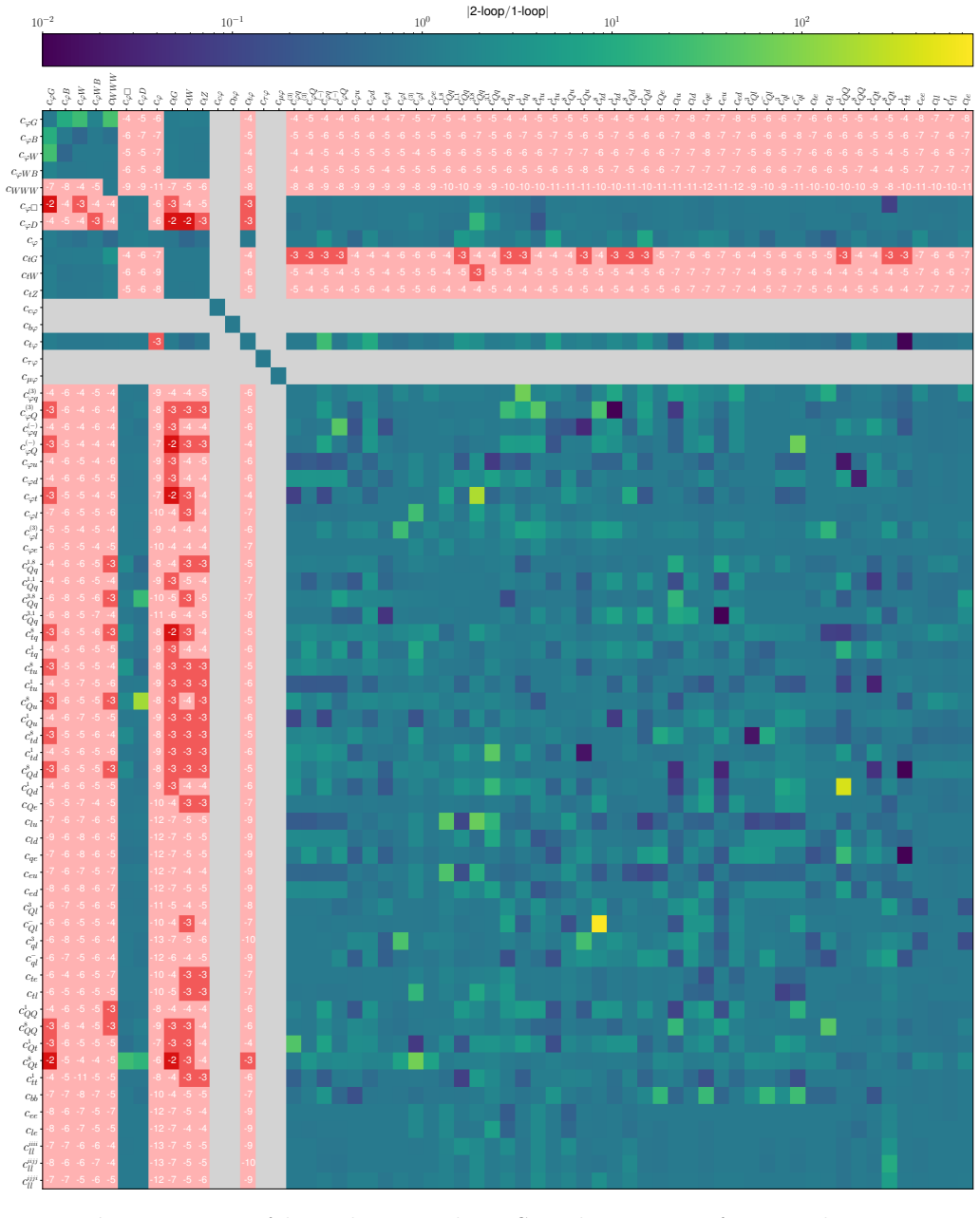
By solving the two-loop SMEFT RGEs numerically, the authors show that two-loop contributions alter mixing patterns and break zeroes that exist at one-loop order. In bottom-up phenomenological studies at HL-LHC and FCC-ee, this produces non-negligible effects for four-quark, top Yukawa and Higgs-gluon operators. In top-down fits to all scalar and fermion extensions of the Granada dictionary matched onto SMEFT at one-loop level, including couplings that enter only at one loop, the sensitivity to the model couplings changes at the percent level.
What carries the argument
The full numerical integration of the two-loop renormalization group equations for the Wilson coefficients of dimension-six SMEFT operators, which yields an evolution matrix that includes additional mixing terms absent at one loop.
If this is right
- Two-loop RGEs break some of the zeroes in the one-loop mixing matrix, allowing new operator mixing channels.
- Global and individual fits at HL-LHC and FCC-ee shift for four-quark operators, the top Yukawa, and Higgs-gluon interactions when two-loop running is used.
- Quadratic-level fits exhibit different behavior once two-loop contributions are retained.
- Sensitivity to the couplings of scalar and fermion UV extensions changes by a few percent when one-loop matching is combined with two-loop running.
Where Pith is reading between the lines
- Current one-loop-only SMEFT analyses for other processes may require re-evaluation once high-precision data arrive.
- The breaking of one-loop zeroes opens new ways to constrain previously decoupled operators through running alone.
- Extending the top-down study to two-loop matching of the same UV models would likely enlarge the observed corrections in some cases.
Load-bearing premise
Higher-order corrections to the matching of UV models onto SMEFT remain negligible compared with the two-loop RGE effects themselves.
What would settle it
A direct measurement at HL-LHC or FCC-ee showing that the extracted bounds on four-quark, top Yukawa or Higgs-gluon Wilson coefficients remain unchanged at the percent level when two-loop RGE evolution is included versus one-loop only.
Figures


read the original abstract
The search for New Physics requires ever increasing precision from experimental and theoretical efforts. Within the Standard Model Effective Field Theory (SMEFT) framework, the latest achievement in this quest has been the complete computation of the two-loop Renormalisation Group Equations (RGEs) for the Wilson Coefficients of dimension-six operators. In this work, we solve the two-loop SMEFT RGEs with full numerical integration and compare the evolution matrix obtained at one and two loops to analyze how two-loop contributions alter mixing patterns and break zeroes present at one-loop order. Then, we perform a first comprehensive analysis of the impact of the two-loop RGEs in phenomenological studies at HL-LHC and FCC-ee. From a bottom-up perspective, we carry out individual and global fits at linear and quadratic level for a set of 61 Wilson coefficients and compare against the results obtained by including only one-loop RGE effects. We find non-negligible two-loop induced effects in some cases, in particular for four-quark, top Yukawa and Higgs-gluon operators. From a top-down perspective, we perform fits to all the scalar and fermion extensions of the Granada dictionary matched onto SMEFT at one-loop level, including for the first time the couplings that enter only at one loop, and find percent-level effects in the sensitivity to the couplings of some models.
Editorial analysis
A structured set of objections, weighed in public.
Referee Report
Summary. The paper numerically integrates the complete two-loop SMEFT RGEs for dimension-six operators and compares the resulting evolution matrices to their one-loop counterparts, identifying altered mixing patterns and broken zeros. It then performs bottom-up linear and quadratic fits to a set of 61 Wilson coefficients using projected HL-LHC and FCC-ee data, reporting non-negligible two-loop-induced shifts especially for four-quark, top-Yukawa and Higgs-gluon operators. In a top-down analysis, all scalar and fermion UV completions from the Granada dictionary are matched onto SMEFT at one loop (including one-loop-only couplings) and evolved with the two-loop RGEs, yielding percent-level changes in the extracted sensitivities for some models.
Significance. If the numerical results hold, the work demonstrates that two-loop running cannot be neglected in precision SMEFT studies at future colliders for selected operator classes, and supplies the first systematic top-down survey that incorporates one-loop-only matching coefficients. The full numerical integration and the breadth of the 61-coefficient fits constitute clear technical strengths.
major comments (2)
- [top-down perspective section] Top-down analysis (abstract and corresponding results section): the reported percent-level shifts in UV-model sensitivities are obtained after one-loop matching followed by two-loop RGE evolution. For the four-quark, top-Yukawa and Higgs-gluon operators where two-loop RGE effects are stated to be non-negligible, two-loop matching corrections are generically O(1/16π²) and of the same order as the one-loop matching terms already included. No estimate or bound on these higher-order matching contributions is provided, so the claimed impact cannot be cleanly attributed to running alone.
- [RGE integration and evolution-matrix comparison] Numerical RGE integration section: the manuscript states that the two-loop RGEs are solved by full numerical integration, yet supplies no information on the integrator, step-size control, convergence tests, or validation against known one-loop analytic limits and benchmark points. Given that the central phenomenological claims rest on the difference between one- and two-loop evolution matrices, such technical details are required to assess numerical reliability.
minor comments (2)
- [abstract] The abstract and introduction should explicitly state the number of UV models considered and the precise set of 61 Wilson coefficients retained in the global fits.
- [figures showing evolution matrices] Figure captions for the evolution-matrix comparisons should indicate the renormalization scale at which the matrices are evaluated and the reference scale used for the initial conditions.
Simulated Author's Rebuttal
We thank the referee for the careful reading of our manuscript and the constructive comments. We address each major comment below and have revised the manuscript to incorporate the suggestions where appropriate.
read point-by-point responses
-
Referee: [top-down perspective section] Top-down analysis (abstract and corresponding results section): the reported percent-level shifts in UV-model sensitivities are obtained after one-loop matching followed by two-loop RGE evolution. For the four-quark, top-Yukawa and Higgs-gluon operators where two-loop RGE effects are stated to be non-negligible, two-loop matching corrections are generically O(1/16π²) and of the same order as the one-loop matching terms already included. No estimate or bound on these higher-order matching contributions is provided, so the claimed impact cannot be cleanly attributed to running alone.
Authors: We agree that two-loop matching corrections are of the same perturbative order as the one-loop matching terms we include. Our top-down analysis is explicitly constructed to isolate the effect of two-loop RGE evolution by using identical one-loop matching coefficients for both the one-loop and two-loop running comparisons. This isolates the running contribution to the observed percent-level shifts in sensitivities. We have added a clarifying paragraph in the revised top-down section stating the scope of the study and noting that a complete NLO treatment would require two-loop matching for each UV model, which is a substantial separate computation beyond the present work. revision: partial
-
Referee: [RGE integration and evolution-matrix comparison] Numerical RGE integration section: the manuscript states that the two-loop RGEs are solved by full numerical integration, yet supplies no information on the integrator, step-size control, convergence tests, or validation against known one-loop analytic limits and benchmark points. Given that the central phenomenological claims rest on the difference between one- and two-loop evolution matrices, such technical details are required to assess numerical reliability.
Authors: We thank the referee for this important observation. In the revised manuscript we have added a dedicated paragraph in the numerical RGE integration section with the requested technical details. The two-loop SMEFT RGEs are integrated using an adaptive fourth-order Runge-Kutta integrator with relative and absolute tolerances set to 10^{-10}. Step-size control is performed dynamically. Validation consists of recovering the exact analytic one-loop evolution matrices when the two-loop beta functions are switched off, for multiple benchmark points including cases with vanishing two-loop mixing. Convergence was verified by tightening the tolerances by an order of magnitude, with the resulting evolution matrices stable to better than 0.1 percent, which is sufficient for the precision of our collider projections. revision: yes
Circularity Check
No significant circularity in derivation chain
full rationale
The paper solves the two-loop SMEFT RGEs via independent numerical integration (external computation) and performs explicit bottom-up and top-down fits to projected collider data. Top-down matching of UV models is done at one-loop order as an explicit assumption, with results compared to one-loop RGE evolution; no step reduces by construction to a fitted parameter renamed as prediction, self-definition, or load-bearing self-citation. The central claims rest on direct numerical comparisons and data fits that remain falsifiable against external benchmarks.
Axiom & Free-Parameter Ledger
axioms (2)
- domain assumption Validity of SMEFT with dimension-six operators up to collider energy scales
- domain assumption One-loop matching of UV models to SMEFT is adequate for RGE impact studies
Forward citations
Cited by 1 Pith paper
-
When Two Loops Matter: Electroweak Precision in the SMEFT
A modification to the top-Higgs Yukawa coupling in SMEFT induces a two-loop shift in the W mass through a large anomalous dimension, providing a new indirect probe via electroweak precision observables.
Reference graph
Works this paper leans on
- [1]
- [2]
-
[3]
R. Alonso, E. E. Jenkins, A. V. Manohar and M. Trott,Renormalization Group Evolution of the Standard Model Dimension Six Operators III: Gauge Coupling Dependence and Phenomenology,JHEP04(2014) 159 [1312.2014]
-
[4]
J. Aebischer, J. Kumar and D. M. Straub,Wilson: a Python package for the running and matching of Wilson coefficients above and below the electroweak scale,Eur. Phys. J. C78 (2018) 1026 [1804.05033]
-
[5]
J. Fuentes-Martin, P. Ruiz-Femenia, A. Vicente and J. Virto,DsixTools 2.0: The Effective Field Theory Toolkit,Eur. Phys. J. C81(2021) 167 [2010.16341]
-
[6]
S. Di Noi and L. Silvestrini,RGESolver: a C++ library to perform renormalization group evolution in the Standard Model Effective Theory,Eur. Phys. J. C83(2023) 200 [2210.06838]
-
[7]
J. de Blas, M. Chala and J. Santiago,Renormalization Group Constraints on New Top Interactions from Electroweak Precision Data,JHEP09(2015) 189 [1507.00757]
- [8]
-
[9]
L. Allwicher, C. Cornella, G. Isidori and B. A. Stefanek,New physics in the third generation. A comprehensive SMEFT analysis and future prospects,JHEP03(2024) 049 [2311.00020]
-
[10]
M. Battaglia, M. Grazzini, M. Spira and M. Wiesemann,Sensitivity to BSM effects in the Higgs p T spectrum within SMEFT,JHEP11(2021) 173 [2109.02987]
- [11]
-
[12]
S. Di Noi and R. Gr¨ ober,Renormalisation group running effects inpp→t ¯thin the Standard Model Effective Field Theory,Eur. Phys. J. C84(2024) 403 [2312.11327]
-
[13]
Indirect constraints on top quark operators from a global SMEFT analysis,
F. Garosi, D. Marzocca, A. R. S´ anchez and A. Stanzione,Indirect constraints on top quark operators from a global SMEFT analysis,JHEP12(2023) 129 [2310.00047]
-
[14]
F. Maltoni, G. Ventura and E. Vryonidou,Impact of SMEFT renormalisation group running on Higgs production at the LHC,JHEP12(2024) 183 [2406.06670]
-
[15]
R. Bartocci, A. Biek¨ otter and T. Hurth,Renormalisation group evolution effects on global SMEFT analyses,JHEP05(2025) 203 [2412.09674]
-
[16]
Connecting scales: RGE effects in the SMEFT at the LHC and future colliders,
J. ter Hoeve, L. Mantani, J. Rojo, A. N. Rossia and E. Vryonidou,Connecting scales: RGE effects in the SMEFT at the LHC and future colliders,JHEP06(2025) 125 [2502.20453]
-
[17]
J. de Blas, A. Goncalves, V. Miralles, L. Reina, L. Silvestrini and M. Valli,Constraining new physics effective interactions via a global fit of electroweak, Drell-Yan, Higgs, top, and flavour observables,JHEP03(2026) 013 [2507.06191]. – 30 –
-
[18]
S. Das Bakshi, J. Chakrabortty and S. K. Patra,CoDEx: Wilson coefficient calculator connecting SMEFT to UV theory,Eur. Phys. J. C79(2019) 21 [1808.04403]
-
[19]
A. Carmona, A. Lazopoulos, P. Olgoso and J. Santiago,Matchmakereft: automated tree-level and one-loop matching,SciPost Phys.12(2022) 198 [2112.10787]
-
[20]
J. Fuentes-Mart´ ın, M. K¨ onig, J. Pag` es, A. E. Thomsen and F. Wilsch,A proof of concept for matchete: an automated tool for matching effective theories,Eur. Phys. J. C83(2023) 662 [2212.04510]
- [21]
-
[22]
From the EFT to the UV: the complete SMEFT one-loop dictionary
G. Guedes and P. O. Ruiz,From the EFT to the UV: the complete SMEFT one-loop dictionary,SciPost Phys.20(2026) 074 [2412.14253]
work page internal anchor Pith review Pith/arXiv arXiv 2026
-
[23]
J. de Blas, J. C. Criado, M. Perez-Victoria and J. Santiago,Effective description of general extensions of the Standard Model: the complete tree-level dictionary,JHEP03(2018) 109 [1711.10391]
-
[24]
F. del Aguila, M. Perez-Victoria and J. Santiago,Observable contributions of new exotic quarks to quark mixing,JHEP09(2000) 011 [hep-ph/0007316]
-
[25]
F. del Aguila, J. de Blas and M. Perez-Victoria,Effects of new leptons in Electroweak Precision Data,Phys. Rev. D78(2008) 013010 [0803.4008]
-
[26]
F. del Aguila, J. de Blas and M. Perez-Victoria,Electroweak Limits on General New Vector Bosons,JHEP09(2010) 033 [1005.3998]
-
[27]
J. de Blas, M. Chala, M. Perez-Victoria and J. Santiago,Observable Effects of General New Scalar Particles,JHEP04(2015) 078 [1412.8480]
-
[28]
L. Allwicher, M. McCullough and S. Renner,New physics at Tera-Z: precision renormalised, JHEP02(2025) 164 [2408.03992]
-
[29]
J. Aebischer, A. J. Buras and J. Kumar,NLO QCD renormalization group evolution for nonleptonic∆F=2 transitions in the SMEFT,Phys. Rev. D106(2022) 035003 [2203.11224]
- [30]
- [31]
- [32]
- [33]
-
[34]
S. Di Noi and R. Gr¨ ober,Two loops, four tops and twoγ5 schemes: A renormalization story, Phys. Lett. B869(2025) 139878 [2507.10295]
-
[35]
HaischJHEP06(2025) 004,arXiv:2503.06249 [hep-ph]
U. Haisch,Higgs production from anomalous gluon dynamics,JHEP06(2025) 004 [2503.06249]
-
[36]
U. Haisch and M. Niggetiedt,Precision tests of third-generation four-quark operators: gg→handh→γγ,2507.20803. – 31 –
- [37]
-
[38]
S. Di Noi, B. A. Erdelyi and R. Gr¨ ober,Complete two-loop Yukawa-induced running of the Higgs-gluon coupling in SMEFT,2510.14680
- [39]
-
[40]
J. Henriksson, S. R. Kousvos and J. Roosmale Nepveu,EFT meets CFT: Multiloop renormalization of higher-dimensional operators in general 4 theories,2511.16740
-
[41]
Zhang,Two-loop renormalization group equations in theνSMEFT,JHEP06(2025) 106 [2504.00792]
D. Zhang,Two-loop renormalization group equations in theνSMEFT,JHEP06(2025) 106 [2504.00792]
- [42]
- [43]
- [44]
-
[45]
C. Degrande, G. Durieux, F. Maltoni, K. Mimasu, E. Vryonidou and C. Zhang,Automated one-loop computations in the standard model effective field theory,Phys. Rev. D103(2021) 096024 [2008.11743]
-
[46]
J. Fuentes-Mart´ ın, M. K¨ onig, J. Pag` es, A. E. Thomsen and F. Wilsch,Evanescent operators in one-loop matching computations,JHEP02(2023) 031 [2211.09144]
- [47]
-
[48]
Armadillo, E
T. Armadillo, E. Celada, J. ter Hoeve, F. Maltoni, L. Mantani, J. Rojo et al.,New Physics Reach through Precision at Future Colliders: a Multi-Pronged Approach,To Appear: 2604.xxyyy
-
[49]
J. de Blas et al.,Physics Briefing Book: Input for the 2026 update of the European Strategy for Particle Physics,2511.03883
-
[50]
E. Celada, T. Giani, J. ter Hoeve, L. Mantani, J. Rojo, A. N. Rossia et al.,Mapping the SMEFT at high-energy colliders: from LEP and the (HL-)LHC to the FCC-ee,JHEP09 (2024) 091 [2404.12809]. [51]FCCcollaboration,Future Circular Collider Feasibility Study Report: Volume 1, Physics, Experiments, Detectors,Eur. Phys. J. C85(2025) 1468 [2505.00272]
- [51]
-
[52]
S. Di Noi, H. El Faham, R. Gr¨ ober, M. Vitti and E. Vryonidou,Constraining four-heavy-quark operators with top-quark, Higgs, and electroweak precision data,JHEP01 (2026) 025 [2507.01137]. [54]SMEFiTcollaboration,Combined SMEFT interpretation of Higgs, diboson, and top quark data from the LHC,JHEP11(2021) 089 [2105.00006]. – 32 –
-
[53]
Brivio,SMEFTsim 3.0 — a practical guide,JHEP04(2021) 073 [2012.11343]
I. Brivio,SMEFTsim 3.0 — a practical guide,JHEP04(2021) 073 [2012.11343]. – 33 –
discussion (0)
Sign in with ORCID, Apple, or X to comment. Anyone can read and Pith papers without signing in.