Recognition: unknown
DMRadio-Core: A new approach for GUT-scale axion searches
Pith reviewed 2026-05-10 06:53 UTC · model grok-4.3
The pith
A segmented solenoid with external resonators reduces stored magnetic energy for axion searches without sacrificing sensitivity.
A machine-rendered reading of the paper's core claim, the machinery that carries it, and where it could break.
Core claim
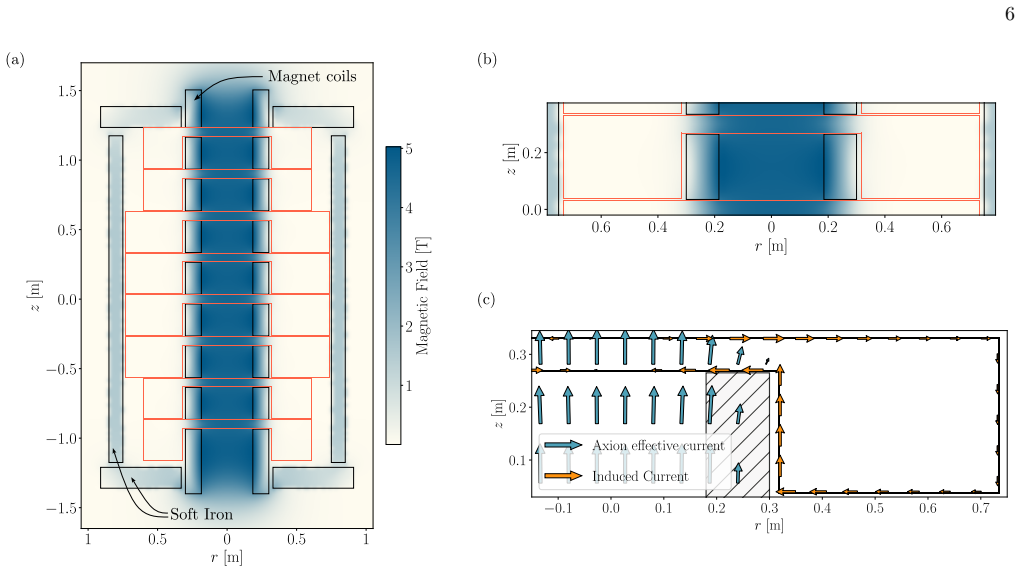
The authors propose that a narrow-bore, segmented solenoid optimizes the collection of axion-induced signals using LC resonators placed outside the high-field region of the magnet bore. This geometry significantly reduces the required stored magnetic energy while preserving sensitivity to axion-photon couplings, enabling near-term experiments in the 30-200 MHz range corresponding to 120-830 neV/c² and cost-effective scaling to GUT-scale searches in the 100 kHz-30 MHz range for 0.4-120 neV/c² masses.
What carries the argument
The narrow-bore segmented solenoid paired with external LC resonators for signal collection.
If this is right
- Reduces stored magnetic energy needed for the experiment.
- Enables a near-term experiment in the 30-200 MHz frequency range.
- Supports staged scaling to a full GUT-scale axion search in the 100 kHz-30 MHz range.
- Maintains sensitivity to small axion-photon couplings despite lower energy.
Where Pith is reading between the lines
- Similar external resonator placements could be adapted for other axion search methods or related particle physics experiments to cut costs.
- If the energy savings hold, this might accelerate timelines for detecting or excluding axions at GUT-motivated scales.
- Future work could test the resonator placement in prototype setups to verify signal collection efficiency.
Load-bearing premise
That LC resonators outside the high-field region can collect the axion-induced signal with negligible loss compared to placement inside the bore, without adding significant noise or coupling problems.
What would settle it
A direct comparison measurement showing that external resonator placement results in more than a small percentage loss in signal-to-noise ratio relative to an in-bore resonator under the same magnetic field conditions.
Figures




read the original abstract
Searches for QCD axions with masses in the neV/$c^2$ mass range are strongly motivated by new physics at the GUT scale and by well-motivated pre-inflationary axion symmetry breaking scales. This parameter space is challenging to probe due to the small axion-photon couplings, which typically require large, high-field magnets with substantial stored energy. In this paper, we propose a new experimental geometry based on a narrow-bore, segmented solenoid that optimizes the collection of the axion-induced signal using LC resonators outside the high-field region of the magnet bore. This alternative optimization significantly reduces the required stored magnetic energy while preserving sensitivity, enabling a near-term experiment in the 30-200 MHz (120-830 neV/$c^2$) range, with a cost-effective, staged scaling to a GUT-scale experiment in the 100 kHz-30 MHz (0.4-120 neV/$c^2$) range.
Editorial analysis
A structured set of objections, weighed in public.
Referee Report
Summary. The manuscript proposes DMRadio-Core, a new experimental geometry for QCD axion searches in the neV/c² range. It employs a narrow-bore segmented solenoid with LC resonators placed outside the high-field region to collect the axion-induced signal, claiming this reduces stored magnetic energy while preserving sensitivity. This is said to enable a near-term experiment in the 30-200 MHz (120-830 neV/c²) range and cost-effective staged scaling to a GUT-scale search in the 100 kHz-30 MHz (0.4-120 neV/c²) range.
Significance. If the proposed geometry can be shown to achieve the claimed energy reduction without loss of sensitivity, it would address a major practical barrier in axion haloscope experiments by lowering magnet costs and enabling scalable designs for the challenging GUT-scale parameter space. The approach is forward-looking and could facilitate near-term prototyping, but its significance remains prospective given the lack of quantitative validation.
major comments (2)
- [Abstract] Abstract: The central claim that the geometry 'significantly reduces the required stored magnetic energy while preserving sensitivity' is stated as an outcome but is unsupported by any calculations, simulations, sensitivity projections, or comparisons to conventional in-bore resonator designs. This quantitative assertion is load-bearing for the paper's motivation and feasibility argument.
- [Abstract] Abstract: The proposal assumes LC resonators outside the bore can collect the axion-induced signal with negligible loss, without introducing new noise or coupling inefficiencies. No analysis of signal transfer efficiency, Q-factor impacts, or noise budgets is provided to support this assumption, which underpins the energy-saving claim.
minor comments (1)
- [Abstract] The frequency and mass ranges are given in both MHz and neV/c² units; a brief note on the conversion relation used would improve clarity for readers.
Simulated Author's Rebuttal
We thank the referee for the constructive and detailed comments on our manuscript proposing the DMRadio-Core geometry. We agree that the central claims require stronger quantitative support to be fully convincing and have outlined revisions below to address each point.
read point-by-point responses
-
Referee: [Abstract] Abstract: The central claim that the geometry 'significantly reduces the required stored magnetic energy while preserving sensitivity' is stated as an outcome but is unsupported by any calculations, simulations, sensitivity projections, or comparisons to conventional in-bore resonator designs. This quantitative assertion is load-bearing for the paper's motivation and feasibility argument.
Authors: We agree that the abstract presents this as a key outcome without explicit supporting calculations or comparisons. The manuscript focuses on describing the novel segmented solenoid and external-resonator geometry at a conceptual level. To strengthen the paper, we will add a new section providing order-of-magnitude calculations of stored magnetic energy for the proposed design versus conventional in-bore haloscopes, along with sensitivity projections based on standard axion-photon conversion formulas and preliminary comparisons. These will be included in the revised manuscript. revision: yes
-
Referee: [Abstract] Abstract: The proposal assumes LC resonators outside the bore can collect the axion-induced signal with negligible loss, without introducing new noise or coupling inefficiencies. No analysis of signal transfer efficiency, Q-factor impacts, or noise budgets is provided to support this assumption, which underpins the energy-saving claim.
Authors: This is a fair observation; the current text assumes efficient external signal collection based on electromagnetic principles but does not quantify transfer efficiency, Q impacts, or noise. In the revision we will add an analysis of signal transfer efficiency for the external LC resonators, discuss any effects on resonator Q-factor from the geometry, and provide a preliminary noise budget demonstrating that the external placement does not introduce prohibitive additional noise or coupling losses relative to in-bore designs. revision: yes
Circularity Check
No significant circularity in the experimental proposal
full rationale
The manuscript is a forward-looking proposal for a segmented solenoid geometry with external LC resonators. The abstract and available description contain no equations, fitted parameters, or self-citations that reduce the claimed sensitivity or energy savings to a self-defined quantity by construction. The optimization is presented as an independent design choice motivated by practical constraints on stored magnetic energy, without load-bearing steps that collapse to prior inputs or renamings of known results.
Axiom & Free-Parameter Ledger
axioms (2)
- domain assumption QCD axions exist with photon couplings in the neV mass range motivated by GUT-scale physics
- ad hoc to paper LC resonators can be positioned outside the magnet bore without significant signal degradation
Forward citations
Cited by 2 Pith papers
-
Heterotic String Theory Suggests a QCD Axion Near 0.5 neV
Heterotic string theory implies the QCD axion mass is bounded below by 0.5 neV and typically falls in [0.5, 0.8] neV across most compactifications.
-
Pre-inflationary QCD axion stars after moduli domination
Pre-inflationary QCD axions form dense stars with densities up to 10^4 eV^4 that contain up to 50% of dark matter after moduli domination.
Reference graph
Works this paper leans on
-
[1]
R. D. Peccei and H. R. Quinn, Phys. Rev. Lett.38, 1440 (1977)
1977
-
[2]
R. D. Peccei and H. R. Quinn, Phys. Rev.D16, 1791 (1977)
1977
-
[3]
Weinberg, Phys
S. Weinberg, Phys. Rev. Lett.40, 223 (1978)
1978
-
[4]
Wilczek, Phys.Rev.Lett.40, 279 (1978)
F. Wilczek, Phys.Rev.Lett.40, 279 (1978)
1978
-
[5]
Preskillet al., Phys
J. Preskillet al., Phys. Lett. B120, 127 (1983)
1983
-
[6]
L. F. Abbott and P. Sikivie, Phys. Lett. B120, 133 (1983)
1983
-
[7]
Dine and W
M. Dine and W. Fischler, Phys. Lett. B120, 137 (1983)
1983
-
[8]
M. B. Green and J. H. Schwarz, Phys. Lett. B149, 117 (1984)
1984
- [9]
-
[10]
J. P. Conlon, JHEP05, 078, arXiv:hep-th/0602233
-
[11]
An M Theory Solution to the Strong CP Problem and Constraints on the Axiverse
B. Acharyaet al., JHEP11, 105, arXiv:1004.5138 [hep- th]
-
[12]
The type IIB string axiverse and its low-energy phenomenology
M. Cicoliet al., JHEP10, 146, arXiv:1206.0819 [hep-th]
-
[13]
J. Halversonet al., Phys. Rev. D100, 106010 (2019), arXiv:1909.05257 [hep-th]. 10
-
[14]
Witten, Phys
E. Witten, Phys. Lett. B149, 351 (1984)
1984
-
[15]
M. B. Wiseet al., Phys. Rev. Lett.47, 402 (1981)
1981
-
[16]
Ballesteroset al., JCAP08, 001, arXiv:1610.01639 [hep-ph]
G. Ballesteroset al., JCAP08, 001, arXiv:1610.01639 [hep-ph]
-
[17]
R. T. Coet al., Journal of High Energy Physics2021, 172 (2021)
2021
- [18]
-
[19]
L. Di Luzioet al., Phys. Rev. D98, 095011 (2018), arXiv:1807.09769 [hep-ph]
-
[20]
Ernstet al., PoSCORFU2018, 054 (2019), arXiv:1811.11860 [hep-ph]
A. Ernstet al., PoSCORFU2018, 054 (2019), arXiv:1811.11860 [hep-ph]
-
[21]
Fileviez P´ erezet al., JHEP11, 093, arXiv:1908.01772 [hep-ph]
P. Fileviez P´ erezet al., JHEP11, 093, arXiv:1908.01772 [hep-ph]
-
[22]
Fileviez P´ erezet al., JHEP01, 091, arXiv:1911.05738 [hep-ph]
P. Fileviez P´ erezet al., JHEP01, 091, arXiv:1911.05738 [hep-ph]
- [23]
- [24]
-
[25]
ADMX SLIC: Results from a Superconducting LC Circuit Investigating Cold Axions,
N. Crisostoet al., Phys. Rev. Lett.124, 241101 (2020), arXiv:1911.05772 [astro-ph.CO]
- [26]
-
[27]
Phippset al., inMicrowave Cavities and Detectors for Axion Research, edited by G
A. Phippset al., inMicrowave Cavities and Detectors for Axion Research, edited by G. Carosi and G. Ry- bka (Springer International Publishing, Cham, 2020) pp. 139–145
2020
-
[28]
Ankelet al., Design of the DMRadio-50L axion search (2026), to appear
V. Ankelet al., Design of the DMRadio-50L axion search (2026), to appear
2026
-
[29]
Ankelet al., The Cryogenic System of DMRadio-50L (2026), to appear
V. Ankelet al., The Cryogenic System of DMRadio-50L (2026), to appear
2026
- [30]
-
[31]
Projected sensitivity of DMRadio-m3: A search for the QCD axion below 1 µeV,
L. Brouweret al.(DMRadio Collaboration), Phys. Rev. D106, 103008 (2022), arXiv:2204.13781 [hep-ex]
-
[32]
AlShirawiet al.(DMRadio Collaboration), Phys
A. AlShirawiet al.(DMRadio Collaboration), Phys. Rev. D112, 052001 (2025), arXiv:2302.14084 [hep-ex]
-
[33]
Chaudhuriet al., Phys
S. Chaudhuriet al., Phys. Rev. D92, 075012 (2015)
2015
- [34]
-
[35]
Brouweret al.(DMRadio Collaboration), Phys
L. Brouweret al.(DMRadio Collaboration), Phys. Rev. D106, 112003 (2022), arXiv:2203.11246 [hep-ex]
-
[36]
Chaudhuriet al., (2018), arXiv:1803.01627 [hep-ph]
S. Chaudhuriet al., (2018), arXiv:1803.01627 [hep-ph]
- [37]
-
[38]
V. Ankelet al., J. Appl. Phys.138, 094505 (2025), arXiv:2504.20398 [quant-ph]
-
[39]
Altenm¨ ulleret al.(CAST), Phys
K. Altenm¨ ulleret al.(CAST), Phys. Rev. Lett.133, 221005 (2024), arXiv:2406.16840 [hep-ex]
-
[40]
R. Kolevatovet al., Rev. Sci. Instrum.97, 024503 (2026), arXiv:2511.03639 [physics.ins-det]
-
[41]
Mitchell, D
N. Mitchell, D. Bessette, R. Gallix, C. Jong, J. Knaster, P. Libeyre, C. Sborchia, and F. Simon, IEEE Transac- tions on Applied Superconductivity18, 435 (2008)
2008
-
[42]
Maeda and Y
H. Maeda and Y. Yanagisawa, IEEE Transactions on Ap- plied Superconductivity24, 1 (2014)
2014
-
[43]
J. Choiet al., Nucl. Instrum. Meth. A1013, 165667 (2021), arXiv:2007.07468 [physics.ins-det]
discussion (0)
Sign in with ORCID, Apple, or X to comment. Anyone can read and Pith papers without signing in.