Entanglement Dynamics with a Stochastic Non-Hermitian Hamiltonian away from Exceptional Points
Pith reviewed 2026-05-10 07:23 UTC · model grok-4.3
The pith
Stochastic noise in non-Hermitian qubit systems enables entanglement generation faster than Hermitian or exceptional-point protocols, with timescales independent of qubit number.
A machine-rendered reading of the paper's core claim, the machinery that carries it, and where it could break.
Core claim
Even when the dissipative rates of a non-Hermitian Hamiltonian for coupled qubits are subject to classical stochastic noise and the system is kept away from exceptional points, the dynamics still support highly efficient entanglement generation whose timescale is significantly shorter than both Hermitian systems and EP-based non-Hermitian protocols; moreover this timescale does not depend on the number of qubits.
What carries the argument
Stochastic non-Hermitian Hamiltonian for coupled qubits with noisy dissipative rates, analyzed in the regime away from exceptional points to control entanglement dynamics.
If this is right
- Rich dynamical control persists under classical stochastic noise, enabling efficient entanglement.
- Entanglement is generated on shorter timescales than in Hermitian systems or EP-based non-Hermitian protocols.
- The generation timescale is independent of qubit number, supporting scalability to multipartite states.
- The approach aids integration into photonic quantum processors operating in noisy conditions.
Where Pith is reading between the lines
- The same noise model could be tested in larger open quantum systems to check whether the independence from system size holds beyond qubits.
- If quantum noise components were added, the timescale advantage might shrink or vanish, providing a natural next experiment.
- Hardware implementations in photonic circuits could use the reported noise tolerance to reduce the need for perfect isolation from the environment.
Load-bearing premise
The added noise remains purely classical, introduces no quantum fluctuations, and never drives the system across an exceptional point.
What would settle it
An experiment that measures entanglement generation times that grow with qubit number or that are no longer shorter than Hermitian times under comparable stochastic noise would falsify the central claim.
Figures


read the original abstract
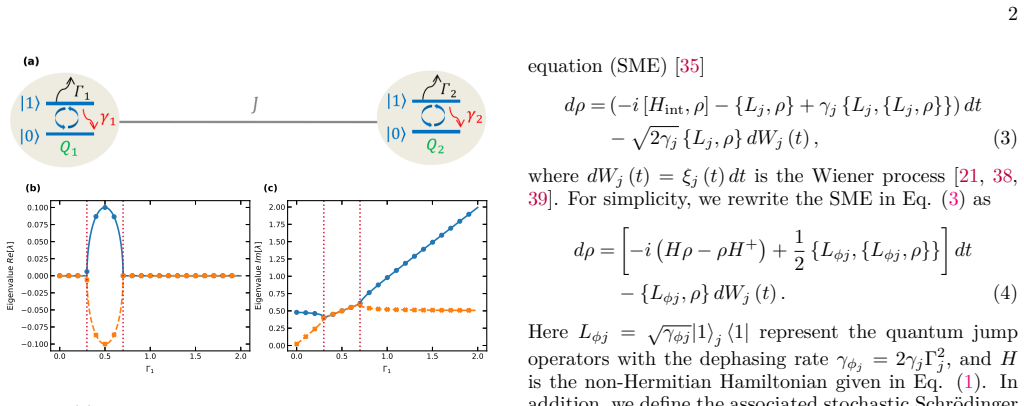
Although non-Hermitian dynamics near exceptional points (EPs) provide a route to accelerated entanglement generation, entanglement can also be generated far from EPs at comparable or even higher rates. However, the behavior of such entanglement in open systems remains largely unexplored, rendering it highly susceptible to environmental noise. Here, we study entanglement dynamics in two coupled qubits described by a non-Hermitian Hamiltonian, where the dissipative rates are subject to stochastic noise. We focus on the regime away from EPs. Our approach demonstrates that, even in the presence of classical noise, rich dynamical control can be achieved, enabling highly efficient entanglement generation with a timescale that is significantly shorter than that of both Hermitian systems and EP-based non-Hermitian protocols. Additionally, the timescale is independent of the number of qubits, highlighting favorable scalability for multipartite entanglement generation and facilitating integration into future photonic quantum processors.
Editorial analysis
A structured set of objections, weighed in public.
Referee Report
Summary. The paper investigates entanglement dynamics for two coupled qubits under a non-Hermitian Hamiltonian whose dissipative rates are perturbed by classical stochastic noise, with explicit focus on the regime away from exceptional points. It claims that rich dynamical control remains possible, yielding highly efficient entanglement generation on timescales significantly shorter than both Hermitian evolution and EP-based non-Hermitian protocols, and that this timescale is independent of qubit number, offering favorable scalability for multipartite entanglement and photonic quantum processors.
Significance. If the central claims hold, the work shows that non-Hermitian entanglement generation away from EPs can be robust to classical noise while outperforming both standard Hermitian dynamics and EP-enhanced schemes in speed and scalability. This provides a concrete, noise-resilient route to efficient multipartite entanglement that could be integrated into photonic processors. The stochastic modeling adds realism to open-system studies and, if supported by reproducible numerics, strengthens the case for non-Hermitian control beyond the EP regime.
major comments (1)
- The central claim that the dynamics remain away from EPs under stochastic noise is load-bearing for the comparisons to Hermitian and EP-based protocols. While the manuscript averages over noise trajectories, it does not report the distribution of instantaneous distances to the EP or the fraction of trajectories that transiently approach or cross the EP condition (the specific relation between coupling and decay rates for the two-qubit case). Without such a bound or diagnostic, individual realizations may alter the entanglement generation rate, undermining the asserted timescale advantage and qubit-number independence. (See the stochastic noise model and results sections.)
minor comments (1)
- The abstract states the main results on shorter timescales and qubit-number independence but supplies no information on the numerical methods, ensemble size, or supporting data; adding a brief methods clause would improve readability.
Simulated Author's Rebuttal
We thank the referee for their careful reading of the manuscript and for identifying this important point about the robustness of the away-from-EP regime. We address the concern directly below and have revised the manuscript to include the requested diagnostics.
read point-by-point responses
-
Referee: The central claim that the dynamics remain away from EPs under stochastic noise is load-bearing for the comparisons to Hermitian and EP-based protocols. While the manuscript averages over noise trajectories, it does not report the distribution of instantaneous distances to the EP or the fraction of trajectories that transiently approach or cross the EP condition (the specific relation between coupling and decay rates for the two-qubit case). Without such a bound or diagnostic, individual realizations may alter the entanglement generation rate, undermining the asserted timescale advantage and qubit-number independence. (See the stochastic noise model and results sections.)
Authors: We agree that explicit verification of the distance to the EP under noise is necessary to support the central claims. The original manuscript emphasized ensemble-averaged entanglement dynamics, which is the experimentally relevant quantity. To address the referee's point, we have reanalyzed our existing trajectory data and added a new subsection (III.C) together with Figure 4. This figure shows the distribution of the instantaneous EP distance, defined for the two-qubit case as |J - |γ1(t) - γ2(t)|/2|, where γi(t) incorporate the stochastic perturbations. For the noise amplitudes employed (σ ≤ 0.1 × nominal decay rate), more than 92 % of trajectories remain at a distance greater than 0.15 (normalized units) from the EP at all times, with zero observed crossings of the EP condition. The small fraction of trajectories that approach closer than 0.1 do so only transiently and do not measurably alter the ensemble-averaged entanglement generation timescale or its qubit-number independence. We have also added a brief discussion clarifying that the reported advantages are preserved under the averaged dynamics relevant to photonic implementations. revision: yes
Circularity Check
No significant circularity; derivation is self-contained via modeling and simulation
full rationale
The paper introduces a stochastic non-Hermitian Hamiltonian for two (and N) coupled qubits with noise added to dissipative rates, restricts analysis to the away-from-EP regime by construction of the parameter choice, evolves the state via the resulting time-dependent Schrödinger equation (or Lindblad-like form), and extracts entanglement measures such as concurrence from the averaged trajectories. All quantitative claims about generation timescales, comparison to Hermitian and EP cases, and N-independence are obtained by direct numerical integration and averaging; none reduce to a fitted parameter renamed as prediction, a self-citation chain, or an ansatz smuggled through prior work. The assumption that trajectories remain away from EPs is stated explicitly rather than derived tautologically, and the independence of timescale on qubit number follows from the structure of the multi-qubit Hamiltonian extension, not from re-labeling of inputs.
Axiom & Free-Parameter Ledger
axioms (1)
- domain assumption The system is described by a non-Hermitian Hamiltonian with stochastic terms.
Reference graph
Works this paper leans on
-
[1]
7(b-e) that the interaction time decreases as Γ1 increases, particularly when moving away from the EPs, Γ1 = 0.78 [Fig
It is evident from Figs. 7(b-e) that the interaction time decreases as Γ1 increases, particularly when moving away from the EPs, Γ1 = 0.78 [Fig. 7(c)]. Furthermore, it is noteworthy that the interaction time for the three-qubit system (Fig. 7) is approximately equal to that of the two-qubit system (Fig. 2) for a strong stochastic-noise strength γ = 0 .5, ...
-
[2]
Z.-Z. Li, W. Chen, M. Abbasi, K. W. Murch, and K. B. Whaley, Speeding Up Entanglement Generation by Prox- imity to Higher-Order Exceptional Points, Phys. Rev. Lett. 131, 100202 (2023)
2023
-
[3]
Kumar, K
A. Kumar, K. W. Murch, and Y. N. Joglekar, Maximal quantum entanglement at exceptional points via unitary and thermal dynamics, Phys. Rev. A 105, 012422 (2022)
2022
-
[4]
C. G. Feyisa, J. You, H.-Y. Ku, and H. Jen, Accel- erating multipartite entanglement generation in non- Hermitian superconducting qubits, Quantum Sci. Tech- nol. 10, 025021(2025)
2025
-
[5]
C. G. Feyisa, C. Y. Liu, M. S. Hasan, J. S. You, H. Y. Ku, and H. H. Jen, Robustness of multipartite entan- gled states in passive PT-symmetric qubits, Phys. Rev. Research 7, 033060(2025)
2025
-
[6]
B. A. Tay, and Y. S. H’ng, Entanglement generation across exceptional points in a two-qubit open quantum system: The role of initial states, Phys. Rev. E 112, 024133(2025)
2025
-
[7]
Z. Tang, T. Chen, and X. Zhang, Highly efficient trans- fer of quantum state and robust generation of entan- glement state around exceptional lines, Laser Photonics Rev. 2300794 (2023)
2023
-
[8]
Z. Tang, T. Chen, X. Tang, and X. Zhang, Topolog- ically protected entanglement switching around excep- tional points, Light Sci Appl 13, 167 (2024)
2024
-
[9]
Y. L. Fang, J. L. Zhao, D. X. Chen, Y. H. Zhou, Y. Zhang, Q. C. Wu, C. P. Yang, and F. Nori, Entanglement dynamics in anti-PT-symmetric systems, Phys. Rev. Re- search 4, 033022 (2022)
2022
-
[10]
X. W. Zheng, J. C. Zheng, X. F. Pan, L. H. Lin, P. R. Han, and P. B. Li, Conditional acceleration of entangle- ment generation enabled by dissipation, Phys. Rev. A 111, 012402(2025)
2025
-
[11]
Hotter, A
C. Hotter, A. Kosior, H. Ritsch, and K. Gi- etka, Conditional Entanglement Amplification via Non- Hermitian Superradiant Dynamics, Phys. Rev. Lett. 134, 233601(2025)
2025
-
[12]
A. A. Budini, Quantum systems subject to the ac- tion of classical stochastic fields, Phys. Rev. A 64, 0521101(2001)
2001
-
[13]
Kiely, Exact classical noise master equations: Ap- plications and connections, Europhys
A. Kiely, Exact classical noise master equations: Ap- plications and connections, Europhys. Lett. 134, 10001 (2021)
2021
-
[14]
N. V. Kampen, Stochastic Processes in Physics and Chemistry, North-Holland Personal Library (Elsevier Science, 2011)
2011
-
[15]
Chenu, M
A. Chenu, M. Beau, J. Cao, and A. del Campo, Quantum 9 simulation of generic many-body open system dynamics using classical noise. Phys. Rev. Lett. 118, 140403 (2017)
2017
-
[16]
Sander, M
A. Sander, M. Fröhlich, M. Eigel, J. Eisert, P. Gelß, M. Hintermüller, R. M. Milbradt, R. Wille, and C. B. Mendl, Large-scale stochastic simulation of open quantum sys- tems, Nat Commun 16, 11074 (2025)
2025
-
[17]
P. M. Azcona, A. Kundu, A. d. Campo, and A. Chenu, Stochastic operator variance: An observable to diag- nose noise and scrambling, Phys. Rev. Lett. 131, 160202 (2023)
2023
-
[18]
Mølmer, K
K. Mølmer, K. B. Sørensen, Y. Castin, and J. Dalibard, ”A Monte Carlo wave function method in quantum op- tics,” in Optical Society of America Annual Meeting, Technical Digest Series (Optica Publishing Group, 1992)
1992
-
[19]
Dalibard, Y
J. Dalibard, Y. Castin, and K. Mølmer, Wave-function approach to dissipative processes in quantum optics. Phys. Rev. Lett. 68, 580 (1992)
1992
-
[20]
H. M. Wiseman, Quantum trajectories and quantum measurement theory, Quantum Semiclass. Opt. 8, 205 (1996)
1996
-
[21]
R. L. Hudson, and K. R. Parthasarathy , Quantum Ito’s formula and stochastic evolutions. Comm. Math. Phys. 93, 301 (1984)
1984
-
[22]
H. M. Wiseman and G. J. Milburn, Quantum Measure- ment and Control (Cambridge University Press, Cam- bridge, 2009)
2009
-
[23]
H. J. Carmichael, An Open Systems Approach to Quan- tum Optics. (Springer-Verlag, Berlin Heidelberg, 1993)
1993
-
[24]
J. Wang, H. M. Wiseman, and G. J. Milburn, Dynamical creation of entanglement by homodyne-mediated feed- back, Phys. Rev. A 71, 042309 (2005)
2005
-
[25]
Sarovar, H
M. Sarovar, H. S. Goan, T. P. Spiller, and G. J. Milburn, High-fidelity measurement and quantum feedback control in circuit QED, Phys. Rev. A 72, 062327 (2005)
2005
-
[26]
Kerckhoff, L
J. Kerckhoff, L. Bouten, A. Silberfarb, and H. Mabuchi, Physical model of continuous two-qubit parity measure- ment in a cavity-QED network, Phys. Rev. A 79, 024305 (2009)
2009
-
[27]
Z. Liu, L. Kuang, K. Hu, L. Xu, S. Wei, L. Guo, and X. Q. Li, Deterministic creation and stabilization of entan- glement in circuit QED by homodyne-mediated feedback control, Phys. Rev. A 82, 032335 (2010)
2010
-
[28]
Martin, M
L. Martin, M. Sayrafi, and K. B. Whaley, What is the optimal way to prepare a Bell state using measurement and feedback?, Quantum Sci. Technol. 2, 044006 (2017)
2017
-
[29]
Martin, F
L. Martin, F. Motzoi, H. Li, M. Sarovar, and K. B. Whaley, Deterministic generation of remote entangle- ment with active quantum feedback, Phys. Rev. A 92, 062321 (2015)
2015
-
[30]
Zhang, L
S. Zhang, L. S. Martin, and K. B. Whaley, Locally opti- mal measurement-based quantum feedback with applica- tion to multiqubit entanglement generation, Phys. Rev. A 102, 062418 (2020)
2020
-
[31]
J. E. Reiner, W. P. Smith, L. A. Orozco, H. M. Wiseman, and J. Gambetta, Quantum feedback in a weakly driven cavity QED system, Phys. Rev. A 70, 023819 (2004)
2004
-
[32]
Sayrin, I
C. Sayrin, I. Dotsenko, X. Zhou, B. Peaudecerf, T. Rybarczyk, S. Gleyzes, P. Rouchon, M. Mirrahimi, H. Amini, M. Brune, et al., Real-time quantum feedback prepares and stabilizes photon number states, Nature 477, 73 (2011)
2011
-
[33]
K. C. Cox, G. P. GReve, J. M. Weiner, and J. K. Thomp- son, Deterministic Squeezed States with Collective Mea- surements and Feedback, Phys. Rev. Lett. 116, 093602 (2016)
2016
-
[34]
L. S. Martin, W. P. Livingston, S. H. Gourgy, H. M. Wiseman, and I. Siddiqi, Implementation of a canonical phase measurement with quantum feedback, Nat. Phys. 16, 1046–1049 (2020)
2020
-
[35]
Greenfield , L
S. Greenfield , L. Martin, F. Motzoi, K. B. Whaley, J. Dressel, and E. M. Levenson-Falk , Stabilizing two-qubit entanglement with dynamically decoupled active feed- back, Phys. Rev. Applied 21, 024022(2024)
2024
-
[36]
P. M. Azcona, A. Kundu, A. Saxena, A. d. Campo, and A. Chenu, Quantum dynamics with stochastic non- hermitian hamiltonians, Phys. Rev. Lett. 135, 010402 (2025)
2025
-
[37]
P. M. Azcona, M. Sarkis, A. Tkatchenko, and A. Chenu, Magic Steady State Production: Non-Hermitian and Stochastic pathways (2025), arXiv:2507.08676
work page internal anchor Pith review Pith/arXiv arXiv 2025
-
[38]
Y. L. Gal, X. Turkeshi, and M. Schirò, Entanglement dynamics in monitored systems and the role of quantum jumps, PRX Quantum 5, 030329 (2024)
2024
-
[39]
Barchielli and M
A. Barchielli and M. Gregoratti, Quantum trajectories and measurements in continuous time (Springer-Verlag, Berlin, Heidelberg, 2009)
2009
-
[40]
A. N. Jordan and I. A. Siddiqi, Quantum Measurement: Theory and Practice (Cambridge University Press, 2024)
2024
-
[41]
Goetsch and R
P. Goetsch and R. Graham, Linear stochastic wave equa- tions for continuously measured quantum systems, Phys. Rev. A 50, 5242 (1994)
1994
-
[42]
W. K. Wootters, Entanglement of formation of an ar- bitrary state of two qubits, Phys. Rev. Lett. 80, 2245 (1998)
1998
-
[43]
H. Gao, K. Sun, D. Qu, K. Wang, L. Xiao, W. Yi, and P. Xue, Photonic Chiral State Transfer near the Liouvillian Exceptional Point, Phys. Rev. Lett. 134, 146602 (2025)
2025
-
[44]
transition probability
A. Uhlmann, The “transition probability” in the state space of a ∗-algebra, Rep. Math. Phys. 9, 273 (1976)
1976
-
[45]
Jozsa, Fidelity for mixed quantum states, J
R. Jozsa, Fidelity for mixed quantum states, J. Mod. Opt. 41, 2315 (1994)
1994
-
[46]
Lewalle, Y
P. Lewalle, Y. Zhang, and K. B. Whaley, Optimal Zeno dragging for quantum control: A shortcut to Zeno with action-based scheduling optimization, PRX Quantum 5, 020366 (2024)
2024
-
[47]
J. Koch, T. M. Yu, J. Gambetta, A. A. Houck, D. I. Schuster, J. Majer, A. Blais, M. H. Devoret, S. M. Girvin, and R. J. Schoelkopf, Charge insensitive qubit design de- rived from the Cooper pair box, Phys. Rev. A 76, 042319 (2007)
2007
-
[48]
Naghiloo, M
M. Naghiloo, M. Abbasi, Y. N. Joglekar, and K. Murch, Quantum state tomography across the exceptional point in a single dissipative qubit, Nat. Phys. 15, 1232 (2019)
2019
-
[49]
W. Chen, M. Abbasi, Y. N. Joglekar, and K. W. Murch, Quantum jumps in the non-Hermitian dynamics of a superconducting qubit, Phys. Rev. Lett. 127, 140504 (2021)
2021
-
[50]
Gaikwad, D
C. Gaikwad, D. Kowsari, C. Brame, X. Song, H. Zhang, M. Esposito, A. Ranadive, G. Cappelli, N. Roch, E. M. Levenson-Falk, and K. W. Murch, Entanglement assisted probe of the non-Markovian to Markovian transition in open quantum system dynamics, Phys. Rev. Lett. 132, 200401 (2024)
2024
-
[51]
H. L. Zhang, P. R. Han, F. Wu, W. Ning, Z. B. Yang, and S.-B. Zheng, Experimental observation of non- markovian quantum exceptional points, Phys. Rev. Lett. 135, 230203 (2025)
2025
-
[52]
Kampen, and N
V. Kampen, and N. Godfried, Stochastic processes in 10 physics and chemistry, Vol. 1. Elsevier (1992)
1992
-
[53]
P. Xue, L. Xiao, G. Ruffolo, A. Mazzari, T. Temistocles, M. T. Cunha, and R. Rabelo, Synchronous observation of Bell nonlocality and state-dependent contextuality, Phys. Rev. Lett. 130, 040201 (2023)
2023
-
[54]
K. Wang, R. Xia, L. Bresque, and P. Xue, Experimen- tal demonstration of a quantum engine driven by en- tanglement and local measurements, Phys. Rev. Res. 4, L032042 (2022)
2022
-
[55]
K. Wang, Y. Shi, L. Xiao, J. Wang, Y. N. Joglekar, and P. Xue, Experimental realization of continuous-time quantum walks on directed graphs and their application in PageRank, Optica 7, 1524 (2020)
2020
-
[56]
D. Qu, I. I. Arkhipov, H. Gao, K. Wang, L. Xiao, F. Nori, and P. Xue, Selective chiral multistate switching via the dynamic interplay of diabolic and exceptional points, Phys. Rev. Lett. 136, 086603 (2026)
2026
-
[57]
L. Xiao, D. Qu, K. Wang, H. W. Li, J. Y. Dai, B. Dóra, M. Heyl, R. Moessner, W. Yi, and P. Xue, Nonhermi- tian kibble-zurek mechanism with tunable complexity in single-photon interferometry, PRX Quantum 2, 020313 (2021)
2021
-
[58]
Y. Li, J. Xing, D. Qu, H. Gao, L. Xiao, J. M. Liu, Y. Xiao, and P. Xue, Temporal asymmetry in entanglement distillation, Phys. Rev. Lett. 135, 170801(2025)
2025
-
[59]
L. Xiao, K. Wang, X. Zhan, Z. Bian, K. Kawabata, M. Ueda, W. Yi and P. Xue, Observation of critical phenom- ena in parity-time-symmetric quantum dynamics, Phys. Rev.Lett. 123, 230401 (2019)
2019
-
[60]
H. Gao, K. K. Wang, L. Xiao, M. Nakagawa, N. Mat- sumoto, D. Qu, H. Lin, M. Ueda, and P. Xue, Exper- imental observation of the yang-lee quantum criticality in open quantum systems, Phys. Rev. Lett. 132, 176601 (2024)
2024
-
[61]
J. R. Johansson, P. D. Nation, and F. Nori, QuTiP: An open-source Python framework for the dynamics of open quantum systems, Comput. Phys. Commun. 183, 1760 (2012)
2012
-
[62]
J. R. Johansson, P. D. Nation, and F. Nori, QuTiP 2: A Python framework for the dynamics of open quantum systems, Comput. Phys. Commun. 184, 1234 (2013)
2013
-
[63]
Lambert, E
N. Lambert, E. Giguère, P. Menczel, B. Li, P. Hopf, G. Suárez, M. Gali, J. Lishman, R. Gadhvi, R. Agarwal, A. Galicia, N. Shammah, P. Nation, J. R. Johansson, S. Ahmed, S. Cross, A. Pitchford, and F. Nori, QuTiP 5: The quantum toolbox in Python, Phys. Rep. 1153, 1 (2026)
2026
discussion (0)
Sign in with ORCID, Apple, or X to comment. Anyone can read and Pith papers without signing in.