On the complementary roles of anisotropic crack density and anisotropic crack driving force in phase-field modeling of mixed-mode fracture
Pith reviewed 2026-05-10 07:13 UTC · model grok-4.3
The pith
Crack density anisotropy governs fracture paths and resistance while anisotropic strain energy governs the driving force in phase-field models of mixed-mode fracture.
A machine-rendered reading of the paper's core claim, the machinery that carries it, and where it could break.
Core claim
The unified phase-field formulation incorporates both an anisotropic crack density function controlling direction-dependent fracture resistance and an anisotropic strain energy governing the fracture driving force. Validation against experiments on soft elastomers confirms the model, and parametric studies on single-edge-notched and open-hole tension specimens isolate each mechanism. The crack density anisotropy controls the crack path and toughness without altering the elastic response, whereas the anisotropic strain energy deflects the crack path but saturates rapidly. In open-hole tension, the anisotropic strain energy additionally governs fiber-orientation-dependent stiffness, peak force
What carries the argument
The anisotropic crack density function and the anisotropic strain energy degradation within the unified phase-field fracture model, which together handle direction-dependent resistance and driving force.
Load-bearing premise
The existing unified phase-field formulation accurately captures the physics of mixed-mode fracture in the elastomer without numerical artifacts or unaccounted material nonlinearities.
What would settle it
Measurements of crack paths, load-displacement responses, and energy distributions in single-edge-notched and open-hole tension tests on anisotropic elastomers, where independently varying the crack density anisotropy parameters versus the strain energy anisotropy parameters produces the predicted distinct effects on path versus force.
Figures






read the original abstract
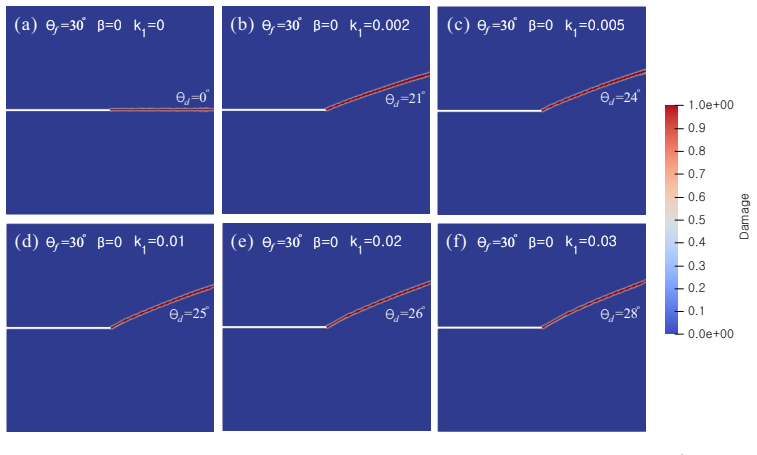
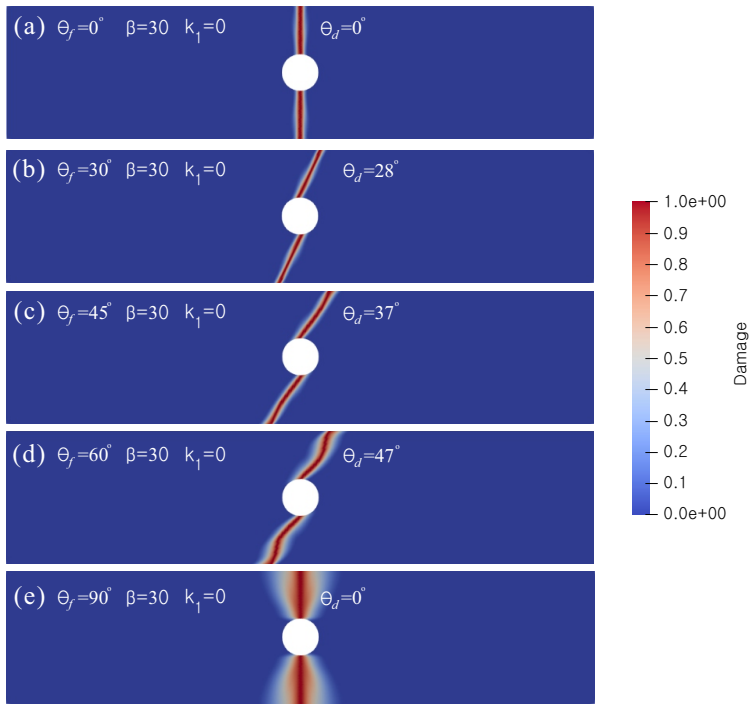
Phase-field models for anisotropic fracture employ two complementary mechanisms: (i) the anisotropic crack density function, controlling direction-dependent fracture resistance, and (ii) the anisotropic strain energy, governing the fracture driving force. Although the unified framework was presented in Pranavi et al.[Comput. Mech., 73 (2024)], the distinct roles of these mechanisms and their interaction remain uninvestigated. This work addresses this gap by first validating the formulation against mixed-mode fracture experiments on a soft elastomer (Lu et al. [Extreme Mech. Lett., 48 (2021)]), and then conducting systematic parametric studies on single-edge-notched (SEN) and open-hole tension (OHT) specimens to isolate each mechanism. The SEN studies show that the crack density anisotropy controls the crack path and toughness while leaving the elastic response unchanged, whereas the anisotropic strain energy deflects the crack but saturates rapidly. The OHT studies reveal a geometry-dependent role expansion: the anisotropic strain energy governs fiber-orientation-dependent stiffness, peak force, and fracture displacement. When both mechanisms act together, the combined response exhibits nonlinear synergistic interaction exceeding the linear sum of the individual contributions. These results establish that the crack density anisotropy governs the crack path (fracture resistance), while the anisotropic strain energy governs the driving force and, in stress-concentration geometries, additionally controls the elastic strain energy distribution around the stress concentrator.
Editorial analysis
A structured set of objections, weighed in public.
Referee Report
Summary. The paper examines the distinct and interactive contributions of anisotropic crack density (governing fracture resistance and path) and anisotropic strain energy (governing driving force) within a unified phase-field formulation for mixed-mode fracture. It first validates the model against published mixed-mode experiments on a soft elastomer, then performs parametric sweeps on single-edge-notched (SEN) and open-hole tension (OHT) specimens to isolate each mechanism, reporting that crack-density anisotropy controls toughness and path with unchanged elastic response, strain-energy anisotropy deflects cracks (with rapid saturation), and the two together produce nonlinear synergistic effects exceeding their linear sum, with an expanded role for strain-energy anisotropy in stress-concentration geometries.
Significance. If the parametric isolation is robust, the work clarifies mechanistic roles in anisotropic phase-field fracture modeling and supplies practical guidance for simulating direction-dependent toughness and driving forces in elastomers and composites. The experimental validation and systematic sweeps constitute clear strengths that enhance applicability to mixed-mode problems.
major comments (3)
- [Validation section] Validation section: the reported agreement with Lu et al. experiments is stated without quantitative error metrics (e.g., RMSE or peak-load deviation on force-displacement curves) or mesh-convergence data, leaving the accuracy of the synergistic-interaction claim only moderately supported.
- [SEN parametric studies] SEN parametric studies: the claim that crack-density anisotropy controls path/toughness while leaving elastic response unchanged is load-bearing for the isolation argument, yet the unified damage evolution equation couples the crack-density and strain-energy contributions; explicit demonstration that elastic strain-energy fields remain identical when only the crack-density anisotropy ratio is varied is required.
- [OHT studies] OHT studies: the geometry-dependent expansion of the strain-energy anisotropy role (controlling stiffness, peak force, and strain-energy distribution) and the nonlinear synergy claim rest on the assumption that parametric variations cleanly separate mechanisms without numerical artifacts; additional checks for mesh sensitivity around the hole and confirmation that the elastomer constitutive law accounts for large-strain hyperelasticity are needed to substantiate the separation.
minor comments (2)
- Figure legends and captions should explicitly label each anisotropy-ratio combination and distinguish crack-density versus strain-energy cases for immediate readability.
- Notation for the two anisotropy ratios should be introduced once in the formulation section and used consistently thereafter.
Simulated Author's Rebuttal
We thank the referee for the constructive comments that help strengthen the manuscript. We address each major comment below and indicate planned revisions.
read point-by-point responses
-
Referee: [Validation section] Validation section: the reported agreement with Lu et al. experiments is stated without quantitative error metrics (e.g., RMSE or peak-load deviation on force-displacement curves) or mesh-convergence data, leaving the accuracy of the synergistic-interaction claim only moderately supported.
Authors: We agree that quantitative metrics would improve the validation section. In the revised manuscript we will report RMSE values between the simulated and experimental force-displacement curves for the mixed-mode cases examined. We will also add mesh-convergence plots demonstrating that peak loads, crack paths, and the observed synergistic effects remain stable under successive refinement. These additions will provide stronger quantitative support for the validation and interaction claims. revision: yes
-
Referee: [SEN parametric studies] SEN parametric studies: the claim that crack-density anisotropy controls path/toughness while leaving elastic response unchanged is load-bearing for the isolation argument, yet the unified damage evolution equation couples the crack-density and strain-energy contributions; explicit demonstration that elastic strain-energy fields remain identical when only the crack-density anisotropy ratio is varied is required.
Authors: The referee correctly identifies the coupling within the damage evolution equation. However, the elastic strain-energy density is computed from the undamaged hyperelastic response, which depends solely on the strain-energy anisotropy parameters and is independent of the crack-density function. When only the crack-density anisotropy ratio is varied (with strain-energy anisotropy held isotropic), the pre-damage elastic fields are therefore identical. We will add supplementary figures showing the strain-energy density and stress distributions at damage initiation for several crack-density anisotropy ratios to make this explicit and reinforce the isolation argument. revision: yes
-
Referee: [OHT studies] OHT studies: the geometry-dependent expansion of the strain-energy anisotropy role (controlling stiffness, peak force, and strain-energy distribution) and the nonlinear synergy claim rest on the assumption that parametric variations cleanly separate mechanisms without numerical artifacts; additional checks for mesh sensitivity around the hole and confirmation that the elastomer constitutive law accounts for large-strain hyperelasticity are needed to substantiate the separation.
Authors: We agree that explicit checks are needed. The constitutive model is the incompressible neo-Hookean hyperelastic law, which accounts for finite-strain behavior in the elastomer; we will state this explicitly in the revised methods section. We will also include a mesh-sensitivity study for the OHT geometry, confirming convergence of stiffness, peak force, and crack paths with respect to local refinement around the hole. All parametric sweeps use identical mesh densities and solver settings, and we will note this to rule out numerical artifacts. These revisions will substantiate the reported geometry-dependent role expansion and nonlinear synergy. revision: yes
Circularity Check
No significant circularity; results from external validation and forward parametric studies
full rationale
The paper validates its unified phase-field formulation against independent experimental data from Lu et al. and isolates the roles of crack-density anisotropy versus strain-energy anisotropy through forward simulations on SEN and OHT geometries. No derivation step reduces outputs to fitted inputs by construction, renames known results, or relies on self-citation chains for load-bearing uniqueness theorems. The cited Pranavi et al. framework is treated as an external starting point, and all claims about mechanism separation rest on simulated responses benchmarked externally rather than internal redefinitions.
Axiom & Free-Parameter Ledger
free parameters (1)
- Anisotropy ratios for crack density and strain energy
axioms (1)
- domain assumption The unified anisotropic phase-field model from Pranavi et al. (2024) correctly encodes the physics of mixed-mode fracture.
Reference graph
Works this paper leans on
-
[1]
arXiv preprint arXiv:2603.15635
A unified variational framework for phase-field fracture and third- medium contact in finite deformation hyperelasticity. arXiv preprint arXiv:2603.15635 . 29 Kim, S., Kim, J.,
-
[2]
Computer Methods in Applied Mechanics and Engineering 450, 118602
A physically consistent and quantitative phase-field model for anisotropic fracture in brittle multiphase solids. Computer Methods in Applied Mechanics and Engineering 450, 118602. doi:10.1016/j.cma.2025.118602. Pranavi, D., Rajagopal, A., Reddy, J.N., 2024a. Phase field modeling of anisotropic fracture. Continuum Mechanics and Thermodynamics 36, 1267–128...
discussion (0)
Sign in with ORCID, Apple, or X to comment. Anyone can read and Pith papers without signing in.