Recognition: unknown
Wave Packet Propagation in Tilted Weyl Semimetals for Black Hole Analog Systems
Pith reviewed 2026-05-10 06:51 UTC · model grok-4.3
The pith
Spatially varying tilt in Weyl semimetals creates analog black hole horizons that either reflect or transmit wave packets.
A machine-rendered reading of the paper's core claim, the machinery that carries it, and where it could break.
Core claim
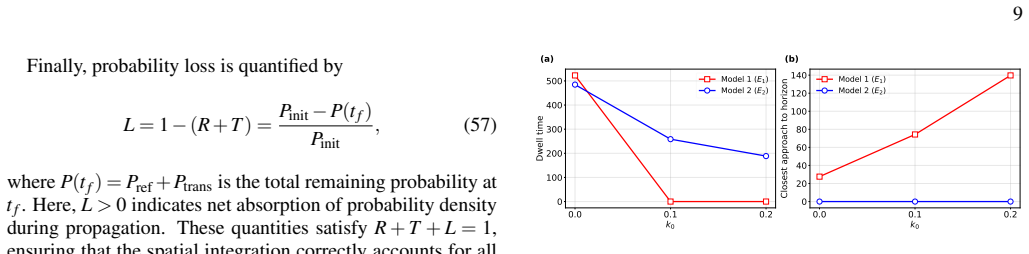
A spatially varying tilt in the Weyl cone structure creates an effect analogous to the tilting of light cones near a gravitational black hole horizon. One model exhibits complete wave packet reflection, effectively mimicking an impenetrable barrier. In contrast, the second model permits wave packet transmission across the horizon. For both models, wave packets initialized with zero momentum experience the strongest horizon effects, characterized by dramatic slowing and significantly longer dwell times, while both systems exhibit substantial probability loss directly correlated with dwell time near the horizon.
What carries the argument
The spatially varying tilt parameter in the Weyl Hamiltonian, which tilts the dispersion cones across space to form effective horizons with distinct reflection or transmission properties.
If this is right
- Zero-momentum wave packets exhibit the strongest slowing and longest dwell times at the analog horizon in both models.
- Probability loss grows proportionally with the wave packet dwell time near the horizon.
- The specific form of the tilt profile determines whether the analog horizon acts as a reflecting barrier or a transmitting surface.
- Tilted Weyl semimetals provide a tunable platform for studying quantum information flow and loss near analog horizons.
Where Pith is reading between the lines
- Separate experimental control over the two tilt profiles could isolate studies of information trapping versus leakage in condensed-matter black-hole analogs.
- Real materials would need spatial control of the tilt, for instance via strain gradients, to realize the predicted reflection-transmission switch.
- Adding electron interactions to the models might reveal whether many-body effects preserve or erase the horizon distinction.
Load-bearing premise
The chosen tilting profiles and zero-momentum wave-packet conditions produce horizons whose reflection or transmission behavior maps faithfully to black-hole dynamics without lattice or interaction corrections altering the outcome.
What would settle it
In a physical tilted Weyl semimetal with engineered spatial tilt variation, observe whether wave packets initialized at zero momentum reflect completely in one tilt profile and transmit in the other; uniform reflection or transmission independent of tilt profile would falsify the distinction.
Figures


read the original abstract
We explore the realization of distinct analog black hole horizons within tilted Weyl semimetals by comparing two models with contrasting spectral properties. We demonstrate that a spatially varying tilt in the Weyl cone structure creates an effect analogous to the tilting of light cones near a gravitational black hole horizon. By analyzing wave packet dynamics in both models, we reveal two fundamentally different types of analog horizons. The first model exhibits complete wave packet reflection, effectively mimicking an impenetrable barrier. In contrast, the second model permits wave packet transmission across the horizon. Critically, for both models, wave packets initialized with zero momentum ($k_0=0.0$) experience the strongest horizon effects, characterized by a dramatic slowing and significantly longer dwell times at the horizon region. Finally, we find that both systems exhibit substantial probability loss, which we demonstrate is directly correlated with the wave packet's dwell time near the horizon. Our findings establish tilted Weyl semimetals as a rich, tunable platform for investigating non-trivial quantum effects and information dynamics associated with analog black hole horizons.
Editorial analysis
A structured set of objections, weighed in public.
Referee Report
Summary. The manuscript numerically studies wave-packet dynamics in two tilted Weyl-semimetal models whose tilt parameter varies spatially so as to produce analog horizons. One model is reported to yield complete reflection of the packet (impenetrable barrier), while the second permits transmission across the horizon. Zero-momentum packets exhibit the longest dwell times at the horizon in both cases, and a direct correlation is claimed between dwell time and the observed probability loss.
Significance. If the reflection/transmission distinction survives a proper accounting for unitarity and if the probability loss is shown to be physical rather than numerical, the work would supply a concrete, tunable condensed-matter platform for analog-gravity studies of horizon effects and information flow. The absence of free parameters in the tilt profiles and the direct numerical propagation are positive features.
major comments (2)
- [Numerical propagation and probability conservation] Numerical propagation and probability conservation (likely §3 or Methods): The abstract and results state that both models exhibit substantial probability loss that correlates with dwell time. For a Hermitian, time-independent Weyl Hamiltonian the L2 norm must be conserved under unitary evolution. The manuscript must therefore specify (i) the explicit form of the Hamiltonian, (ii) whether absorbing or open boundaries are used, and (iii) the time-stepping algorithm and its convergence. Without this information the reported correlation and the claimed qualitative difference between the two horizon types cannot be regarded as robust.
- [Definition of the two models and analog metric] Definition of the two models and analog metric (likely §2): The distinction between “complete reflection” and “transmission” is presented as arising from the tilt-induced analog metric. The manuscript should derive or cite the effective metric for each tilt profile and demonstrate that the horizon condition (light-cone tilting) is satisfied without lattice-scale corrections that would erase the qualitative difference. This step is load-bearing for the central claim that the two models realize fundamentally different analog horizons.
minor comments (2)
- [Abstract] Abstract: the notation “k_0=0.0” should be accompanied by the momentum unit or the Brillouin-zone scale to avoid ambiguity.
- [Figures and captions] Figure captions and text should explicitly state the system size, discretization grid, and total simulation time so that the dwell-time and probability-loss values can be reproduced.
Simulated Author's Rebuttal
We thank the referee for the careful reading, the positive assessment of the work's potential significance, and the constructive major comments. We address each point below and will revise the manuscript to incorporate the requested clarifications and derivations.
read point-by-point responses
-
Referee: [Numerical propagation and probability conservation] Numerical propagation and probability conservation (likely §3 or Methods): The abstract and results state that both models exhibit substantial probability loss that correlates with dwell time. For a Hermitian, time-independent Weyl Hamiltonian the L2 norm must be conserved under unitary evolution. The manuscript must therefore specify (i) the explicit form of the Hamiltonian, (ii) whether absorbing or open boundaries are used, and (iii) the time-stepping algorithm and its convergence. Without this information the reported correlation and the claimed qualitative difference between the two horizon types cannot be regarded as robust.
Authors: We agree that these technical specifications are required to establish the robustness of the numerical results. In the revised manuscript we will add a dedicated Methods subsection that provides: (i) the explicit Hamiltonian for each of the two tilted Weyl models, (ii) the boundary conditions employed (open boundaries along the propagation direction), and (iii) the time-stepping algorithm together with convergence tests with respect to time step and spatial discretization. We will also include plots of the L2-norm evolution to quantify any residual loss and demonstrate that the reported correlation between dwell time and probability loss survives these checks and is not an artifact of the discretization. These additions will allow readers to confirm that the qualitative distinction between the two horizon types remains intact. revision: yes
-
Referee: [Definition of the two models and analog metric] Definition of the two models and analog metric (likely §2): The distinction between “complete reflection” and “transmission” is presented as arising from the tilt-induced analog metric. The manuscript should derive or cite the effective metric for each tilt profile and demonstrate that the horizon condition (light-cone tilting) is satisfied without lattice-scale corrections that would erase the qualitative difference. This step is load-bearing for the central claim that the two models realize fundamentally different analog horizons.
Authors: We will expand Section 2 to derive the effective analog metric for each spatially varying tilt profile, following the standard Weyl-to-metric mapping and citing the relevant literature. For the first model we will show that the tilt crosses the critical value, producing an event horizon at which the effective light cones tilt inward and forbid transmission, yielding complete reflection. For the second model the tilt profile permits the light cones to remain open across the horizon, allowing transmission. We will additionally verify that the horizon condition holds in the continuum limit and that the qualitative difference between the two cases is insensitive to lattice-scale corrections by presenting supporting analytic arguments and supplementary numerical checks at reduced lattice spacing. revision: yes
Circularity Check
No circularity: claims rest on direct numerical wave-packet evolution
full rationale
The paper defines two explicit tilted-Weyl models, propagates wave packets numerically under the resulting Hamiltonians, and reports the observed reflection/transmission contrast plus dwell-time correlation with probability loss as simulation outputs. No step equates a fitted parameter to a prediction, renames an input as a derived result, or reduces the horizon distinction to a self-citation or self-definition. The chain is self-contained: model Hamiltonians and initial conditions are stated independently of the reported behaviors, and the probability-loss observation follows from the unitary (or non-unitary) evolution chosen in the numerics rather than being presupposed.
Axiom & Free-Parameter Ledger
Reference graph
Works this paper leans on
-
[1]
Weylet al., Electron and gravitation, z
H. Weylet al., Electron and gravitation, z. Phys56, 330 (1929)
1929
-
[2]
B. Lv, H. Weng, B. Fu, X. P. Wang, H. Miao, J. Ma, P. Richard, X. Huang, L. Zhao, G. Chen,et al., Experimental discovery of weyl semimetal taas, Physical Review X5, 031013 (2015)
2015
-
[3]
B. Lv, N. Xu, H. Weng, J. Ma, P. Richard, X. Huang, L. Zhao, G. Chen, C. Matt, F. Bisti,et al., Observation of weyl nodes in taas, Nature Physics11, 724 (2015)
2015
-
[4]
S.-Y . Xu, I. Belopolski, N. Alidoust, M. Neupane, G. Bian, C. Zhang, R. Sankar, G. Chang, Z. Yuan, C.-C. Lee,et al., Dis- covery of a weyl fermion semimetal and topological fermi arcs, Science349, 613 (2015)
2015
-
[5]
L. Yang, Z. Liu, Y . Sun, H. Peng, H. Yang, T. Zhang, B. Zhou, Y . Zhang, Y . Guo, M. Rahn,et al., Weyl semimetal phase in the non-centrosymmetric compound taas, Nature physics11, 728 (2015)
2015
-
[6]
S.-Y . Xu, N. Alidoust, I. Belopolski, Z. Yuan, G. Bian, T.-R. Chang, H. Zheng, V . N. Strocov, D. S. Sanchez, G. Chang, et al., Discovery of a weyl fermion state with fermi arcs in nio- bium arsenide, Nature Physics11, 748 (2015)
2015
-
[7]
N. Xu, H. Weng, B. Lv, C. E. Matt, J. Park, F. Bisti, V . N. Strocov, D. Gawryluk, E. Pomjakushina, K. Conder,et al., Ob- servation of weyl nodes and fermi arcs in tantalum phosphide, Nature communications7, 11006 (2016)
2016
-
[8]
Shekhar, A
C. Shekhar, A. K. Nayak, Y . Sun, M. Schmidt, M. Nicklas, I. Leermakers, U. Zeitler, Y . Skourski, J. Wosnitza, Z. Liu, et al., Extremely large magnetoresistance and ultrahigh mo- bility in the topological weyl semimetal candidate nbp, Nature Physics11, 645 (2015)
2015
-
[9]
Armitage, E
N. Armitage, E. Mele, and A. Vishwanath, Weyl and dirac semimetals in three-dimensional solids, Reviews of Modern Physics90, 015001 (2018)
2018
-
[10]
Rao,Weyl semi-metals: a short review,arXiv preprint arXiv:1603.02821(2016) [1603.02821]
S. Rao, Weyl semi-metals: a short review, arXiv preprint arXiv:1603.02821 (2016)
-
[11]
Haller, S
A. Haller, S. Hegde, C. Xu, C. De Beule, T. L. Schmidt, and T. Meng, Black hole mirages: Electron lensing and berry curva- ture effects in inhomogeneously tilted weyl semimetals, SciPost Physics14, 119 (2023)
2023
-
[12]
K¨onye, C
V . K¨onye, C. Morice, D. Chernyavsky, A. G. Moghaddam, J. van Den Brink, and J. van Wezel, Horizon physics of quasi- one-dimensional tilted weyl cones on a lattice, Physical Review Research4, 033237 (2022)
2022
-
[13]
K ¨onye, L
V . K ¨onye, L. Mertens, C. Morice, D. Chernyavsky, A. G. Moghaddam, J. Van Wezel, and J. van Den Brink, Anisotropic optics and gravitational lensing of tilted weyl fermions, Physi- cal Review B107, L201406 (2023)
2023
-
[14]
Sabsovich, P
D. Sabsovich, P. Wunderlich, V . Fleurov, D. I. Pikulin, R. Ilan, and T. Meng, Hawking fragmentation and hawking attenua- tion in weyl semimetals, Physical Review Research4, 013055 (2022)
2022
-
[15]
A. A. Soluyanov, D. Gresch, Z. Wang, Q. Wu, M. Troyer, X. Dai, and B. A. Bernevig, Type-ii weyl semimetals, Nature 527, 495 (2015)
2015
-
[16]
Huang, K.-H
H. Huang, K.-H. Jin, and F. Liu, Black-hole horizon in the dirac semimetal zn 2 in 2 s 5, Physical Review B98, 121110 (2018)
2018
-
[17]
G. E. V olovik, Black hole and hawking radiation by type-ii weyl fermions, JETP letters104, 645 (2016)
2016
-
[18]
De Beule, S
C. De Beule, S. Groenendijk, T. Meng, and T. L. Schmidt, Artificial event horizons in weyl semimetal heterostructures and their non-equilibrium signatures, SciPost Physics11, 095 (2021)
2021
-
[19]
Zubkov, Analogies between the black hole interior and the type ii weyl semimetals, Universe4, 135 (2018)
M. Zubkov, Analogies between the black hole interior and the type ii weyl semimetals, Universe4, 135 (2018)
2018
-
[20]
A. N. Tamanna, A. Lakra, X. Ding, E. Buzi, K. Park, K. Sobczak, H. Deng, G. Sharma, S. Tewari, and L. Krusin- Elbaum, Transport chirality generated by a tunable tilt of weyl nodes in a van der waals topological magnet, Nature Commu- nications15, 9830 (2024)
2024
-
[21]
Sun, S.-C
Y . Sun, S.-C. Wu, M. N. Ali, C. Felser, and B. Yan, Prediction of weyl semimetal in orthorhombic mote 2, Physical Review B 92, 161107 (2015)
2015
-
[22]
X. Kong, J. He, Y . Liang, and S.-P. Kou, Tunable weyl semimetal and its possible realization in optical lattices, Physi- cal Review A95, 033629 (2017)
2017
-
[23]
Einstein, Die feldgleichungen der gravitation, Sitzungs- berichte der K ¨oniglich Preußischen Akademie der Wis- senschaften , 844 (1915)
A. Einstein, Die feldgleichungen der gravitation, Sitzungs- berichte der K ¨oniglich Preußischen Akademie der Wis- senschaften , 844 (1915)
1915
-
[24]
Blinn, Schwarzschild solution to einstein’s general relativity, Journal of Modern Physics (2017)
C. Blinn, Schwarzschild solution to einstein’s general relativity, Journal of Modern Physics (2017)
2017
-
[25]
Kedem, E
Y . Kedem, E. J. Bergholtz, and F. Wilczek, Black and white holes at material junctions, Physical Review Research2, 043285 (2020)
2020
-
[26]
L. E. F. Torres, Perspective on topological states of non- hermitian lattices, Journal of Physics: Materials3, 014002 (2019)
2019
-
[27]
Ozawa, H
T. Ozawa, H. M. Price, A. Amo, N. Goldman, M. Hafezi, L. Lu, M. C. Rechtsman, D. Schuster, J. Simon, O. Zilberberg,et al., Topological photonics, Reviews of Modern Physics91, 015006 (2019)
2019
-
[28]
X. Zhu, H. Wang, S. K. Gupta, H. Zhang, B. Xie, M. Lu, and Y . Chen, Photonic non-hermitian skin effect and non-bloch bulk-boundary correspondence, Physical Review Research2, 013280 (2020)
2020
-
[29]
X. Yang, Y . Cao, and Y . Zhai, Non-hermitian weyl semimetals: Non-hermitian skin effect and non-bloch bulk–boundary corre- spondence, Chinese Physics B31, 010308 (2022). 12
2022
-
[30]
E. J. Bergholtz and J. C. Budich, Non-hermitian weyl physics in topological insulator ferromagnet junctions, Physical Review Research1, 012003 (2019)
2019
-
[31]
M. A. Lozande, Ma-lozande/wave-packet-propagation-in- tilted-weyl-semimetal-for-black-hole-analog-systems: Wsm simulation (2025), available athttps://doi.org/10.5281/ zenodo.17727711
2025
discussion (0)
Sign in with ORCID, Apple, or X to comment. Anyone can read and Pith papers without signing in.