Recognition: unknown
Beyond Meta-Reasoning: Metacognitive Consolidation for Self-Improving LLM Reasoning
Pith reviewed 2026-05-10 06:09 UTC · model grok-4.3
The pith
LLMs self-improve reasoning by consolidating metacognitive experience into reusable knowledge
A machine-rendered reading of the paper's core claim, the machinery that carries it, and where it could break.
Core claim
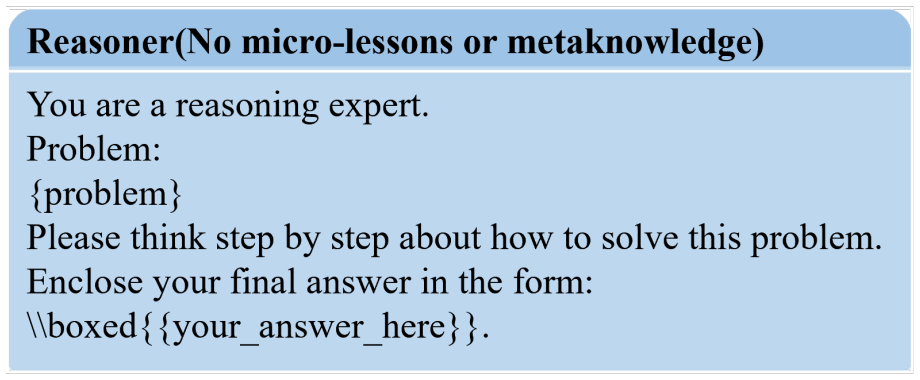
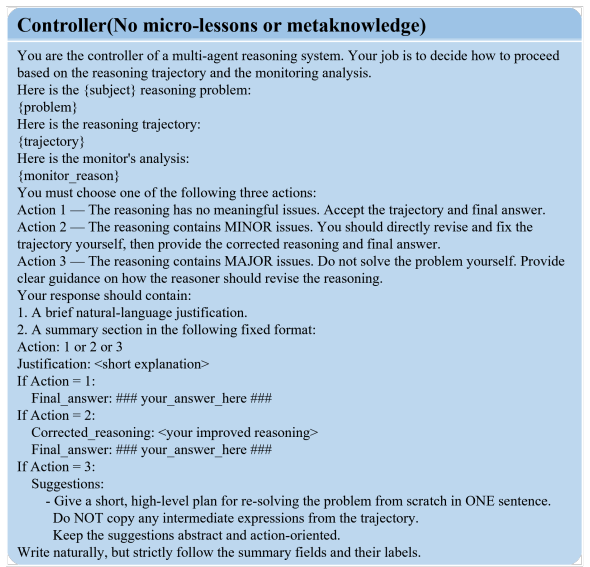
The authors claim that structuring problem solving into reasoning, monitoring, and control roles creates attributable meta-level traces. A hierarchical, multi-timescale consolidation mechanism then turns these traces into evolving meta-knowledge. This produces consistent performance gains across benchmarks and backbone models, with the gains increasing as metacognitive experience accumulates.
What carries the argument
The three-role structure for generating meta-level traces and the hierarchical multi-timescale consolidation mechanism that forms reusable meta-knowledge.
Load-bearing premise
The meta-level traces must contain knowledge that remains useful and accurate when consolidated across different problems without losing essential details or adding errors.
What would settle it
A demonstration that performance stays the same or worsens after many consolidation cycles on a set of reasoning problems would falsify the claim that accumulating meta-knowledge leads to improvement.
Figures






read the original abstract
Large language models (LLMs) have demonstrated strong reasoning capabilities, and as existing approaches for enhancing LLM reasoning continue to mature, increasing attention has shifted toward meta-reasoning as a promising direction for further improvement. However, most existing meta-reasoning methods remain episodic: they focus on executing complex meta-reasoning routines within individual instances, but ignore the accumulation of reusable meta-reasoning skills across instances, leading to recurring failure modes and repeatedly high metacognitive effort. In this paper, we introduce Metacognitive Consolidation, a novel framework in which a model consolidates metacognitive experience from past reasoning episodes into reusable knowledge that improves future meta-reasoning. We instantiate this framework by structuring instance-level problem solving into distinct roles for reasoning, monitoring, and control to generate rich, attributable meta-level traces. These traces are then consolidated through a hierarchical, multi-timescale update mechanism that gradually forms evolving meta-knowledge. Experimental results demonstrate consistent performance gains across benchmarks and backbone models, and show that performance improves as metacognitive experience accumulates over time.
Editorial analysis
A structured set of objections, weighed in public.
Referee Report
Summary. The paper introduces Metacognitive Consolidation, a framework in which LLMs structure instance-level problem solving into distinct reasoning, monitoring, and control roles to generate attributable meta-level traces. These traces are consolidated via a hierarchical multi-timescale update mechanism that forms evolving reusable meta-knowledge. The central claim is that this produces consistent performance gains across benchmarks and backbone models, with further improvement as metacognitive experience accumulates over time.
Significance. If the results hold, the work offers a principled shift from episodic meta-reasoning to cumulative self-improvement in LLMs, potentially mitigating recurring failure modes and reducing repeated metacognitive effort. The three-role trace generation combined with hierarchical consolidation is a distinctive contribution that could influence future designs for long-term meta-cognitive development.
major comments (2)
- [Experiments] Experimental results section: the claim that performance improves as metacognitive experience accumulates is load-bearing for the paper's contribution, yet the provided description supplies no quantitative metrics, baselines, statistical tests, or ablations (e.g., consolidation vs. simple trace accumulation or repeated prompting). Without these, it is impossible to confirm that gains derive from the proposed mechanism rather than increased context length or other confounds.
- [Method] Method section on the hierarchical multi-timescale update: the assertion that meta-level traces contain reusable, attributable knowledge that can be consolidated without noise or loss of task-specific details requires explicit specification (e.g., update equations or pseudocode) and controls showing preservation of structure. This assumption underpins the accumulation benefit and is not yet anchored by evidence.
minor comments (1)
- [Abstract] Abstract: adding one sentence naming the benchmarks and backbone models used would make the performance claims more concrete for readers.
Simulated Author's Rebuttal
We thank the referee for their constructive feedback and for recognizing the potential of Metacognitive Consolidation as a shift toward cumulative self-improvement in LLMs. We address each major comment below and will incorporate revisions to strengthen the empirical and methodological grounding of the claims.
read point-by-point responses
-
Referee: [Experiments] Experimental results section: the claim that performance improves as metacognitive experience accumulates is load-bearing for the paper's contribution, yet the provided description supplies no quantitative metrics, baselines, statistical tests, or ablations (e.g., consolidation vs. simple trace accumulation or repeated prompting). Without these, it is impossible to confirm that gains derive from the proposed mechanism rather than increased context length or other confounds.
Authors: We agree that the accumulation claim requires stronger quantitative support to rule out confounds. The current experiments demonstrate consistent gains across benchmarks as experience accumulates, but we acknowledge the need for explicit metrics, baselines, and controls. In the revision we will expand the experimental section with: mean performance and standard deviations over multiple runs; paired statistical tests with p-values; direct baselines including simple trace accumulation (without hierarchical updates) and repeated prompting (without consolidation); and context-length-matched controls. These additions will isolate the contribution of the multi-timescale consolidation mechanism. revision: yes
-
Referee: [Method] Method section on the hierarchical multi-timescale update: the assertion that meta-level traces contain reusable, attributable knowledge that can be consolidated without noise or loss of task-specific details requires explicit specification (e.g., update equations or pseudocode) and controls showing preservation of structure. This assumption underpins the accumulation benefit and is not yet anchored by evidence.
Authors: We accept that the hierarchical update mechanism would benefit from greater formality and supporting evidence. The method section describes the three-role trace generation and multi-timescale consolidation, but lacks explicit equations. In the revised manuscript we will add update equations and pseudocode for the short-, medium-, and long-term consolidation steps. We will also include a new analysis showing preservation of task-specific structure, for example by reporting similarity metrics between original traces and consolidated knowledge and by evaluating downstream performance on tasks that require retention of instance-specific details. revision: yes
Circularity Check
No circularity: framework and gains presented as independent experimental mechanism
full rationale
The paper introduces Metacognitive Consolidation as a new framework that structures reasoning into roles to produce traces and applies a hierarchical multi-timescale update to form meta-knowledge. No equations, fitted parameters, self-citations, or uniqueness theorems appear in the abstract or described structure. The central claim of accumulating performance gains is supported by experimental results across benchmarks rather than any derivation that reduces to its own inputs by construction. The mechanism is presented as an external addition to existing meta-reasoning, with no load-bearing step that renames or tautologically re-derives the observed improvement.
Axiom & Free-Parameter Ledger
Reference graph
Works this paper leans on
-
[2]
Charlie Victor Snell and Jaehoon Lee and Kelvin Xu and Aviral Kumar , booktitle=. Scaling. 2025 , url=
2025
-
[3]
Position:
Hanqi Yan and Linhai Zhang and Jiazheng Li and Zhenyi Shen and Yulan He , booktitle=. Position:. 2025 , url=
2025
-
[4]
Ziyu Wan and Yunxiang LI and Xiaoyu Wen and Yan Song and Hanjing Wang and Linyi Yang and Mark Schmidt and Jun Wang and Weinan Zhang and Shuyue Hu and Ying Wen , booktitle=. Re. 2025 , url=
2025
-
[12]
, author=
Acquisition of cognitive skill. , author=. Psychological review , volume=. 1982 , publisher=
1982
-
[13]
Advances in Neural Information Processing Systems , editor=
Chain of Thought Prompting Elicits Reasoning in Large Language Models , author=. Advances in Neural Information Processing Systems , editor=. 2022 , url=
2022
-
[15]
The Thirty-ninth Annual Conference on Neural Information Processing Systems , year=
Titans: Learning to Memorize at Test Time , author=. The Thirty-ninth Annual Conference on Neural Information Processing Systems , year=
-
[16]
The Thirty-ninth Annual Conference on Neural Information Processing Systems , year=
Nested Learning: The Illusion of Deep Learning Architectures , author=. The Thirty-ninth Annual Conference on Neural Information Processing Systems , year=
-
[17]
Inference Scaling Laws: An Empirical Analysis of Compute-Optimal Inference for
Yangzhen Wu and Zhiqing Sun and Shanda Li and Sean Welleck and Yiming Yang , booktitle=. Inference Scaling Laws: An Empirical Analysis of Compute-Optimal Inference for. 2025 , url=
2025
-
[18]
2024 , eprint=
OpenAI o1 System Card , author=. 2024 , eprint=
2024
-
[19]
2025 , eprint=
MetaScale: Test-Time Scaling with Evolving Meta-Thoughts , author=. 2025 , eprint=
2025
-
[20]
2025 , eprint=
Meta-Reasoner: Dynamic Guidance for Optimized Inference-time Reasoning in Large Language Models , author=. 2025 , eprint=
2025
-
[21]
2025 , eprint=
ReasoningBank: Scaling Agent Self-Evolving with Reasoning Memory , author=. 2025 , eprint=
2025
-
[22]
Thirty-seventh Conference on Neural Information Processing Systems , year=
Reflexion: language agents with verbal reinforcement learning , author=. Thirty-seventh Conference on Neural Information Processing Systems , year=
-
[23]
The Thirty-eighth Annual Conference on Neural Information Processing Systems , year=
Buffer of Thoughts: Thought-Augmented Reasoning with Large Language Models , author=. The Thirty-eighth Annual Conference on Neural Information Processing Systems , year=
-
[24]
ReasonFlux-
Jiaru Zou and Ling Yang and Jingwen Gu and Jiahao Qiu and Ke Shen and Jingrui He and Mengdi Wang , booktitle=. ReasonFlux-. 2025 , url=
2025
-
[25]
2021 , eprint=
Training Verifiers to Solve Math Word Problems , author=. 2021 , eprint=
2021
-
[26]
Measuring Mathematical Problem Solving With the
Dan Hendrycks and Collin Burns and Saurav Kadavath and Akul Arora and Steven Basart and Eric Tang and Dawn Song and Jacob Steinhardt , booktitle=. Measuring Mathematical Problem Solving With the. 2021 , url=
2021
-
[27]
Thirty-seventh Conference on Neural Information Processing Systems , year=
Tree of Thoughts: Deliberate Problem Solving with Large Language Models , author=. Thirty-seventh Conference on Neural Information Processing Systems , year=
-
[28]
The Eleventh International Conference on Learning Representations , year=
Self-Consistency Improves Chain of Thought Reasoning in Language Models , author=. The Eleventh International Conference on Learning Representations , year=
-
[29]
Thirty-seventh Conference on Neural Information Processing Systems , year=
Self-Refine: Iterative Refinement with Self-Feedback , author=. Thirty-seventh Conference on Neural Information Processing Systems , year=
-
[30]
Trends in Cognitive Sciences, 607–617 (2017) https: //doi.org/10.1016/j.tics.2017.05.004
Rakefet Ackerman and Valerie A. Thompson. 2017. https://doi.org/10.1016/j.tics.2017.05.004 Meta-reasoning: Monitoring and control of thinking and reasoning . Trends in Cognitive Sciences, 21(8):607--617
-
[31]
John R Anderson. 1982. Acquisition of cognitive skill. Psychological review, 89(4):369
1982
-
[32]
Ali Behrouz, Meisam Razaviyayn, Peilin Zhong, and Vahab Mirrokni. 2025 a . https://openreview.net/forum?id=nbMeRvNb7A Nested learning: The illusion of deep learning architectures . In The Thirty-ninth Annual Conference on Neural Information Processing Systems
2025
-
[33]
Ali Behrouz, Peilin Zhong, and Vahab Mirrokni. 2025 b . https://openreview.net/forum?id=8GjSf9Rh7Z Titans: Learning to memorize at test time . In The Thirty-ninth Annual Conference on Neural Information Processing Systems
2025
-
[34]
Wenhu Chen, Ming Yin, Max Ku, Pan Lu, Yixin Wan, Xueguang Ma, Jianyu Xu, Xinyi Wang, and Tony Xia. 2023. https://doi.org/10.18653/v1/2023.emnlp-main.489 T heorem QA : A theorem-driven question answering dataset . In Proceedings of the 2023 Conference on Empirical Methods in Natural Language Processing, pages 7889--7901, Singapore. Association for Computat...
-
[35]
Karl Cobbe, Vineet Kosaraju, Mohammad Bavarian, Mark Chen, Heewoo Jun, Lukasz Kaiser, Matthias Plappert, Jerry Tworek, Jacob Hilton, Reiichiro Nakano, Christopher Hesse, and John Schulman. 2021. https://arxiv.org/abs/2110.14168 Training verifiers to solve math word problems . Preprint, arXiv:2110.14168
work page internal anchor Pith review Pith/arXiv arXiv 2021
- [36]
-
[37]
Daya Guo, Dejian Yang, Haowei Zhang, Junxiao Song, Ruoyu Zhang, Runxin Xu, Qihao Zhu, Shirong Ma, Peiyi Wang, Xiao Bi, and 1 others. 2025. Deepseek-r1: Incentivizing reasoning capability in llms via reinforcement learning. arXiv preprint arXiv:2501.12948
work page internal anchor Pith review Pith/arXiv arXiv 2025
-
[38]
Peng, Zhaoxiang Zhang, Zhicheng Zheng, Wenbo Su, and Bo Zheng
Yancheng He, Shilong Li, Jiaheng Liu, Weixun Wang, Xingyuan Bu, Ge Zhang, Z.y. Peng, Zhaoxiang Zhang, Zhicheng Zheng, Wenbo Su, and Bo Zheng. 2025. https://doi.org/10.18653/v1/2025.acl-long.905 Can large language models detect errors in long chain-of-thought reasoning? In Proceedings of the 63rd Annual Meeting of the Association for Computational Linguist...
-
[39]
Dan Hendrycks, Collin Burns, Saurav Kadavath, Akul Arora, Steven Basart, Eric Tang, Dawn Song, and Jacob Steinhardt. 2021. https://openreview.net/forum?id=7Bywt2mQsCe Measuring mathematical problem solving with the MATH dataset . In Thirty-fifth Conference on Neural Information Processing Systems Datasets and Benchmarks Track (Round 2)
2021
-
[40]
Huang, Fei Wang, Sheng Zhang, Hoifung Poon, and Muhao Chen
Qin Liu, Wenxuan Zhou, Nan Xu, James Y. Huang, Fei Wang, Sheng Zhang, Hoifung Poon, and Muhao Chen. 2025. https://arxiv.org/abs/2503.13447 Metascale: Test-time scaling with evolving meta-thoughts . Preprint, arXiv:2503.13447
-
[41]
Aman Madaan, Niket Tandon, Prakhar Gupta, Skyler Hallinan, Luyu Gao, Sarah Wiegreffe, Uri Alon, Nouha Dziri, Shrimai Prabhumoye, Yiming Yang, Shashank Gupta, Bodhisattwa Prasad Majumder, Katherine Hermann, Sean Welleck, Amir Yazdanbakhsh, and Peter Clark. 2023. https://openreview.net/forum?id=S37hOerQLB Self-refine: Iterative refinement with self-feedback...
2023
-
[42]
OpenAI, Aaron Jaech, Adam Kalai, Adam Lerer, Adam Richardson, Ahmed El-Kishky, Aiden Low, Alec Helyar, Aleksander Madry, Alex Beutel, Alex Carney, Alex Iftimie, Alex Karpenko, Alex Tachard Passos, Alexander Neitz, Alexander Prokofiev, Alexander Wei, Allison Tam, Ally Bennett, and 243 others. 2024. https://arxiv.org/abs/2412.16720 Openai o1 system card . P...
work page internal anchor Pith review Pith/arXiv arXiv 2024
-
[43]
ReasoningBank: Scaling Agent Self-Evolving with Reasoning Memory
Siru Ouyang, Jun Yan, I-Hung Hsu, Yanfei Chen, Ke Jiang, Zifeng Wang, Rujun Han, Long T. Le, Samira Daruki, Xiangru Tang, Vishy Tirumalashetty, George Lee, Mahsan Rofouei, Hangfei Lin, Jiawei Han, Chen-Yu Lee, and Tomas Pfister. 2025. https://arxiv.org/abs/2509.25140 Reasoningbank: Scaling agent self-evolving with reasoning memory . Preprint, arXiv:2509.25140
work page internal anchor Pith review arXiv 2025
-
[44]
Noah Shinn, Federico Cassano, Ashwin Gopinath, Karthik R Narasimhan, and Shunyu Yao. 2023. https://openreview.net/forum?id=vAElhFcKW6 Reflexion: language agents with verbal reinforcement learning . In Thirty-seventh Conference on Neural Information Processing Systems
2023
-
[45]
Charlie Victor Snell, Jaehoon Lee, Kelvin Xu, and Aviral Kumar. 2025. https://openreview.net/forum?id=4FWAwZtd2n Scaling LLM test-time compute optimally can be more effective than scaling parameters for reasoning . In The Thirteenth International Conference on Learning Representations
2025
-
[46]
Yuan Sui, Yufei He, Tri Cao, Simeng Han, Yulin Chen, and Bryan Hooi. 2025. https://arxiv.org/abs/2502.19918 Meta-reasoner: Dynamic guidance for optimized inference-time reasoning in large language models . Preprint, arXiv:2502.19918
work page internal anchor Pith review Pith/arXiv arXiv 2025
- [47]
-
[48]
Hexiang Tan, Fei Sun, Sha Liu, Du Su, Qi Cao, Xin Chen, Jingang Wang, Xunliang Cai, Yuanzhuo Wang, Huawei Shen, and Xueqi Cheng. 2025. https://doi.org/10.18653/v1/2025.emnlp-main.238 Too consistent to detect: A study of self-consistent errors in LLM s . In Proceedings of the 2025 Conference on Empirical Methods in Natural Language Processing, pages 4755--...
-
[49]
Ziyu Wan, Yunxiang LI, Xiaoyu Wen, Yan Song, Hanjing Wang, Linyi Yang, Mark Schmidt, Jun Wang, Weinan Zhang, Shuyue Hu, and Ying Wen. 2025. https://openreview.net/forum?id=ur295YVtmt Re MA : Learning to meta-think for LLM s with multi-agent reinforcement learning . In The Thirty-ninth Annual Conference on Neural Information Processing Systems
2025
-
[50]
Chi, Sharan Narang, Aakanksha Chowdhery, and Denny Zhou
Xuezhi Wang, Jason Wei, Dale Schuurmans, Quoc V Le, Ed H. Chi, Sharan Narang, Aakanksha Chowdhery, and Denny Zhou. 2023. https://openreview.net/forum?id=1PL1NIMMrw Self-consistency improves chain of thought reasoning in language models . In The Eleventh International Conference on Learning Representations
2023
-
[51]
Yuqing Wang and Yun Zhao. 2024. https://doi.org/10.18653/v1/2024.naacl-long.106 Metacognitive prompting improves understanding in large language models . In Proceedings of the 2024 Conference of the North American Chapter of the Association for Computational Linguistics: Human Language Technologies (Volume 1: Long Papers), pages 1914--1926, Mexico City, M...
-
[52]
Chi, Quoc V Le, and Denny Zhou
Jason Wei, Xuezhi Wang, Dale Schuurmans, Maarten Bosma, brian ichter, Fei Xia, Ed H. Chi, Quoc V Le, and Denny Zhou. 2022. https://openreview.net/forum?id=_VjQlMeSB_J Chain of thought prompting elicits reasoning in large language models . In Advances in Neural Information Processing Systems
2022
-
[53]
Yangzhen Wu, Zhiqing Sun, Shanda Li, Sean Welleck, and Yiming Yang. 2025. https://openreview.net/forum?id=VNckp7JEHn Inference scaling laws: An empirical analysis of compute-optimal inference for LLM problem-solving . In The Thirteenth International Conference on Learning Representations
2025
- [54]
-
[55]
Hanqi Yan, Linhai Zhang, Jiazheng Li, Zhenyi Shen, and Yulan He. 2025. https://openreview.net/forum?id=RrvhbxO2hd Position: LLM s need a bayesian meta-reasoning framework for more robust and generalizable reasoning . In Forty-second International Conference on Machine Learning Position Paper Track
2025
- [56]
-
[57]
Gonzalez, and Bin CUI
Ling Yang, Zhaochen Yu, Tianjun Zhang, Shiyi Cao, Minkai Xu, Wentao Zhang, Joseph E. Gonzalez, and Bin CUI. 2024. https://openreview.net/forum?id=ANO1i9JPtb Buffer of thoughts: Thought-augmented reasoning with large language models . In The Thirty-eighth Annual Conference on Neural Information Processing Systems
2024
-
[58]
Griffiths, Yuan Cao, and Karthik R Narasimhan
Shunyu Yao, Dian Yu, Jeffrey Zhao, Izhak Shafran, Thomas L. Griffiths, Yuan Cao, and Karthik R Narasimhan. 2023. https://openreview.net/forum?id=5Xc1ecxO1h Tree of thoughts: Deliberate problem solving with large language models . In Thirty-seventh Conference on Neural Information Processing Systems
2023
- [59]
-
[60]
Jiaru Zou, Ling Yang, Jingwen Gu, Jiahao Qiu, Ke Shen, Jingrui He, and Mengdi Wang. 2025. https://openreview.net/forum?id=f3sZjkQbv2 Reasonflux- PRM : Trajectory-aware PRM s for long chain-of-thought reasoning in LLM s . In The Thirty-ninth Annual Conference on Neural Information Processing Systems
2025
discussion (0)
Sign in with ORCID, Apple, or X to comment. Anyone can read and Pith papers without signing in.