Theory of Quantum Imaginary-Time Mpemba Effect
Pith reviewed 2026-05-10 05:59 UTC · model grok-4.3
The pith
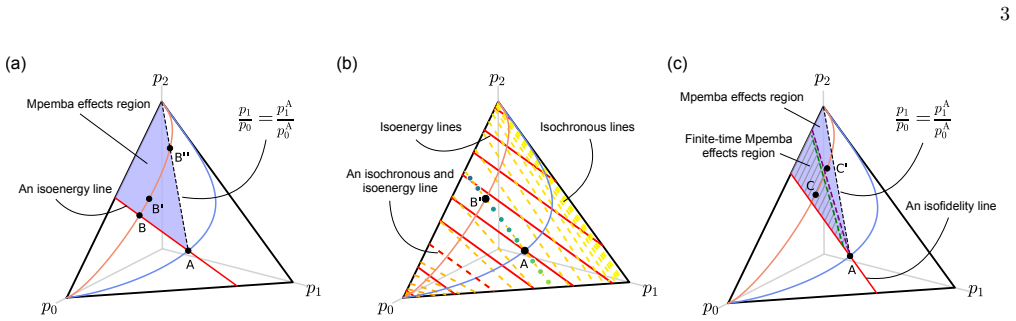
The quantum imaginary-time Mpemba effect occurs exactly when the population ratios of excited states to the ground state are larger for the initially farther state.
A machine-rendered reading of the paper's core claim, the machinery that carries it, and where it could break.
Core claim
The Mpemba effect in QITE occurs if and only if one initial state's excited-to-ground population ratios exceed those of the other state, causing the farther state to approach the ground state more rapidly under imaginary-time Schrödinger dynamics. This condition is both necessary and sufficient and is independent of the specific Hamiltonian. The framework additionally identifies a rigorous sufficient condition for the finite-time version of the effect and reveals that multi-level systems can display multiple trajectory crossings while collinear initial states intersect simultaneously.
What carries the argument
The population-ratio condition, which compares the ratios of excited-state populations to the ground-state population between two initial states and determines whether their imaginary-time relaxation trajectories cross.
If this is right
- The Mpemba effect occurs precisely when the excited-to-ground population ratios of the farther state exceed those of the closer state.
- A sufficient condition on the ratios guarantees that the trajectories cross before reaching any prescribed distance threshold to the ground state.
- Multi-level systems exhibit a multiple-crossing phenomenon during the evolution.
- Collinear initial states produce simultaneous intersections of their relaxation trajectories at every time.
Where Pith is reading between the lines
- Selecting initial states according to the ratio condition could systematically reduce the imaginary time needed to prepare ground states in variational algorithms.
- The condition supplies a Hamiltonian-independent metric for ranking the efficiency of different starting points for the same system.
- Analogous ratio criteria may apply to other exponential-relaxation processes that share the structure of imaginary-time evolution.
- Verification on small quantum hardware by preparing states with tunable populations would test the predictions without requiring full-scale simulations.
Load-bearing premise
The derivations assume ideal closed-system imaginary-time dynamics governed by the Schrödinger equation in imaginary time, with no decoherence, noise, or real-time components, and that initial states can be prepared with controllable population ratios.
What would settle it
Preparing two initial states on a quantum device with the predicted population ratios and measuring their distances to the ground state as functions of imaginary time; absence of the expected crossing would falsify the necessary-and-sufficient condition.
Figures

read the original abstract
Quantum imaginary-time evolution (QITE) is a fundamental framework for preparing ground and thermal states, yet its computational cost scales significantly with the evolution duration $\tau$. Reducing this duration is critical for practical quantum advantage. Here, we establish a unified theoretical framework for the Mpemba effect in QITE -- a counterintuitive phenomenon where a state initially farther from the ground state relaxes to it faster than one initially closer. We derive a remarkably simple necessary and sufficient condition for the occurrence of this effect, showing it is uniquely determined by the population ratios of excited states to the ground state. For practical state preparation, we introduce a rigorous sufficient condition for the finite-time Mpemba effect, ensuring the crossing occurs before reaching a prescribed proximity threshold. Furthermore, we unveil unique dynamical features, including a multiple-crossing phenomenon in multi-level systems and simultaneous intersections for collinear initial states. Our results provide criteria for identifying favorable initial states in QITE and offer deep insights into the speed limit of quantum state preparation.
Editorial analysis
A structured set of objections, weighed in public.
Referee Report
Summary. The paper establishes a theoretical framework for the quantum imaginary-time Mpemba effect (QITME) under closed-system QITE dynamics. It derives a necessary and sufficient condition for the effect that depends only on the initial population ratios r_k = p_k / p_0 of excited states to the ground state, with the ratios evolving deterministically as r_k(τ) = r_k(0) exp(−(E_k − E_0)τ). The work also supplies a sufficient condition ensuring the crossing occurs before a prescribed proximity threshold, and identifies multiple-crossing behavior in multi-level systems together with simultaneous intersections for collinear initial states.
Significance. If the derivations hold, the ratio-based criterion supplies a simple, parameter-free diagnostic for selecting initial states that accelerate ground-state preparation in QITE, directly addressing the cost scaling with evolution time τ. The clean mapping from initial ratios to crossing dynamics, the finite-time sufficient condition, and the extensions to multi-level and collinear cases constitute genuine theoretical contributions that could guide state-preparation protocols. The ideal closed-system setting permits exact analytic results, which is a strength of the analysis.
major comments (1)
- [Derivation of the necessary and sufficient condition (likely §3)] The central necessary-and-sufficient condition is asserted to be uniquely fixed by the initial population ratios under the exact evolution |ψ(τ)⟩ ∝ exp(−Hτ)|ψ(0)⟩. The manuscript should explicitly demonstrate (with the relevant equation or lemma) that the ground-state population is a strictly monotonic function of the vector r(τ), as this monotonicity is load-bearing for the uniqueness claim.
minor comments (2)
- A concrete numerical example with an explicit Hamiltonian (e.g., a two- or three-level system) would illustrate the ratio condition, the crossing time, and the finite-time sufficient condition, making the results more immediately usable.
- [Abstract and main derivation section] The abstract states that the condition is 'remarkably simple'; the manuscript should state the condition as an explicit inequality or equality involving the initial r_k(0) values so that readers can verify it without re-deriving the full dynamics.
Simulated Author's Rebuttal
We thank the referee for their careful reading, positive assessment of the significance of our results, and constructive suggestion for improving the clarity of the central derivation. We address the major comment below and will incorporate the requested clarification in the revised manuscript.
read point-by-point responses
-
Referee: [Derivation of the necessary and sufficient condition (likely §3)] The central necessary-and-sufficient condition is asserted to be uniquely fixed by the initial population ratios under the exact evolution |ψ(τ)⟩ ∝ exp(−Hτ)|ψ(0)⟩. The manuscript should explicitly demonstrate (with the relevant equation or lemma) that the ground-state population is a strictly monotonic function of the vector r(τ), as this monotonicity is load-bearing for the uniqueness claim.
Authors: We agree that an explicit demonstration of the monotonicity will strengthen the presentation. In the revised manuscript we will add a short lemma (new Lemma 1) immediately preceding the statement of the necessary-and-sufficient condition. The lemma derives the ground-state population directly from normalization: P_0(τ) = 1 / (1 + ∑_k r_k(τ)), where the vector r(τ) evolves deterministically according to the given rule r_k(τ) = r_k(0) exp(−(E_k − E_0)τ). Because the right-hand side is strictly monotonically decreasing in each component of r(τ), the entire trajectory P_0(τ) (and therefore the occurrence and timing of any crossing) is uniquely determined by the initial ratio vector r(0). We will reference this lemma when stating the central result to make the uniqueness claim fully explicit. revision: yes
Circularity Check
No significant circularity detected in derivation chain
full rationale
The paper's central result—a necessary and sufficient condition on initial population ratios r_k = p_k / p_0 for the QITE Mpemba effect—is obtained directly from the exact closed-system dynamics |ψ(τ)⟩ ∝ exp(−Hτ)|ψ(0)⟩, which yields the deterministic evolution r_k(τ) = r_k(0) exp(−(E_k−E_0)τ) and a monotonic ground-state population function. This is a standard mathematical consequence of the imaginary-time Schrödinger equation under the stated assumptions, with no reduction to self-definition, fitted parameters renamed as predictions, or load-bearing self-citations. The multi-level and collinear extensions follow identically from the same equations. The derivation is self-contained and externally falsifiable via the model assumptions; no circular steps are present.
Axiom & Free-Parameter Ledger
axioms (1)
- standard math Quantum systems evolve according to the imaginary-time Schrödinger equation in the absence of decoherence
Reference graph
Works this paper leans on
-
[1]
McArdle, T
S. McArdle, T. Jones, S. Endo, Y. Li, S. C. Benjamin, and X. Yuan, Variational ansatz-based quantum simula- tion of imaginary time evolution, npj Quantum Inf.5, 75 (2019)
2019
-
[2]
Yeter-Aydeniz, R
K. Yeter-Aydeniz, R. C. Pooser, and G. Siopsis, Practi- cal quantum computation of chemical and nuclear energy levels using quantum imaginary time evolution and lanc- zos algorithms, npj Quantum Inf.6, 63 (2020)
2020
-
[3]
Gomes, F
N. Gomes, F. Zhang, N. F. Berthusen, C.-Z. Wang, K.-M. Ho, P. P. Orth, and Y. Yao, Efficient step-merged quan- tum imaginary time evolution algorithm for quantum chemistry, J. Chem. Theory Comput.16, 6256 (2020). 8
2020
-
[4]
Y. Mao, M. Chaudhary, M. Kondappan, J. Shi, E. O. Ilo- Okeke, V. Ivannikov, and T. Byrnes, Measurement-based deterministic imaginary time evolution, Phys. Rev. Lett. 131, 110602 (2023)
2023
-
[5]
Motta, C
M. Motta, C. Sun, A. T. K. Tan, M. J. O’Rourke, E. Ye, A. J. Minnich, F. G. S. L. Brand˜ ao, and G. K.-L. Chan, Determining eigenstates and thermal states on a quan- tum computer using quantum imaginary time evolution, Nat. Phys.16, 205 (2020)
2020
-
[6]
Nishi, T
H. Nishi, T. Kosugi, and Y.-i. Matsushita, Implemen- tation of quantum imaginary-time evolution method on nisq devices by introducing nonlocal approximation, npj Quantum Inf.7, 85 (2021)
2021
-
[7]
S.-N. Sun, M. Motta, R. N. Tazhigulov, A. T. Tan, G. K.-L. Chan, and A. J. Minnich, Quantum computa- tion of finite-temperature static and dynamical proper- ties of spin systems using quantum imaginary time evo- lution, PRX Quantum2, 010317 (2021)
2021
-
[8]
Kamakari, S.-N
H. Kamakari, S.-N. Sun, M. Motta, and A. J. Minnich, Digital quantum simulation of open quantum systems us- ing quantum imaginary–time evolution, PRX Quantum 3, 010320 (2022)
2022
-
[9]
Gluza, J
M. Gluza, J. Son, B. H. Tiang, R. Zander, R. Seidel, Y. Suzuki, Z. Holmes, and N. H. Y. Ng, Double-bracket quantum algorithms for quantum imaginary-time evolu- tion, Phys. Rev. Lett.136, 020601 (2026)
2026
-
[10]
G. H. Low and I. L. Chuang, Optimal hamiltonian sim- ulation by quantum signal processing, Phys. Rev. Lett. 118, 010501 (2017)
2017
-
[11]
G. H. Low and I. L. Chuang, Hamiltonian Simulation by Qubitization, Quantum3, 163 (2019)
2019
-
[12]
Kempe, A
J. Kempe, A. Kitaev, and O. Regev, The complexity of the local hamiltonian problem, SIAM Journal on Com- puting35, 1070 (2006)
2006
-
[13]
T. L. Silva, M. M. Taddei, S. Carrazza, and L. Aolita, Fragmented imaginary-time evolution for early-stage quantum signal processors, Sci. Rep.13, 18258 (2023)
2023
- [14]
-
[15]
Suzuki, B
Y. Suzuki, B. H. Tiang, J. Son, N. H. Y. Ng, Z. Holmes, and M. Gluza, Double-bracket algorithm for quantum signal processing without post-selection, Quantum9, 1954 (2025)
1954
-
[16]
J. Son, M. Gluza, R. Takagi, and N. H. Y. Ng, Quantum dynamic programming, Phys. Rev. Lett.134, 180602 (2025)
2025
- [17]
-
[18]
E. B. Mpemba and D. G. Osborne, Cool?, Phys. Educ. 4, 172 (1969)
1969
-
[19]
G. S. Kell, The freezing of hot and cold water, Am. J. Phys.37, 564 (1969)
1969
-
[20]
Auerbach, Supercooling and the mpemba effect: When hot water freezes quicker than cold, Am
D. Auerbach, Supercooling and the mpemba effect: When hot water freezes quicker than cold, Am. J. Phys. 63, 882 (1995)
1995
-
[21]
Jeng, The mpemba effect: When can hot water freeze faster than cold?, Am
M. Jeng, The mpemba effect: When can hot water freeze faster than cold?, Am. J. Phys.74, 514 (2006)
2006
-
[22]
J. I. Katz, When hot water freezes before cold, Am. J. Phys.77, 27 (2009)
2009
-
[23]
Vynnycky and S
M. Vynnycky and S. Kimura, Can natural convection alone explain the mpemba effect?, Int. J. Heat Mass Transf.80, 243 (2015)
2015
-
[24]
Lu and O
Z. Lu and O. Raz, Nonequilibrium thermodynamics of the markovian mpemba effect and its inverse, Proc. Natl. Acad. Sci. U.S.A.114, 5083 (2017)
2017
-
[25]
Lasanta, F
A. Lasanta, F. Vega Reyes, A. Prados, and A. Santos, When the hotter cools more quickly: Mpemba effect in granular fluids, Phys. Rev. Lett.119, 148001 (2017)
2017
-
[26]
Kumar and J
A. Kumar and J. Bechhoefer, Exponentially faster cool- ing in a colloidal system, Nature584, 64 (2020)
2020
-
[27]
Carollo, A
F. Carollo, A. Lasanta, and I. Lesanovsky, Exponentially accelerated approach to stationarity in markovian open quantum systems through the mpemba effect, Phys. Rev. Lett.127, 060401 (2021)
2021
-
[28]
A. K. Chatterjee, S. Takada, and H. Hayakawa, Quantum mpemba effect in a quantum dot with reservoirs, Phys. Rev. Lett.131, 080402 (2023)
2023
-
[29]
A. K. Chatterjee, S. Takada, and H. Hayakawa, Multiple quantum mpemba effect: Exceptional points and oscilla- tions, Phys. Rev. A110, 022213 (2024)
2024
-
[30]
Moroder, O
M. Moroder, O. Culhane, K. Zawadzki, and J. Goold, Thermodynamics of the quantum mpemba effect, Phys. Rev. Lett.133, 140404 (2024)
2024
-
[31]
Wang and J
X. Wang and J. Wang, Mpemba effects in nonequilibrium open quantum systems, Phys. Rev. Res.6, 033330 (2024)
2024
-
[32]
Nava and R
A. Nava and R. Egger, Mpemba effects in open nonequi- librium quantum systems, Phys. Rev. Lett.133, 136302 (2024)
2024
-
[33]
Aharony Shapira, Y
S. Aharony Shapira, Y. Shapira, J. Markov, G. Teza, N. Akerman, O. Raz, and R. Ozeri, Inverse mpemba ef- fect demonstrated on a single trapped ion qubit, Phys. Rev. Lett.133, 010403 (2024)
2024
-
[34]
D. J. Strachan, A. Purkayastha, and S. R. Clark, Non- markovian quantum mpemba effect, Phys. Rev. Lett. 134, 220403 (2025)
2025
-
[35]
Van Vu and H
T. Van Vu and H. Hayakawa, Thermomajorization mpemba effect, Phys. Rev. Lett.134, 107101 (2025)
2025
-
[36]
Zhang, G
J. Zhang, G. Xia, C.-W. Wu, T. Chen, Q. Zhang, Y. Xie, W.-B. Su, W. Wu, C.-W. Qiu, P.-X. Chen, W. Li, H. Jing, and Y.-L. Zhou, Observation of quantum strong mpemba effect, Nat. Commun.16, 301 (2025)
2025
-
[37]
Bao and Z
R. Bao and Z. Hou, Accelerating quantum relaxation via temporary reset: A mpemba-inspired approach, Physical Review Letters135, 150403 (2025)
2025
-
[38]
Rylands, K
C. Rylands, K. Klobas, F. Ares, P. Calabrese, S. Mur- ciano, and B. Bertini, Microscopic origin of the quantum mpemba effect in integrable systems, Phys. Rev. Lett. 133, 010401 (2024)
2024
-
[39]
L. K. Joshi, J. Franke, A. Rath, F. Ares, S. Murciano, F. Kranzl, R. Blatt, P. Zoller, B. Vermersch, P. Cal- abrese, C. F. Roos, and M. K. Joshi, Observing the quan- tum mpemba effect in quantum simulations, Phys. Rev. Lett.133, 010402 (2024)
2024
-
[40]
Murciano, F
S. Murciano, F. Ares, I. Klich, and P. Calabrese, Entan- glement asymmetry and quantum mpemba effect in the xy spin chain, J. Stat. Mech.: Theory Exp.2024(1), 013103
2024
-
[41]
Turkeshi, P
X. Turkeshi, P. Calabrese, and A. De Luca, Quantum mpemba effect in random circuits, Phys. Rev. Lett.135, 040403 (2025)
2025
-
[42]
F. Ares, P. Calabrese, and S. Murciano, The quantum mpemba effects, Nat. Rev. Phys.7, 451 (2025)
2025
-
[43]
Summer, M
A. Summer, M. Moroder, L. P. Bettmann, X. Turkeshi, I. Marvian, and J. Goold, Resource-theoretical unifica- tion of mpemba effects: Classical and quantum, Phys. 9 Rev. X16, 011065 (2026)
2026
-
[44]
Chang, S
W.-X. Chang, S. Yin, S.-X. Zhang, and Z.-X. Li, Imaginary-time mpemba effect in quantum many-body systems, Phys. Rev. Lett.136, 100403 (2026)
2026
-
[45]
H. Yu, J. Hu, and S.-X. Zhang, Quantum pontus- mpemba effects in real and imaginary-time dynamics (2025), arXiv:2509.01960 [quant-ph]
work page internal anchor Pith review Pith/arXiv arXiv 2025
-
[46]
Zander, R
R. Zander, R. Seidel, L. Xiaoyue, and M. Gluza, Role of riemannian geometry in double-bracket quantum imaginary-time evolution, inGeometric Science of Infor- mation, edited by F. Nielsen and F. Barbaresco (Springer Nature Switzerland, Cham, 2026) pp. 105–114
2026
-
[47]
Anshu, D
A. Anshu, D. Gosset, K. J. Morenz Korol, and M. Soleimanifar, Improved approximation algorithms for bounded-degree local hamiltonians, Phys. Rev. Lett. 127, 250502 (2021)
2021
-
[48]
Brockett, Dynamical systems that sort lists, diago- nalize matrices, and solve linear programming problems, Linear Algebra Appl.146, 79 (1991)
R. Brockett, Dynamical systems that sort lists, diago- nalize matrices, and solve linear programming problems, Linear Algebra Appl.146, 79 (1991)
1991
-
[49]
Helmke and J
U. Helmke and J. B. Moore,Optimization and Dynamical Systems, 1st ed., Communications and Control Engineer- ing (Springer London, 1994)
1994
- [50]
-
[51]
L. K. Grover, A fast quantum mechanical algorithm for database search, inProceedings of the Twenty-Eighth An- nual ACM Symposium on Theory of Computing, STOC ’96 (Association for Computing Machinery, New York, NY, USA, 1996) pp. 212–219
1996
-
[52]
C. H. Bennett, E. Bernstein, G. Brassard, and U. Vazi- rani, Strengths and weaknesses of quantum computing, SIAM Journal on Computing26, 1510 (1997)
1997
-
[53]
Zalka, Grover’s quantum searching algorithm is opti- mal, Phys
C. Zalka, Grover’s quantum searching algorithm is opti- mal, Phys. Rev. A60, 2746 (1999). Supplemetary Information: Theory of Quantum Imaginary-Time Mpemba Effect Yumeng Zeng, 1,∗ Jeongrak Son, 2,∗ Mile Gu, 2, 3, 4,† and Xiao Yuan 1,‡ 1Center on Frontiers of Computing Studies, School of Computer Science, Peking University, Beijing 100871, China 2Nanyang Q...
1999
-
[54]
(S55) is shorter than stopping time, then we can observe the Mpemba effect, and vice versa
ln ph kh 1 (0)pc 0(0)Ekh 1 pc kc 1 (0)ph 0(0)Ekc 1 .(S55) So ifτ ∗ of Eq. (S55) is shorter than stopping time, then we can observe the Mpemba effect, and vice versa. Note that ph kh 1 (0) ph 0 (0) Ekh 1 should be greater than pc kc 1 (0) pc 0(0) Ekc 1, which is usually sufficient. Otherwise, the crossing time would be much shorter than the stop time. The ...
discussion (0)
Sign in with ORCID, Apple, or X to comment. Anyone can read and Pith papers without signing in.