Quantum Pontus-Mpemba Effects in Real and Imaginary-time Dynamics
Pith reviewed 2026-05-18 20:05 UTC · model grok-4.3
The pith
A two-step protocol with initial symmetry breaking accelerates quantum relaxation in both real and imaginary time.
A machine-rendered reading of the paper's core claim, the machinery that carries it, and where it could break.
Core claim
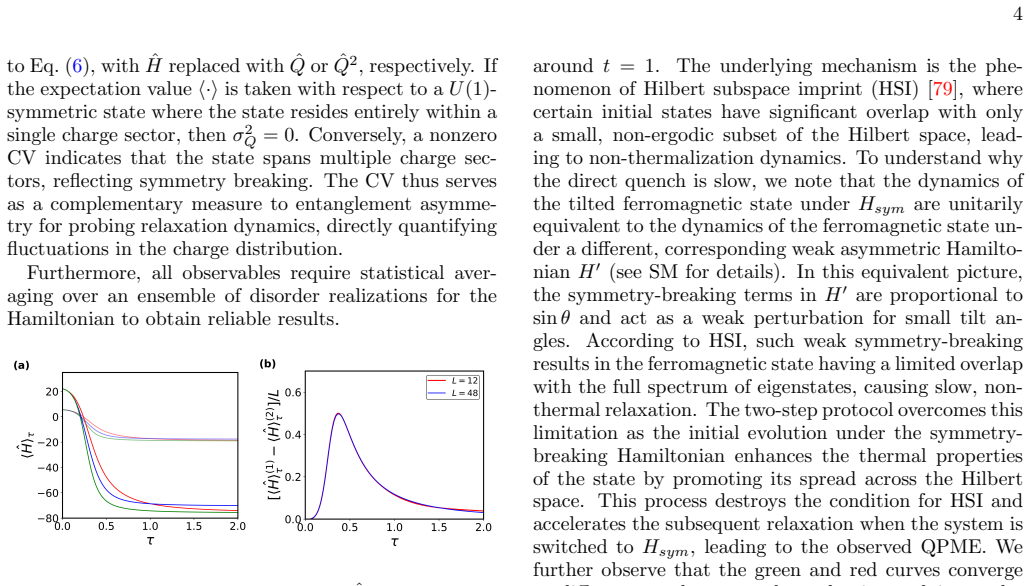
Using tilted ferromagnetic initial states, a transient evolution under a U(1)-symmetry-breaking Hamiltonian followed by evolution under a symmetric Hamiltonian produces faster thermalization in real time and faster convergence to the ground state in imaginary time than direct evolution under the symmetric Hamiltonian alone.
What carries the argument
The two-step protocol that applies a short symmetry-breaking Hamiltonian before switching to the symmetric target Hamiltonian.
Load-bearing premise
The faster relaxation depends on using tilted ferromagnetic initial states with small tilt angles and on the numerical definition of relaxation times.
What would settle it
Numerical runs or experiments on small-tilt ferromagnetic starts in which the two-step protocol takes the same or longer time to thermalize or reach the ground state than direct symmetric evolution would falsify the claim.
Figures




read the original abstract
The quantum Pontus-Mpemba effect (QPME) is a counterintuitive phenomenon wherein a quantum system relaxes more rapidly through a two-step evolution protocol than through direct evolution under a symmetric Hamiltonian alone. In this protocol, the system first evolves under a symmetry-breaking Hamiltonian and then switches to a symmetric one. We demonstrate that QPME occurs under both real-time and imaginary-time dynamics with respect to $U(1)$-symmetry. Using tilted ferromagnetic initial states, we demonstrate that a transient asymmetric evolution significantly accelerates thermalization or convergence to the ground state for both real-time and imaginary-time evolutions, respectively. The effect is pronounced for small tilt angles, while larger tilts or antiferromagnetic initial states suppress it. Numerical evidence across different system sizes confirms the robustness of QPME, demonstrating its stability in the thermodynamic limit. This work extends the framework of nonequilibrium quantum phenomena to incorporate active state preparation, with direct implications for the implementation of quantum simulation.
Editorial analysis
A structured set of objections, weighed in public.
Referee Report
Summary. The manuscript claims to demonstrate a quantum Pontus-Mpemba effect (QPME) under U(1) symmetry for both real-time thermalization and imaginary-time ground-state convergence. A two-step protocol is introduced in which the system evolves transiently under a symmetry-breaking Hamiltonian before switching to the symmetric Hamiltonian; using tilted ferromagnetic product states with small tilt angle θ, the protocol is reported to yield shorter relaxation times than direct evolution under the symmetric Hamiltonian alone. The effect is stated to be pronounced only for small θ and suppressed for larger tilts or antiferromagnetic initial states, with numerical checks across system sizes supporting stability in the thermodynamic limit.
Significance. If the reported acceleration survives scrutiny of the relaxation-time metric and is shown to be robust to alternative, parameter-free measures of distance to equilibrium, the work would usefully extend nonequilibrium quantum dynamics to include active symmetry-breaking preparation steps, with possible relevance to quantum simulation protocols. The dual real- and imaginary-time demonstration is a positive feature, yet the dependence on a narrow class of initial states and on numerically fitted timescales limits the generality of the central claim.
major comments (2)
- [Numerical Results] Numerical Results section: the reported speedup is obtained from numerical extraction of relaxation times (presumably via exponential fits or threshold crossings) on small-tilt ferromagnetic states; because the precise definition of the metric, fitting window, and reference equilibrium value is not given, it remains possible that an alternative parameter-free measure such as integrated distance to equilibrium or time-to-90 % overlap would remove the ordering between the two-step and direct protocols.
- [Methods] Methods and Model Hamiltonians section: the manuscript does not supply the explicit form of the U(1)-breaking and symmetric Hamiltonians, the range of system sizes, or error bars on the extracted relaxation times; these omissions are load-bearing for the claim that the acceleration is significant, tilt-angle dependent, and robust in the thermodynamic limit.
minor comments (2)
- [Abstract] The abstract states that the effect is 'pronounced for small tilt angles' but does not quantify the range of θ examined or the criterion used to classify 'small' versus 'larger' tilts.
- [Figures] Figure captions and axis labels should explicitly indicate whether the plotted relaxation times are obtained from real-time or imaginary-time evolution and whether error bars are shown.
Simulated Author's Rebuttal
We thank the referee for the careful reading and constructive comments, which have helped us improve the clarity and robustness of the manuscript. We address each major comment point by point below.
read point-by-point responses
-
Referee: [Numerical Results] Numerical Results section: the reported speedup is obtained from numerical extraction of relaxation times (presumably via exponential fits or threshold crossings) on small-tilt ferromagnetic states; because the precise definition of the metric, fitting window, and reference equilibrium value is not given, it remains possible that an alternative parameter-free measure such as integrated distance to equilibrium or time-to-90 % overlap would remove the ordering between the two-step and direct protocols.
Authors: We appreciate this observation on the need for an unambiguous and robust metric. In the revised manuscript we explicitly define the relaxation time as the time at which the trace distance to the long-time equilibrium state drops to 1/e of its initial value, with the equilibrium reference obtained from direct long-time evolution under the symmetric Hamiltonian. The exponential fit is performed over a fixed intermediate-time window (t ∈ [5, 20] in units where ħ = 1). To address the referee’s suggestion, we have recomputed the ordering using two parameter-free alternatives: the time-integrated distance to equilibrium and the time required to reach 90 % overlap. Both quantities preserve the reported speedup for small tilt angles θ while confirming suppression at larger θ. These additional checks will be added to the Numerical Results section and Supplementary Material. revision: yes
-
Referee: [Methods] Methods and Model Hamiltonians section: the manuscript does not supply the explicit form of the U(1)-breaking and symmetric Hamiltonians, the range of system sizes, or error bars on the extracted relaxation times; these omissions are load-bearing for the claim that the acceleration is significant, tilt-angle dependent, and robust in the thermodynamic limit.
Authors: We agree that these technical details are essential for reproducibility. The revised manuscript will provide the explicit operator expressions for both the U(1)-symmetric Hamiltonian and the transient U(1)-breaking Hamiltonian. We will also state the system sizes employed (N = 6 to N = 18) together with the finite-size scaling analysis already performed, and we will display error bars on all extracted relaxation times arising from least-squares fitting uncertainties. These additions will directly support the claims of tilt-angle dependence and stability in the thermodynamic limit. revision: yes
Circularity Check
No circularity in numerical demonstration of QPME
full rationale
The paper reports a numerical observation of accelerated relaxation under a two-step protocol with tilted ferromagnetic initial states in both real and imaginary time. No load-bearing step reduces by construction to a fitted parameter, self-definition, or self-citation chain; relaxation times are extracted from direct simulation data and presented as empirical results rather than predictions forced by the protocol definition itself. The derivation chain consists of standard time-evolution numerics whose outputs are compared to reference symmetric evolution, remaining independent of the target phenomenon.
Axiom & Free-Parameter Ledger
free parameters (1)
- tilt angle
axioms (1)
- domain assumption The second Hamiltonian respects U(1) symmetry while the first breaks it transiently
Lean theorems connected to this paper
-
IndisputableMonolith/Cost/FunctionalEquation.leanwashburn_uniqueness_aczel unclear?
unclearRelation between the paper passage and the cited Recognition theorem.
Using tilted ferromagnetic initial states, we demonstrate that a transient asymmetric evolution significantly accelerates thermalization or convergence to the ground state
-
IndisputableMonolith/Foundation/AlphaCoordinateFixation.leanalpha_pin_under_high_calibration unclear?
unclearRelation between the paper passage and the cited Recognition theorem.
the two-step protocol... Hamiltonian switch... γ=0.2... switching time τ=0.1
What do these tags mean?
- matches
- The paper's claim is directly supported by a theorem in the formal canon.
- supports
- The theorem supports part of the paper's argument, but the paper may add assumptions or extra steps.
- extends
- The paper goes beyond the formal theorem; the theorem is a base layer rather than the whole result.
- uses
- The paper appears to rely on the theorem as machinery.
- contradicts
- The paper's claim conflicts with a theorem or certificate in the canon.
- unclear
- Pith found a possible connection, but the passage is too broad, indirect, or ambiguous to say the theorem truly supports the claim.
Forward citations
Cited by 3 Pith papers
-
Theory of Quantum Imaginary-Time Mpemba Effect
A necessary and sufficient condition for the quantum imaginary-time Mpemba effect is that it depends only on the population ratios of excited states to the ground state.
-
Pontus-Mpemba effect in cavity quantum electrodynamics
Quenching the cavity decay rate in the Jaynes-Cummings model produces faster atomic excitation decay than constant dissipation, realizing the quantum Pontus-Mpemba effect.
-
Dynamics of entanglement fluctuations and quantum Mpemba effect in the $\nu=1$ QSSEP model
Incorporating noise-induced quasiparticle correlations in the ν=1 QSSEP model yields the full-time distribution of entanglement entropy and shows the quantum Mpemba effect is extremely fine-tuned and hard to observe.
Reference graph
Works this paper leans on
-
[1]
E. B. Mpemba and D. G. Osborne, Cool?, Physics Edu- cation 4, 172 (1969)
work page 1969
-
[2]
R. Bacon, Opus majus [great work](rb burke, trans.), New York: Russell & Russell.(Original work written in
-
[3]
R. Descartes and L. Liard, Discours de la m´ ethode pour bien conduire sa raison et chercher la v´ erit´ e dans les sci- ences (Continental-Verlag, 1948)
work page 1948
-
[4]
L. M. Groves, Now it can be told: The story of the Man- hattan Project (Hachette+ ORM, 2009)
work page 2009
-
[5]
S. Esposito, R. De Risi, and L. Somma, Mpemba effect and phase transitions in the adiabatic cooling of water before freezing, Physica A: Statistical Mechanics and its Applications 387, 757 (2008)
work page 2008
-
[6]
D. Auerbach, Supercooling and the mpemba effect: When hot water freezes quicker than cold, American Journal of Physics 63, 882 (1995)
work page 1995
-
[7]
A. Lasanta, F. Vega Reyes, A. Prados, and A. Santos, When the hotter cools more quickly: Mpemba effect in granular fluids, Physical review letters 119, 148001 (2017)
work page 2017
-
[8]
Y.-H. Ahn, H. Kang, D.-Y. Koh, and H. Lee, Experimen- tal verifications of mpemba-like behaviors of clathrate hydrates, Korean Journal of Chemical Engineering 33, 1903 (2016)
work page 1903
-
[9]
P. A. Greaney, G. Lani, G. Cicero, and J. C. Grossman, Mpemba-like behavior in carbon nanotube resonators, Metallurgical and Materials Transactions A 42, 3907 (2011)
work page 2011
- [10]
- [11]
- [12]
- [13]
-
[14]
C. Hu, J. Li, S. Huang, H. Li, C. Luo, J. Chen, S. Jiang, and L. An, Conformation directed mpemba effect on polylactide crystallization, Crystal Growth & Design 18, 5757 (2018)
work page 2018
- [15]
-
[16]
R. Holtzman and O. Raz, Landau theory for the mpemba effect through phase transitions, Communica- tions physics 5, 280 (2022)
work page 2022
-
[17]
M. Baity-Jesi, E. Calore, A. Cruz, L. A. Fernandez, J. M. Gil-Narvi´ on, A. Gordillo-Guerrero, D. I˜ niguez, A. Las- anta, A. Maiorano, E. Marinari, et al. , The mpemba effect in spin glasses is a persistent memory effect, Pro- ceedings of the National Academy of Sciences 116, 15350 (2019)
work page 2019
- [18]
-
[19]
A. Santos, Mpemba meets newton: Exploring the mpemba and kovacs effects in the time-delayed cooling law, Physical Review E 109, 044149 (2024)
work page 2024
-
[20]
F. J. Schwarzendahl and H. L¨ owen, Anomalous cooling and overcooling of active colloids, Physical review letters 129, 138002 (2022)
work page 2022
-
[21]
G. Teza, R. Yaacoby, and O. Raz, Relaxation shortcuts through boundary coupling, Physical review letters 131, 017101 (2023)
work page 2023
-
[22]
I. G.-A. Pemart ´ ın, E. Momp´ o, A. Lasanta, V. Mart ´ ın- Mayor, and J. Salas, Shortcuts of freely relaxing systems using equilibrium physical observables, Physical Review Letters 132, 117102 (2024)
work page 2024
- [23]
- [24]
- [25]
- [26]
- [27]
-
[28]
F. Ares, P. Calabrese, and S. Murciano, The quantum Mpemba effects, Nature Reviews Physics 7, 451 (2025)
work page 2025
-
[29]
H. Yu, S. Liu, and S.-X. Zhang, Quantum mpemba ef- fects from symmetry perspectives, AAPPS Bulletin 35, 17 (2025)
work page 2025
-
[30]
A. Nava and M. Fabrizio, Lindblad dissipative dynamics in the presence of phase coexistence, Physical Review B 100, 125102 (2019)
work page 2019
-
[31]
F. Carollo, A. Lasanta, and I. Lesanovsky, Exponentiall y accelerated approach to stationarity in markovian open quantum systems through the mpemba effect, Physical Review Letters 127, 060401 (2021)
work page 2021
- [32]
-
[33]
M. Moroder, O. Culhane, K. Zawadzki, and J. Goold, Thermodynamics of the quantum mpemba effect, Physi- cal Review Letters 133, 140404 (2024). 8
work page 2024
-
[34]
S. Aharony Shapira, Y. Shapira, J. Markov, G. Teza, N. Akerman, O. Raz, and R. Ozeri, Inverse mpemba ef- fect demonstrated on a single trapped ion qubit, Physical Review Letters 133, 010403 (2024)
work page 2024
-
[35]
S. Kochsiek, F. Carollo, and I. Lesanovsky, Accelerat- ing the approach of dissipative quantum spin systems towards stationarity through global spin rotations, Phys- ical Review A 106, 012207 (2022)
work page 2022
-
[36]
X. Wang and J. Wang, Mpemba effects in nonequilib- rium open quantum systems, Physical Review Research 6, 033330 (2024)
work page 2024
-
[37]
M. Boubakour, S. Endo, T. Fogarty, and T. Busch, Dy- namical invariant based shortcut to equilibration in open quantum systems, Quantum Science and Technology 10, 025036 (2025)
work page 2025
-
[38]
J. Furtado and A. C. Santos, Strong quantum mpemba effect with squeezed thermal reservoirs, arXiv preprint arXiv:2411.04545 (2024)
-
[39]
D. Qian, H. Wang, and J. Wang, Intrinsic quantum mpemba effect in markovian systems and quantum cir- cuits, Physical Review B 111, L220304 (2025)
work page 2025
-
[40]
J. Dong, H. Mu, M. Qin, and H. Cui, Quantum mpemba effect of localization in the dissipative mosaic model, Physical Review A 111, 022215 (2025)
work page 2025
-
[41]
D. Liu, J. Yuan, H. Ruan, Y. Xu, S. Luo, J. He, X. He, Y. Ma, and J. Wang, Speeding up quantum heat engines by the mpemba effect, Physical Review A 110, 042218 (2024)
work page 2024
-
[42]
F. Ares, S. Murciano, and P. Calabrese, Entanglement asymmetry as a probe of symmetry breaking, Nature Communications 14, 2036 (2023)
work page 2036
- [43]
-
[44]
X. Turkeshi, P. Calabrese, and A. De Luca, Quantum mpemba effect in random circuits, Physical Review Let- ters 135, 040403 (2025)
work page 2025
-
[45]
M. Fagotti, M. Collura, F. H. Essler, and P. Cal- abrese, Relaxation after quantum quenches in the spin-1 2 heisenberg xxz chain, Physical Review B 89, 125101 (2014)
work page 2014
-
[46]
F. H. Essler and M. Fagotti, Quench dynamics and relax- ation in isolated integrable quantum spin chains, Journal of Statistical Mechanics: Theory and Experiment 2016, 064002 (2016)
work page 2016
-
[47]
Doyon, Lecture notes on generalised hydrodynamics, SciPost Physics Lecture Notes , 018 (2020)
B. Doyon, Lecture notes on generalised hydrodynamics, SciPost Physics Lecture Notes , 018 (2020)
work page 2020
-
[48]
M. Fagotti, On conservation laws, relaxation and pre- relaxation after a quantum quench, Journal of Statisti- cal Mechanics: Theory and Experiment 2014, P03016 (2014)
work page 2014
-
[49]
B. Bertini and M. Fagotti, Pre-relaxation in weakly inter- acting models, Journal of Statistical Mechanics: Theory and Experiment 2015, P07012 (2015)
work page 2015
-
[50]
L. Vidmar and M. Rigol, Generalized gibbs ensemble in integrable lattice models, Journal of Statistical Mechan- ics: Theory and Experiment 2016, 064007 (2016)
work page 2016
-
[51]
P. Calabrese, F. Essler, and G. Mussardo, Quantum in- tegrability in out-of-equilibrium systems, special issue, J. Stat. Mech 2016, 064001 (2016)
work page 2016
-
[52]
A. Polkovnikov, K. Sengupta, A. Silva, and M. Vengalat- tore, Colloquium: Nonequilibrium dynamics of closed in- teracting quantum systems, Reviews of Modern Physics 83, 863 (2011)
work page 2011
-
[53]
A. Bastianello, B. Bertini, B. Doyon, and R. Vasseur, In- troduction to the special issue on emergent hydrodynam- ics in integrable many-body systems, Journal of Statis- tical Mechanics: Theory and Experiment 2022, 014001 (2022)
work page 2022
-
[54]
F. Ares, S. Murciano, E. Vernier, and P. Calabrese, Lack of symmetry restoration after a quantum quench: An entanglement asymmetry study, SciPost Physics 15, 089 (2023)
work page 2023
-
[55]
B. J. Khor, D. M. K¨ urk¸ c¨ uoglu, T. Hobbs, G. N. Per- due, and I. Klich, Confinement and kink entanglement asymmetry on a quantum ising chain, Quantum 8, 1462 (2024)
work page 2024
-
[56]
C. Rylands, E. Vernier, and P. Calabrese, Dynamical symmetry restoration in the heisenberg spin chain, Jour- nal of Statistical Mechanics: Theory and Experiment 2024, 123102 (2024)
work page 2024
-
[57]
S. Murciano, F. Ares, I. Klich, and P. Calabrese, Entan- glement asymmetry and quantum mpemba effect in the xy spin chain, Journal of Statistical Mechanics: Theory and Experiment 2024, 013103 (2024)
work page 2024
- [58]
- [59]
-
[60]
S. Yamashika and F. Ares, The quantum mpemba effect in long-range spin systems, arXiv preprint arXiv:2507.06636 (2025)
- [61]
- [62]
- [63]
-
[64]
C. Rylands, K. Klobas, F. Ares, P. Calabrese, S. Mur- ciano, and B. Bertini, Microscopic origin of the quantum mpemba effect in integrable systems, Physical Review Letters 133, 010401 (2024)
work page 2024
- [65]
- [66]
-
[67]
G. Di Giulio, X. Turkeshi, and S. Murciano, Measurement-induced symmetry restoration and quantum mpemba effect, Entropy 27, 407 (2025)
work page 2025
- [68]
- [69]
-
[70]
L. K. Joshi, J. Franke, A. Rath, F. Ares, S. Murciano, F. Kranzl, R. Blatt, P. Zoller, B. Vermersch, P. Cal- abrese, et al. , Observing the quantum mpemba effect in quantum simulations, Physical Review Letters 133, 9 010402 (2024)
work page 2024
-
[71]
Observa- tion and modulation of the quantum Mpemba effect,
Y. Xu, C.-P. Fang, B.-J. Chen, M.-C. Wang, Z.-Y. Ge, Y.-H. Shi, Y. Liu, C.-L. Deng, K. Zhao, Z.-H. Liu, et al. , Observation and modulation of the quantum mpemba effect on a superconducting quantum processor, arXiv preprint arXiv:2508.07707 (2025)
-
[72]
A. Nava and R. Egger, Pontus-mpemba effects, arXiv preprint arXiv:2505.14622 (2025)
-
[73]
S. Alipour and T. Ojanen, State-based quantum sim- ulation of imaginary-time evolution, arXiv preprint arXiv:2506.12381 (2025)
-
[74]
L. Capizzi and V. Vitale, A universal formula for the en- tanglement asymmetry of matrix product states, Journal of Physics A: Mathematical and Theoretical 57, 45LT01 (2024)
work page 2024
-
[75]
L. Capizzi and M. Mazzoni, Entanglement asymmetry in the ordered phase of many-body systems: the ising field theory, Journal of High Energy Physics 2023, 1 (2023)
work page 2023
-
[76]
M. Chen and H.-H. Chen, R´ enyi entanglement asymme- try in (1+ 1)-dimensional conformal field theories, Phys- ical Review D 109, 065009 (2024)
work page 2024
-
[77]
F. Ares, S. Murciano, P. Calabrese, and L. Piroli, Entan- glement asymmetry dynamics in random quantum cir- cuits, Physical Review Research 7, 033135 (2025)
work page 2025
- [78]
-
[80]
G. Vidal, Efficient simulation of one-dimensional quan- tum many-body systems, Physical review letters 93, 040502 (2004)
work page 2004
-
[81]
J. E. Hirsch and R. M. Fye, Monte carlo method for magnetic impurities in metals, Physical review letters 56, 2521 (1986)
work page 1986
discussion (0)
Sign in with ORCID, Apple, or X to comment. Anyone can read and Pith papers without signing in.