Recognition: unknown
Long-CODE: Isolating Pure Long-Context as an Orthogonal Dimension in Video Evaluation
Pith reviewed 2026-05-10 05:51 UTC · model grok-4.3
The pith
Short-term visual quality and long-context attributes in videos are orthogonal, requiring separate metrics and benchmarks for long generations.
A machine-rendered reading of the paper's core claim, the machinery that carries it, and where it could break.
Core claim
Short-term visual perception and long-context attributes are fundamentally orthogonal dimensions, so long-video evaluation must be disentangled from short-video assessments. Existing metrics prove insensitive to structural inconsistencies such as shot-level perturbations and narrative shuffling. A novel metric based on shot dynamics is sensitive to the long-range testing framework, and the Long-CODE dataset supplies human annotations focused solely on genuine long-range characteristics, with the new metrics achieving state-of-the-art correlation with those annotations.
What carries the argument
Shot-dynamics metric that quantifies sensitivity to long-range structural inconsistencies such as narrative shuffling and shot perturbations, paired with the Long-CODE dataset that isolates human annotations to long-context attributes.
If this is right
- Long-video generation models can be evaluated on narrative and consistency dimensions without interference from short-term quality scores.
- Shot-level perturbations and narrative shuffling become detectable failure modes that current metrics overlook.
- Benchmarks can now isolate long-range human judgments to guide improvements in global coherence of generated videos.
- Evaluation protocols can treat long-context as an independent axis rather than an extension of short-video standards.
Where Pith is reading between the lines
- Model training loops could incorporate the shot-dynamics signal directly to penalize long-range inconsistencies without harming local visual quality.
- The separation may expose that current video models are optimized primarily for short clips and require new architectures for sustained narrative.
- Similar orthogonal splits could apply to audio or text generation where local fluency and global structure are often conflated.
Load-bearing premise
Short-term visual perception and long-context attributes are fundamentally orthogonal dimensions.
What would settle it
Human ratings on narrative consistency and causal structure in long videos show equal or lower correlation with the shot-dynamics metric than with conventional frame-quality metrics when both are tested on the Long-CODE dataset.
Figures
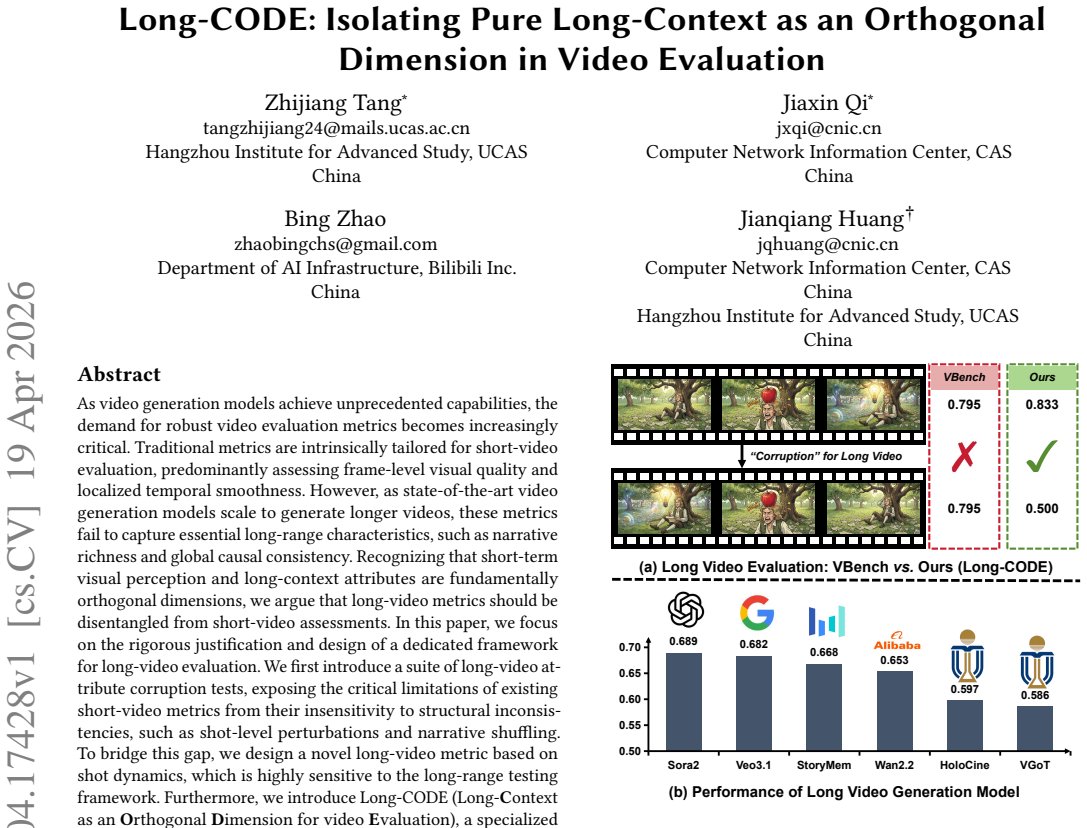


read the original abstract
As video generation models achieve unprecedented capabilities, the demand for robust video evaluation metrics becomes increasingly critical. Traditional metrics are intrinsically tailored for short-video evaluation, predominantly assessing frame-level visual quality and localized temporal smoothness. However, as state-of-the-art video generation models scale to generate longer videos, these metrics fail to capture essential long-range characteristics, such as narrative richness and global causal consistency. Recognizing that short-term visual perception and long-context attributes are fundamentally orthogonal dimensions, we argue that long-video metrics should be disentangled from short-video assessments. In this paper, we focus on the rigorous justification and design of a dedicated framework for long-video evaluation. We first introduce a suite of long-video attribute corruption tests, exposing the critical limitations of existing hort-video metrics from their insensitivity to structural inconsistencies, such as shot-level perturbations and narrative shuffling. To bridge this gap, we design a novel long-video metric based on shot dynamics, which is highly sensitive to the long-range testing framework. Furthermore, we introduce Long-CODE (Long-Context as an Orthogonal Dimension for video Evaluation), a specialized dataset designed to benchmark long-video evaluation, with human annotations isolated specifically to genuine long-range characteristics. Extensive experiments show that our proposed metrics achieve state-of-the-art correlation with human judgments. Ultimately, our metric and benchmark seamlessly complement existing short-video standards, establishing a holistic and unbiased evaluation paradigm for video generation models.
Editorial analysis
A structured set of objections, weighed in public.
Referee Report
Summary. The paper claims that short-term visual perception and long-context attributes are fundamentally orthogonal dimensions in video evaluation. It introduces long-video attribute corruption tests to expose limitations of existing short-video metrics on structural issues like shot-level perturbations and narrative shuffling, designs a novel long-video metric based on shot dynamics that is sensitive to long-range aspects, and presents the Long-CODE dataset with human annotations isolated to genuine long-range characteristics. Extensive experiments are stated to show that the proposed metrics achieve state-of-the-art correlation with human judgments, complementing short-video standards for a holistic evaluation paradigm.
Significance. If the orthogonality holds and the metric is decoupled from short-term factors, this could fill a critical gap in evaluating long video generation models by focusing on narrative richness and global consistency that current metrics overlook. The corruption tests and specialized dataset represent constructive steps toward more comprehensive benchmarks.
major comments (2)
- [Abstract] Abstract: The premise that short-term visual perception and long-context attributes are 'fundamentally orthogonal dimensions' is asserted as an argument rather than derived or tested; the corruption tests only establish insufficiency of short metrics for long perturbations but provide no ablation, covariance analysis, or controlled experiment showing the shot-dynamics metric is insensitive to short-term visual quality or temporal smoothness, which is load-bearing for the disentanglement claim.
- [Abstract] Abstract: The assertion that 'extensive experiments show that our proposed metrics achieve state-of-the-art correlation with human judgments' lacks any equations, implementation details, dataset statistics, experimental controls, or results tables in the manuscript text, preventing verification of the central empirical outcome.
minor comments (2)
- [Abstract] Typo in Abstract: 'hort-video metrics' should read 'short-video metrics'.
- [Abstract] The shot-dynamics metric is introduced at a high level without mathematical formulation, pseudocode, or parameter details, which hinders reproducibility even if not central to the claim.
Simulated Author's Rebuttal
We thank the referee for the constructive and detailed feedback. The comments help clarify the presentation of our core claims on orthogonality and the verifiability of our empirical results. We address each major comment below, indicating planned revisions to strengthen the manuscript.
read point-by-point responses
-
Referee: [Abstract] Abstract: The premise that short-term visual perception and long-context attributes are 'fundamentally orthogonal dimensions' is asserted as an argument rather than derived or tested; the corruption tests only establish insufficiency of short metrics for long perturbations but provide no ablation, covariance analysis, or controlled experiment showing the shot-dynamics metric is insensitive to short-term visual quality or temporal smoothness, which is load-bearing for the disentanglement claim.
Authors: We agree that the orthogonality claim requires stronger empirical grounding beyond motivation. The corruption tests demonstrate that existing short-video metrics fail to detect structural long-range issues such as shot perturbations and narrative shuffling. To directly address the disentanglement, we will add a new subsection with ablation studies and covariance analysis showing that the shot-dynamics metric exhibits low correlation with short-term visual quality and temporal smoothness metrics (e.g., near-zero covariance with frame-level PSNR/SSIM under local perturbations) while remaining sensitive to global narrative changes. This will be included in the revised manuscript to support the claim more rigorously. revision: yes
-
Referee: [Abstract] Abstract: The assertion that 'extensive experiments show that our proposed metrics achieve state-of-the-art correlation with human judgments' lacks any equations, implementation details, dataset statistics, experimental controls, or results tables in the manuscript text, preventing verification of the central empirical outcome.
Authors: The abstract is intentionally concise and does not contain implementation details or tables, per standard practice. The full manuscript includes: the shot-dynamics metric formulation and equations in Section 3.2, Long-CODE dataset statistics and annotation protocol (including inter-annotator agreement) in Section 4, experimental controls and baselines in Section 5.1, and correlation results tables (Pearson/Spearman with human judgments) in Section 6.2. To improve immediate verifiability from the abstract, we will revise it to include a brief pointer to these sections and key quantitative outcomes (e.g., correlation improvements). If the referee finds any specific detail still missing, we will expand the relevant sections further. revision: partial
Circularity Check
No circularity; orthogonality is explicit premise, results are empirical
full rationale
The paper states the core premise directly as recognition rather than derivation: 'Recognizing that short-term visual perception and long-context attributes are fundamentally orthogonal dimensions, we argue that long-video metrics should be disentangled from short-video assessments.' No equations, fitted parameters, or self-citations are shown reducing any claim to its inputs by construction. The corruption tests, shot-dynamics metric, Long-CODE dataset, and human-correlation experiments are presented as new contributions whose validity rests on external empirical outcomes, not on re-labeling of inputs. This matches the default case of a non-circular proposal paper whose central claims remain independent of the stated assumption.
Axiom & Free-Parameter Ledger
Reference graph
Works this paper leans on
-
[1]
Shuai Bai, Yuxuan Cai, Ruizhe Chen, Keqin Chen, Xionghui Chen, Zesen Cheng, Lianghao Deng, Wei Ding, Chang Gao, Chunjiang Ge, et al . 2025. Qwen3-vl technical report.arXiv preprint arXiv:2511.21631(2025)
work page internal anchor Pith review Pith/arXiv arXiv 2025
-
[2]
2010.Memoirs of the life, writings, and discoveries of Sir Isaac Newton
David Brewster. 2010.Memoirs of the life, writings, and discoveries of Sir Isaac Newton. Vol. 2. Cambridge University Press
2010
- [3]
-
[4]
1998.Applied regression analysis
Norman R Draper and Harry Smith. 1998.Applied regression analysis. Vol. 326. John Wiley & Sons
1998
-
[5]
Miquel Farré, Andi Marafioti, Lewis Tunstall, Leandro Von Werra, and Thomas Wolf. 2024. FineVideo. https://huggingface.co/datasets/HuggingFaceFV/ finevideo
2024
-
[6]
Google. 2024. Veo: a text-to-video generation system. https://storage.googleapis. com/deepmind-media/veo/Veo-3-Tech-Report.pdf
2024
-
[7]
Hui Han, Siyuan Li, Jiaqi Chen, Yiwen Yuan, Yuling Wu, Yufan Deng, Chak Tou Leong, Hanwen Du, Junchen Fu, Youhua Li, et al. 2025. Video-bench: Human- aligned video generation benchmark. InProceedings of the Computer Vision and Pattern Recognition Conference. 18858–18868
2025
- [8]
-
[9]
Jonathan Ho, Ajay Jain, and Pieter Abbeel. 2020. Denoising diffusion probabilistic models.Advances in neural information processing systems33 (2020), 6840–6851
2020
-
[10]
Jonathan Ho, Tim Salimans, Alexey Gritsenko, William Chan, Mohammad Norouzi, and David J Fleet. 2022. Video diffusion models.Advances in neu- ral information processing systems35 (2022), 8633–8646
2022
- [11]
-
[12]
Ziqi Huang, Yinan He, Jiashuo Yu, Fan Zhang, Chenyang Si, Yuming Jiang, Yuan- han Zhang, Tianxing Wu, Qingyang Jin, Nattapol Chanpaisit, et al. 2024. Vbench: Comprehensive benchmark suite for video generative models. InProceedings of the IEEE/CVF Conference on Computer Vision and Pattern Recognition. 21807– 21818
2024
-
[13]
Ziqi Huang, Fan Zhang, Xiaojie Xu, Yinan He, Jiashuo Yu, Ziyue Dong, Qianli Ma, Nattapol Chanpaisit, Chenyang Si, Yuming Jiang, et al . 2025. Vbench++: Comprehensive and versatile benchmark suite for video generative models.IEEE Transactions on Pattern Analysis and Machine Intelligence(2025)
2025
- [14]
-
[15]
Zeyinzi Jiang, Zhen Han, Chaojie Mao, Jingfeng Zhang, Yulin Pan, and Yu Liu
-
[16]
InProceedings of the IEEE/CVF International Conference on Computer Vision
Vace: All-in-one video creation and editing. InProceedings of the IEEE/CVF International Conference on Computer Vision. 17191–17202
- [17]
-
[18]
Zhiqiu Lin, Deepak Pathak, Baiqi Li, Jiayao Li, Xide Xia, Graham Neubig, Pengchuan Zhang, and Deva Ramanan. 2024. Evaluating text-to-visual gen- eration with image-to-text generation. InEuropean Conference on Computer Vision. Springer, 366–384
2024
-
[19]
Yaron Lipman, Ricky TQ Chen, Heli Ben-Hamu, Maximilian Nickel, and Matt Le
-
[20]
Flow matching for generative modeling.arXiv preprint arXiv:2210.02747 (2022)
work page internal anchor Pith review Pith/arXiv arXiv 2022
-
[21]
Jie Liu, Gongye Liu, Jiajun Liang, Yangguang Li, Jiaheng Liu, Xintao Wang, Pengfei Wan, Di Zhang, and Wanli Ouyang. 2025. Flow-grpo: Training flow matching models via online rl.arXiv preprint arXiv:2505.05470(2025)
work page internal anchor Pith review arXiv 2025
-
[22]
Yaofang Liu, Xiaodong Cun, Xuebo Liu, Xintao Wang, Yong Zhang, Haoxin Chen, Yang Liu, Tieyong Zeng, Raymond Chan, and Ying Shan. 2024. Evalcrafter: Benchmarking and evaluating large video generation models. InProceedings of the IEEE/CVF conference on computer vision and pattern recognition. 22139–22149
2024
-
[23]
Yixin Liu, Kai Zhang, Yuan Li, Zhiling Yan, Chujie Gao, Ruoxi Chen, Zhengqing Yuan, Yue Huang, Hanchi Sun, Jianfeng Gao, et al . 2024. Sora: A review on background, technology, limitations, and opportunities of large vision models. arXiv preprint arXiv:2402.17177(2024)
work page internal anchor Pith review arXiv 2024
- [24]
-
[25]
Karl Pearson. 1895. VII. Note on regression and inheritance in the case of two parents.proceedings of the royal society of London58, 347-352 (1895), 240–242
-
[26]
William Peebles and Saining Xie. 2023. Scalable diffusion models with transform- ers. InProceedings of the IEEE/CVF international conference on computer vision. 4195–4205
2023
- [27]
-
[28]
Charles Spearman. 1961. The proof and measurement of association between two things. (1961)
1961
-
[29]
Team Wan, Ang Wang, Baole Ai, Bin Wen, Chaojie Mao, Chen-Wei Xie, Di Chen, Feiwu Yu, Haiming Zhao, Jianxiao Yang, et al. 2025. Wan: Open and advanced large-scale video generative models.arXiv preprint arXiv:2503.20314(2025)
work page internal anchor Pith review Pith/arXiv arXiv 2025
-
[30]
Jiapeng Wang, Chengyu Wang, Kunzhe Huang, Jun Huang, and Lianwen Jin
-
[31]
InProceedings of the 2024 Conference on Empirical Methods in Natural Language Processing
Videoclip-xl: Advancing long description understanding for video clip models. InProceedings of the 2024 Conference on Empirical Methods in Natural Language Processing. 16061–16075
2024
-
[32]
Zhuoyi Yang, Jiayan Teng, Wendi Zheng, Ming Ding, Shiyu Huang, Jiazheng Xu, Yuanming Yang, Wenyi Hong, Xiaohan Zhang, Guanyu Feng, et al . 2024. Cogvideox: Text-to-video diffusion models with an expert transformer.arXiv preprint arXiv:2408.06072(2024)
work page internal anchor Pith review arXiv 2024
- [33]
-
[34]
Dian Zheng, Ziqi Huang, Hongbo Liu, Kai Zou, Yinan He, Fan Zhang, Lulu Gu, Yuanhan Zhang, Jingwen He, Wei-Shi Zheng, et al. 2025. Vbench-2.0: Advanc- ing video generation benchmark suite for intrinsic faithfulness.arXiv preprint arXiv:2503.21755(2025)
work page internal anchor Pith review arXiv 2025
- [35]
- [36]
-
[37]
Zangwei Zheng, Xiangyu Peng, Tianji Yang, Chenhui Shen, Shenggui Li, Hongxin Liu, Yukun Zhou, Tianyi Li, and Yang You. 2024. Open-sora: Democratizing efficient video production for all.arXiv preprint arXiv:2412.20404(2024)
work page internal anchor Pith review arXiv 2024
-
[38]
Yupeng Zhou, Daquan Zhou, Ming-Ming Cheng, Jiashi Feng, and Qibin Hou
-
[39]
Received 20 February 2007; revised 12 March 2009; accepted 5 June 2009
Storydiffusion: Consistent self-attention for long-range image and video generation.Advances in Neural Information Processing Systems37 (2024), 110315– 110340. Received 20 February 2007; revised 12 March 2009; accepted 5 June 2009
2024
discussion (0)
Sign in with ORCID, Apple, or X to comment. Anyone can read and Pith papers without signing in.