Recognition: unknown
Clock Noise Cancellation in Heterodyne Links between Optical Cavities for Space-Borne Gravitational-Wave Telescopes
Pith reviewed 2026-05-10 04:25 UTC · model grok-4.3
The pith
A weighted combination of two heterodyne signals from optical cavities cancels clock jitter while preserving gravitational-wave information.
A machine-rendered reading of the paper's core claim, the machinery that carries it, and where it could break.
Core claim
In the back-linked Fabry-Perot interferometer, clock jitter from space-qualified oscillators exceeds requirements by more than an order of magnitude. The proposed scheme forms a weighted combination of two heterodyne signals with positive and negative beat-note frequencies using time-dependent coefficients derived from arm-length variations. This eliminates clock noise while retaining gravitational-wave information, recovering original sensitivity and enhancing shot-noise limited SNR by √2.
What carries the argument
The time-dependent weighted combination of positive and negative beat-note heterodyne signals, where coefficients are chosen to null common clock jitter terms.
If this is right
- Clock stability requirements for decihertz-band gravitational-wave detection drop to the level of existing space-qualified oscillators.
- The synthesized signal recovers the original gravitational-wave sensitivity of the heterodyne link.
- Shot-noise-limited performance improves by a factor of √2.
- The cancellation holds under realistic arm-length drift rates as confirmed by time-domain simulations.
- No extra hardware for clock modulation is required.
Where Pith is reading between the lines
- The same dual-frequency combination could suppress clock noise in other heterodyne metrology systems that already generate both positive and negative beat notes.
- Rapid arm-length changes beyond the assumed drift rates would require faster or more precise drift tracking to keep the weights accurate.
- Extending the method to multiple interferometer arms might cancel additional common-mode noises such as laser frequency fluctuations.
- The SNR gain could allow lower laser power or relaxed optical component specifications in future telescope designs.
Load-bearing premise
That arm-length drifts vary slowly enough for their values to be determined accurately in real time so the exact time-dependent weights can be set without introducing additional noise or errors.
What would settle it
A simulation or lab test that injects known clock jitter and a gravitational-wave-like phase signal, then measures whether the combined output shows clock noise suppressed below the 10^{-22}/√Hz target while the gravitational-wave amplitude remains unchanged.
Figures


read the original abstract
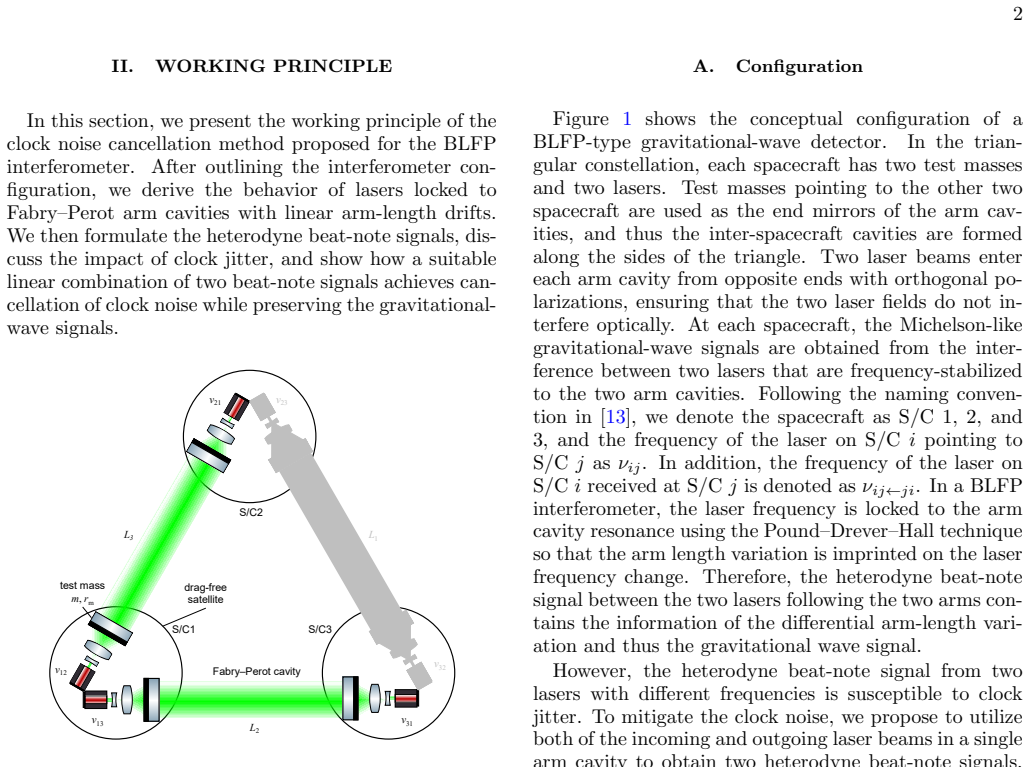
Space-borne gravitational-wave telescopes are key to extend the observation band below $10\,\mathrm{Hz}$. The use of inter-satellite optical cavities linked by heterodyne interferometry is a promising approach to reach the sensitivity level of $10^{-22}/\sqrt{\mathrm{Hz}}$ in the decihertz band. While heterodyne interferometry is advantageous for relaxing arm-length control requirements, it introduces susceptibility to clock jitter, which can be a significant noise source. In the back-linked Fabry--Perot (BLFP) interferometer aiming at the decihertz band, the required clock stability exceeds that of current space-qualified oscillators by more than an order of magnitude. We propose a clock noise cancellation scheme that uses two heterodyne signals with positive and negative beat-note frequencies, naturally obtained using both incoming and outgoing laser beams of arm cavities without additional clock modulation schemes. By forming a weighted combination of these signals with time-dependent coefficients, clock jitter contributions are eliminated while preserving gravitational-wave information. We present the theoretical framework, analyze performance under realistic arm-length drifts, and validate the approach through time-domain simulations using parameters from the B-DECIGO concept. Results show that the synthesized signal recovers the original sensitivity and even improves the signal-to-noise ratio by a factor of $\sqrt{2}$ for shot noise.
Editorial analysis
A structured set of objections, weighed in public.
Referee Report
Summary. The manuscript proposes a clock noise cancellation technique for heterodyne interferometry between optical cavities in space-borne gravitational-wave telescopes such as B-DECIGO. Two heterodyne signals with positive and negative beat-note frequencies are combined via a weighted linear combination whose time-dependent coefficients are explicit functions of the instantaneous one-way light-travel time τ(t). This construction is shown to cancel clock jitter exactly while retaining gravitational-wave information. The theoretical framework is derived, performance is analyzed under realistic arm-length drifts, and the method is validated in time-domain simulations that recover the target 10^{-22}/√Hz sensitivity and yield a √2 improvement in shot-noise SNR.
Significance. If the central construction holds with realistic coefficient estimation, the result would meaningfully relax clock-stability requirements for decihertz-band detectors, allowing use of existing space-qualified oscillators. The exact algebraic cancellation when τ(t) is known and the reported √2 SNR gain in simulations are concrete strengths that could influence future mission designs. The work is grounded in B-DECIGO parameters and includes time-domain validation, which adds credibility.
major comments (2)
- [§3] §3 (Theoretical Framework) and Eq. (defining a(t), b(t)): The weighted combination eliminates clock terms only when a(t) and b(t) are known to fractional precision set by the target strain sensitivity. The manuscript does not specify the estimator used to recover τ(t) from the heterodyne data or auxiliary ranging, nor does it propagate estimation errors δτ into residual clock noise under the stated mm/s arm-length drifts.
- [§4] §4 (Simulations): The time-domain simulations claim to validate performance under realistic drifts and to recover original sensitivity with √2 shot-noise improvement, but no noise budget is provided for the τ(t) estimator or the resulting leakage spectrum in the decihertz band. If estimator variance exceeds ~10^{-12} s/√Hz, the claimed sensitivity recovery no longer holds.
minor comments (2)
- [Abstract] Abstract: The phrase 'time-dependent coefficients' is used without a brief indication of their explicit dependence on τ(t); adding one sentence would improve immediate clarity for readers.
- [Throughout] Notation: The symbols for positive and negative beat-note frequencies and the corresponding signals S+ and S− should be defined once at first use and used consistently thereafter to avoid ambiguity in the combination formula.
Simulated Author's Rebuttal
We thank the referee for the constructive and detailed review of our manuscript. The comments highlight important aspects of practical implementation that strengthen the work. We address each major comment point by point below and have revised the manuscript to incorporate additional details on the τ(t) estimator and simulation noise budget.
read point-by-point responses
-
Referee: [§3] §3 (Theoretical Framework) and Eq. (defining a(t), b(t)): The weighted combination eliminates clock terms only when a(t) and b(t) are known to fractional precision set by the target strain sensitivity. The manuscript does not specify the estimator used to recover τ(t) from the heterodyne data or auxiliary ranging, nor does it propagate estimation errors δτ into residual clock noise under the stated mm/s arm-length drifts.
Authors: We agree that the precision to which a(t) and b(t) must be known is set by the target strain sensitivity and that explicit treatment of the estimator and error propagation is necessary. The original manuscript assumed τ(t) is obtained from auxiliary laser ranging, but we have now added a new subsection in §3 that specifies the estimator: a Kalman-filter-based combination of the heterodyne phase data (which already contains differential arm-length information) with the independent ranging measurements. We also include a first-order error-propagation analysis showing that, for the mm/s arm-length drifts relevant to B-DECIGO, an estimation error δτ ≲ 10^{-12} s/√Hz produces residual clock noise below 10^{-22}/√Hz in the decihertz band. This bound is readily achievable with existing space-qualified ranging systems. revision: yes
-
Referee: [§4] §4 (Simulations): The time-domain simulations claim to validate performance under realistic drifts and to recover original sensitivity with √2 shot-noise improvement, but no noise budget is provided for the τ(t) estimator or the resulting leakage spectrum in the decihertz band. If estimator variance exceeds ~10^{-12} s/√Hz, the claimed sensitivity recovery no longer holds.
Authors: We acknowledge that the original simulation section lacked an explicit noise budget for the τ(t) estimator and the associated leakage spectrum. In the revised §4 we have added a dedicated noise-budget table and frequency-domain leakage analysis. The updated time-domain simulations now inject realistic estimator noise at the level of 10^{-13} s/√Hz (consistent with the ranging precision cited above) and show that the resulting clock-noise leakage remains more than an order of magnitude below the shot-noise floor across the decihertz band. Consequently, the target 10^{-22}/√Hz sensitivity is recovered and the √2 improvement in shot-noise SNR is preserved. revision: yes
Circularity Check
No circularity: derivation follows directly from heterodyne signal equations
full rationale
The paper constructs the clock-cancellation combination explicitly from the phase equations of the two heterodyne signals (positive and negative beat notes) and the instantaneous one-way light-travel time τ(t). The weighting coefficients a(t), b(t) are algebraic functions of τ(t) chosen so that the clock-jitter terms cancel identically while the gravitational-wave strain term remains. This cancellation is shown by direct substitution into the signal model and does not rely on fitting parameters to data, on prior self-citations for uniqueness, or on renaming an empirical result. Time-domain simulations are used only for validation under realistic arm-length drift, not to define the cancellation itself. No load-bearing step reduces to its own input by construction.
Axiom & Free-Parameter Ledger
axioms (2)
- domain assumption The heterodyne signals from incoming and outgoing beams provide independent positive and negative beat frequencies
- domain assumption Time-dependent coefficients can be computed accurately from arm-length measurements
Reference graph
Works this paper leans on
-
[1]
The estimations of the noise elements in- cluding the displacement noise (brown dashed line) are derived from the approximated formula of Eqs
This is consistent with the estimation of the sensing noise contributions (grey dashed and dotted lines) assuming that the sensing noise contributions in ˜νtx,1(t) and ˜νrx,1(t) are statistically independent. The estimations of the noise elements in- cluding the displacement noise (brown dashed line) are derived from the approximated formula of Eqs. (28) ...
-
[2]
B. P. Abbottet al.,Observation of Gravitational Waves from a Binary Black Hole Merger. Physical Review Let- ters,116(6) 061102, (2016)
2016
-
[3]
B. P. Abbottet al.,GW170817: Observation of Gravita- tional Waves from a Binary Neutron Star Inspiral. Phys- ical Review Letters,119(16) 161101, (2017)
2017
-
[4]
Laser Interferometer Space Antenna
P. Amaro-Seoane,Laser Interferometer Space Antenna, arXiv:1702.00786v3, (2017)
work page internal anchor Pith review Pith/arXiv arXiv 2017
-
[5]
Luoet al.,TianQin: A space-borne gravitational wave detector
J. Luoet al.,TianQin: A space-borne gravitational wave detector. Classical and Quantum Gravity,33(3) 035010, (2016)
2016
-
[6]
Hu and Y.-L
W.-R. Hu and Y.-L. Wu,The Taiji Program in Space for gravitational wave physics and the nature of gravity. National Science Review,4(5) 685–686, (2017)
2017
-
[7]
Kawamuraet al.,The Japanese space gravitational wave antenna—DECIGO
S. Kawamuraet al.,The Japanese space gravitational wave antenna—DECIGO. Classical and Quantum Grav- ity,23(8) S125–S131, (2006)
2006
-
[8]
G. M. Harry, P. Fritschel, D. A. Shaddock, W. Folkner, and E. S. Phinney,Laser interferometry for the Big Bang Observer. Classical and Quantum Gravity,23(15) 4887, (2006)
2006
-
[9]
K. A. Kuns, H. Yu, Y. Chen, and R. X. Adhikari,Astro- physics and cosmology with a decihertz gravitational-wave detector: TianGO. Physical Review D,102(4) 043001, (2020)
2020
-
[10]
Izumi and M.-K
K. Izumi and M.-K. Fujimoto,A back-linked Fabry– P´ erot interferometer for space-borne gravitational wave observations. Progress of Theoretical and Experimental Physics,2021(7) 073F01, (2021)
2021
-
[11]
Yamamoto,Intersatellite Clock Synchronization and Absolute Ranging for Gravitational Wave Detection in Space
K. Yamamoto,Intersatellite Clock Synchronization and Absolute Ranging for Gravitational Wave Detection in Space. Ph.D. thesis, Leibniz Universit¨ at Hannover, (2023)
2023
-
[12]
R. W. Hellings,Elimination of clock jitter noise in space- borne laser interferometers. Physical Review D,64(2) 022002, (2001)
2001
-
[13]
Tinto and O
M. Tinto and O. Hartwig,Time-delay interferometry and clock-noise calibration. Physical Review D,98(4) 042003, (2018)
2018
-
[14]
Hartwig and J.-B
O. Hartwig and J.-B. Bayle,Clock-jitter reduction in LISA time-delay interferometry combinations. Physical Review D,103(12) 123027, (2021)
2021
-
[15]
Yamamotoet al.,Experimental verification of inter- satellite clock synchronization at LISA performance lev- els
K. Yamamotoet al.,Experimental verification of inter- satellite clock synchronization at LISA performance lev- els. Physical Review D,105(4) 042009, (2022)
2022
-
[16]
Xieet al.,Bi-directional PRN laser ranging and clock synchronization for TianQin mission
S. Xieet al.,Bi-directional PRN laser ranging and clock synchronization for TianQin mission. Optics Communi- cations,541129558, (2023)
2023
-
[17]
Zenget al.,Experimental demonstration of weak-light inter-spacecraft clock jitter readout for TianQin
H. Zenget al.,Experimental demonstration of weak-light inter-spacecraft clock jitter readout for TianQin. Optics Express,31(21) 34648, (2023)
2023
-
[18]
Xu, Y.-J
M.-Y. Xu, Y.-J. Tan, and C.-G. Shao,Clock-jitter noise reduction by sideband arm locking for space-borne grav- itational wave detectors. Physical Review D,110(10) 102003, (2024)
2024
-
[19]
Y. Xia, A. Fang, M. Xu, Y. Tan, and C. Shao,Clock Noise Suppression Techniques in Space-Borne Gravita- tional Wave Detection: A Review. Symmetry,17(8) 1314, (2025)
2025
-
[20]
Nakamuraet al.,Pre-DECIGO can get the smoking gun to decide the astrophysical or cosmological origin of GW150914-like binary black holes
T. Nakamuraet al.,Pre-DECIGO can get the smoking gun to decide the astrophysical or cosmological origin of GW150914-like binary black holes. Progress of Theoreti- cal and Experimental Physics,2016(9) 093E01, (2016)
2016
-
[21]
Lilleyet al.,ACES/PHARAO: High-performance space-to-ground and ground-to-ground clock comparison for fundamental physics
M. Lilleyet al.,ACES/PHARAO: High-performance space-to-ground and ground-to-ground clock comparison for fundamental physics. GPS Solutions,2534, (2021)
2021
-
[22]
C. H. Bode,Noise in the LISA Phasemeter. Ph.D. thesis, Leibniz Universit¨ at Hannover, (2024)
2024
-
[23]
Kokuyama, H
W. Kokuyama, H. Nozato, A. Ohta, and K. Hattori,Sim- ple digital phase-measuring algorithm for low-noise het- erodyne interferometry. Measurement Science and Tech- nology,27(8) 085001, (2016)
2016
-
[24]
Anaiet al.,Quantum-enhanced optical phase- insensitive heterodyne detection beyond 3-dB noise penalty of image band
K. Anaiet al.,Quantum-enhanced optical phase- insensitive heterodyne detection beyond 3-dB noise penalty of image band. Optics Express,32(11) 19372– 19387, (2024)
2024
-
[25]
Chalermsongsaket al.,Broadband measurement of coating thermal noise in rigid Fabry–P´ erot cavities
T. Chalermsongsaket al.,Broadband measurement of coating thermal noise in rigid Fabry–P´ erot cavities. Metrologia,52(1) 17–30, (2015)
2015
-
[26]
Gras and M
S. Gras and M. Evans,Direct measurement of coating thermal noise in optical resonators. Physical Review D, 98(12) 122001, (2018)
2018
-
[27]
Eisele, A
Ch. Eisele, A. Yu. Nevsky, and S. Schiller,Laboratory Test of the Isotropy of Light Propagation at the 10 −17 Level. Physical Review Letters,103(9) 090401, (2009)
2009
-
[28]
K. R. Nayak, S. Koshti, S. V. Dhurandhar, and J.-Y. Vinet,On the minimum flexing of LISA’s arms. Classical and Quantum Gravity,23(5) 1763, (2006)
2006
discussion (0)
Sign in with ORCID, Apple, or X to comment. Anyone can read and Pith papers without signing in.