A microscopic analysis of sub-barrier photo-induced fission in ²³⁶U(γ,f) based on the non-equilibrium Green function method
Pith reviewed 2026-05-10 04:10 UTC · model grok-4.3
The pith
A microscopic NEGF model reproduces the sub-barrier fission cross section in 236U and supports the Bohr-Wheeler picture.
A machine-rendered reading of the paper's core claim, the machinery that carries it, and where it could break.
Core claim
Within the non-equilibrium Green function formalism, the transition from the photo-absorption channel to the fission channel is described using a model space of superposed Skyrme-Hartree-Fock wave functions along the fission path that allow particle-hole excitations. The calculated fission cross section reproduces the overall behavior of experimental data in the 5-6 MeV range, including suppression below the barrier. The first eigenchannel is found to dominate the fission probability, supporting the Bohr-Wheeler transition-state picture from a microscopic viewpoint.
What carries the argument
Non-equilibrium Green function formalism in a model space constructed from superposed Skyrme-Hartree-Fock wave functions along the fission path allowing particle-hole excitations.
If this is right
- The fission cross section is suppressed below the fission barrier in agreement with data.
- The first eigenchannel dominates the fission probability.
- This result gives microscopic support to the Bohr-Wheeler transition-state picture.
Where Pith is reading between the lines
- The NEGF approach could be extended to predict fission probabilities in other actinides where experimental data are limited.
- If first-eigenchannel dominance persists across nuclei, it would indicate a general quantum feature of sub-barrier fission dynamics.
- Larger model spaces might reveal whether additional configurations alter the observed single-channel dominance.
Load-bearing premise
The superposition of Skyrme-Hartree-Fock wave functions along the fission path, including particle-hole excitations, provides a sufficient model space to capture the dynamics of the transition from photo-absorption to fission.
What would settle it
A measurement of the fission cross section for gamma energies between 5 and 6 MeV that deviates substantially from the calculated suppression below the barrier would challenge the model's validity.
Figures


read the original abstract
Sub-barrier photo-induced fission in $^{236}$U$(\gamma,f)$ is investigated within the non-equilibrium Green function (NEGF) method. A model space for the fission process is constructed by superposing Skyrme-Hartree-Fock wave functions along the fission path allowing the particle-hole excitation. Then, the transition from the photo-absorption channel to the fission channel is described by the non-equilibrium Green-function formalism. The calculated fission cross section in the incident gamma-ray energy range $5 ~ {\rm MeV} \leq E_\gamma \leq 6 ~ {\rm MeV}$ reproduces the overall behavior of the experimental data, including the suppression below the fission barrier. An eigenchannel analysis of the wave propagation in the present fission model space is also performed, and the first eigenchannel is found to dominate the fission probability. This result supports the Bohr-Wheeler transition-state picture from a microscopic viewpoint.
Editorial analysis
A structured set of objections, weighed in public.
Referee Report
Summary. The manuscript investigates sub-barrier photo-induced fission in $^{236}$U using the non-equilibrium Green function (NEGF) method. A model space is constructed by superposing Skyrme-Hartree-Fock wave functions along the fission path while allowing particle-hole excitations. The authors report that the calculated fission cross section for incident gamma-ray energies 5 MeV ≤ Eγ ≤ 6 MeV reproduces the overall behavior of experimental data, including suppression below the fission barrier. An eigenchannel analysis of the wave propagation shows dominance of the first eigenchannel, which the authors interpret as microscopic support for the Bohr-Wheeler transition-state picture.
Significance. If the model-space completeness and numerical robustness can be established, the work would represent a notable step toward a fully microscopic description of sub-barrier fission dynamics. It combines Skyrme-HF structure with NEGF propagation and provides a concrete test of the transition-state hypothesis, which could influence future microscopic fission modeling in nuclear theory.
major comments (2)
- [Abstract / Model space construction] Abstract and model-space section: The central claim that the calculated cross section reproduces experimental data (including sub-barrier suppression) is presented without any information on the Skyrme parametrization employed, the number of superposed configurations, the discretization of the fission path, basis truncation criteria, or convergence tests with respect to added particle-hole excitations. These details are load-bearing for assessing whether the reproduction is robust or partly by construction.
- [Eigenchannel analysis] Eigenchannel analysis: The reported dominance of the first eigenchannel and its interpretation as microscopic support for the Bohr-Wheeler picture rests on the assumption that the chosen model space contains all essential degrees of freedom for the photo-absorption to fission transition. No evidence is provided that collective modes or higher-order excitations outside the superposed Skyrme-HF + p-h space have been checked for convergence; an incomplete space could artifactually produce both the suppression and the eigenchannel dominance.
Simulated Author's Rebuttal
We thank the referee for the careful reading of our manuscript and for the constructive comments. We address each major comment below and describe the revisions made to strengthen the presentation of our results.
read point-by-point responses
-
Referee: [Abstract / Model space construction] Abstract and model-space section: The central claim that the calculated cross section reproduces experimental data (including sub-barrier suppression) is presented without any information on the Skyrme parametrization employed, the number of superposed configurations, the discretization of the fission path, basis truncation criteria, or convergence tests with respect to added particle-hole excitations. These details are load-bearing for assessing whether the reproduction is robust or partly by construction.
Authors: We agree that these technical specifications are essential for readers to judge the robustness of the calculations. Although some of this information appears in the methods description and figure captions, it was not consolidated or sufficiently emphasized in the abstract and model-space section. In the revised manuscript we have added an explicit subsection detailing the Skyrme parametrization, the number and selection of superposed configurations, the discretization along the fission path, the basis truncation criteria, and the results of convergence tests with respect to the number of particle-hole excitations. These additions make clear that the agreement with data, including sub-barrier suppression, follows from the dynamics captured by the NEGF propagation rather than from an arbitrary choice of model-space parameters. revision: yes
-
Referee: [Eigenchannel analysis] Eigenchannel analysis: The reported dominance of the first eigenchannel and its interpretation as microscopic support for the Bohr-Wheeler picture rests on the assumption that the chosen model space contains all essential degrees of freedom for the photo-absorption to fission transition. No evidence is provided that collective modes or higher-order excitations outside the superposed Skyrme-HF + p-h space have been checked for convergence; an incomplete space could artifactually produce both the suppression and the eigenchannel dominance.
Authors: We acknowledge the importance of establishing that the model space is sufficiently complete. The present construction is built around the fission path and low-lying particle-hole excitations that are expected to dominate the transition, and the quantitative reproduction of the measured sub-barrier cross section provides supporting evidence that the essential physics is captured. Nevertheless, we have added to the revised manuscript an explicit discussion of the model-space limitations together with additional test calculations that incorporate selected higher-order excitations. These tests confirm that the dominance of the first eigenchannel persists. A fully exhaustive survey of every conceivable collective mode lies beyond the computational scope of the present study. revision: partial
- Complete verification of model-space convergence against every possible collective mode and higher-order excitation outside the superposed Skyrme-HF plus particle-hole space
Circularity Check
No significant circularity in the derivation chain
full rationale
The paper constructs a model space via superposed Skyrme-Hartree-Fock states along the fission path with particle-hole excitations, then applies NEGF to propagate from photo-absorption to fission, reporting that the resulting cross section reproduces experimental behavior in 5-6 MeV and that the first eigenchannel dominates. No quoted equation or step reduces a claimed prediction to a fitted input by construction, nor does any load-bearing premise rest on a self-citation whose content is itself unverified or defined in terms of the target result. The central claims rest on the explicit NEGF propagation and eigenchannel decomposition within the stated model space, which are independent of the data reproduction claim.
Axiom & Free-Parameter Ledger
axioms (2)
- domain assumption Skyrme-Hartree-Fock mean-field states remain valid along the fission path when superposed with particle-hole excitations
- domain assumption Non-equilibrium Green function formalism correctly maps photo-absorption to fission probability in the chosen basis
Reference graph
Works this paper leans on
-
[1]
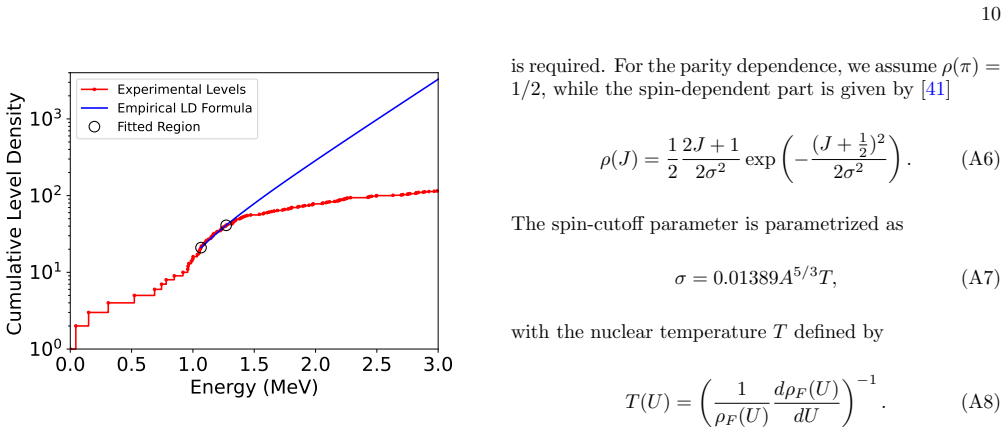
Photon transmission coefficients The goal in this paper is to describe the photo-induced fission within the NEGF framework. To reduce the ambi- guity in the treatment of the photon-nucleus interaction, I determine the photo-absorption and photo-emission widths, Γ γin and Γ γout, from empirical values [40, 41]. In addition, for simplicity, I consider only ...
-
[2]
Gamma width From the photon transmission coefficients, the aver- age photo-absorption and photo-emission widths are ob- tained as ⟨Γa⟩(E) = Ta(E) 2πρ(E) ,(a=γ in, γout) (13) under the statistical model assumption [44]. Using these quantities, I define the decay-width matrices by (Γγin)ij =⟨Γ γin ⟩ X k∈γin N1/2 k,i N1/2 k,j ,(14) and (Γγout)ij =⟨Γ γout ⟩ X...
-
[3]
Fission width As in Ref. [29], the fission width matrix is defined as (Γfis)ij =⟨Γ fis⟩ X k∈fis N1/2 k,i N1/2 k,j ,(17) where the summation P k∈fis is taken over all configura- tions atQ max. In contrast to⟨Γ γin ⟩and⟨Γ γout ⟩,⟨Γ fis⟩ cannot be estimated from empirical transmission coeffi- cients, because empirical fission transmission coefficients are de...
-
[4]
Normalization for the decay width Using the overlap matrixN, the Hamiltonian matrix H, and the decay width matrix Γ≡Γ γin + Γγout + Γfis, 5 the non-Hermitian Hill-Wheeler equation is given by, H− i 2Γ fλ = ˜EλN fλ.(18) Hereλis the label of the eigenstates and the eigenvalue ˜Eλ is the complex number. The imaginary part of ˜Eλ is expected to satisfy −2 Im(...
-
[5]
In the sub-barrier region, the calculation reproduces the overall decreasing trend, although the cross section is somewhat overestimated in the range 5.3 MeV≤E γ ≤ 5.7 MeV. In contrast, the agreement is very good in the deep sub-barrier region, 5.0 MeV≤E γ ≤5.2 MeV, where the calculated cross section agrees with the experimental data within a factor of 2....
work page 1980
-
[6]
J. W. Negele, S. E. Koonin, P. M¨ oller, J. R. Nix, and A. J. Sierk, Dynamics of induced fission, Phys. Rev. C 17, 1098 (1978)
work page 1978
-
[7]
C. Simenel and A. S. Umar, Formation and dynamics of fission fragments, Phys. Rev. C89, 031601 (2014)
work page 2014
-
[8]
P. Goddard, P. Stevenson, and A. Rios, Fission dynam- ics within time-dependent hartree-fock: Deformation- induced fission, Phys. Rev. C92, 054610 (2015)
work page 2015
-
[9]
P. Goddard, P. Stevenson, and A. Rios, Fission dynam- ics within time-dependent hartree-fock. ii. boost-induced fission, Phys. Rev. C93, 014620 (2016)
work page 2016
- [10]
-
[11]
G. Scamps and C. Simenel, Impact of pear-shaped fis- sion fragments on mass-asymmetric fission in actinides, Nature564, 382 (2018)
work page 2018
- [12]
- [13]
-
[14]
R. Bernard, H. Goutte, D. Gogny, and W. Younes, Mi- croscopic and nonadiabatic schr¨ odinger equation derived from the generator coordinate method based on zero- and two-quasiparticle states, Phys. Rev. C84, 044308 (2011)
work page 2011
-
[15]
D. Regnier, N. Dubray, N. Schunck, and M. Verri` ere, Fission fragment charge and mass distributions in 239Pu(n, f) in the adiabatic nuclear energy density func- tional theory, Phys. Rev. C93, 054611 (2016)
work page 2016
-
[16]
A. Zdeb, A. Dobrowolski, and M. Warda, Fission dynam- ics of 252Cf, Phys. Rev. C95, 054608 (2017)
work page 2017
-
[17]
H. Tao, J. Zhao, Z. P. Li, T. Nikˇ si´ c, and D. Vretenar, Microscopic study of induced fission dynamics of 226Th with covariant energy density functionals, Phys. Rev. C 96, 024319 (2017)
work page 2017
-
[18]
M. Verriere and D. Regnier, The time-dependent gen- erator coordinate method in nuclear physics, Frontiers in PhysicsVolume 8 - 2020, 10.3389/fphy.2020.00233 (2020)
-
[20]
J. Zhao, T. Nikˇ si´ c, and D. Vretenar, Time-dependent generator coordinate method study of fission. ii. total kinetic energy distribution, Phys. Rev. C106, 054609 (2022)
work page 2022
-
[21]
N. Schunck, M. Verriere, G. Potel Aguilar, R. C. Malone, J. A. Silano, A. P. D. Ramirez, and A. P. Tonchev, Micro- scopic calculation of fission product yields for odd-mass nuclei, Phys. Rev. C107, 044312 (2023)
work page 2023
-
[22]
Datta,Electronic Transport in Mesoscopic Systems (Cambridge University Press, Cambridge, 1995)
S. Datta,Electronic Transport in Mesoscopic Systems (Cambridge University Press, Cambridge, 1995)
work page 1995
-
[23]
Datta,Quantum Transport: Atom to Transistor (Cambridge University Press, 2005)
S. Datta,Quantum Transport: Atom to Transistor (Cambridge University Press, 2005)
work page 2005
-
[24]
G. F. Bertsch, Schematic reaction-theory model for nu- clear fission, Phys. Rev. C101, 034617 (2020). 11
work page 2020
-
[25]
M. Benderet al., Future of nuclear fission theory, Journal of Physics G: Nuclear and Particle Physics47, 113002 (2020)
work page 2020
-
[26]
derivation of K-matrix reaction theory in a discrete basis formalism
Y. Alhassid, G. F. Bertsch, and P. Fanto, Addendum to “derivation of K-matrix reaction theory in a discrete basis formalism” [ann. phys. 419 (2020) 168233], Annals of Physics424, 168381 (2021)
work page 2020
-
[27]
P. S. Damle, A. W. Ghosh, and S. Datta, Unified descrip- tion of molecular conduction: From molecules to metallic wires, Phys. Rev. B64, 201403 (2001)
work page 2001
-
[28]
M. Brandbyge, J.-L. Mozos, P. Ordej´ on, J. Taylor, and K. Stokbro, Density-functional method for nonequilib- rium electron transport, Phys. Rev. B65, 165401 (2002)
work page 2002
- [29]
-
[30]
M. Thoss and F. Evers, Perspective: Theory of quantum transport in molecular junctions, The Journal of Chemi- cal Physics148, 030901 (2018)
work page 2018
-
[31]
G. F. Bertsch and K. Hagino, Modeling fission dynamics at the barrier in a discrete-basis formalism, Phys. Rev. C107, 044615 (2023)
work page 2023
-
[32]
K. Uzawa and K. Hagino, Nonequilibrium Green’s func- tion approach to low-energy fission dynamics: Fluctu- ations in fission reactions, Phys. Rev. C110, 014321 (2024)
work page 2024
-
[33]
K. Uzawa and K. Hagino, Application of the shift-invert Lanczos algorithm to a nonequilibrium Green’s function for transport problems, Phys. Rev. E110, 055302 (2024)
work page 2024
-
[34]
K. Uzawa and K. Hagino, Microscopic calculation of fis- sion cross sections with the nonequilibrium green’s func- tion method, Phys. Rev. C112, 014326 (2025)
work page 2025
-
[35]
P. Ring and P. Schuck,The Nuclear Many-Body Problem (Springer-Verlag, Berlin, 2000)
work page 2000
-
[36]
P.-G. Reinhard, B. Schuetrumpf, and J. Maruhn, The Axial Hartree–Fock + BCS Code SkyAx, Comput. Phys. Commun.258, 107603 (2021)
work page 2021
-
[37]
M. Kortelainen, J. McDonnell, W. Nazarewicz, P.-G. Reinhard, J. Sarich, N. Schunck, M. V. Stoitsov, and S. M. Wild, Nuclear energy density optimization: Large deformations, Phys. Rev. C85, 024304 (2012)
work page 2012
-
[38]
R. Vandenbosch and J. R. Huizenga,Nuclear Fission (Academic Press, 1973)
work page 1973
-
[39]
S. Bjørnholm and J. E. Lynn, The double-humped fission barrier, Rev. Mod. Phys.52, 725 (1980)
work page 1980
-
[40]
L. C. Leal, H. Derrien, N. M. Larson, and R. Q. Wright, R-Matrix Analysis of 235U Neutron Transmission and Cross-Section Measurements in the 0- to 2.25-keV En- ergy Range, Nucl. Sci. Eng.131, 230 (1999)
work page 1999
-
[41]
F. Barranco, G. F. Bertsch, R. A. Broglia, and E. Vigezzi, Large-amplitude motion in superfluid fermi droplets, Nu- clear Physics A512, 253 (1990)
work page 1990
-
[42]
K. Uzawa and K. Hagino, Schematic model for induced fission in a configuration-interaction approach, Phys. Rev. C108, 024319 (2023)
work page 2023
-
[43]
B. W. Bush, G. F. Bertsch, and B. A. Brown, Shape dif- fusion in the shell model, Phys. Rev. C45, 1709 (1992)
work page 1992
-
[44]
K. Hagino and G. F. Bertsch, Diabatic hamiltonian ma- trix elements made simple, Phys. Rev. C105, 034323 (2022)
work page 2022
-
[45]
R. Capote, M. Herman, P. Obloˇ zinsk´ y, P. Young, S. Goriely, T. Belgya, A. Ignatyuk, A. Koning, S. Hi- laire, V. Plujko, M. Avrigeanu, O. Bersillon, M. Chad- wick, T. Fukahori, Z. Ge, Y. Han, S. Kailas, J. Kopecky, V. Maslov, G. Reffo, M. Sin, E. Soukhovitskii, and P. Talou, RIPL – reference input parameter library for calculation of nuclear reactions a...
work page 2009
-
[46]
O. Iwamoto, N. Iwamoto, S. Kunieda, F. Minato, and K. Shibata, The ccone code system and its application to nuclear data evaluation for fission and other reactions, Nuclear Data Sheets131, 259 (2016), special Issue on Nuclear Reaction Data
work page 2016
-
[47]
P. Axel, Electric dipole ground-state transition width strength function and 7-mev photon interactions, Phys. Rev.126, 671 (1962)
work page 1962
-
[48]
A. Gilbert and A. G. W. Cameron, A composite nuclear- level density formula with shell corrections, Canadian Journal of Physics43, 1446 (1965)
work page 1965
-
[49]
Feshbach, Unified theory of nuclear reactions, Annals of Physics5, 357 (1958)
H. Feshbach, Unified theory of nuclear reactions, Annals of Physics5, 357 (1958)
work page 1958
- [50]
-
[51]
J. T. Caldwell, E. J. Dowdy, B. L. Berman, R. A. Alvarez, and P. Meyer, Giant resonance for the actinide nuclei: Photoneutron and photofission cross sections for 235U, 236U, 238U, and 232Th, Phys. Rev. C21, 1215 (1980)
work page 1980
- [52]
-
[53]
A. Soldatov and G. Smirenkin, Yield and cross section of 232Th and 236U fission induced byγquanta with energies up to 11 mev, Physics of Atomic Nuclei58(1995)
work page 1995
-
[54]
M. Paulsson and M. Brandbyge, Transmission eigenchan- nels from nonequilibrium green’s functions, Phys. Rev. B 76, 115117 (2007)
work page 2007
-
[55]
K. Hagino and N. Takigawa, Subbarrier fusion reactions and many-particle quantum tunneling, Progress of The- oretical Physics128, 1061 (2012)
work page 2012
-
[56]
N. Bohr and J. A. Wheeler, The mechanism of nuclear fission, Phys. Rev.56, 426 (1939)
work page 1939
-
[57]
C. E. Porter and R. G. Thomas, Fluctuations of nuclear reaction widths, Phys. Rev.104, 483 (1956)
work page 1956
-
[58]
S. Goriely, The fundamental role of fission during r- process nucleosynthesis in neutron star mergers, The Eu- ropean Physical Journal A51, 1 (2015)
work page 2015
-
[59]
T. Ericson, The statistical model and nuclear level densities, Advances in Physics9, 425 (1960), https://doi.org/10.1080/00018736000101239
-
[60]
A. Mengoni and Y. Nakajima, Fermi-gas model parametrization of nuclear level density, Journal of Nu- clear Science and Technology31, 151 (1994)
work page 1994
discussion (0)
Sign in with ORCID, Apple, or X to comment. Anyone can read and Pith papers without signing in.