0-π transitions in non-Hermitian magnetic Josephson junctions
Pith reviewed 2026-05-10 03:46 UTC · model grok-4.3
The pith
Dissipation shifts the 0-π transition to higher magnetic fields in non-Hermitian magnetic Josephson junctions, and the relative angle between the applied field and the reservoir magnetization can drive the transition at fixed field.
A machine-rendered reading of the paper's core claim, the machinery that carries it, and where it could break.
Core claim
By combining Green's function calculations with an effective non-Hermitian description restricted to the sub-gap Andreev quasi-bound states, we show that dissipation shifts the 0-π transition to higher magnetic fields. Remarkably, also the relative angle between the applied field and the reservoir magnetization can be used to drive the transition, at fixed field magnitude. We demonstrate that this effect can be entirely ascribed to the behavior of the complex eigenvalues of the non-Hermitian Hamiltonian.
What carries the argument
The effective non-Hermitian Hamiltonian restricted to the sub-gap Andreev quasi-bound states, whose complex eigenvalues determine the location of the 0-π transition.
If this is right
- The 0-π transition magnetic field increases with added dissipation.
- The relative angle between fields acts as a control parameter for the transition at constant field magnitude.
- The current-phase relation of the junction can be tuned through non-Hermitian effects.
- The transition points are set by the complex eigenvalues of the effective non-Hermitian Hamiltonian.
Where Pith is reading between the lines
- Similar dissipation and angular tuning may appear in other non-Hermitian superconducting nanostructures.
- Device designs could incorporate variable magnetization directions to achieve phase control without stronger magnets.
- The approach suggests routes to dissipation-engineered Josephson junctions for quantum circuits.
- Extensions to include continuum states could test the boundaries of the sub-gap approximation.
Load-bearing premise
The effective non-Hermitian description restricted to the sub-gap Andreev quasi-bound states is sufficient to capture the full transport properties and 0-π transitions without contributions from the continuum spectrum or additional environmental effects.
What would settle it
An observation or calculation in which the magnetic field value for the 0-π transition stays unchanged as dissipation increases or shows no dependence on the angle between applied field and reservoir magnetization at fixed field strength would falsify the claim.
Figures


read the original abstract
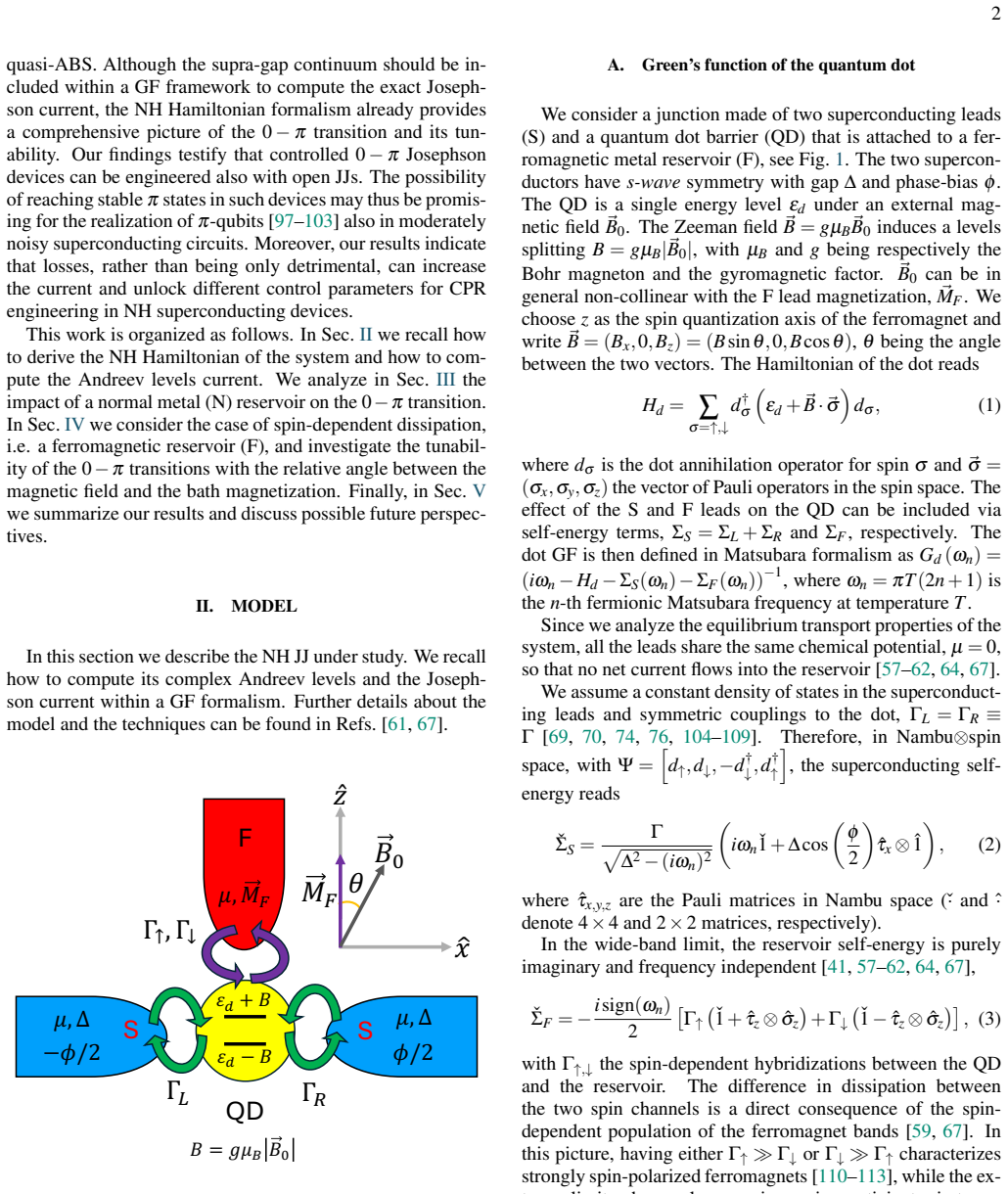
We study the transport properties of non-Hermitian magnetic Josephson junctions, considering a superconductor-quantum dot-superconductor device coupled to a ferromagnetic metallic reservoir in the presence of an external magnetic field. We focus on the $0-\pi$ transitions that occur when the equilibrium phase difference between the superconductors shifts from $\phi=0$ to $\phi=\pi$ upon increasing the magnetic field amplitude. The coupling to the environment induces spin-dependent dissipation and leads to the broadening of the junction Andreev levels. By combining Green's function calculations with an effective non-Hermitian description restricted to the sub-gap Andreev quasi-bound states, we show that dissipation shifts the $0-\pi$ transition to higher magnetic fields. Remarkably, also the relative angle between the applied field and the reservoir magnetization can be used to drive the transition, at fixed field magnitude. We demonstrate that this effect can be entirely ascribed to the behavior of the complex eigenvalues of the non-Hermitian Hamiltonian. These findings highlight non-Hermiticity as a resource that can introduce new control knobs for engineering the current-phase relation in superconducting junctions.
Editorial analysis
A structured set of objections, weighed in public.
Referee Report
Summary. The manuscript examines 0-π transitions in a non-Hermitian magnetic Josephson junction formed by a superconductor-quantum dot-superconductor device coupled to a ferromagnetic reservoir under an external magnetic field. It combines Green's function calculations with an effective non-Hermitian Hamiltonian restricted to sub-gap Andreev quasi-bound states to argue that spin-dependent dissipation shifts the transition to higher magnetic fields, that the relative angle between the applied field and reservoir magnetization can drive the transition at fixed field magnitude, and that these effects arise entirely from the complex eigenvalues of the non-Hermitian model.
Significance. If the restriction to sub-gap states is rigorously justified and the eigenvalue-based attribution holds without continuum corrections, the work would demonstrate non-Hermiticity as a practical resource for tuning the current-phase relation in superconducting junctions, adding angle-dependent control as a new experimental knob.
major comments (1)
- [Abstract] Abstract: The central attribution—that the 0-π shift and angle-driven transition 'can be entirely ascribed to the behavior of the complex eigenvalues' of the restricted non-Hermitian Hamiltonian—requires explicit validation that continuum states above the gap do not alter the transition point or current-phase relation under spin-dependent dissipation. No such comparison (full Green's function versus projected sub-gap model) is described, yet Josephson transport in open systems routinely receives above-gap quasiparticle corrections that could shift the reported transition fields.
minor comments (1)
- The abstract refers to 'Green's function calculations' without specifying the technique (e.g., equation-of-motion, Keldysh, or numerical implementation) or the parameter regime (coupling strengths, gap values, field magnitudes) used to obtain the reported shifts.
Simulated Author's Rebuttal
We thank the referee for their thorough review and constructive comments on our manuscript. We address the major comment regarding validation of the effective non-Hermitian model below.
read point-by-point responses
-
Referee: [Abstract] Abstract: The central attribution—that the 0-π shift and angle-driven transition 'can be entirely ascribed to the behavior of the complex eigenvalues' of the restricted non-Hermitian Hamiltonian—requires explicit validation that continuum states above the gap do not alter the transition point or current-phase relation under spin-dependent dissipation. No such comparison (full Green's function versus projected sub-gap model) is described, yet Josephson transport in open systems routinely receives above-gap quasiparticle corrections that could shift the reported transition fields.
Authors: We agree that an explicit side-by-side comparison would strengthen the manuscript. The full Green's function calculations already include all states (sub-gap and continuum) and determine the supercurrent and 0-π transition points directly from the complete system. The effective non-Hermitian Hamiltonian is obtained by projecting the Green's function onto the sub-gap Andreev states and is used solely for mechanistic interpretation. Re-inspection of our data shows that the transition fields extracted from the full Green's function and from the eigenvalues of the projected model agree to within numerical accuracy for the dissipation strengths examined, indicating that above-gap corrections do not shift the reported transitions. To address the referee's concern explicitly, we will add a supplementary comparison (e.g., transition field versus dissipation strength from both approaches) in the revised manuscript. revision: yes
Circularity Check
No circularity in derivation chain
full rationale
The paper derives its claims on dissipation-shifted 0-π transitions and angle-driven control explicitly from Green's function calculations combined with a restricted non-Hermitian effective model on sub-gap Andreev states, with the effect ascribed to complex eigenvalues as a computed outcome rather than a definitional identity. No self-citations, fitted inputs renamed as predictions, or ansatzes smuggled via prior work appear as load-bearing steps; the restriction to sub-gap states is stated as a modeling choice whose consequences are then calculated, leaving the chain self-contained against the described methods without reduction to inputs by construction.
Axiom & Free-Parameter Ledger
Reference graph
Works this paper leans on
-
[1]
To gain physical insight on the phenomenon, one can give a look into the expansion of the single contributions,J zi, which are given in Eq
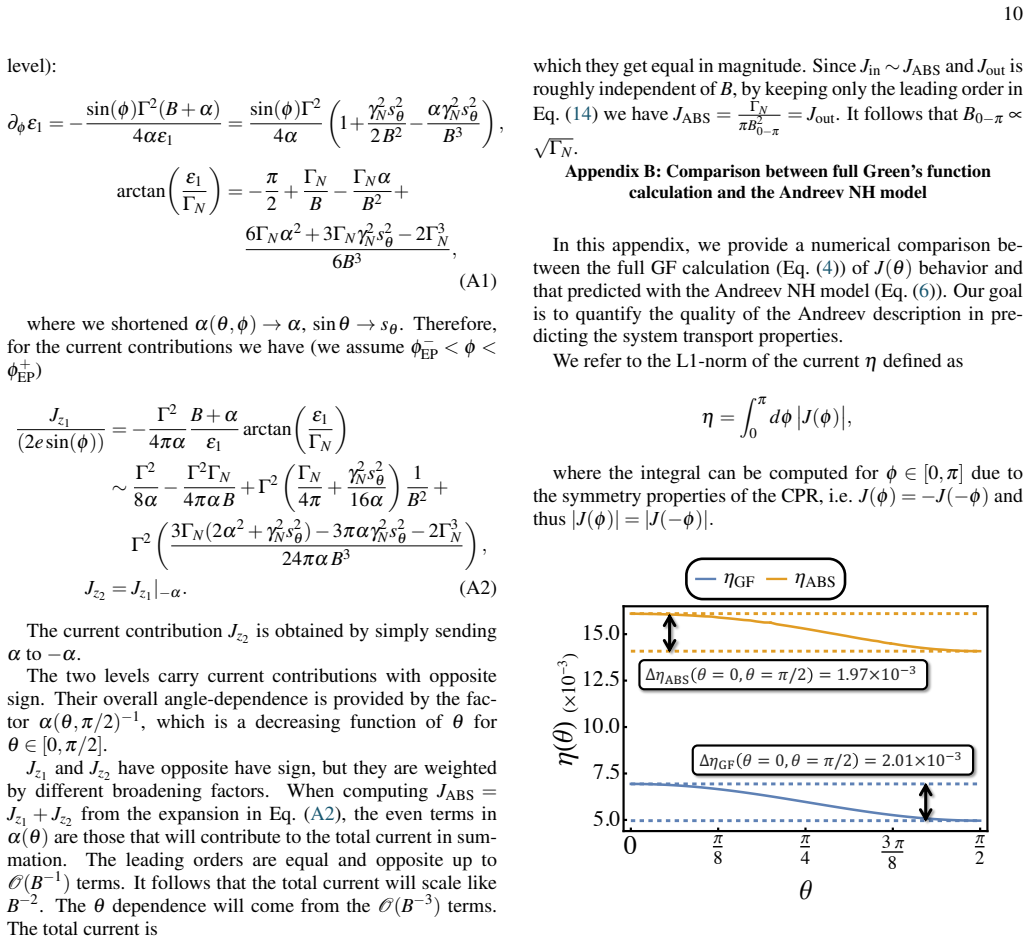
As a consequence, our analysis applies to maxφ |JABS|(θ)which, at finiteB, is well approximated byJ ABS(φ=π/2,θ), under the aforementioned conditions on the dissipation. To gain physical insight on the phenomenon, one can give a look into the expansion of the single contributions,J zi, which are given in Eq. (A2) and discussed in App. A. Phe- nomenologica...
2020
-
[2]
Breuer and F
H. Breuer and F. Petruccione,The Theory of Open Quantum Systems(Oxford University Press, 2002)
2002
-
[3]
U. Weiss,Quantum Dissipative Systems, 4th ed. (WORLD SCIENTIFIC, 2012) 11 https://www.worldscientific.com/doi/pdf/10.1142/8334
-
[4]
Gong and M
A. Gong and M. Ueda, Non-hermitian physics, Adv. Phys.69, 249 (2020)
2020
-
[5]
C. M. Bender, Making sense of non-hermitian hamiltonians, Reports on Progress in Physics70, 947 (2007)
2007
-
[6]
C. M. Bender and S. Boettcher, Real spectra in non-hermitian hamiltonians havingPTsymmetry, Phys. Rev. Lett.80, 5243 (1998)
1998
-
[7]
Kawabata, K
K. Kawabata, K. Shiozaki, M. Ueda, and M. Sato, Symme- try and topology in non-hermitian physics, Phys. Rev. X9, 041015 (2019)
2019
-
[8]
B. Zhen, C. W. Hsu, Y . Igarashi, L. Lu, I. Kaminer, A. Pick, S.-L. Chua, J. D. Joannopoulos, and M. Solja ˇci´c, Spawning rings of exceptional points out of dirac cones, Nature525, 354 (2015)
2015
-
[9]
H. Shen, B. Zhen, and L. Fu, Topological band theory for non- hermitian hamiltonians, Phys. Rev. Lett.120, 146402 (2018)
2018
-
[10]
Cerjan, S
A. Cerjan, S. Huang, M. Wang, K. P. Chen, Y . Chong, and M. C. Rechtsman, Experimental realization of a weyl excep- tional ring, Nature Photonics13, 623 (2019)
2019
-
[11]
E. J. Bergholtz, J. C. Budich, and F. K. Kunst, Exceptional topology of non-hermitian systems, Rev. Mod. Phys.93, 015005 (2021)
2021
-
[12]
Okuma and M
N. Okuma and M. Sato, Non-hermitian topological phenom- ena: A review, Annual Review of Condensed Matter Physics 14, 83 (2023)
2023
-
[13]
V . M. Martinez Alvarez, J. E. Barrios Vargas, and L. E. F. Foa Torres, Non-hermitian robust edge states in one dimen- sion: Anomalous localization and eigenspace condensation at exceptional points, Phys. Rev. B97, 121401 (2018)
2018
-
[14]
Yao and Z
S. Yao and Z. Wang, Edge states and topological invariants of non-hermitian systems, Phys. Rev. Lett.121, 086803 (2018)
2018
-
[15]
Zhang, Z
K. Zhang, Z. Yang, and C. Fang, Correspondence between winding numbers and skin modes in non-hermitian systems, Phys. Rev. Lett.125, 126402 (2020)
2020
-
[16]
M.-H. L. Xiujuan Zhang, Tian Zhang and Y .- F. Chen, A review on non-hermitian skin ef- fect, Advances in Physics: X7, 2109431 (2022), https://doi.org/10.1080/23746149.2022.2109431
-
[17]
Zhang, Z
K. Zhang, Z. Yang, and C. Fang, Universal non-hermitian skin effect in two and higher dimensions, Nature Communications 13, 2496 (2022)
2022
-
[18]
M. V . Berry, Physics of nonhermitian degeneracies, Czechoslovak Journal of Physics54, 1039 (2004)
2004
-
[19]
B. Peng, ¸ S. K. Özdemir, S. Rotter, H. Yilmaz, M. Liertzer, F. Monifi, C. M. Bender, F. Nori, and L. Yang, Loss-induced suppression and revival of lasing, Science346, 328 (2014), https://www.science.org/doi/pdf/10.1126/science.1258004
-
[20]
Doppler, A
J. Doppler, A. A. Mailybaev, J. Böhm, U. Kuhl, A. Girschik, F. Libisch, T. J. Milburn, P. Rabl, N. Moiseyev, and S. Rotter, Dynamically encircling an exceptional point for asymmetric mode switching, Nature537, 76 (2016)
2016
-
[21]
St-Jean, V
P. St-Jean, V . Goblot, E. Galopin, A. Lemaître, T. Ozawa, L. Le Gratiet, I. Sagnes, J. Bloch, and A. Amo, Lasing in topo- logical edge states of a one-dimensionallattice, Nature Photon- ics11, 651 (2017)
2017
-
[22]
H. Zhou, C. Peng, Y . Yoon, C. W. Hsu, K. A. Nelson, L. Fu, J. D. Joannopoulos, M. Solja ˇci´c, and B. Zhen, Ob- servation of bulk fermi arc and polarization half charge from paired exceptional points, Science359, 1009 (2018), https://www.science.org/doi/pdf/10.1126/science.aap9859
-
[23]
El-Ganainy, M
R. El-Ganainy, M. Khajavikhan, D. N. Christodoulides, and S. K. Ozdemir, The dawn of non-hermitian optics, Communi- cations Physics2, 37 (2019)
2019
-
[24]
D. W. Schönleber, A. Eisfeld, and R. El-Ganainy, Optome- chanical interactions in non-hermitian photonic molecules, New Journal of Physics18, 045014 (2016)
2016
-
[25]
H. Xu, D. Mason, L. Jiang, and J. G. E. Harris, Topological energy transfer in an optomechanical system with exceptional points, Nature537, 80 (2016)
2016
-
[26]
Mandal, R
S. Mandal, R. Banerjee, E. A. Ostrovskaya, and T. C. H. Liew, Nonreciprocal transport of exciton polaritons in a non- hermitian chain, Phys. Rev. Lett.125, 123902 (2020)
2020
-
[27]
Zhang, X
W. Zhang, X. Ouyang, X. Huang, X. Wang, H. Zhang, Y . Yu, X. Chang, Y . Liu, D.-L. Deng, and L.-M. Duan, Observation of non-hermitian topology with nonunitary dynamics of solid- state spins, Phys. Rev. Lett.127, 090501 (2021)
2021
-
[28]
H. Geng, J. Y . Wei, M. H. Zou, L. Sheng, W. Chen, and D. Y . Xing, Nonreciprocal charge and spin transport induced by non-hermitian skin effect in mesoscopic heterojunctions, Phys. Rev. B107, 035306 (2023)
2023
-
[29]
Q. Yan, H. Li, Q.-F. Sun, and X. C. Xie, Transport theory in non-hermitian systems, Phys. Rev. B110, 045138 (2024)
2024
-
[30]
T. M. Philip, M. R. Hirsbrunner, and M. J. Gilbert, Loss of hall conductivity quantization in a non-hermitian quantum anoma- lous hall insulator, Phys. Rev. B98, 155430 (2018)
2018
-
[31]
Chen and H
Y . Chen and H. Zhai, Hall conductance of a non-hermitian chern insulator, Phys. Rev. B98, 245130 (2018)
2018
-
[32]
E. J. Bergholtz and J. C. Budich, Non-hermitian weyl physics in topological insulator ferromagnet junctions, Phys. Rev. Res. 1, 012003 (2019)
2019
-
[33]
J. C. Budich and E. J. Bergholtz, Non-hermitian topological sensors, Phys. Rev. Lett.125, 180403 (2020)
2020
-
[34]
Cayao, Exceptional degeneracies in non-hermitian rashba semiconductors, Journal of Physics: Condensed Matter35, 254002 (2023)
J. Cayao, Exceptional degeneracies in non-hermitian rashba semiconductors, Journal of Physics: Condensed Matter35, 254002 (2023)
2023
-
[35]
S. Mi, D. I. Pikulin, M. Marciani, and C. W. J. Beenakker, X- shaped and y-shaped andreev resonance profiles in a supercon- ducting quantum dot, Journal of Experimental and Theoretical Physics119, 1018 (2014)
2014
-
[36]
San-Jose, J
P. San-Jose, J. Cayao, E. Prada, and R. Aguado, Majorana bound states from exceptional points in non-topological su- perconductors, Scientific Reports6, 21427 (2016)
2016
-
[37]
Avila, F
J. Avila, F. Peñaranda, E. Prada, P. San-Jose, and R. Aguado, Non-hermitian topology a unifying framework for the andreev versus majorana states controversy, Communications Physics 2, 133 (2019)
2019
-
[38]
Cayao and A
J. Cayao and A. M. Black-Schaffer, Bulk bogoliubov fermi arcs in non-hermitian superconducting systems, Phys. Rev. B 107, 104515 (2023)
2023
-
[39]
Arouca, J
R. Arouca, J. Cayao, and A. M. Black-Schaffer, Topological superconductivity enhanced by exceptional points, Phys. Rev. B108, L060506 (2023)
2023
-
[40]
Sayyad and J
S. Sayyad and J. L. Lado, Topological phase diagrams of ex- actly solvable non-hermitian interacting kitaev chains, Phys. Rev. Res.5, L022046 (2023)
2023
-
[41]
Cayao, Non-hermitian zero-energy pinning of andreev and majorana bound states in superconductor-semiconductor sys- tems, Phys
J. Cayao, Non-hermitian zero-energy pinning of andreev and majorana bound states in superconductor-semiconductor sys- tems, Phys. Rev. B110, 085414 (2024)
2024
-
[42]
Cayao and R
J. Cayao and R. Aguado, Non-hermitian minimal kitaev chains, Phys. Rev. B111, 205432 (2025)
2025
-
[43]
Kawabata, Y
K. Kawabata, Y . Ashida, H. Katsura, and M. Ueda, Parity- time-symmetric topological superconductor, Phys. Rev. B98, 085116 (2018)
2018
-
[44]
Cayao and A
J. Cayao and A. M. Black-Schaffer, Exceptional odd- frequency pairing in non-hermitian superconducting systems, Phys. Rev. B105, 094502 (2022)
2022
-
[45]
Kornich and B
V . Kornich and B. Trauzettel, Andreev bound states in 12 junctions formed by conventional andPT-symmetric non- hermitian superconductors, Phys. Rev. Res.4, 033201 (2022)
2022
-
[46]
Kornich and B
V . Kornich and B. Trauzettel, Signature ofPT-symmetric non-hermitian superconductivity in angle-resolved photoelec- tron fluctuation spectroscopy, Phys. Rev. Res.4, L022018 (2022)
2022
-
[47]
Kornich, Current-voltage characteristics of the normal metal-insulator-pt-symmetric non-hermitian superconductor junction as a probe of non-hermitian formalisms, Phys
V . Kornich, Current-voltage characteristics of the normal metal-insulator-pt-symmetric non-hermitian superconductor junction as a probe of non-hermitian formalisms, Phys. Rev. Lett.131, 116001 (2023)
2023
-
[48]
Kokhanchik, D
P. Kokhanchik, D. Solnyshkov, and G. Malpuech, Non- hermitian skin effect induced by rashba-dresselhaus spin-orbit coupling, Phys. Rev. B108, L041403 (2023)
2023
-
[49]
C. Payá, O. Solow, E. Prada, R. Aguado, and K. Flensberg, Non-hermitian skin effect and electronic nonlocal transport (2025), arXiv:2510.00921 [cond-mat.mes-hall]
work page internal anchor Pith review Pith/arXiv arXiv 2025
-
[50]
Josephson, Possible new effects in superconductive tun- nelling, Physics Letters1, 251 (1962)
B. Josephson, Possible new effects in superconductive tun- nelling, Physics Letters1, 251 (1962)
1962
-
[51]
Barone and G
A. Barone and G. Paternò,Physics and applications of the Josephson effect(Wiley, 1982)
1982
-
[52]
M. H. Devoret, J. M. Martinis, D. Esteve, and J. Clarke, Reso- nant activation from the zero-voltage state of a current-biased josephson junction, Phys. Rev. Lett.53, 1260 (1984)
1984
-
[53]
J. M. Martinis, M. H. Devoret, and J. Clarke, Experimental tests for the quantum behavior of a macroscopic degree of freedom: The phase difference across a Josephson junction, Phys. Rev. B35, 4682 (1987)
1987
-
[54]
J. Clarke, A. N. Cleland, M. H. Devoret, D. Es- teve, and J. M. Martinis, Quantum mechanics of a macroscopic variable: The phase difference of a josephson junction, Science239, 992 (1988), https://www.science.org/doi/pdf/10.1126/science.239.4843.992
-
[55]
A. N. Cleland, J. M. Martinis, and J. Clarke, Measurement of the effect of moderate dissipation on macroscopic quantum tunneling, Phys. Rev. B37, 5950 (1988)
1988
-
[56]
M. H. Devoret and R. J. Schoelkopf, Su- perconducting circuits for quantum informa- tion: An outlook, Science339, 1169 (2013), https://www.science.org/doi/pdf/10.1126/science.1231930
-
[57]
Li, H.-P
C.-A. Li, H.-P. Sun, and B. Trauzettel, Anomalous andreev spectrum and transport in non-hermitian josephson junctions, Phys. Rev. B109, 214514 (2024)
2024
-
[58]
P.-X. Shen, Z. Lu, J. L. Lado, and M. Trif, Non-hermitian fermi-dirac distribution in persistent current transport, Phys. Rev. Lett.133, 086301 (2024)
2024
-
[59]
C. W. J. Beenakker, Josephson effect in a junction cou- pled to an electron reservoir, Applied Physics Letters 125, 122601 (2024), https://pubs.aip.org/aip/apl/article- pdf/doi/10.1063/5.0215522/20158679/122601_1_5.0215522.pdf
work page doi:10.1063/5.0215522/20158679/122601_1_5.0215522.pdf 2024
-
[60]
Cayao and M
J. Cayao and M. Sato, Non-hermitian phase-biased josephson junctions, Phys. Rev. B110, L201403 (2024)
2024
-
[61]
Cayao and M
J. Cayao and M. Sato, Non-hermitian multiterminal phase- biased josephson junctions, Phys. Rev. B110, 235426 (2024)
2024
-
[62]
Capecelatro, M
R. Capecelatro, M. Marciani, G. Campagnano, and P. Lucig- nano, Andreev non-hermitian hamiltonian for open josephson junctions from green’s functions, Phys. Rev. B111, 064517 (2025)
2025
-
[63]
D. M. Pino, Y . Meir, and R. Aguado, Thermodynamics of non- hermitian josephson junctions with exceptional points, Phys. Rev. B111, L140503 (2025)
2025
-
[64]
D. C. Ohnmacht, V . Wilhelm, H. Weisbrich, and W. Belzig, Non-hermitian topology in multiterminal superconducting junctions, Phys. Rev. Lett.134, 156601 (2025)
2025
-
[65]
Solow and K
O. Solow and K. Flensberg, Signatures of exceptional points in multiterminal superconductor–normal metal junctions, Phys. Rev. B112, L161402 (2025)
2025
-
[66]
Li and B
C.-A. Li and B. Trauzettel, Exceptional andreev spectrum and supercurrent inp-wave non-hermitian josephson junctions, Phys. Rev. B112, 184504 (2025)
2025
-
[67]
J. Qi, M. Lu, J. Liu, C.-Z. Chen, and X. C. Xie, Non-hermitian superconducting diode effect, Phys. Rev. B112, L060502 (2025)
2025
-
[68]
Supercurrent from the imaginary part of the Andreev levels in non-Hermitian Josephson junctions
R. Capecelatro, M. Marciani, G. Campagnano, R. Citro, and P. Lucignano, Supercurrent from the imaginary part of the andreev levels in non-hermitian josephson junctions (2025), arXiv:2512.24745 [cond-mat.mes-hall]
work page internal anchor Pith review Pith/arXiv arXiv 2025
-
[69]
Cayao and M
J. Cayao and M. Sato, Non-hermitian josephson junctions with four majorana zero modes, Journal of the Physical Society of Japan95, 014705 (2026)
2026
-
[70]
Sellier, T
G. Sellier, T. Kopp, J. Kroha, and Y . S. Barash,πjunction behavior and andreev bound states in kondo quantum dots with superconducting leads, Phys. Rev. B72, 174502 (2005)
2005
-
[71]
C. Benjamin, T. Jonckheere, A. Zazunov, and T. Martin, Con- trollable junction in a josephson quantum-dot device with molecular spin, Eur. Phys. J. B 10.1140/epjb/e2007-00167-6 (2007)
-
[72]
Yamashita, J
T. Yamashita, J. Lee, T. Habe, and Y . Asano, Proximity effect in a ferromagnetic semiconductor with spin-orbit interactions, Phys. Rev. B100, 094501 (2019)
2019
-
[73]
Minutillo, R
M. Minutillo, R. Capecelatro, and P. Lucignano, Realiza- tion of 0-πstates in superconductor/ferromagnetic insula- tor/superconductor josephson junctions: The role of spin-orbit interaction and lattice impurities, Phys. Rev. B104, 184504 (2021)
2021
-
[74]
H. G. Ahmad, M. Minutillo, R. Capecelatro, A. Pal, R. Caruso, G. Passarelli, M. G. Blamire, F. Tafuri, P. Lucignano, and D. Massarotti, Coexistence and tuning of spin-singlet and triplet transport in spin-filter josephson junctions, Communi- cations Physics5, 2 (2022)
2022
-
[75]
Capecelatro, V
R. Capecelatro, V . Brosco, G. Campagnano, and P. Lucig- nano, Andreev spin-noise detector, Phys. Rev. B108, 104508 (2023)
2023
-
[76]
A. A. Reynoso, G. Usaj, C. A. Balseiro, D. Feinberg, and M. Avignon, Anomalous josephson current in junctions with spin polarizing quantum point contacts, Phys. Rev. Lett.101, 107001 (2008)
2008
-
[77]
Zazunov, R
A. Zazunov, R. Egger, T. Jonckheere, and T. Martin, Anoma- lous josephson current through a spin-orbit coupled quantum dot, Phys. Rev. Lett.103, 147004 (2009)
2009
-
[78]
Yokoyama, M
T. Yokoyama, M. Eto, and Y . V . Nazarov, Josephson current through semiconductor nanowire with spin–orbit interaction in magnetic field, Journal of the Physical Society of Japan82, 054703 (2013)
2013
-
[79]
Yokoyama, M
T. Yokoyama, M. Eto, and Y . V . Nazarov, Anomalous joseph- son effect induced by spin-orbit interaction and zeeman effect in semiconductor nanowires, Phys. Rev. B89, 195407 (2014)
2014
-
[80]
Campagnano, P
G. Campagnano, P. Lucignano, D. Giuliano, and A. Taglia- cozzo, Spin–orbit coupling and anomalous josephson effect in nanowires, Journal of Physics: Condensed Matter27, 205301 (2015)
2015
discussion (0)
Sign in with ORCID, Apple, or X to comment. Anyone can read and Pith papers without signing in.