Horospherical Depth and Busemann Median on Hadamard Manifolds
Pith reviewed 2026-05-14 21:44 UTC · model grok-4.3
The pith
Horospherical depth on Hadamard manifolds produces a Busemann median that exists for every Borel probability measure.
A machine-rendered reading of the paper's core claim, the machinery that carries it, and where it could break.
Core claim
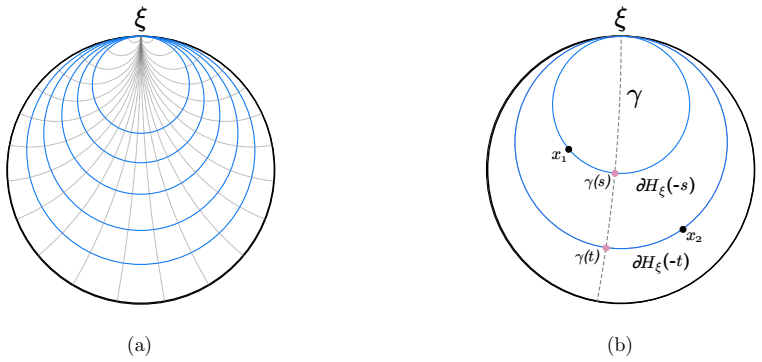
The horospherical depth is defined using Busemann functions parametrized by the visual boundary, replacing half-spaces with horoballs. For any Hadamard manifold, the depth regions are nested and geodesically convex, ensuring the existence of a centerpoint with depth at least 1/(d+1) and thus the Busemann median for every probability measure. The construction is isometry-equivariant and intrinsic.
What carries the argument
Busemann functions and their associated horoballs as intrinsic analogs of half-spaces in the definition of statistical depth.
If this is right
- Depth regions are nested and geodesically convex.
- A centerpoint of depth at least 1/(d+1) exists.
- The Busemann median exists for every Borel probability measure.
- Under strictly negative sectional curvature the depth is strictly quasi-concave and the median is unique.
- The depth is robust to total-variation perturbations and sample depth converges uniformly.
Where Pith is reading between the lines
- This may allow robust median estimation in hyperbolic spaces without choosing a base point.
- It contrasts with Fréchet means by having limiting behavior depending on escape direction but not distance.
- The VC analysis on symmetric spaces suggests efficient computation for certain manifolds.
- Extensions could apply similar limiting procedures to other geometric objects in statistics.
Load-bearing premise
The manifold is Hadamard so that Busemann functions are well-defined and horoballs behave like half-spaces.
What would settle it
A Hadamard manifold and probability measure where the maximum horospherical depth is less than 1/(d+1) for all points.
Figures


read the original abstract
\We introduce the horospherical depth, an intrinsic notion of statistical depth on Hadamard manifolds, and define the Busemann median as the set of its maximizers. The construction exploits the fact that the linear functionals appearing in Tukey's half-space depth are themselves limits of renormalized distance functions; on a Hadamard manifold the same limiting procedure produces Busemann functions, whose sublevel sets are horoballs, the intrinsic replacements for halfspaces. The resulting depth is parametrized by the visual boundary, is isometry-equivariant, and requires neither tangent-space linearization nor a chosen base point. For arbitrary Hadamard manifolds, we prove that the depth regions are nested and geodesically convex, that a centerpoint of depth at least $1/(d+1)$ exists, and hence that the Busemann median exists for every Borel probability measure. Under strictly negative sectional curvature and mild regularity assumptions, the depth is strictly quasi-concave and the median is unique. We also establish robustness: the depth is stable under total-variation perturbations, and under contamination escaping to infinity the limiting median depends on the escape direction but not on how far the contaminating mass has moved along the geodesic ray, in contrast with the Fr\'echet mean. Finally, we establish uniform consistency of the sample depth and convergence of sample depth regions and sample Busemann medians; on symmetric spaces of noncompact type, the argument proceeds through a VC analysis of upper horospherical halfspaces, while on general Hadamard manifolds it follows from a compactness argument under a mild non-atomicity assumption.
Editorial analysis
A structured set of objections, weighed in public.
Referee Report
Summary. The paper introduces horospherical depth on Hadamard manifolds, constructed via Busemann functions (limits of renormalized distance functions) whose sublevel sets are horoballs serving as intrinsic half-spaces. The Busemann median is the set of maximizers of this depth. The authors prove that depth regions are nested and geodesically convex, that a centerpoint of depth at least 1/(d+1) exists for every Borel probability measure (hence the median exists), that the depth is strictly quasi-concave and the median unique under strict negative curvature plus mild regularity, and that the depth is robust to total-variation perturbations and to contamination escaping to infinity. Sample consistency and convergence of depth regions and medians are established, via VC analysis on symmetric spaces of noncompact type and via compactness under non-atomicity on general Hadamard manifolds.
Significance. If the central claims hold, the work supplies an intrinsic, isometry-equivariant statistical depth and median for Hadamard manifolds that requires neither a base point nor tangent-space linearization. The centerpoint theorem, the robustness contrast with Fréchet means under escaping contamination, and the consistency proofs (especially the VC argument on symmetric spaces) are substantive contributions to geometric statistics. The explicit separation of assumptions between symmetric spaces and general Hadamard manifolds is a strength.
major comments (2)
- [Theorem stating centerpoint existence] The centerpoint theorem (existence of a point of depth at least 1/(d+1) for arbitrary Borel measures on any Hadamard manifold) is load-bearing for the median existence claim. The manuscript should explicitly indicate which properties of the visual boundary and Busemann functions are used to adapt the standard convex-geometry argument, and confirm that geodesic convexity plus nesting alone suffice without further curvature restrictions.
- [Consistency theorem for general Hadamard manifolds] In the consistency result for general Hadamard manifolds, the mild non-atomicity assumption is essential for the compactness argument; it should appear verbatim in the theorem statement rather than only in the proof sketch, so that the precise scope is clear.
minor comments (2)
- [Abstract and introduction] The abstract refers to 'mild regularity assumptions' for uniqueness; these should be stated precisely (e.g., as a condition on the measure or on the curvature) already in the introduction.
- [Notation and definitions] Notation for the visual boundary and the parametrization of depth by boundary points should be introduced once and used uniformly; a short table of symbols would improve readability.
Simulated Author's Rebuttal
We thank the referee for the careful reading, positive assessment, and constructive suggestions. We address the two major comments below and will revise the manuscript accordingly.
read point-by-point responses
-
Referee: The centerpoint theorem (existence of a point of depth at least 1/(d+1) for arbitrary Borel measures on any Hadamard manifold) is load-bearing for the median existence claim. The manuscript should explicitly indicate which properties of the visual boundary and Busemann functions are used to adapt the standard convex-geometry argument, and confirm that geodesic convexity plus nesting alone suffice without further curvature restrictions.
Authors: We agree that the centerpoint result is central. The proof adapts the classical argument by using that depth regions are closed, geodesically convex, and nested; these properties follow directly from the fact that Busemann functions are convex and 1-Lipschitz, with sublevel sets being horoballs (which are geodesically convex). The visual boundary parametrizes the family of such half-spaces without requiring a base point. No additional curvature assumptions beyond the Hadamard definition (complete, simply connected, non-positive sectional curvature) are used. We will insert a short clarifying paragraph in the proof of the centerpoint theorem (and a corresponding remark in the introduction) that explicitly lists these properties and confirms that geodesic convexity plus nesting suffice. revision: yes
-
Referee: In the consistency result for general Hadamard manifolds, the mild non-atomicity assumption is essential for the compactness argument; it should appear verbatim in the theorem statement rather than only in the proof sketch, so that the precise scope is clear.
Authors: We thank the referee for this observation. The non-atomicity condition is indeed required for the compactness argument that yields convergence of sample depth regions and medians on general Hadamard manifolds. We will move the assumption verbatim into the statement of the relevant consistency theorem so that the precise hypotheses are stated at the theorem level rather than only in the proof. revision: yes
Circularity Check
No significant circularity detected
full rationale
The derivation defines horospherical depth directly via Busemann functions on Hadamard manifolds and proves nesting, geodesic convexity, and centerpoint existence (at least 1/(d+1)) from the geometry of horoballs and the visual boundary. These steps rely on intrinsic manifold properties rather than fitted parameters, self-referential equations, or load-bearing self-citations that reduce the result to its inputs. The consistency arguments distinguish symmetric spaces (VC dimension) from general cases (compactness + non-atomicity) without circularity. The construction is self-contained against external geometric benchmarks.
Axiom & Free-Parameter Ledger
axioms (2)
- domain assumption Hadamard manifold: complete, simply connected Riemannian manifold with non-positive sectional curvature
- standard math Existence of visual boundary and Busemann functions as limits of renormalized distances
invented entities (2)
-
horospherical depth
no independent evidence
-
Busemann median
no independent evidence
Lean theorems connected to this paper
-
IndisputableMonolith/Cost/FunctionalEquation.leanwashburn_uniqueness_aczel echoes?
echoesECHOES: this paper passage has the same mathematical shape or conceptual pattern as the Recognition theorem, but is not a direct formal dependency.
horospherical depth D(z;P) := inf_ξ P({x : B_ξ(x) ≥ B_ξ(z)}), depth regions as intersections of horoballs H_ξ(t_ξ(α)), centerpoint D* ≥ 1/(d+1)
-
IndisputableMonolith/Foundation/AlexanderDuality.leanalexander_duality_circle_linking unclear?
unclearRelation between the paper passage and the cited Recognition theorem.
geodesic convexity of horoballs and depth regions; strict convexity under Sec X < 0
What do these tags mean?
- matches
- The paper's claim is directly supported by a theorem in the formal canon.
- supports
- The theorem supports part of the paper's argument, but the paper may add assumptions or extra steps.
- extends
- The paper goes beyond the formal theorem; the theorem is a base layer rather than the whole result.
- uses
- The paper appears to rely on the theorem as machinery.
- contradicts
- The paper's claim conflicts with a theorem or certificate in the canon.
- unclear
- Pith found a possible connection, but the passage is too broad, indirect, or ambiguous to say the theorem truly supports the claim.
Reference graph
Works this paper leans on
-
[1]
Riemannian Lp center of mass: existence, uniqueness, and convexity
Afsari, B.(2011). Riemannian Lp center of mass: existence, uniqueness, and convexity. Proceedings of the American Mathematical Society139655–673
work page 2011
-
[2]
Computing medians and means in Hadamard spaces.SIAM Journal on Optimization241542–1566
Bačák, M.(2014). Computing medians and means in Hadamard spaces.SIAM Journal on Optimization241542–1566
work page 2014
-
[3]
Large sample theory of intrinsic and extrinsic sample means on manifolds
Bhattacharya, R.andPatrangenaru, V.(2003). Large sample theory of intrinsic and extrinsic sample means on manifolds. I.The Annals of Statistics311–29
work page 2003
-
[4]
Billera, L. J.,Holmes, S. P.andVogtmann, K.(2001). Geometry of the space of phylogenetic trees.Advances in Applied Mathematics27733–767
work page 2001
-
[5]
R.andHaefliger, A.(2013).Metric spaces of non-positive curvature319
Bridson, M. R.andHaefliger, A.(2013).Metric spaces of non-positive curvature319. Springer Science & Business Media. [6]Busemann, H.(1955). The geometry of geodesics.Pure and Applied Mathematics
work page 2013
- [6]
-
[7]
Cholaquidis, A.,Fraiman, R.,Gamboa, F.andMoreno, L.(2023). Weighted lens depth: Some applications to supervised classification.Canadian Journal of Statistics51652–673
work page 2023
-
[8]
Level sets of depth measures in abstract spaces.Test32942–957
Cholaquidis, A.,Fraiman, R.andMoreno, L.(2023). Level sets of depth measures in abstract spaces.Test32942–957
work page 2023
-
[9]
Dai, X.,Lopez-Pintado, S.andInitiative, A. D. N.(2023). Tukey’s depth for object data. Journal of the American Statistical Association1181760–1772. 26
work page 2023
-
[10]
Donoho, D. L.andGasko, M.(1992). Breakdown Properties of Location Estimates Based on Halfspace Depth and Projected Outlyingness.The Annals of Statistics201803 – 1827
work page 1992
-
[11]
Visibility manifolds.Pacific Journal of Mathematics 4645–109
Eberlein, P.andO’Neill, B.(1973). Visibility manifolds.Pacific Journal of Mathematics 4645–109
work page 1973
-
[12]
Fletcher, P. T.andJoshi, S.(2007). Riemannian geometry for the statistical analysis of diffusion tensor data.Signal Processing87250–262
work page 2007
-
[13]
Les éléments aléatoires de nature quelconque dans un espace distancié
Fréchet, M.(1948). Les éléments aléatoires de nature quelconque dans un espace distancié. InAnnales de l’institut Henri Poincaré10215–310
work page 1948
-
[14]
Grigoryan, A.(2009).Heat kernel and analysis on manifolds47. American Mathematical Soc
work page 2009
-
[15]
Geometry of horospheres.Journal of Differential geometry12481–491
Heintze, E.andIm Hof, H.-C.(1977). Geometry of horospheres.Journal of Differential geometry12481–491
work page 1977
-
[16]
Johnson, H. R.andLaskowski, M. C.(2010). Compression schemes, stable definable families, and o-minimal structures.Discrete & Computational Geometry43914–926
work page 2010
-
[17]
Lee, J.andJung, S.(2025). Huber means on Riemannian manifolds.Journal of the Royal Statistical Society Series B: Statistical Methodologyqkaf054. [19]Lee, J. M.(2018).Introduction to Riemannian manifolds, 2 ed. Springer
work page 2025
-
[18]
Lens data depth and median.Journal of Nonparametric Statistics231063–1074
Liu, Z.andModarres, R.(2011). Lens data depth and median.Journal of Nonparametric Statistics231063–1074
work page 2011
-
[19]
Mizera, I.andVolauf, M.(2002). Continuity of halfspace depth contours and maximum depth estimators: diagnostics of depth-related methods.Journal of Multivariate Analysis83 365–388
work page 2002
-
[20]
Nickel, M.andKiela, D.(2017). Poincaré embeddings for learning hierarchical representa- tions.Advances in neural information processing systems30
work page 2017
-
[21]
Pennec, X.(2006). Intrinsic statistics on Riemannian manifolds: Basic tools for geometric measurements.Journal of Mathematical Imaging and Vision25127–154
work page 2006
-
[22]
A theorem on general measure.Journal of the London Mathematical Society 1291–300
Rado, R.(1946). A theorem on general measure.Journal of the London Mathematical Society 1291–300
work page 1946
-
[23]
Rousseeuw, P. J.andRuts, I.(1999). The depth function of a population distribution. Metrika49213–244
work page 1999
-
[24]
A Riemannian Corollary of Helly’s theorem.arXiv preprint arXiv:1804.10738
Rusciano, A.(2018). A Riemannian Corollary of Helly’s theorem.arXiv preprint arXiv:1804.10738
-
[25]
Solan, O. N.andTamam, N.(2025). Geometric interpretation of quantitative instability: ON Solan, N. Tamam.Geometriae Dedicata21978
work page 2025
-
[26]
Tukey, J. W.(1975).Mathematicsandthepicturingofdata.InProceedings of the International Congress of Mathematicians2523–531
work page 1975
-
[27]
v an den Dries, L.andMiller, C.(1994). On the real exponential field with restricted analytic functions.Israel Journal of Mathematics8519–56
work page 1994
- [28]
-
[29]
General notions of statistical depth function.The Annals of Statistics28461 – 482
Zuo, Y.andSerfling, R.(2000). General notions of statistical depth function.The Annals of Statistics28461 – 482
work page 2000
-
[30]
Zuo, Y.andSerfling, R.(2000). Structural properties and convergence results for contours of sample statistical depth functions.The Annals of Statistics28483 – 499. 27 Appendix A: Useful Lemmas Lemma A.1.Let X be a finite-dimensional Hadamard manifold. Ifξn →ξ in ∂X, then Bξn →B ξ uniformly on compact subsets ofX. In particular,ξ7→B ξ is continuous. Proof....
work page 2000
discussion (0)
Sign in with ORCID, Apple, or X to comment. Anyone can read and Pith papers without signing in.