Recognition: 2 theorem links
· Lean TheoremDust characterization of halos: The extended emission in protoplanetary disks
Pith reviewed 2026-05-13 06:55 UTC · model grok-4.3
The pith
Extended halos in three protoplanetary disks hold 20-30 percent of the total dust emission with gas-to-dust ratios as low as 18.
A machine-rendered reading of the paper's core claim, the machinery that carries it, and where it could break.
Core claim
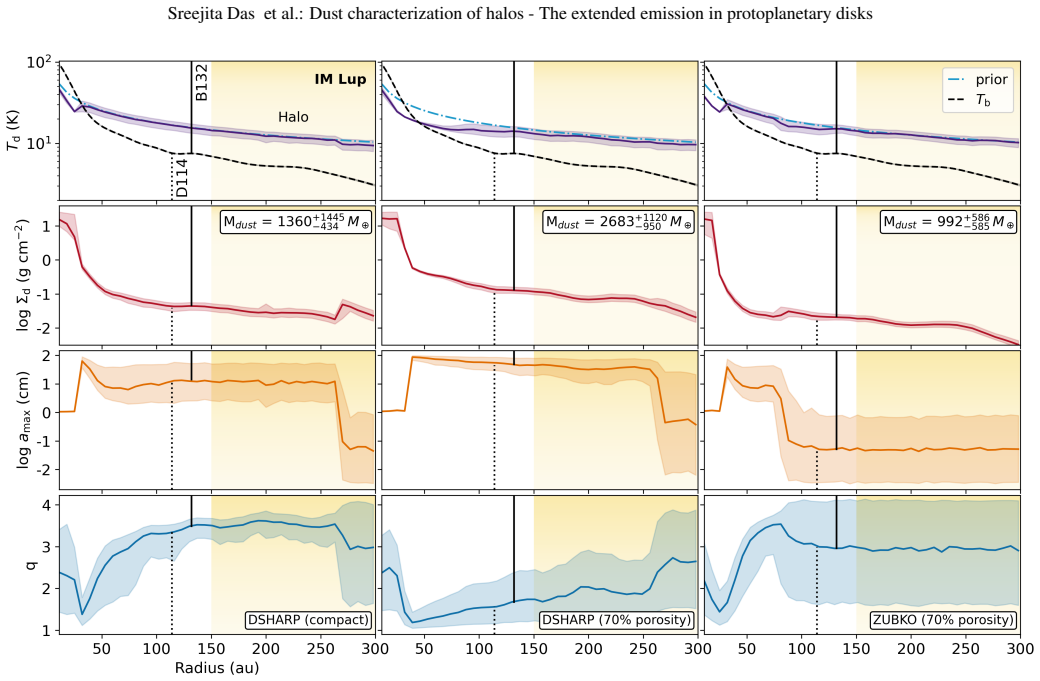
The halos identified in Elias 2-24, IM Lup, and DM Tau account for 20-30 percent of the total flux density at submillimeter wavelengths. Maximum grain sizes reach 2 cm, less than 4 mm, and less than 9 mm respectively, with the observations best matched by porous amorphous carbon, compact amorphous carbon, and compact organic carbon compositions. The corresponding halo dust masses are 33, 103, and 316 Earth masses. The halos of IM Lup and DM Tau have gas-to-dust ratios of 64 and 18, and in all three disks the drift and growth timescales are shorter than the system ages. These halos therefore contain relevant fractions of the total dust reservoir and help alleviate the mass-budget problem, an
What carries the argument
Spectral energy distribution fitting applied to multiwavelength ALMA continuum observations to extract radial profiles of maximum grain size, total dust mass, and halo flux contributions.
If this is right
- The halos contain 20-30 percent of the total (sub)millimeter flux and therefore a sizable share of the overall dust reservoir.
- Dust drift and growth timescales shorter than disk ages imply that smooth outer disk structures cannot persist without additional sustaining processes.
- The dust-rich character of the halos in IM Lup and DM Tau directly addresses the missing-mass discrepancy in protoplanetary disks.
- Centimeter-sized grains in Elias 2-24's halo point to unresolved dust traps as one possible retention mechanism alongside late infall.
Where Pith is reading between the lines
- If such halos prove common, total disk dust masses inferred from compact emission alone would systematically underestimate the true solid reservoir available for planet formation.
- Higher-resolution continuum imaging could test whether the large grains are trapped in unresolved substructures within the halos.
- The low gas-to-dust ratios raise the possibility that outer-disk planet formation efficiencies have been underestimated in models that ignore extended low-brightness dust.
Load-bearing premise
The chosen dust compositions and opacity models in the spectral energy distribution fits recover accurate grain sizes and masses without significant bias from unresolved substructure or composition uncertainties, and the standard radial drift and growth timescale formulas apply directly to the halo regions.
What would settle it
Molecular line observations that measure gas masses in the halo regions yielding gas-to-dust ratios well above 100, or high-resolution imaging that shows no substructure capable of retaining centimeter-sized grains against rapid inward drift.
Figures



read the original abstract
Extended low surface brightness emission has been identified in a number of protoplanetary disks, in tension with predictions of radial drift theory. We aim to investigate the nature and origin of faint, extended dust emission in the outer regions of protoplanetary disks, which we define as the "Halo", using multiwavelength (sub)millimeter continuum observations of three systems: Elias 2-24, IM Lup, and DM Tau. We utilized Atacama Large Millimeter Array (ALMA) observations of our targets to perform spectral energy distribution (SED) fitting with four dust compositions and derived radial profiles of their dust properties. The halos identified in our sources account for 20 - 30% of the total flux density at (sub)millimeter wavelengths. In Elias 2-24, IM Lup, and DM Tau, we infer maximum grain sizes of 2 cm, $<$ 4 mm, and $<$ 9 mm, with the data best reproduced by porous amorphous carbon, compact amorphous carbon, and compact organic carbon compositions, respectively. Their total dust masses are $125^{+34}_{-23}$, $301^{+139}_{-101}$, and $829^{+761}_{-378}$ M$_{\oplus}$, with corresponding halo masses of $33^{+12}_{-6}$, $103^{+25}_{-17}$, and $316^{+202}_{-117}$ M$_{\oplus}$. The halos of IM Lup and DM Tau are dust rich with gas-to-dust mass ratios of 64 and 18, respectively. In all three disks, the dust drift and growth timescales are shorter than the disk ages, implying that the smooth outer disks should not exist. The halos in our sources hold relevant fractions of the total dust reservoir, demonstrating that they play an important role in alleviating the mass-budget problem. While the persistence of halos in IM Lup and DM Tau could be explained by late infall, the presence of centimeter-sized grains in Elias 2-24's halo suggests that unresolved dust traps also play a role.
Editorial analysis
A structured set of objections, weighed in public.
Referee Report
Summary. The paper analyzes ALMA multiwavelength continuum data for three protoplanetary disks (Elias 2-24, IM Lup, DM Tau) to characterize faint extended 'halo' emission beyond the main disk. Using SED fitting with four fixed dust compositions, the authors derive radial profiles of maximum grain size and dust mass, reporting that halos contribute 20-30% of the total (sub)mm flux, with a_max values of 2 cm, <4 mm, and <9 mm respectively, halo masses of 33, 103, and 316 M⊕, and gas-to-dust ratios of 64 and 18 for IM Lup and DM Tau. They conclude that dust drift and growth timescales in the halos are shorter than the disk ages, implying the smooth outer disks should not persist, and that halos represent a significant fraction of the total dust reservoir that helps alleviate the mass-budget problem, possibly via late infall or unresolved traps.
Significance. If the halo mass fractions and grain-size inferences hold, the work provides direct evidence that extended low-surface-brightness components contain a non-negligible share (20-30%) of the dust mass in these systems, offering a concrete mechanism to address the discrepancy between observed disk masses and those required for planet formation. The multiwavelength approach and explicit timescale comparisons add falsifiable content to discussions of radial drift and dust trapping.
major comments (3)
- [SED fitting and radial profiles] Section on SED fitting and radial profile derivation: the reported halo masses and a_max values rest on fits with only four fixed dust compositions and the assumption that emission is optically thin with no unresolved substructure on scales smaller than the beam; no quantitative sensitivity test to opacity variations (e.g., porosity or carbon fraction) or hidden traps is presented, yet a factor-of-two opacity shift would proportionally alter the 20-30% flux fractions and the 'drift time < age' conclusion.
- [Timescale analysis] Results on timescale comparisons: the statement that dust drift and growth timescales are shorter than disk ages for all three halos uses standard analytic expressions, but the manuscript does not specify the exact temperature, surface-density, or turbulence parameters adopted for the low-surface-brightness halo regions, nor does it propagate uncertainties from the fitted masses and a_max into the timescale ratios.
- [Halo flux extraction] Halo flux extraction procedure: the claim that halos hold relevant fractions of the total dust reservoir depends on clean separation of halo emission from the inner disk; the paper provides no explicit test (e.g., visibility-domain modeling or residual maps) demonstrating that inner-disk contamination or beam-smearing effects are negligible at the reported surface-brightness levels.
minor comments (2)
- [Abstract] The abstract lists asymmetric mass uncertainties but does not state whether they incorporate only statistical errors or also systematic uncertainties from composition choice and temperature assumptions.
- [Results] Notation for maximum grain size is inconsistent between text ('2 cm', '<4 mm') and any accompanying tables; a uniform format would improve clarity.
Simulated Author's Rebuttal
We thank the referee for their constructive and detailed report. We address each major comment point by point below, indicating where revisions will be made to strengthen the manuscript.
read point-by-point responses
-
Referee: Section on SED fitting and radial profile derivation: the reported halo masses and a_max values rest on fits with only four fixed dust compositions and the assumption that emission is optically thin with no unresolved substructure on scales smaller than the beam; no quantitative sensitivity test to opacity variations (e.g., porosity or carbon fraction) or hidden traps is presented, yet a factor-of-two opacity shift would proportionally alter the 20-30% flux fractions and the 'drift time < age' conclusion.
Authors: We agree that quantitative sensitivity tests to opacity variations would improve the robustness of the results. The four compositions were chosen to span realistic ranges in porosity and carbon content, but we will add an appendix with explicit tests varying carbon fraction by ±20% and porosity levels, quantifying impacts on a_max, masses, and flux fractions. Optical depth will be calculated from the derived surface densities to justify the thin-emission assumption. We will also add discussion of unresolved substructure or hidden traps as a limitation, noting that the smooth observed profiles provide no direct evidence for them. revision: partial
-
Referee: Results on timescale comparisons: the statement that dust drift and growth timescales are shorter than disk ages for all three halos uses standard analytic expressions, but the manuscript does not specify the exact temperature, surface-density, or turbulence parameters adopted for the low-surface-brightness halo regions, nor does it propagate uncertainties from the fitted masses and a_max into the timescale ratios.
Authors: We thank the referee for this clarification request. The revised manuscript will explicitly state the adopted parameters: temperature from the radial SED-derived profiles, surface density from the dust mass profiles (using the reported gas-to-dust ratios for IM Lup and DM Tau, and a fiducial value for Elias 2-24), and turbulence parameter α = 10^{-3}. Uncertainties in mass and a_max will be propagated through the analytic drift and growth timescale expressions, with the resulting ranges shown relative to the disk ages. revision: yes
-
Referee: Halo flux extraction procedure: the claim that halos hold relevant fractions of the total dust reservoir depends on clean separation of halo emission from the inner disk; the paper provides no explicit test (e.g., visibility-domain modeling or residual maps) demonstrating that inner-disk contamination or beam-smearing effects are negligible at the reported surface-brightness levels.
Authors: The halo regions were defined via azimuthally averaged surface-brightness thresholds in the CLEANed images. We will revise to include residual maps after subtracting an inner-disk model and quantify beam-smearing effects using the beam sizes and radial profiles. Full visibility-domain modeling with substructure is beyond the present scope without additional assumptions, but we will justify the image-based separation and add explicit caveats on potential contamination. revision: partial
Circularity Check
No significant circularity: halo masses and grain sizes derived from direct SED fits to ALMA fluxes using external opacity models
full rationale
The paper defines halos observationally as extended low-surface-brightness emission in the outer disk regions. It then performs SED fitting on multiwavelength ALMA continuum data using four fixed dust compositions to extract radial profiles, maximum grain sizes, and dust masses. These quantities are computed from observed fluxes via standard radiative transfer and opacity assumptions, not by re-using the halo definition or fitted parameters as the prediction itself. Gas-to-dust ratios and drift/growth timescale comparisons employ literature gas masses and standard analytic formulas against independently estimated disk ages. No load-bearing self-citations, ansatz smuggling, or uniqueness theorems from the same authors appear in the derivation chain. The central results (20-30% flux fractions, specific halo masses, and the mass-budget alleviation claim) therefore retain independent content from the input data.
Axiom & Free-Parameter Ledger
free parameters (2)
- maximum grain size
- dust composition choice
axioms (2)
- domain assumption Standard radial drift and grain growth timescales from literature apply directly to halo dust.
- domain assumption Dust opacity models for the chosen compositions are accurate at (sub)mm wavelengths.
Lean theorems connected to this paper
-
IndisputableMonolith/Cost/FunctionalEquation.leanwashburn_uniqueness_aczel unclear?
unclearRelation between the paper passage and the cited Recognition theorem.
We utilize Atacama Large Millimeter Array (ALMA) observations ... to perform spectral energy distribution (SED) fitting with four dust compositions and derive radial profiles of their dust properties.
-
IndisputableMonolith/Foundation/ArithmeticFromLogic.leanembed_strictMono_of_one_lt unclear?
unclearRelation between the paper passage and the cited Recognition theorem.
tdrift = (r/hg)^2 (St + St^{-1}) / ((1+ϵ)^2 γ ΩK); tgrow ...
What do these tags mean?
- matches
- The paper's claim is directly supported by a theorem in the formal canon.
- supports
- The theorem supports part of the paper's argument, but the paper may add assumptions or extra steps.
- extends
- The paper goes beyond the formal theorem; the theorem is a base layer rather than the whole result.
- uses
- The paper appears to rely on the theorem as machinery.
- contradicts
- The paper's claim conflicts with a theorem or certificate in the canon.
- unclear
- Pith found a possible connection, but the passage is too broad, indirect, or ambiguous to say the theorem truly supports the claim.
Reference graph
Works this paper leans on
-
[1]
Gaps and Rings: A Near-Universal Trait of Extended Protoplanetary Discs
Andrews, S. M., Huang, J., Pérez, L. M., et al. 2018, ApJ, 869, L41 Avenhaus, H., Quanz, S. P., Garufi, A., et al. 2018, ApJ, 863, 44 Barenfeld, S. A., Carpenter, J. M., Ricci, L., & Isella, A. 2016, ApJ, 827, 142 Beckwith, S. V . W., Sargent, A. I., Chini, R. S., & Guesten, R. 1990, AJ, 99, 924 Birnstiel, T. 2024, ARA&A, 62, 157 Birnstiel, T. & Andrews, ...
work page internal anchor Pith review Pith/arXiv arXiv 2018
-
[2]
Appendix C.1: Elias 2-24 Since we impose a strong prior onT d, the temperature solu- tions remain consistent across all four opacity models within 1σ. A notable trend is that both DSHARP models (compact and porous) yield temperatures that are∼10 K lower than the values expected in the inner 50 au, similar to the findings of Macías et al. 2021 for the inne...
work page 2021
discussion (0)
Sign in with ORCID, Apple, or X to comment. Anyone can read and Pith papers without signing in.