Recognition: unknown
Extending the ALMA survey of the SCUBA-2 CLS UDS field: Tracing the obscured formation of spheroids across z~1-4
Pith reviewed 2026-05-10 03:56 UTC · model grok-4.3
The pith
Submillimeter galaxies transition at 1 mJy and redshift 2 from compact starbursts in unstable discs to extended secular star-forming discs.
A machine-rendered reading of the paper's core claim, the machinery that carries it, and where it could break.
Core claim
Submm galaxies with S870 ~1 mJy at z>~2.5 share properties with brighter more active populations, while those at z<~2.5 are distinct, with lower gas fractions, shorter depletion times, and stellar morphologies from JWST imaging that show less structured dust obscuration, resembling less-active field galaxies. This indicates a shift in the characteristics of 870-um-selected galaxies at S870~1mJy and z~2, likely driven by the stability of their gas discs. Brighter and higher-z galaxies can sustain dense, globally unstable discs through efficient gas accretion, powering compact obscured starbursts. In contrast, fainter systems at z<~2.5 lack this accretion, leading to more stable discs and more
What carries the argument
The extended AS2UDSx sample of 84 sources selected down to 3.1 sigma significance, matched to K-selected galaxies with photometric redshift and (H-K) colour cuts, to compare gas fractions, depletion times, and JWST morphologies across flux and redshift bins.
If this is right
- Brighter higher-redshift submm galaxies form a distinct population of compact starbursts within massive unstable gas-rich discs.
- Fainter lower-redshift sources represent the most active secularly-driven extended star-forming discs.
- The brighter higher-z population is consistent with progenitors of massive spheroids.
- The transition is driven by the stability of gas discs and the efficiency of continued gas accretion.
Where Pith is reading between the lines
- If the division is real, semi-analytic models and simulations of galaxy formation will need to incorporate a redshift-dependent threshold for when gas discs become globally unstable in massive halos.
- The result suggests that the contribution of compact starbursts to the total obscured star-formation rate density peaks at higher redshift than the contribution from extended discs.
- Future high-resolution molecular gas maps could test whether the compact high-z systems rapidly build the central mass concentrations seen in local elliptical galaxies.
Load-bearing premise
The photometric redshift and (H-K) colour cuts combined with matching to the K-selected sample sufficiently remove noise contamination and selection biases without distorting the measured gas fractions, depletion times, and morphological properties across the redshift and flux bins.
What would settle it
If deeper ALMA or JWST observations of the same sources show no statistically significant difference in gas depletion times or dust continuum sizes between the z<2.5 faint and z>2.5 bright subsamples once selection effects are fully modeled, the claimed natural division would not hold.
Figures


read the original abstract
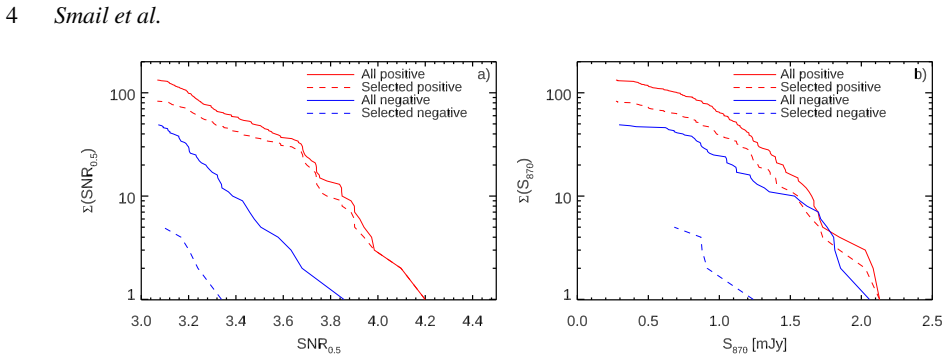
We investigate the properties of 870-um selected galaxies at z~1-4 with FIR luminosities of LIR~1e11-1e13Lo, encompassing systems that dominate obscured activity at the peak of cosmic star formation, to identify variations in star-formation processes as a function of dust mass and redshift. We revisit ALMA 870-um continuum maps from the ALMA/SCUBA-2 UDS (AS2UDS) survey, lowering the source selection threshold from 4.3 sigma to 3.1 sigma to enlarge the sample with S870~1mJy. To reduce contamination from noise peaks, we match submm sources to a K-selected galaxy sample and apply cuts on photometric redshift and near-infrared (H-K) colour. This yields 84 sources in our extended AS2UDS survey, AS2UDSx, with S870=0.3-2.2mJy, doubling the sample at S870~1mJy relative to the original study. Using this expanded sample, we find that submm galaxies with S870~1mJy at z>~2.5 share properties with brighter, more active populations, while those at z<~2.5 are distinct, with lower gas fractions, shorter depletion times, and stellar morphologies from JWST imaging that show less structured dust obscuration, resembling less-active field galaxies. This indicates a shift in the characteristics of 870-um-selected galaxies at S870~1mJy and z~2, likely driven by the stability of their gas discs. Brighter and higher-z galaxies can sustain dense, globally unstable discs through efficient gas accretion, powering compact obscured starbursts. In contrast, fainter systems at z<~2.5 lack this accretion, leading to more stable discs and more extended dust continuum emission. This suggests a natural division around S870~1mJy and z~2: lower-z, fainter sources represent the most active secularly-driven extended star-forming discs, while similar and brighter, higher-z submm galaxies form a distinct population of compact starbursts within massive, unstable, gas-rich discs, consistent with progenitors of massive spheroids.
Editorial analysis
A structured set of objections, weighed in public.
Referee Report
Summary. The manuscript extends the AS2UDS ALMA 870-μm survey by lowering the detection threshold from 4.3σ to 3.1σ and applying K-band matching plus photometric-redshift and (H-K) colour cuts, producing a sample of 84 sources (S870 = 0.3–2.2 mJy, z ~ 1–4). It compares gas fractions, depletion times, and JWST morphologies across flux and redshift bins, reporting a transition near S870 ~ 1 mJy and z ~ 2: fainter, lower-redshift sources exhibit lower gas fractions, shorter depletion times, and more extended morphologies consistent with secularly driven discs, while brighter, higher-redshift sources show properties of compact, unstable starbursts that may be progenitors of massive spheroids.
Significance. If the selection and measurement biases are shown to be controlled, the work supplies a valuable doubling of the faint-end (~1 mJy) sample and links submm galaxy properties to morphological evolution via JWST data. The proposed division offers a concrete, observationally testable division in star-formation modes at the peak of cosmic star formation and connects directly to models of gas accretion and spheroid assembly.
major comments (3)
- [Sample Selection] Sample Selection section: after lowering the threshold to 3.1σ, the photometric-redshift and (H-K) colour cuts are applied without a quantitative completeness or bias assessment as a function of redshift and flux. Differential completeness (e.g., larger photo-z scatter at z > 2.5 or colour cuts tracing dust content) could systematically alter the measured gas fractions and morphologies between the z ≲ 2.5 and z ≳ 2.5 bins, directly undermining the claimed physical transition.
- [Results] Results on gas fractions and depletion times: the manuscript provides no explicit description of how gas masses are derived from the 870-μm continuum or how uncertainties (including those introduced by the lowered detection threshold and the applied cuts) are propagated into the binned comparisons. Without these, the statistical significance of the reported differences in gas fraction and depletion time cannot be evaluated.
- [Morphological Analysis] JWST morphological analysis: the distinction between 'less structured dust obscuration' in lower-z sources and compact structures at higher z is presented qualitatively. Quantitative metrics (e.g., effective radius, asymmetry, or clumpiness parameters) and their uncertainties are required to support the interpretation that the morphological shift traces a change in disc stability.
minor comments (2)
- [Abstract] The abstract states that cuts 'reduce noise' but does not list the precise photometric-redshift or colour thresholds; adding these values would improve clarity for readers.
- [Figures] Figures displaying binned properties should include the number of sources per bin and explicit error bars (including systematic contributions) to allow direct assessment of the robustness of the trends.
Simulated Author's Rebuttal
We thank the referee for the constructive and positive review, which highlights the potential value of our extended sample in linking submillimetre galaxy properties to morphological evolution. We address each major comment below, providing the strongest honest defense of the original analysis while committing to revisions that strengthen the manuscript without misrepresenting the data.
read point-by-point responses
-
Referee: [Sample Selection] Sample Selection section: after lowering the threshold to 3.1σ, the photometric-redshift and (H-K) colour cuts are applied without a quantitative completeness or bias assessment as a function of redshift and flux. Differential completeness (e.g., larger photo-z scatter at z > 2.5 or colour cuts tracing dust content) could systematically alter the measured gas fractions and morphologies between the z ≲ 2.5 and z ≳ 2.5 bins, directly undermining the claimed physical transition.
Authors: We agree that a quantitative completeness assessment would strengthen the claims. In revision we will add mock source injection tests using the original AS2UDS noise maps to quantify detection completeness as a function of flux and redshift, and we will compare the distributions of photo-z quality and (H-K) colours before versus after the cuts. The cuts were applied uniformly and conservatively to suppress noise peaks, and the primary trends in gas fraction and morphology remain visible in the brighter (S870 > 1 mJy) subset that requires no threshold lowering; nevertheless, we will explicitly test for differential bias between the z ≲ 2.5 and z ≳ 2.5 bins. revision: yes
-
Referee: [Results] Results on gas fractions and depletion times: the manuscript provides no explicit description of how gas masses are derived from the 870-μm continuum or how uncertainties (including those introduced by the lowered detection threshold and the applied cuts) are propagated into the binned comparisons. Without these, the statistical significance of the reported differences in gas fraction and depletion time cannot be evaluated.
Authors: We will insert a dedicated methods subsection describing the gas-mass derivation: molecular gas masses are obtained from the 870-μm continuum via the standard dust-to-gas conversion with a fixed dust temperature of 25 K and a metallicity-dependent dust-to-gas ratio, exactly as used in the parent AS2UDS papers. Uncertainties will be propagated with Monte Carlo realisations that include the measured flux errors, photometric-redshift uncertainties, and the range of plausible conversion factors. We will also report the results of two-sample statistical tests (Kolmogorov-Smirnov and Mann-Whitney) on the binned distributions to quantify the significance of the reported differences. revision: yes
-
Referee: [Morphological Analysis] JWST morphological analysis: the distinction between 'less structured dust obscuration' in lower-z sources and compact structures at higher z is presented qualitatively. Quantitative metrics (e.g., effective radius, asymmetry, or clumpiness parameters) and their uncertainties are required to support the interpretation that the morphological shift traces a change in disc stability.
Authors: We accept that quantitative metrics are needed. In the revised manuscript we will report effective radii and asymmetry parameters measured with GALFIT on the available JWST NIRCam imaging for the subset of sources with sufficient depth and coverage. Uncertainties will be derived from the fitting covariance matrices and from bootstrap resampling of the images. These metrics will be tabulated and compared directly between the low- and high-redshift bins. We note that JWST coverage is not uniform across the full sample, which is why the original presentation remained partly qualitative, but the quantitative trends in the available data are consistent with the visual classification and with the proposed change in disc stability. revision: yes
Circularity Check
No circularity: purely observational sample expansion and bin comparison
full rationale
The paper's chain consists of lowering the ALMA detection threshold from 4.3σ to 3.1σ, applying K-band matching plus photometric-redshift and (H-K) colour cuts to reduce noise, then binning the resulting 84 sources by flux and redshift and directly comparing measured quantities (gas fractions, depletion times, JWST morphologies). No equations, fitted parameters, or model predictions appear; the central claim of a transition at S870~1 mJy and z~2 is an empirical statement about observed differences across bins. This is self-contained observational astronomy with no self-definitional steps, no fitted-input predictions, and no load-bearing self-citations that reduce the result to its inputs.
Axiom & Free-Parameter Ledger
axioms (2)
- domain assumption Photometric redshifts are accurate enough for reliable sample selection and redshift binning at z~1-4.
- domain assumption The (H-K) colour cut combined with K-band matching removes the majority of noise peaks without introducing major biases in galaxy properties.
Reference graph
Works this paper leans on
-
[1]
Adscheid S., et al., 2024, @doi [ ] 10.1051/0004-6361/202348407 , https://ui.adsabs.harvard.edu/abs/2024A&A...685A...1A 685, A1
-
[2]
J., Menanteau F., Lutz D., Tacconi L
Aguirre P., Baker A. J., Menanteau F., Lutz D., Tacconi L. J., 2013, @doi [ ] 10.1088/0004-637X/768/2/164 , https://ui.adsabs.harvard.edu/abs/2013ApJ...768..164A 768, 164
-
[3]
Amvrosiadis A., et al., 2019, @doi [ ] 10.1093/mnras/sty3013 , https://ui.adsabs.harvard.edu/abs/2019MNRAS.483.4649A 483, 4649
-
[4]
An F. X., et al., 2018, @doi [ ] 10.3847/1538-4357/aacdaa , https://ui.adsabs.harvard.edu/abs/2018ApJ...862..101A 862, 101
-
[5]
Armus L., Heckman T., Miley G., 1987, @doi [ ] 10.1086/114517 , https://ui.adsabs.harvard.edu/abs/1987AJ.....94..831A 94, 831
-
[6]
J., da Cunha, E., Grasha, K., et al
Battisti A. J., et al., 2019, @doi [ ] 10.3847/1538-4357/ab345d , https://ui.adsabs.harvard.edu/abs/2019ApJ...882...61B 882, 61
-
[7]
Blain A. W., 1997, @doi [ ] 10.1093/mnras/290.3.553 , https://ui.adsabs.harvard.edu/abs/1997MNRAS.290..553B 290, 553
-
[8]
Bodansky S., et al., 2025, @doi [arXiv e-prints] 10.48550/arXiv.2507.19472 , https://ui.adsabs.harvard.edu/abs/2025arXiv250719472B p. arXiv:2507.19472
-
[9]
Bouwens R., et al., 2020, @doi [ ] 10.3847/1538-4357/abb830 , https://ui.adsabs.harvard.edu/abs/2020ApJ...902..112B 902, 112
-
[10]
Casali M., et al., 2007, @doi [ ] 10.1051/0004-6361:20066514 , https://ui.adsabs.harvard.edu/abs/2007A&A...467..777C 467, 777
-
[11]
Chabrier G., 2003, @doi [ ] 10.1086/376392 , https://ui.adsabs.harvard.edu/abs/2003PASP..115..763C 115, 763
work page internal anchor Pith review doi:10.1086/376392 2003
-
[12]
Chan S.-W., Ao Y., Tan Q.-h., 2025, @doi [ ] 10.3847/1538-4357/ae10a2 , https://ui.adsabs.harvard.edu/abs/2025ApJ...995...90C 995, 90
-
[13]
Chapman S. C., Blain A. W., Smail I., Ivison R. J., 2005, @doi [ ] 10.1086/428082 , https://ui.adsabs.harvard.edu/abs/2005ApJ...622..772C 622, 772
-
[14]
Chen C.-C., Cowie L. L., Barger A. J., Casey C. M., Lee N., Sanders D. B., Wang W.-H., Williams J. P., 2013, @doi [ ] 10.1088/0004-637X/776/2/131 , https://ui.adsabs.harvard.edu/abs/2013ApJ...776..131C 776, 131
-
[15]
Chen C.-C., et al., 2015, @doi [ ] 10.1088/0004-637X/799/2/194 , https://ui.adsabs.harvard.edu/abs/2015ApJ...799..194C 799, 194
-
[16]
Chen C.-C., et al., 2016, @doi [ ] 10.3847/0004-637X/820/2/82 , https://ui.adsabs.harvard.edu/abs/2016ApJ...820...82C 820, 82
-
[17]
Chen C.-C., et al., 2022, @doi [ ] 10.3847/2041-8213/ac98c6 , https://ui.adsabs.harvard.edu/abs/2022ApJ...939L...7C 939, L7
-
[18]
Cheng C., et al., 2023, @doi [ ] 10.3847/2041-8213/aca9d0 , https://ui.adsabs.harvard.edu/abs/2023ApJ...942L..19C 942, L19
-
[19]
Colina L., Arribas S., Monreal-Ibero A., 2005, @doi [ ] 10.1086/427683 , https://ui.adsabs.harvard.edu/abs/2005ApJ...621..725C 621, 725
-
[20]
L., Gonz \'a lez-L \'o pez J., Barger A
Cowie L. L., Gonz \'a lez-L \'o pez J., Barger A. J., Bauer F. E., Hsu L.-Y., Wang W.-H., 2018, @doi [ ] 10.3847/1538-4357/aadc63 , https://ui.adsabs.harvard.edu/abs/2018ApJ...865..106C 865, 106
-
[21]
Cunha da Cunha E., Charlot S., Elbaz D., 2008, @doi [ ] 10.1111/j.1365-2966.2008.13535.x , https://ui.adsabs.harvard.edu/abs/2008MNRAS.388.1595D 388, 1595
-
[22]
Cunha da Cunha E., et al., 2015, @doi [ ] 10.1088/0004-637X/806/1/110 , https://ui.adsabs.harvard.edu/abs/2015ApJ...806..110D 806, 110
-
[23]
D., Lutz D., Tacconi L., Bertoldi F., Carilli C., Genzel R., Menten K
Dannerbauer H., Lehnert M. D., Lutz D., Tacconi L., Bertoldi F., Carilli C., Genzel R., Menten K. M., 2004, @doi [ ] 10.1086/383138 , https://ui.adsabs.harvard.edu/abs/2004ApJ...606..664D 606, 664
-
[24]
Decarli R., et al., 2014, @doi [ ] 10.1088/0004-637X/780/2/115 , https://ui.adsabs.harvard.edu/abs/2014ApJ...780..115D 780, 115
-
[25]
Dekel A., Birnboim Y., 2006, @doi [ ] 10.1111/j.1365-2966.2006.10145.x , https://ui.adsabs.harvard.edu/abs/2006MNRAS.368....2D 368, 2
-
[26]
Dole H., et al., 2006, @doi [ ] 10.1051/0004-6361:20054446 , https://ui.adsabs.harvard.edu/abs/2006A&A...451..417D 451, 417
-
[27]
Donley J. L., et al., 2012, @doi [ ] 10.1088/0004-637X/748/2/142 , https://ui.adsabs.harvard.edu/abs/2012ApJ...748..142D 748, 142
-
[28]
Downes A. J. B., Peacock J. A., Savage A., Carrie D. R., 1986, @doi [ ] 10.1093/mnras/218.1.31 , https://ui.adsabs.harvard.edu/abs/1986MNRAS.218...31D 218, 31
-
[29]
Dudzevi c i \= u t \. e U., et al., 2020, @doi [ ] 10.1093/mnras/staa769 , https://ui.adsabs.harvard.edu/abs/2020MNRAS.494.3828D 494, 3828
-
[30]
Dudzevi c i \= u t \. e U., et al., 2021, @doi [ ] 10.1093/mnras/staa3285 , https://ui.adsabs.harvard.edu/abs/2021MNRAS.500..942D 500, 942
-
[31]
Dunlop J. S., Peacock J. A., Savage A., Lilly S. J., Heasley J. N., Simon A. J. B., 1989, @doi [ ] 10.1093/mnras/238.4.1171 , https://ui.adsabs.harvard.edu/abs/1989MNRAS.238.1171D 238, 1171
-
[32]
Eales S., et al., 2010, @doi [ ] 10.1086/653086 , https://ui.adsabs.harvard.edu/abs/2010PASP..122..499E 122, 499
-
[33]
Elbaz D., et al., 2018, @doi [ ] 10.1051/0004-6361/201732370 , https://ui.adsabs.harvard.edu/abs/2018A&A...616A.110E 616, A110
-
[34]
M., Shanks T., Metcalfe N., Ansarinejad B., Barrientos L
Eltvedt A. M., Shanks T., Metcalfe N., Ansarinejad B., Barrientos L. F., Murphy D. N. A., Alexander D. M., 2024, @doi [ ] 10.1093/mnras/stae2467 , https://ui.adsabs.harvard.edu/abs/2024MNRAS.535.2105E 535, 2105
-
[35]
Engel H., et al., 2010, @doi [ ] 10.1088/0004-637X/724/1/233 , https://ui.adsabs.harvard.edu/abs/2010ApJ...724..233E 724, 233
-
[36]
Fakhouri O., Ma C.-P., Boylan-Kolchin M., 2010, @doi [ ] 10.1111/j.1365-2966.2010.16859.x , https://ui.adsabs.harvard.edu/abs/2010MNRAS.406.2267F 406, 2267
-
[37]
Farrah D., et al., 2001, @doi [ ] 10.1111/j.1365-2966.2001.04721.x , https://ui.adsabs.harvard.edu/abs/2001MNRAS.326.1333F 326, 1333
-
[38]
Fazio G. G., et al., 2004, @doi [ ] 10.1086/422843 , https://ui.adsabs.harvard.edu/abs/2004ApJS..154...10F 154, 10
-
[39]
Franco M., et al., 2020, @doi [ ] 10.1051/0004-6361/202038310 , https://ui.adsabs.harvard.edu/abs/2020A&A...643A..53F 643, A53
-
[40]
Frayer D. T., Reddy N. A., Armus L., Blain A. W., Scoville N. Z., Smail I., 2004, @doi [ ] 10.1086/380943 , https://ui.adsabs.harvard.edu/abs/2004AJ....127..728F 127, 728
-
[41]
Fujimoto S., et al., 2024, @doi [ ] 10.3847/1538-4365/ad5ae2 , https://ui.adsabs.harvard.edu/abs/2024ApJS..275...36F 275, 36
-
[42]
Geach J. E., et al., 2017, @doi [ ] 10.1093/mnras/stw2721 , https://ui.adsabs.harvard.edu/abs/2017MNRAS.465.1789G 465, 1789
-
[43]
Gillman S., et al., 2023, @doi [ ] 10.1051/0004-6361/202346531 , https://ui.adsabs.harvard.edu/abs/2023A&A...676A..26G 676, A26
-
[44]
Gillman S., et al., 2024, @doi [ ] 10.1051/0004-6361/202451006 , https://ui.adsabs.harvard.edu/abs/2024A&A...691A.299G 691, A299
-
[45]
Gillman S., et al., 2026, @doi [arXiv e-prints] 10.48550/arXiv.2602.18558 , https://ui.adsabs.harvard.edu/abs/2026arXiv260218558G p. arXiv:2602.18558
-
[46]
G \'o mez-Guijarro C., et al., 2022a, @doi [ ] 10.1051/0004-6361/202141615 , https://ui.adsabs.harvard.edu/abs/2022A&A...658A..43G 658, A43
-
[47]
G \'o mez-Guijarro C., et al., 2022b, @doi [ ] 10.1051/0004-6361/202142352 , https://ui.adsabs.harvard.edu/abs/2022A&A...659A.196G 659, A196
-
[48]
Gonz \'a lez-L \'o pez J., et al., 2020, @doi [ ] 10.3847/1538-4357/ab765b , https://ui.adsabs.harvard.edu/abs/2020ApJ...897...91G 897, 91
-
[49]
Gullberg B., et al., 2019, @doi [ ] 10.1093/mnras/stz2835 , https://ui.adsabs.harvard.edu/abs/2019MNRAS.490.4956G 490, 4956
-
[50]
Hatsukade B., et al., 2018, @doi [ ] 10.1093/pasj/psy104 , https://ui.adsabs.harvard.edu/abs/2018PASJ...70..105H 70, 105
-
[51]
Hickox R. C., et al., 2012, @doi [ ] 10.1111/j.1365-2966.2011.20303.x , https://ui.adsabs.harvard.edu/abs/2012MNRAS.421..284H 421, 284
-
[52]
Royal Society Open Science , keywords =
Hodge J. A., da Cunha E., 2020, @doi [Royal Society Open Science] 10.1098/rsos.200556 , https://ui.adsabs.harvard.edu/abs/2020RSOS....700556H 7, 200556
-
[53]
A., Karim, A., Smail, I., et al
Hodge J. A., et al., 2013, @doi [ ] 10.1088/0004-637X/768/1/91 , https://ui.adsabs.harvard.edu/abs/2013ApJ...768...91H 768, 91
-
[54]
Hodge J. A., et al., 2016, @doi [ ] 10.3847/1538-4357/833/1/103 , https://ui.adsabs.harvard.edu/abs/2016ApJ...833..103H 833, 103
-
[55]
A., Smail, I., Walter, F., et al
Hodge J. A., et al., 2019, @doi [ ] 10.3847/1538-4357/ab1846 , https://ui.adsabs.harvard.edu/abs/2019ApJ...876..130H 876, 130
-
[56]
A., da Cunha, E., Kendrew, S., et al
Hodge J. A., et al., 2025, @doi [ ] 10.3847/1538-4357/ad9a52 , https://ui.adsabs.harvard.edu/abs/2025ApJ...978..165H 978, 165
-
[57]
Hsu Q.-N., Cowie L. L., Chen C.-C., Barger A. J., 2024, @doi [ ] 10.3847/2041-8213/ad3421 , https://ui.adsabs.harvard.edu/abs/2024ApJ...964L..32H 964, L32
-
[58]
H., Serjeant, S., Dunlop, J., et al
Hughes D. H., et al., 1998, @doi [ ] 10.1038/28328 , https://ui.adsabs.harvard.edu/abs/1998Natur.394..241H 394, 241
-
[59]
Hung C.-L., et al., 2014, @doi [ ] 10.1088/0004-637X/791/1/63 , https://ui.adsabs.harvard.edu/abs/2014ApJ...791...63H 791, 63
-
[60]
Ikarashi S., et al., 2011, @doi [ ] 10.1111/j.1365-2966.2011.18918.x , https://ui.adsabs.harvard.edu/abs/2011MNRAS.415.3081I 415, 3081
-
[61]
Ikarashi S., et al., 2017, @doi [ ] 10.3847/2041-8213/aa9572 , https://ui.adsabs.harvard.edu/abs/2017ApJ...849L..36I 849, L36
-
[62]
Jarvis M. J., et al., 2013, @doi [ ] 10.1093/mnras/sts118 , https://ui.adsabs.harvard.edu/abs/2013MNRAS.428.1281J 428, 1281
-
[63]
Karim A., et al., 2011, @doi [ ] 10.1088/0004-637X/730/2/61 , https://ui.adsabs.harvard.edu/abs/2011ApJ...730...61K 730, 61
-
[64]
Karim A., et al., 2013, @doi [ ] 10.1093/mnras/stt196 , https://ui.adsabs.harvard.edu/abs/2013MNRAS.432....2K 432, 2
-
[65]
Kartaltepe J. S., et al., 2012, @doi [ ] 10.1088/0004-637X/757/1/23 , https://ui.adsabs.harvard.edu/abs/2012ApJ...757...23K 757, 23
-
[66]
, archivePrefix = "arXiv", eprint =
Kelvin L. S., et al., 2014, @doi [ ] 10.1093/mnras/stu1507 , https://ui.adsabs.harvard.edu/abs/2014MNRAS.444.1647K 444, 1647
-
[67]
Monthly Notices of the Royal Astronomical Society 378, 245–275
Knudsen K. K., van der Werf P. P., Kneib J.-P., 2008, @doi [ ] 10.1111/j.1365-2966.2007.12820.x , https://ui.adsabs.harvard.edu/abs/2008MNRAS.384.1611K 384, 1611
-
[68]
D., Hasinger, G., Brightman, M., et al
Kocevski D. D., et al., 2018, @doi [ ] 10.3847/1538-4365/aab9b4 , https://ui.adsabs.harvard.edu/abs/2018ApJS..236...48K 236, 48
-
[69]
Lawrence A., et al., 2007, @doi [ ] 10.1111/j.1365-2966.2007.12040.x , https://ui.adsabs.harvard.edu/abs/2007MNRAS.379.1599L 379, 1599
-
[70]
Le \'s niewska A., Hjorth J., Gall C., 2025, @doi [ ] 10.1051/0004-6361/202555007 , https://ui.adsabs.harvard.edu/abs/2025A&A...699A.352L 699, A352
-
[71]
Liang L., et al., 2019, @doi [ ] 10.1093/mnras/stz2134 , https://ui.adsabs.harvard.edu/abs/2019MNRAS.489.1397L 489, 1397
-
[72]
Lim C.-F., et al., 2020, @doi [ ] 10.3847/1538-4357/ab8eaf , https://ui.adsabs.harvard.edu/abs/2020ApJ...895..104L 895, 104
-
[73]
Liu F.-Y., et al., 2026, @doi [ ] 10.1093/mnras/staf1961 , https://ui.adsabs.harvard.edu/abs/2026MNRAS.545f1961L 545, staf1961
-
[74]
Lonsdale C. J., Farrah D., Smith H. E., 2006, in Mason J. W., ed., , Astrophysics Update 2. p. 285, @doi 10.1007/3-540-30313-8_9
-
[75]
Lotz J. M., Primack J., Madau P., 2004, @doi [ ] 10.1086/421849 , https://ui.adsabs.harvard.edu/abs/2004AJ....128..163L 128, 163
-
[76]
Lutz D., et al., 2011, @doi [ ] 10.1051/0004-6361/201117107 , https://ui.adsabs.harvard.edu/abs/2011A&A...532A..90L 532, A90
-
[77]
Magnelli B., et al., 2012, @doi [ ] 10.1051/0004-6361/201220074 , https://ui.adsabs.harvard.edu/abs/2012A&A...548A..22M 548, A22
-
[78]
McAlpine S., et al., 2019, @doi [ ] 10.1093/mnras/stz1692 , https://ui.adsabs.harvard.edu/abs/2019MNRAS.488.2440M 488, 2440
-
[79]
McKay S. J., Barger A. J., Cowie L. L., Nicandro Rosenthal M. J., 2025, @doi [ ] 10.3847/1538-4357/ade394 , https://ui.adsabs.harvard.edu/abs/2025ApJ...988..135M 988, 135
-
[80]
A Deep ALMA Survey of the Redshift Distribution of Dusty Star-forming Galaxies
McKay S. J., Barger A. J., Cowie L. L., Bauer F. E., 2026, arXiv e-prints, https://ui.adsabs.harvard.edu/abs/2026arXiv260411879M p. arXiv:2604.11879
work page internal anchor Pith review Pith/arXiv arXiv 2026
discussion (0)
Sign in with ORCID, Apple, or X to comment. Anyone can read and Pith papers without signing in.