Equation of state for the edge flow of chiral colloidal fluids
Pith reviewed 2026-05-10 03:17 UTC · model grok-4.3
The pith
Edge flows in chiral colloidal fluids obey an equation of state set by bulk odd stress.
A machine-rendered reading of the paper's core claim, the machinery that carries it, and where it could break.
Core claim
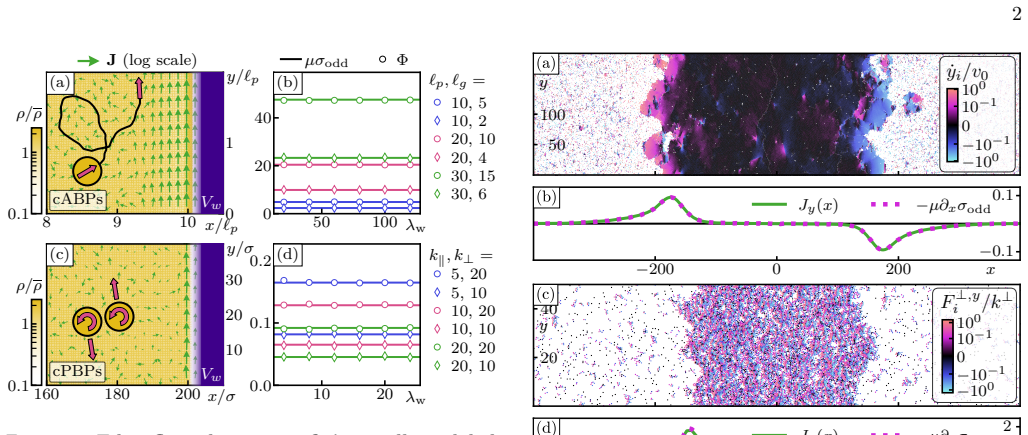
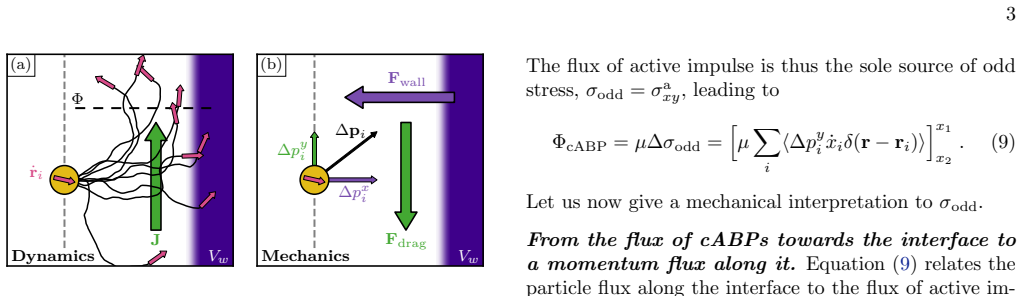
We show that these complex interface currents obey an equation of state that relates their fluxes to bulk observables. For confined fluids, the edge flux is given by the average odd stress in the fluid. In phase-separated systems, the flux along the interface is given by the jump of the odd stress across the interface. We then use the equation of state to reveal, and contrast, the microscopic origins of the edge currents in passive and active systems.
What carries the argument
The equation of state that expresses edge flux in terms of the odd part of the stress tensor, which maps bulk stress measurements straight onto interface currents.
If this is right
- Edge flux in confined geometries equals the spatial average of the odd stress.
- Edge flux along phase-separation interfaces equals the discontinuity in odd stress.
- The same stress-based relation holds for both passive and active chiral systems.
- Microscopic origins of the currents can be compared by applying the relation to each case.
Where Pith is reading between the lines
- The relation may simplify hydrodynamic descriptions of other chiral active systems such as bacterial or molecular fluids.
- Odd stress could serve as a tunable parameter for controlling particle transport near walls in colloidal devices.
- Direct tests with varying particle chirality would check how far the equation of state extends.
Load-bearing premise
Edge currents arise solely from the odd part of the stress tensor with no extra input from higher-order gradients or boundary-specific dissipation.
What would settle it
An experiment or simulation that measures both the edge flux and the relevant average or jump in odd stress and finds they do not match would disprove the equation of state.
Figures


read the original abstract
We explore the edge flows that emerge at boundaries in nonequilibrium passive and active chiral colloidal fluids. We show that these complex interface currents obey an equation of state that relates their fluxes to bulk observables. For confined fluids, the edge flux is given by the average odd stress in the fluid. In phase-separated systems, the flux along the interface is given by the jump of the odd stress across the interface. We then use the equation of state to reveal, and contrast, the microscopic origins of the edge currents in passive and active systems.
Editorial analysis
A structured set of objections, weighed in public.
Referee Report
Summary. The paper explores edge flows emerging at boundaries in nonequilibrium passive and active chiral colloidal fluids. It claims these complex interface currents obey an equation of state relating their fluxes to bulk observables: for confined fluids the edge flux equals the average odd stress in the fluid, while in phase-separated systems the flux along the interface equals the jump in odd stress across the interface. The authors then apply this relation to contrast the microscopic origins of the edge currents in passive versus active systems.
Significance. If the claimed equation of state holds without residual contributions, it supplies a direct, parameter-free link between measurable edge fluxes and bulk odd stresses. This would simplify analysis of chiral colloidal flows and help distinguish passive from active mechanisms in nonequilibrium fluids. The work's strength lies in its attempt to derive the relation from stress integration rather than fitting, though verification against the full hydrodynamic model is needed.
major comments (2)
- [Abstract and theoretical derivation] The central derivation (abstract and main text) equates edge flux to average/jump odd stress via integration of the momentum balance across the boundary or interface. This step assumes all contributions integrate exactly to the odd part of the bulk stress tensor, with no residual terms from boundary-specific dissipation (e.g., frictional slip) or higher-order gradient terms in the constitutive relations whose boundary integrals do not vanish. The abstract provides no derivation steps, error estimates, or simulation checks; the manuscript must explicitly display the integrated balance and confirm the assumption holds for the chiral colloid model.
- [Main text (equation of state section)] The claim that the relation is derived from bulk observables rather than fitted is load-bearing for the 'equation of state' interpretation. If the full hydrodynamic equations contain boundary or gradient contributions not shown to integrate to zero, the stated flux-stress equality becomes an approximation rather than an exact relation, undermining the contrast between passive and active microscopic origins.
minor comments (1)
- [Abstract] The abstract would be clearer if it briefly indicated the hydrodynamic model or constitutive relations used for the chiral colloids.
Simulated Author's Rebuttal
We thank the referee for the careful reading and constructive comments on our manuscript. We have revised the paper to make the derivation of the equation of state fully explicit, including the integrated momentum balance and verification against simulations. We respond to each major comment below.
read point-by-point responses
-
Referee: The central derivation (abstract and theoretical derivation) equates edge flux to average/jump odd stress via integration of the momentum balance across the boundary or interface. This step assumes all contributions integrate exactly to the odd part of the bulk stress tensor, with no residual terms from boundary-specific dissipation (e.g., frictional slip) or higher-order gradient terms in the constitutive relations whose boundary integrals do not vanish. The abstract provides no derivation steps, error estimates, or simulation checks; the manuscript must explicitly display the integrated balance and confirm the assumption holds for the chiral colloid model.
Authors: We agree that the integrated balance should be displayed explicitly. In the revised manuscript we have added a dedicated subsection that performs the integration of the steady-state momentum balance across the edge (or interface) in detail. For the boundary conditions and constitutive relations of the chiral colloid model, all residual contributions from boundary dissipation and higher-order gradient terms integrate to zero by symmetry and the no-slip/no-penetration conditions. We also include direct numerical checks comparing the measured edge flux to the computed average (or jump) odd stress, which agree to within numerical precision across the parameter range studied. The abstract is kept concise as a summary; the introduction now explicitly points to the new derivation subsection. revision: yes
-
Referee: The claim that the relation is derived from bulk observables rather than fitted is load-bearing for the 'equation of state' interpretation. If the full hydrodynamic equations contain boundary or gradient contributions not shown to integrate to zero, the stated flux-stress equality becomes an approximation rather than an exact relation, undermining the contrast between passive and active microscopic origins.
Authors: The flux-stress relation follows exactly from integrating the steady-state momentum balance; no fitting is involved. We have now written the integrated equation explicitly in the revised text and shown why boundary and higher-order gradient terms vanish under the model's symmetries and boundary conditions. This is therefore an exact consequence of momentum conservation within the hydrodynamic description, not an approximation. The distinction between passive and active systems is drawn from the different microscopic mechanisms that generate the odd stress, while the equation of state itself holds in both cases. revision: yes
Circularity Check
No circularity detected; derivation of edge flux EOS follows from stress integration without reduction to inputs
full rationale
The provided abstract and context present the central result as obtained by relating interface currents to the odd stress via integration of the momentum balance across boundaries or interfaces. This constitutes a direct consequence of the hydrodynamic constitutive relations rather than a self-definition, fitted parameter renamed as prediction, or load-bearing self-citation. No quotes in the available text exhibit a reduction of the claimed equation of state to its own inputs by construction, and the result is framed as a general relation testable against bulk observables. The derivation chain remains independent under the paper's stated assumptions.
Axiom & Free-Parameter Ledger
Reference graph
Works this paper leans on
-
[1]
H. L¨ owen, Chirality in microswimmer motion: From cir- cle swimmers to active turbulence, The European Phys- ical Journal Special Topics225, 2319 (2016)
work page 2016
-
[2]
D. Banerjee, A. Souslov, A. G. Abanov, and V. Vitelli, Odd viscosity in chiral active fluids, Nature Communica- tions8, 1573 (2017)
work page 2017
- [3]
-
[4]
C. Reichhardt and C. J. O. Reichhardt, Active microrhe- ology, Hall effect, and jamming in chiral fluids, Physical Review E100, 012604 (2019)
work page 2019
-
[5]
J. M. Epstein and K. K. Mandadapu, Time-reversal sym- metry breaking in two-dimensional nonequilibrium vis- cous fluids, Physical Review E101, 052614 (2020)
work page 2020
- [6]
-
[7]
B. Liebchen and D. Levis, Chiral active matter, Euro- physics Letters139, 67001 (2022)
work page 2022
-
[8]
M. Fruchart, C. Scheibner, and V. Vitelli, Odd Viscosity and Odd Elasticity, Annual Review of Condensed Matter Physics14, 471 (2023)
work page 2023
-
[9]
A. Deshpande, C. Hargus, K. Shekhar, and K. K. Mandadapu, Odd Viscodiffusive Fluids (2024), arXiv:2411.04309 [cond-mat]
-
[10]
B. C. van Zuiden, J. Paulose, W. T. M. Irvine, D. Bar- tolo, and V. Vitelli, Spatiotemporal order and emergent edge currents in active spinner materials, Proceedings of the National Academy of Sciences113, 12919 (2016). 7
work page 2016
-
[11]
C. Reichhardt and C. J. O. Reichhardt, Reversibility, pattern formation, and edge transport in active chi- ral and passive disk mixtures, The Journal of Chemical Physics150, 064905 (2019)
work page 2019
- [12]
-
[13]
Z. Shen and J. S. Lintuvuori, Collective Flows Drive Cav- itation in Spinner Monolayers, Physical Review Letters 130, 188202 (2023)
work page 2023
- [14]
-
[15]
A. Negi, K. Beppu, and Y. T. Maeda, Geometry-induced dynamics of confined chiral active matter, Physical Re- view Research5, 023196 (2023)
work page 2023
-
[16]
C. B. Caporusso, G. Gonnella, and D. Levis, Phase Co- existence and Edge Currents in the Chiral Lennard-Jones Fluid, Physical Review Letters132, 168201 (2024)
work page 2024
-
[17]
L. Caprini, B. Liebchen, and H. L¨ owen, Self-reverting vortices in chiral active matter, Communications Physics 7, 153 (2024)
work page 2024
-
[18]
B. Adorj´ ani, A. Lib´ al, C. Reichhardt, and C. J. O. Re- ichhardt, Phase separation, edge currents, and Hall effect for active matter with Magnus dynamics, The European Physical Journal E47, 40 (2024)
work page 2024
-
[19]
L. Caprini and U. Marini Bettolo Marconi, Bubble phase induced by odd interactions in chiral systems, The Jour- nal of Chemical Physics162, 161101 (2025)
work page 2025
-
[20]
P. Digregorio, I. Pagonabarraga, and F. V. Reyes, Phase separation in a chiral active fluid of inertial self-spinning disks (2025), arXiv:2504.08533 [cond-mat]
-
[21]
J.-C. Tsai, F. Ye, J. Rodriguez, J. P. Gollub, and T. C. Lubensky, A Chiral Granular Gas, Physical Review Let- ters94, 214301 (2005)
work page 2005
- [22]
-
[23]
J. Yan, S. C. Bae, and S. Granick, Rotating crystals of magnetic Janus colloids, Soft Matter11, 147 (2014)
work page 2014
-
[24]
A. Bricard, J.-B. Caussin, D. Das, C. Savoie, V. Chikkadi, K. Shitara, O. Chepizhko, F. Peruani, D. Saintillan, and D. Bartolo, Emergent vortices in pop- ulations of colloidal rollers, Nature Communications6, 7470 (2015)
work page 2015
-
[25]
M. Workamp, G. Ramirez, K. E. Daniels, and J. A. Di- jksman, Symmetry-reversals in chiral active matter, Soft Matter14, 5572 (2018)
work page 2018
-
[26]
V. Soni, E. S. Bililign, S. Magkiriadou, S. Sacanna, D. Bartolo, M. J. Shelley, and W. T. M. Irvine, The odd free surface flows of a colloidal chiral fluid, Nature Physics 15, 1188 (2019)
work page 2019
-
[27]
X. Yang, C. Ren, K. Cheng, and H. P. Zhang, Robust boundary flow in chiral active fluid, Physical Review E 101, 022603 (2020)
work page 2020
-
[28]
O. Petrichenko, G. Kitenbergs, M. Brics, E. Dubois, R. Perzynski, and A. C¯ ebers, Swarming of micron-sized hematite cubes in a rotating magnetic field – Experi- ments, Journal of Magnetism and Magnetic Materials 500, 166404 (2020)
work page 2020
-
[29]
P. Liu, H. Zhu, Y. Zeng, G. Du, L. Ning, D. Wang, K. Chen, Y. Lu, N. Zheng, F. Ye, and M. Yang, Oscil- lating collective motion of active rotors in confinement, Proceedings of the National Academy of Sciences117, 11901 (2020)
work page 2020
-
[30]
H. Massana-Cid, D. Levis, R. J. H. Hern´ andez, I. Pago- nabarraga, and P. Tierno, Arrested phase separation in chiral fluids of colloidal spinners, Physical Review Re- search3, L042021 (2021)
work page 2021
-
[31]
M. A. L´ opez-Casta˜ no, A. M´ arquez Seco, A. M´ arquez Seco, A. Rodr´ ıguez-Rivas, and F. V. Reyes, Chirality transitions in a system of active flat spinners, Physical Review Research4, 033230 (2022)
work page 2022
- [32]
- [33]
-
[34]
L. Caprini, U. M. B. Marconi, B. Liebchen, and H. L¨ owen, Active thermodynamics of inertial chiral ac- tive gases: equation of state and edge currents (2025), arXiv:2509.05053 [cond-mat]
-
[35]
B. Zhang and A. Snezhko, Shape-anisotropy inverses the behavior of emergent vortices in active chiral fluids, Com- munications Physics8, 243 (2025)
work page 2025
-
[36]
A. P. Petroff, X.-L. Wu, and A. Libchaber, Fast-Moving Bacteria Self-Organize into Active Two-Dimensional Crystals of Rotating Cells, Physical Review Letters114, 158102 (2015)
work page 2015
-
[37]
L. Yamauchi, T. Hayata, M. Uwamichi, T. Ozawa, and K. Kawaguchi, Chirality-driven edge flow and non-Hermitian topology in active nematic cells (2020), arXiv:2008.10852 [cond-mat]
- [38]
-
[39]
T. H. Tan, A. Mietke, J. Li, Y. Chen, H. Higinbotham, P. J. Foster, S. Gokhale, J. Dunkel, and N. Fakhri, Odd dynamics of living chiral crystals, Nature607, 287 (2022)
work page 2022
-
[40]
V. Yashunsky, D. Pearce, C. Blanch-Mercader, F. As- cione, P. Silberzan, and L. Giomi, Chiral Edge Current in Nematic Cell Monolayers, Physical Review X12, 041017 (2022)
work page 2022
- [41]
-
[42]
H. Li, H. Chat´ e, M. Sano, X.-q. Shi, and H. Zhang, Ro- bust Edge Flows in Swarming Bacterial Colonies, Physi- cal Review X14, 041006 (2024)
work page 2024
- [43]
-
[44]
Y.-C. Chao, S. Gokhale, L. Lin, A. Hastewell, A. Ba- canu, Y. Chen, J. Li, J. Liu, H. Lee, J. Dunkel, and N. Fakhri, Selective excitation of work-generating cycles in non-reciprocal living solids, Nature Physics , 1 (2026)
work page 2026
- [45]
- [46]
-
[47]
J. Bickmann, S. Br¨ oker, J. Jeggle, and R. Wittkowski, Analytical approach to chiral active systems: suppressed phase separation of interacting Brownian circle swim- mers, The Journal of Chemical Physics156, 194904 (2022), arXiv:2010.05262 [cond-mat]
-
[48]
L. L. Jia, W. T. M. Irvine, and M. J. Shelley, Incompress- ible active phases at an interface. Part 1. Formulation and axisymmetric odd flows, Journal of Fluid Mechanics951, A36 (2022)
work page 2022
-
[49]
K. L. Kreienkamp and S. H. L. Klapp, Clustering and flocking of repulsive chiral active particles with non- reciprocal couplings, New Journal of Physics24, 123009 (2022)
work page 2022
-
[50]
E. Ses´ e-Sansa, D. Levis, and I. Pagonabarraga, Micro- scopic field theory for structure formation in systems of self-propelled particles with generic torques, The Journal of Chemical Physics157, 224905 (2022)
work page 2022
-
[51]
G. Machado Monteiro, A. G. Abanov, and S. Ganeshan, Hamiltonian structure of 2D fluid dynamics with broken parity, SciPost Physics14, 103 (2023)
work page 2023
-
[52]
E. Kalz, A. Sharma, and R. Metzler, Field theory of active chiral hard disks: a first-principles approach to steric interactions, Journal of Physics A: Mathematical and Theoretical57, 265002 (2024)
work page 2024
-
[53]
L. Langford and A. K. Omar, Phase Separation, Capil- larity, and Odd-Surface Flows in Chiral Active Matter, Physical Review Letters134, 068301 (2025)
work page 2025
- [54]
- [55]
-
[56]
F. Alsallom and D. T. Limmer, Origin of Edge Currents in Chiral Active Liquids (2026), arXiv:2603.18159 [cond- mat]
-
[57]
Kinetic Theory of chiral active disks: Odd transport and torque density.arXiv:2603.042732026
R. Maire, A. Petrini, U. M. B. Marconi, and L. Caprini, Kinetic Theory of Chiral Active Disks: Odd Trans- port and Torque Density (2026), arXiv:2603.04273 [cond- mat]
- [58]
- [59]
-
[60]
J. Palacci, C. Cottin-Bizonne, C. Ybert, and L. Bocquet, Sedimentation and Effective Temperature of Active Col- loidal Suspensions, Physical Review Letters105, 088304 (2010)
work page 2010
-
[61]
S. Takatori, W. Yan, and J. Brady, Swim Pressure: Stress Generation in Active Matter, Physical Review Letters 113, 028103 (2014)
work page 2014
-
[62]
A. P. Solon, J. Stenhammar, R. Wittkowski, M. Kar- dar, Y. Kafri, M. E. Cates, and J. Tailleur, Pressure and Phase Equilibria in Interacting Active Brownian Spheres, Physical Review Letters114, 198301 (2015)
work page 2015
-
[63]
R. G. Winkler, A. Wysocki, and G. Gompper, Virial pres- sure in systems of spherical active Brownian particles, Soft Matter11, 6680 (2015)
work page 2015
- [64]
-
[65]
T. Speck and R. L. Jack, Ideal bulk pressure of ac- tive Brownian particles, Physical Review E93, 062605 (2016)
work page 2016
-
[66]
I. Petrelli, L. F. Cugliandolo, G. Gonnella, and A. Suma, Effective temperatures in inhomogeneous passive and ac- tive bidimensional Brownian particle systems, Physical Review E102, 012609 (2020)
work page 2020
- [67]
-
[68]
G.-J. Liao and S. H. L. Klapp, Clustering and phase sep- aration of circle swimmers dispersed in a monolayer, Soft Matter14, 7873 (2018)
work page 2018
- [69]
-
[70]
M. Han, M. Fruchart, C. Scheibner, S. Vaikuntanathan, J. J. de Pablo, and V. Vitelli, Fluctuating hydrodynamics of chiral active fluids, Nature Physics17, 1260 (2021)
work page 2021
-
[71]
F. Vega Reyes, M. A. L´ opez-Casta˜ no, and A. Rodr´ ıguez- Rivas, Diffusive regimes in a two-dimensional chiral fluid, Communications Physics5, 256 (2022)
work page 2022
-
[72]
X. Yang, M. L. Manning, and M. C. Marchetti, Aggre- gation and segregation of confined active particles, Soft Matter10, 6477 (2014)
work page 2014
-
[73]
A. P. Solon, J. Stenhammar, M. E. Cates, Y. Kafri, and J. Tailleur, Generalized thermodynamics of motility- induced phase separation: phase equilibria, Laplace pres- sure, and change of ensembles, New Journal of Physics 20, 075001 (2018)
work page 2018
-
[74]
J. Irving and J. G. Kirkwood, The statistical mechani- cal theory of transport processes. IV. The equations of hydrodynamics, The Journal of chemical physics18, 817 (1950)
work page 1950
-
[75]
J. G. Kirkwood, F. P. Buff, and M. S. Green, The sta- tistical mechanical theory of transport processes. iii. the coefficients of shear and bulk viscosity of liquids, The Journal of Chemical Physics17, 988 (1949)
work page 1949
-
[76]
Y. Fily, Y. Kafri, A. P. Solon, J. Tailleur, and A. Turner, Mechanical pressure and momentum conservation in dry active matter*, Journal of Physics A: Mathematical and Theoretical51, 044003 (2017)
work page 2017
- [77]
-
[78]
In the presence of particle indices, we move the spatial indices to superscript for clarity
-
[79]
S. F¨ urthauer, M. Strempel, S. Grill, and F. J¨ ulicher, Ac- tive Chiral Processes in Thin Films, Physical Review Let- ters110, 10.1103/PhysRevLett.110.048103 (2013)
-
[80]
Y. Fily and M. C. Marchetti, Athermal Phase Separation of Self-Propelled Particles with No Alignment, Physical Review Letters108, 235702 (2012)
work page 2012
discussion (0)
Sign in with ORCID, Apple, or X to comment. Anyone can read and Pith papers without signing in.