Vortex structures in electron-positron pair production by two-colored fields
Pith reviewed 2026-05-10 03:04 UTC · model grok-4.3
The pith
Tuning the time delay between two-color laser pulses nucleates quantized vortex lattices in the momentum distribution of electron-positron pairs created from vacuum.
A machine-rendered reading of the paper's core claim, the machinery that carries it, and where it could break.
Core claim
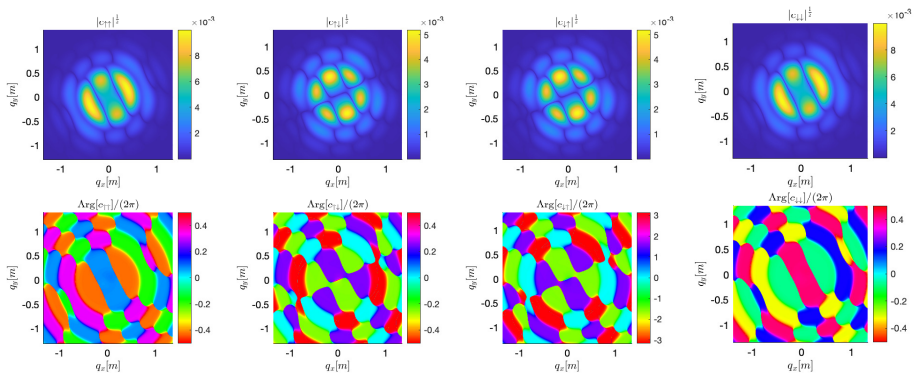
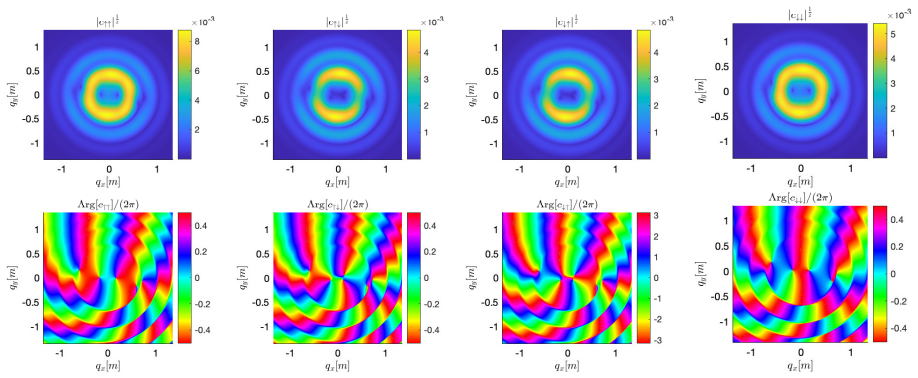
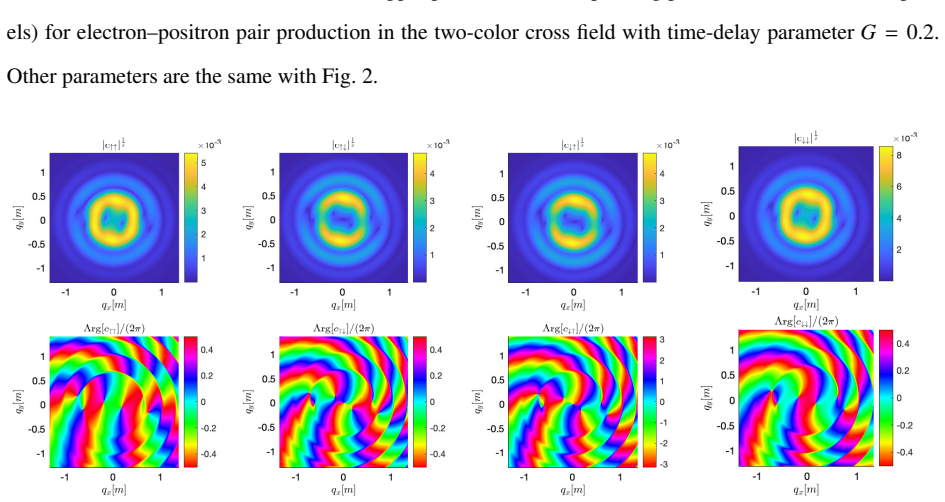
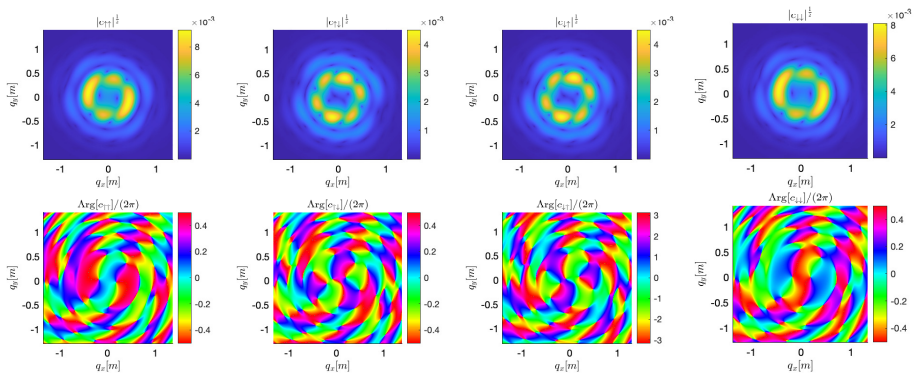
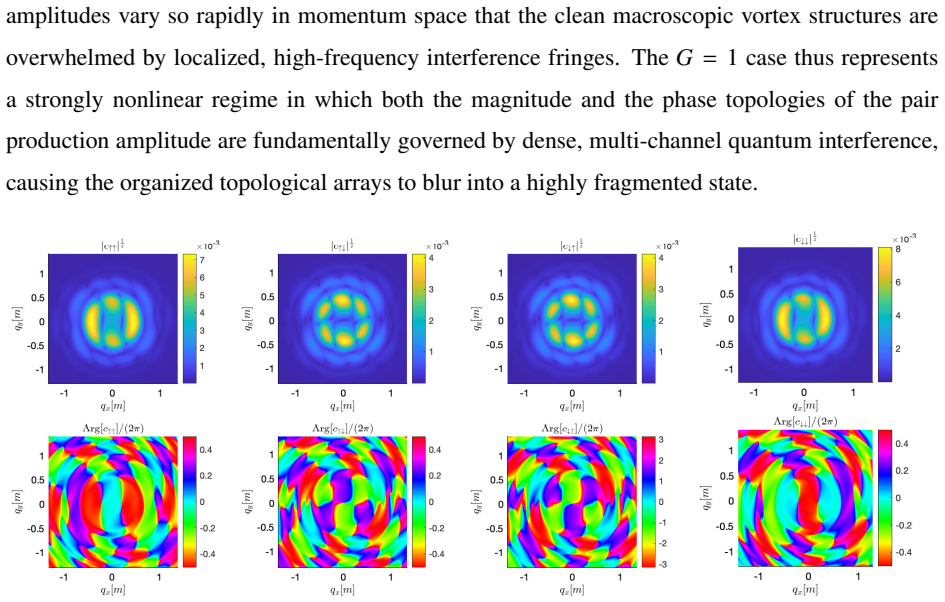
By treating the temporal delay G as a continuous tuning parameter, the momentum-space distribution of created pairs transitions from interference-dominated domains at zero delay to quantized vortex lattices at G equal to 0.5, arranged in a staggered manner. The morphology is dictated by spin-orbit selection rules arising from total angular momentum conservation, with parallel spins producing dipole-like connections and anti-parallel spins producing quadrupole structures. At large delays the overall coherence breaks down due to multi-channel effects while the nodal geometries tied to spin remain.
What carries the argument
The tunable temporal delay G between the two-color field components, which drives the transition from interference to vortex nucleation, combined with spin-orbit selection rules that link spin projection to required orbital angular momentum through conservation of total Jz.
If this is right
- Spin-resolved momentum maps directly encode the angular-momentum rules that govern vacuum pair creation.
- The staggered vortex arrangement supplies a topological diagnostic that distinguishes different spin channels.
- Macroscopic coherence in the lattices appears only at intermediate delays before multi-channel effects destroy it.
- The spin-dependent nodal geometries survive even after overall coherence is lost at large delays.
- These structures offer a route to read out the quantum dynamics of strong-field QED through momentum-space topology.
Where Pith is reading between the lines
- If the vortex lattices are confirmed, similar delay tuning could be applied to other strong-field processes such as muon-pair or pion-pair production to test whether quantized structures appear there as well.
- The fluid-dynamics analogy suggests that hydrodynamic or effective-field descriptions of pair production might capture the emergence of these lattices without full QED numerics.
- High-resolution momentum imaging in upcoming laser experiments could isolate the spin channels and thereby test the angular-momentum assignment directly.
- The persistence of nodal geometry at large delays implies that spin signatures remain usable even in fields with uncontrolled phase jitter or additional spectral components.
Load-bearing premise
The observed transition to quantized vortex lattices and the strict control by spin-orbit rules are not distorted by numerical discretization effects or additional unmodeled production channels.
What would settle it
Compute or measure the momentum distribution of pairs at G=0.5 for both spin configurations and check whether the amplitude nodes form discrete points with 2π phase winding and the predicted dipole versus quadrupole connectivity rather than unbroken interference fringes.
Figures
read the original abstract
We investigate the spin resolved vortex properties of electron positron pairs created from vacuum in time delayed, two color electromagnetic fields. By treating the temporal delay G as a continuous tuning parameter, we reveal a dynamic transition from interference-dominated domain patterns at G=0 to the nucleation of quantized vortex lattices at G=0.5. These topological structures exhibit a staggered arrangement analogous to von Karman vortex streets in fluid dynamics. We demonstrate that the momentum-space morphology is strictly governed by spin orbit selection rules, i.e., parallel spin configurations enforce a dipole-like connectivity, while anti-parallel configurations resolve into distinct quadrupole structures. This difference originates from the conservation of total angular momentum Jz, where the spin projection determines the required orbital angular momentum Lz of the created pairs. At large delays (G greater than 1), macroscopic vortex coherence dissolves into a chaotic phase landscope due to multi-channel interference, yet the spin-dependent nodal geometries remain robust. Our findings suggest that these topological signatures provide a high-fidelity diagnostic for the quantum dynamics of vacuum excitations in strong field QED.
Editorial analysis
A structured set of objections, weighed in public.
Referee Report
Summary. The manuscript investigates spin-resolved vortex structures in electron-positron pair production from vacuum using time-delayed two-color electromagnetic fields. Treating the temporal delay parameter G as a continuous variable, the authors report a transition from interference-dominated domain patterns at G=0 to the nucleation of quantized vortex lattices at G=0.5, arranged in a staggered pattern reminiscent of von Kármán vortex streets. The momentum-space morphology is claimed to be dictated by spin-orbit selection rules arising from conservation of total angular momentum Jz, with parallel and anti-parallel spin configurations leading to dipole-like and quadrupole structures, respectively. At larger delays (G > 1), the coherence dissolves into chaotic landscapes due to multi-channel interference, while spin-dependent nodal features persist.
Significance. If the numerical findings are robust, this work introduces a potentially useful topological diagnostic for strong-field QED vacuum excitations by linking vortex nucleation to a tunable delay parameter and angular-momentum selection rules. The continuous tuning of G and the reported analogy to fluid-dynamical vortex streets are novel elements. However, the overall significance hinges on confirming that the observed lattices are genuinely quantized and not induced by discretization or incomplete channel summation.
major comments (2)
- [Results (G=0.5 case)] The central claim of quantized vortex lattices at G=0.5 (abstract and results section) requires explicit demonstration that phase windings around amplitude zeros are integers. Finite momentum-grid resolution, interpolation, or filtering can produce spurious zeros and non-integer windings; the manuscript must report the winding-number computation method and convergence with respect to grid spacing.
- [Methods and Results] The assertion that multi-channel interference causes dissolution only for G>1 while the G=0.5 lattices remain clean (abstract) needs supporting convergence tests: the number of included photon channels must be varied and the stability of the vortex pattern at G=0.5 verified. Without these, the transition cannot be distinguished from an artifact of truncated summation.
minor comments (3)
- [Abstract] Abstract: 'landscope' is a typographical error and should read 'landscape'.
- [Abstract] The abstract provides no information on the underlying formalism (Dirac-equation solver, DHW transport equations, or otherwise) or on the precise definition of the two-color vector potential and the delay parameter G; these details are essential for reproducibility.
- [Figures] Figure captions and text should explicitly state the momentum-space resolution and any smoothing or interpolation applied when identifying vortices.
Simulated Author's Rebuttal
We thank the referee for the thorough review and valuable suggestions, which have strengthened the rigor of our analysis. We address each major comment below and have revised the manuscript to incorporate the requested demonstrations and tests.
read point-by-point responses
-
Referee: [Results (G=0.5 case)] The central claim of quantized vortex lattices at G=0.5 (abstract and results section) requires explicit demonstration that phase windings around amplitude zeros are integers. Finite momentum-grid resolution, interpolation, or filtering can produce spurious zeros and non-integer windings; the manuscript must report the winding-number computation method and convergence with respect to grid spacing.
Authors: We agree that explicit verification of integer windings is necessary to confirm the quantized nature of the lattices. In the revised manuscript, we have added a dedicated subsection in the Methods describing the winding-number calculation: we compute the phase winding via the discrete summation of the argument difference along closed rectangular contours centered on each amplitude zero, using the principal branch of the argument to avoid branch-cut artifacts. We further report convergence tests by successively halving the momentum-grid spacing (from the original 0.05 a.u. down to 0.0125 a.u.) and confirm that all identified zeros retain integer windings (within 0.01 numerical tolerance) while their locations stabilize to within one grid cell. These results are now presented in a new supplementary figure and referenced in the main text. revision: yes
-
Referee: [Methods and Results] The assertion that multi-channel interference causes dissolution only for G>1 while the G=0.5 lattices remain clean (abstract) needs supporting convergence tests: the number of included photon channels must be varied and the stability of the vortex pattern at G=0.5 verified. Without these, the transition cannot be distinguished from an artifact of truncated summation.
Authors: We acknowledge that channel truncation could in principle affect the observed transition. The revised manuscript now includes explicit convergence tests in a new Results subsection: we recompute the momentum distributions at G=0.5 and G=1.5 while increasing the number of retained photon channels from the baseline set (up to |n|≤4) to |n|≤8. At G=0.5 the staggered vortex lattice remains topologically unchanged, with the same integer windings and staggered arrangement preserved; only minor amplitude adjustments occur. At G>1 the dissolution into chaotic nodal patterns persists and becomes even more pronounced with additional channels, reinforcing the multi-channel interference interpretation. These tests are documented with comparative plots. revision: yes
Circularity Check
No significant circularity in numerical investigation of vortex structures
full rationale
The paper's central claims arise from numerical simulations of electron-positron pair production in time-delayed two-color fields, with G treated as a continuous parameter to observe pattern transitions. The spin-orbit selection rules and Jz conservation explanations follow directly from standard QED angular momentum conservation applied to the computed momentum-space amplitudes; they are not fitted to or defined by the numerical outputs. No self-definitional loops, fitted inputs renamed as predictions, load-bearing self-citations, or ansatzes smuggled via prior work appear. The derivation chain is self-contained, relying on direct computation and fundamental conservation laws rather than reducing to its own inputs.
Axiom & Free-Parameter Ledger
free parameters (1)
- temporal delay G
axioms (2)
- standard math Conservation of total angular momentum Jz
- domain assumption Spin-orbit selection rules govern momentum-space morphology
invented entities (1)
-
quantized vortex lattices
no independent evidence
Reference graph
Works this paper leans on
-
[1]
cos(ω1t)ex +E y exp(−(t−T d)2/2τ2
-
[2]
The polarization vectorse x ande y align with thex−andy−directions, as shown in the Fig
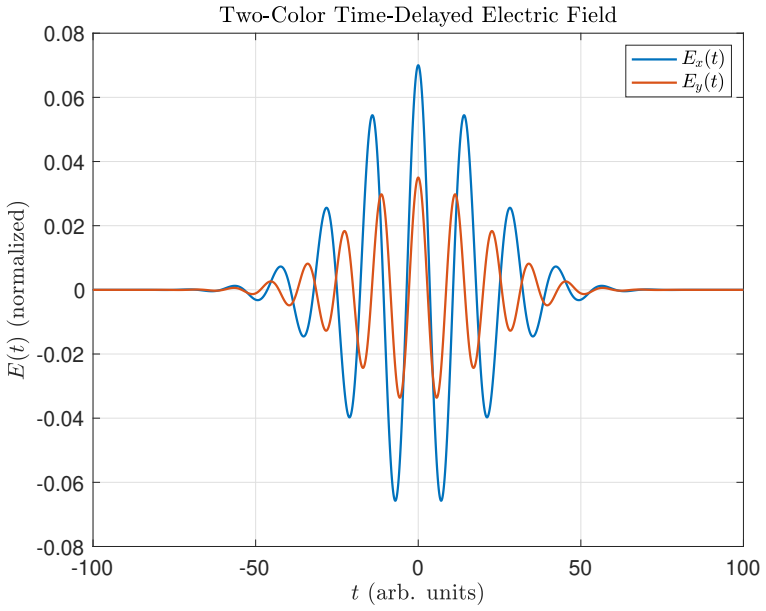
cos(ω2(t−T d))ey,(13) whereE x =0.07E cr,E y =0.035E cr gives the external field amplitude in units of the critical field Ecr =m 2/e≈1.3×10 16V/cm, we set the fields frequencies asω 1 =0.44c 2, ω2 =0.55c 2 and τ1 =τ 2 =20,T d =G(τ 1 +τ 2),pulse durations expressed in number of field cyclesN 1 =ω 1τ1 ≈ 9,N 2 =ω 2τ2 =11. The polarization vectorse x ande y a...
-
[3]
F. Sauter, Uber das Verhalten eines Elektrons im homogenen elektrischen Feld nach der relativistis- chen Theorie Diracs, Z. Phys.69, 742 (1931)
work page 1931
-
[4]
W. Heisenberg and H. Euler, Folgerungen aus der Diracschen Theorie des Positrons, Z. Phys.98, 714 (1936)
work page 1936
-
[5]
J. S. Schwinger, On gauge invariance and vacuum polarization, Phys. Rev.82, 664 (1951). 13
work page 1951
-
[6]
I. Bialynicki-Birula, P. Gornicki and J. Rafelski, Phase-space structure of the Dirac vacuum, Phys. Rev. D44, 1825 (1991)
work page 1991
-
[7]
E. S. Fradkin, D. M. Gitman and S. M. Shvartsman, Quantum Electrodynamics with Unstable Vacuum (Springer Verlag, Berlin, 1991)
work page 1991
-
[8]
A. Di Piazza, C. M ¨uller, K. Z. Hatsagortsyan and C. H. Keitel, Extremely high-intensity laser interac- tions with fundamental quantum systems, Rev. Mod. Phys.84, 1177 (2012)
work page 2012
-
[9]
B. S. Xie, Z. L. Li and S. Tang, Electron-positron pair production in ultrastrong laser fields, Matter Radiat. Extremes2, 225 (2017)
work page 2017
-
[10]
L.-N. Hu, O. Amat, L. Wang, and B.-S. Xie, Momentum spirals in multiphoton pair production revis- ited, Phys. Rev. D107, 116010 (2023)
work page 2023
-
[11]
L. N. Hu, H. H. Fan, O. Amat, S. Tang and B. S. Xie, Spin effect induced momentum spiral and asymmetry degree in pair production, Phys. Rev. D110, 056013 (2024)
work page 2024
-
[12]
I. A. Aleksandrov, and A. Kudlis, Pair production in rotating electric fields via quantum kinetic equa- tions: Resolving helicity states, Phys. Rev. D110, L011901 (2024)
work page 2024
-
[13]
O. Amat, H. H. Fan, S. Tang, Y . F. Huang and B. S. Xie, Spin resolved momentum spectra for vacuum pair production via a generalized two level model, Phys. Rev. D111, 056020 (2025)
work page 2025
-
[14]
H. Gies and G. Torgrimsson, Spin effects in Schwinger pair production, Phys. Rev. D94, 065012 (2016)
work page 2016
-
[15]
A. Otto, D. Seipt, D. Blaschke, B. K ¨ampfer, and S. A. Smolyansky, Momentum spectra of Schwinger pair production in rotating electric fields, Phys. Rev. D91, 105018 (2015)
work page 2015
-
[16]
Z. Y . Chen, O. Amat, J. h. Bai and M. A. Bake, Spin effect in vacuum pair production under two-color rotating electric fields, Phys. Rev. D111, 116005 (2025)
work page 2025
-
[17]
C. Kohlf ¨urst, H. Gies, R. Alkofer, and G. V . Dunne, Momentum signatures for Schwinger pair pro- duction in short laser pulses, Phys. Rev. D88, 045028 (2013)
work page 2013
-
[18]
Kohlf ¨urst, Spin states in multiphoton pair production for circularly polarized light, Phys
C. Kohlf ¨urst, Spin states in multiphoton pair production for circularly polarized light, Phys. Rev. D 99, 096017 (2019); Effect of time-dependent inhomogeneous magnetic fields on the particle momen- tum spectrum in electron-positron pair production, Phys. Rev. D101, 096003 (2020)
work page 2019
-
[19]
Y . Li, Y . Dai and Y . Shi, Pairwise mode entanglement in Schwinger production of particle-antiparticle pairs in an electric field, Phys. Rev. D95, 036006 (2017); Y . Li, Q. Mao and Y . Shi, Schwinger effect of a relativistic boson entangled with a qubit, Phys. Rev. A99, 032340 (2019). 14
work page 2017
-
[20]
H. H. Fan, C. W. Zhang, S. Tang and B. S. Xie, V ortex state properties in multiphoton scalar pair production, Phys. Rev. D111, 076017 (2025)
work page 2025
-
[21]
Z. L. Li, Y . J. Li and B. S. Xie, Momentum vortices on pairs production by two counter-rotating fields, Phys. Rev. D96, 076010 (2017); Z. L. Li, B. S. Xie and Y . J. Li, V ortices in multiphoton pair production by two-color rotating laser fields, J. Phys. B52, 025601 (2018)
work page 2017
-
[22]
P. A. M. Dirac, Quantised singularities in the electromagnetic field Proc. R. Soc. A133, 60 (1931)
work page 1931
-
[23]
M. V . Berry, Quantal phase factors accompanying adiabatic changes, Proc. R. Soc. A392, 45 (1984)
work page 1984
-
[24]
I. Bialynicki-Birula and Z. Bialynicka-Birula, Relativistic electron wave packets carrying angular mo- mentum, Phys. Rev. Lett.118, 114801 (2017)
work page 2017
-
[25]
I. Bialynicki-Birula, M. Cieplak and J. Kami ´nski, Theory of Quanta (Oxford University Press, New York, 1992)
work page 1992
- [26]
- [27]
-
[28]
I. P. Ivanov, Promises and challenges of high-energy vortex states collisions, Prog. Part. Nucl. Phys. 127, 103987 (2022)
work page 2022
-
[29]
D. A. Smirnova, F. Nori, and K.Y . Bliokh, Water-Wave V ortices and Skyrmions, Phys. Rev. Lett.132, 054003 (2025)
work page 2025
-
[30]
J. M. Ngoko Djiokap, S. X. Hu, L. B. Madsen, N. L. Manakov, A. V . Meremianin and An- thony F. Starace, Electron V ortices in Photoionization by Circularly Polarized Attosecond Pulses, Phys. Rev. Lett.115, 113004 (2015)
work page 2015
-
[31]
Hebenstreit, V ortex formation and dynamics in two-dimensional driven-dissipative condensates, Phys
F. Hebenstreit, V ortex formation and dynamics in two-dimensional driven-dissipative condensates, Phys. Rev. A94, 063617 (2016)
work page 2016
- [32]
-
[33]
L. Geng, F. Cajiao V´elez, J. Z. Kami´nski, Liang-You Peng and Katarzyna Krajewska, V ortex structures in photodetachment by few-cycle circularly polarized pulses, Phys. Rev. A102, 043117 (2020)
work page 2020
-
[34]
M. M. Majczak, F. Cajiao V ´elez, J. Z. Kami´nski and K. Krajewska, Carrier-envelope-phase and helic- ity control of electron vortices and spirals in photodetachment, Opt. Express30, 43330 (2022). 15
work page 2022
-
[35]
A. P. Sukhorukov and V . V . Yangirova, Spatio-temporal vortices: properties, generation and recording, Proc. SPIE5949, 594906 (2005)
work page 2005
-
[36]
K. Y . Bliokh, Orbital angular momentum of optical, acoustic, and quantum-mechanical spatiotemporal vortex pulses, Phys. Rev. A107, L031501 (2023)
work page 2023
- [37]
-
[38]
S. W. Hancock, S. Zahedpour, A. Goffin, and H. M. Milchberg, Free-space propagation of spatiotem- poral optical vortices, Optica6, 1547 (2019)
work page 2019
- [39]
-
[40]
F. Cajiao V ´elez, Lei Geng, J. Z. Kami ´nski, Liang-You Peng and K. Krajewska, V ortex streets and honeycomb structures in photodetachment driven by linearly polarized few-cycle laser pulses, Phys. Rev. A102, 043102 (2020)
work page 2020
-
[41]
A. Bechler, F. Cajiao V ´elez, K. Krajewska and J. Z. Kami ´nski, V ortex structures and momentum sharing in dynamic Sauter-Schwinger process, Acta Phys. Polon. A143, S18 (2023)
work page 2023
-
[42]
M. M. Majczak, K. Krajewska, J. Z. Kami ´nski and A. Bechler, Scattering matrix approach to dynami- cal Sauter-Schwinger process: Spin- and helicity-resolved momentum distributions, Phys. Rev. D110, 116025 (2024)
work page 2024
-
[43]
K. Y . Bliokh, Elastic Spin and Orbital Angular Momenta, Phys. Rev. Lett.129, 204303 (2022)
work page 2022
-
[44]
K. Y . Bliokh, M. R. Dennis and F. Nori, Relativistic electron vortex beams: angular momentum and spin-orbit interaction, Phys. Rev. Lett.107, 174802 (2011)
work page 2011
-
[45]
D. J. Acheson,Elementary Fluid Dynamics(Oxford University Press, Oxford, 1990)
work page 1990
-
[46]
M. He, Y . Li, Y . Zhou, M. Li, P. Lan, and P. Lu, ”Direct visualization of excitation and ionization dynamics in a Lissajous field,” Phys. Rev. Lett.124, 163203 (2020). 16
work page 2020
discussion (0)
Sign in with ORCID, Apple, or X to comment. Anyone can read and Pith papers without signing in.