Recognition: unknown
ClawCoin: An Agentic AI-Native Cryptocurrency for Decentralized Agent Economies
Pith reviewed 2026-05-10 01:44 UTC · model grok-4.3
The pith
A compute-cost-indexed cryptocurrency lets AI agents quote and settle workflows in units matching their actual token burn.
A machine-rendered reading of the paper's core claim, the machinery that carries it, and where it could break.
Core claim
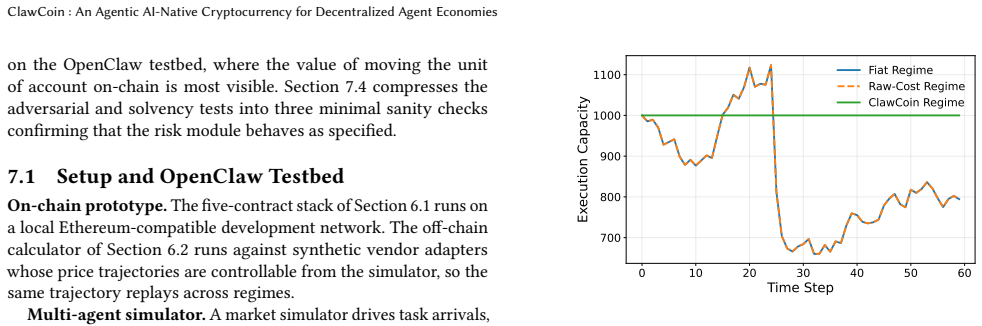
ClawCoin is a tokenized, compute-cost-indexed unit of account and settlement asset built from four layers: a robust basket index over standardized prices, an oracle that publishes signed fresh attestations, a NAV-based mint/redeem vault with coverage thresholds and rate limits, and an on-chain settlement layer for multi-hop delegations. Implemented on an Ethereum-compatible L2 and tested in a multi-agent simulator plus the OpenClaw testbed, it stabilizes execution capacity under cost shocks, reduces cross-agent quote dispersion, eliminates partial settlements, and sustains cooperative market dynamics that fiat-denominated baselines cannot.
What carries the argument
The basket index and oracle that produce signed attestations of compute costs, which agents treat as binding for quoting, escrowing, and settling tasks in a unit aligned with the inference capacity they actually burn.
If this is right
- Agents gain the ability to escrow and settle entire workflows without leaving partial or unmatched payments.
- Cross-agent quoting becomes more consistent because all parties reference the same cost-indexed unit rather than fluctuating fiat amounts.
- Market cooperation persists even when compute prices change abruptly, unlike in fiat systems that lose stability.
- Multi-hop delegations and procurement tasks can be executed with capacity that directly matches the resources agents consume.
Where Pith is reading between the lines
- The same indexing approach could be applied to other scarce resources agents use, such as data access or bandwidth, to create similar stable units.
- Widespread use might push API providers to publish more standardized cost data to feed the basket index.
- Real-world deployment on live agent platforms would allow direct measurement of whether quote dispersion and settlement failures decline compared with current rails.
Load-bearing premise
The basket index and oracle can produce timely, manipulation-resistant attestations of real compute costs that agents will treat as binding for quoting and settlement.
What would settle it
Run the multi-agent simulator with sudden compute price spikes and check whether execution capacity stays stable and quote dispersion stays low, as claimed, or reverts to the instability seen in fiat baselines.
Figures


read the original abstract
Autonomous AI agents live or die by the API tokens they consume: without paid inference capacity they cannot reason, act, or delegate. Compute-token cost has become the binding resource of the emerging agent economy, yet it is non-transferable: it is account-bound, vendor-specific, and absent from on-chain ledgers. Existing payment rails such as x402 move fiat-backed value between agents, but they do not represent the quantity agents actually burn. As a result, agents can transport purchasing power but cannot quote, escrow, or settle workflows in a unit aligned with compute cost. We present ClawCoin, a tokenized, compute-cost-indexed unit of account and settlement asset for decentralized agent economies. ClawCoin combines four layers: a robust basket index over standardized prices; an oracle publishing signed fresh attestations; a NAV-based mint/redeem vault with coverage thresholds and rate limits; and an on-chain settlement layer for multi-hop delegations. We implement a prototype on an Ethereum-compatible L2 and evaluate it using a multi-agent simulator and the OpenClaw testbed. Across single-agent, multi-agent, workflow, and procurement experiments, ClawCoin stabilizes execution capacity under cost shocks, reduces cross-agent quote dispersion, eliminates partial settlements, and sustains cooperative market dynamics that fiat-denominated baselines cannot. These results suggest that compute-indexed units of account can improve decentralized agent coordination.
Editorial analysis
A structured set of objections, weighed in public.
Referee Report
Summary. The paper proposes ClawCoin, a compute-cost-indexed cryptocurrency for AI agents consisting of a basket index over standardized prices, an oracle for signed attestations, a NAV-based mint/redeem vault with coverage thresholds and rate limits, and an on-chain settlement layer. Implemented on an Ethereum L2, it is evaluated in a multi-agent simulator and OpenClaw testbed across single-agent, multi-agent, workflow, and procurement scenarios, claiming that it stabilizes execution capacity under cost shocks, reduces cross-agent quote dispersion, eliminates partial settlements, and sustains cooperative dynamics superior to fiat-denominated baselines.
Significance. If the stabilization and coordination claims hold under rigorous testing, the work could provide a practical unit of account aligned with agents' actual resource consumption, addressing a gap in current payment rails like x402. The prototype architecture and simulator experiments offer a concrete starting point for agent-native economic primitives, though the absence of detailed methodology weakens immediate impact.
major comments (3)
- [Evaluation] Evaluation section: The abstract and experimental claims report positive outcomes (stabilization under cost shocks, reduced quote dispersion, no partial settlements) but provide no error bars, no description of how fiat baselines were constructed or parameterized, no raw data or simulator code, and no analysis of oracle failure modes or index construction details. This is load-bearing for the central claim that ClawCoin outperforms baselines.
- [Design] Design and Oracle sections: The headline results require agents to treat basket-index oracle outputs as timely and binding for quoting and settlement, yet the simulator evaluates only nominal operation with no modeling of oracle attacks, delayed attestations, basket-provider collusion, or adversarial deviation. Without such tests, the advantages over fiat baselines cannot be substantiated.
- [Simulator and Metrics] Metrics and Simulator description: The cost-shock and quote-dispersion metrics appear defined using the same coverage thresholds and rate-limit parameters that tune the vault, creating potential circularity that undermines the cross-experiment claims of improved cooperation and stability.
minor comments (2)
- [Abstract] The abstract would benefit from a brief sentence on the number of runs, agent counts, and shock magnitudes used in the experiments.
- [Vault Design] Notation for the NAV-based vault and coverage thresholds should be introduced with explicit equations or pseudocode for reproducibility.
Simulated Author's Rebuttal
We thank the referee for the constructive and detailed feedback. We address each major comment below with clarifications and commitments to revisions that strengthen the manuscript without overstating our current results.
read point-by-point responses
-
Referee: [Evaluation] Evaluation section: The abstract and experimental claims report positive outcomes (stabilization under cost shocks, reduced quote dispersion, no partial settlements) but provide no error bars, no description of how fiat baselines were constructed or parameterized, no raw data or simulator code, and no analysis of oracle failure modes or index construction details. This is load-bearing for the central claim that ClawCoin outperforms baselines.
Authors: We agree that additional rigor is needed in the evaluation. The revised manuscript will include error bars computed across multiple simulator runs for all key metrics. We will expand the experimental setup to fully describe the construction and parameterization of the fiat baselines, including how they were matched to compute-cost equivalents. Simulator code and anonymized raw data will be released publicly upon acceptance. We will also add a new subsection discussing oracle failure modes as a limitation and provide complete details on basket index construction, including price standardization and weighting, in the appendix. These revisions directly support the central claims. revision: yes
-
Referee: [Design] Design and Oracle sections: The headline results require agents to treat basket-index oracle outputs as timely and binding for quoting and settlement, yet the simulator evaluates only nominal operation with no modeling of oracle attacks, delayed attestations, basket-provider collusion, or adversarial deviation. Without such tests, the advantages over fiat baselines cannot be substantiated.
Authors: The current simulator is intentionally scoped to nominal operation to isolate and demonstrate the coordination benefits of compute-indexed settlement under cost shocks. We agree that adversarial robustness is important and will add a dedicated discussion in the Design and Oracle sections outlining risks such as delayed attestations, collusion, and attacks, along with the rationale for deferring full adversarial modeling to future work. This addition provides necessary context and prevents over-substantiation of the nominal results while preserving the paper's focus. revision: partial
-
Referee: [Simulator and Metrics] Metrics and Simulator description: The cost-shock and quote-dispersion metrics appear defined using the same coverage thresholds and rate-limit parameters that tune the vault, creating potential circularity that undermines the cross-experiment claims of improved cooperation and stability.
Authors: We clarify that no circularity exists: coverage thresholds and rate limits are tunable vault parameters that control mint/redeem behavior, whereas the cost-shock and quote-dispersion metrics are independent outcome measures based on agent execution success rates and quote variance across runs. To eliminate any ambiguity, we will revise the Metrics and Simulator description to explicitly separate these elements, providing standalone mathematical definitions for the metrics and showing how they are computed from simulation logs independent of the specific parameter values. revision: partial
Circularity Check
No mathematical derivations or self-referential predictions present
full rationale
The manuscript describes a four-layer system architecture (basket index, oracle, NAV vault, on-chain settlement) and reports qualitative outcomes from an unreported multi-agent simulator and OpenClaw testbed. No equations, parameter-fitting procedures, uniqueness theorems, or ansatzes appear in the text. Experimental claims (stabilization under cost shocks, reduced quote dispersion, elimination of partial settlements) are presented as direct results of running the prototype rather than as quantities derived from or fitted to the same inputs by construction. Because the derivation chain is empty, none of the enumerated circularity patterns can be instantiated with a quote and reduction; the work is self-contained as a system proposal plus nominal simulation.
Axiom & Free-Parameter Ledger
free parameters (1)
- coverage thresholds and rate limits
axioms (1)
- domain assumption A standardized basket of compute prices exists and can be attested by an oracle without significant lag or manipulation.
invented entities (1)
-
ClawCoin token
no independent evidence
Reference graph
Works this paper leans on
-
[1]
2025.Agent2Agent (A2A) Protocol Specification
A2A Project. 2025.Agent2Agent (A2A) Protocol Specification. https://a2aproject. github.io/A2A/latest/specification
2025
-
[2]
2026.Agentic Coin: A Peer-to-Peer Electronic Cash System for Autonomous Agents
Agentic Coin Project. 2026.Agentic Coin: A Peer-to-Peer Electronic Cash System for Autonomous Agents. White paper. https://agentic-coin.org/
2026
-
[3]
2020.Akash Network: A Decentralized Open Source Cloud
Greg Osuri and Adam Bozanich. 2020.Akash Network: A Decentralized Open Source Cloud. White paper, Akash Network. https://akash.network/whitepaper
2020
-
[4]
2022.Explained: The Beanstalk Hack (April 2022)
Halborn. 2022.Explained: The Beanstalk Hack (April 2022). https://www.halborn. com/blog/post/explained-the-beanstalk-hack-april-2022
2022
- [5]
-
[6]
2024.BlackRock Launches Its First Tokenized Fund, BUIDL, on the Ethereum Network
BlackRock. 2024.BlackRock Launches Its First Tokenized Fund, BUIDL, on the Ethereum Network. Press release, March 20, 2024. https://www.businesswire.com/ news/home/20240320771318/en/
-
[7]
2021.Chainlink 2.0: Next Steps in the Evolution of Decentralized Oracle Networks
Lorenz Breidenbach, Christian Cachin, Benedict Chan, Alex Coventry, Steve Ellis, Ari Juels, Farinaz Koushanfar, Andrew Miller, Brendan Magauran, Daniel Moroz, Sergey Nazarov, Alexandru Topliceanu, Florian Tramèr, and Fan Zhang. 2021.Chainlink 2.0: Next Steps in the Evolution of Decentralized Oracle Networks. White paper. https://research.chain.link/whitep...
2021
-
[8]
2020.bZx Hack II Full Disclosure (With Detailed Profit Analy- sis)
PeckShield. 2020.bZx Hack II Full Disclosure (With Detailed Profit Analy- sis). https://peckshield.medium.com/bzx-hack-ii-full-disclosure-with-detailed- profit-analysis-8126eecc1360
2020
-
[9]
Giulio Caldarelli. 2020. Understanding the Blockchain Oracle Problem: A Call for Action.Information11, 11 (2020), 509. https://doi.org/10.3390/info11110509
-
[10]
Christian Catalini, Alonso de Gortari, and Nihar Shah. 2022. Some Simple Eco- nomics of Stablecoins.Annual Review of Financial Economics14 (2022), 117 to
2022
-
[11]
https://doi.org/10.1146/annurev-financial-111621-101151
-
[12]
Ryan Clements. 2021. Built to Fail: The Inherent Fragility of Algo- rithmic Stablecoins.Wake Forest Law Review Online11 (2021), 131 to
2021
-
[13]
http://www.wakeforestlawreview.com/2021/10/built-to-fail-the-inherent- fragility-of-algorithmic-stablecoins/
2021
-
[14]
2026.Coyns Launches First Virtual Currency Built Exclusively for AI Agent- to-Agent Transactions
Coyns. 2026.Coyns Launches First Virtual Currency Built Exclusively for AI Agent- to-Agent Transactions. Press release, April 2026
2026
-
[15]
C.R.E.A.M. Finance. 2021.C.R.E.A.M. Finance Post Mortem: Flash Loan Exploit Oct
2021
-
[16]
https://medium.com/cream-finance/c-r-e-a-m-finance-post-mortem-flash- loan-exploit-oct-27-507b12bb6f8e
-
[17]
Philip Daian, Steven Goldfeder, Tyler Kell, Yunqi Li, Xueyuan Zhao, Iddo Bentov, Lorenz Breidenbach, and Ari Juels. 2020. Flash Boys 2.0: Frontrunning in Decen- tralized Exchanges, Miner Extractable Value, and Consensus Instability. In2020 IEEE Symposium on Security and Privacy (S&P). IEEE, 910 to 927. arXiv:1904.05234
work page Pith review arXiv 2020
-
[18]
Shayan Eskandari, Mehdi Salehi, Wanyun Catherine Gu, and Jeremy Clark
-
[19]
InProceed- ings of the 3rd ACM Conference on Advances in Financial Technologies (AFT ’21)
SoK: Oracles from the Ground Truth to Market Manipulation. InProceed- ings of the 3rd ACM Conference on Advances in Financial Technologies (AFT ’21). arXiv:2106.00667
- [20]
-
[21]
2017.Filecoin: A Decentralized Storage Network
Protocol Labs. 2017.Filecoin: A Decentralized Storage Network. White paper. https://filecoin.io/filecoin.pdf
2017
-
[22]
José M. Garrido. 2023.Digital Tokens: A Legal Perspective. IMF Working Paper No. WP/23/151. https://www.imf.org/en/Publications/WP/Issues/2023/07/28/Digital- Tokens-A-Legal-Perspective-537041
2023
-
[23]
Gary Gorton and George Pennacchi. 1993. Security Baskets and Index-Linked Securities.Journal of Business66, 1 (1993), 1 to 27
1993
-
[24]
Gorton and Jeffery Y
Gary B. Gorton and Jeffery Y. Zhang. 2023. Taming Wildcat Stablecoins.Univer- sity of Chicago Law Review90, 3 (2023), 909 to 972
2023
-
[25]
2020.Harvest Flashloan Economic Attack Post-Mortem
Harvest Finance. 2020.Harvest Flashloan Economic Attack Post-Mortem. https://medium.com/harvest-finance/harvest-flashloan-economic-attack-post- mortem-3cf900d65217
2020
-
[26]
2021.Iron Finance Post-Mortem: 17 June 2021
Iron Finance. 2021.Iron Finance Post-Mortem: 17 June 2021. https://ironfinance. medium.com/iron-finance-post-mortem-17-june-2021-6a4e9ccf23f5
2021
-
[27]
2024.LangGraph Overview
LangChain. 2024.LangGraph Overview. Documentation. https://docs.langchain. com/langgraph
2024
-
[28]
2021.Liquity Releases Updated Whitepaper
Liquity. 2021.Liquity Releases Updated Whitepaper. Blog post, February 10, 2021. https://www.liquity.org/blog/liquity-releases-updated-whitepaper
2021
-
[29]
Jiageng Liu, Igor Makarov, and Antoinette Schoar. 2023. Anatomy of a Run: The Terra Luna Crash. NBER Working Paper No. 31160. https://www.nber.org/ papers/w31160
2023
-
[30]
Lyons and Ganesh Viswanath-Natraj
Richard K. Lyons and Ganesh Viswanath-Natraj. 2023. What Keeps Stablecoins Stable?Journal of International Money and Finance131 (2023), 102777
2023
-
[31]
2020.The Maker Protocol: MakerDAO’s Multi-Collateral Dai (MCD) System
MakerDAO. 2020.The Maker Protocol: MakerDAO’s Multi-Collateral Dai (MCD) System. White paper. https://makerdao.com/whitepaper/
2020
-
[32]
Commodity Futures Trading Commission
U.S. Commodity Futures Trading Commission. 2023.CFTC Charges A vraham Eisenberg with Manipulative and Deceptive Scheme to Misappropriate Over $110 Million from Mango Markets, a Digital Asset Exchange. Press Release No. 8647-23. https://www.cftc.gov/PressRoom/PressReleases/8647-23
2023
-
[33]
2026.Jensen Huang at GTC 2026: Tokens, Token Factories, and the AI Industrial Revolution
NVIDIA. 2026.Jensen Huang at GTC 2026: Tokens, Token Factories, and the AI Industrial Revolution. Keynote, NVIDIA GTC, March 2026
2026
-
[34]
2026.NVIDIA’s Jensen Huang on Compute as a New Economic Engine
Morgan Stanley. 2026.NVIDIA’s Jensen Huang on Compute as a New Economic Engine. Morgan Stanley Technology, Media & Telecom Conference, March
2026
-
[35]
https://www.morganstanley.com/insights/articles/nvidia-jensen-huang- compute-new-economic-engine-tmt-2026
2026
-
[36]
Joon Sung Park, Joseph C. O’Brien, Carrie J. Cai, Meredith Ringel Morris, Percy Liang, and Michael S. Bernstein. 2023. Generative Agents: Interactive Simulacra of Human Behavior. InProceedings of the 36th Annual ACM Symposium on User Interface Software and Technology (UIST ’23). ACM, Article 2, 22 pages. https://doi.org/10.1145/3586183.3606763
-
[37]
Antti Petajisto. 2017. Inefficiencies in the Pricing of Exchange-Traded Funds. Financial Analysts Journal73, 1 (2017), 24 to 54
2017
-
[38]
2023.Pyth Network: A First-Party Financial Oracle (Whitepaper v2.0)
Pyth Network. 2023.Pyth Network: A First-Party Financial Oracle (Whitepaper v2.0). https://www.pyth.network/blog/7-pyth-network-a-first-party-financial- oracle
2023
- [39]
-
[40]
The agentic economy.arXiv preprint arXiv:2505.15799, 2025
David M. Rothschild, Markus Mobius, Jake M. Hofman, Eleanor Dillon, Daniel G. Goldstein, Nicole Immorlica, Sonia Jaffe, Brendan Lucier, Aleksandrs Slivkins, and Matthew Vogel. 2025. The Agentic Economy. arXiv:2505.15799
-
[41]
Department of the Treasury
U.S. Department of the Treasury. 2024.Treasury Inflation-Protected Securities (TIPS). TreasuryDirect. https://treasurydirect.gov/marketable-securities/tips/
2024
-
[42]
Longbridge News Desk. 2026.“Burning Tokens” Has Become a KPI: AI Token Consumption as a Performance Metric and Compensation Item. https://longbridge. com/news/280231355
-
[43]
2018.UMA: A Decentralized Financial Contracts Platform (Universal Market Access)
Hart Lambur, Allison Lu, and Regina Cai. 2018.UMA: A Decentralized Financial Contracts Platform (Universal Market Access). White paper. https://github.com/ UMAprotocol/whitepaper
2018
-
[44]
2023.An Update on USDC and Silicon Valley Bank
Circle. 2023.An Update on USDC and Silicon Valley Bank. Blog post, March 11,
2023
- [45]
-
[46]
Werner, Daniel Perez, Lewis Gudgeon, Ariah Klages-Mundt, Dominik Harz, and William J
Sam M. Werner, Daniel Perez, Lewis Gudgeon, Ariah Klages-Mundt, Dominik Harz, and William J. Knottenbelt. 2021. SoK: Decentralized Finance (DeFi). arXiv:2101.08778
-
[47]
AutoGen: Enabling Next-Gen LLM Applications via Multi-Agent Conversation
Qingyun Wu, Gagan Bansal, Jieyu Zhang, Yiran Wu, Beibin Li, Erkang Zhu, Li Jiang, Xiaoyun Zhang, Shaokun Zhang, Jiale Liu, Ahmed Hassan Awadallah, Ryen W. White, Doug Burger, and Chi Wang. 2024. AutoGen: Enabling Next- Gen LLM Applications via Multi-Agent Conversation. InProceedings of the 1st Conference on Language Modeling (COLM). arXiv:2308.08155
work page internal anchor Pith review Pith/arXiv arXiv 2024
-
[48]
2025.x402: An Open Protocol for Internet-Native Payments over HTTP
Coinbase. 2025.x402: An Open Protocol for Internet-Native Payments over HTTP. Specification. https://docs.x402.org/
2025
-
[49]
2026.x402 Protocol: How a Forgotten HTTP Code Became the Payment Rails for 15 Million AI Agent Transactions
BlockEden. 2026.x402 Protocol: How a Forgotten HTTP Code Became the Payment Rails for 15 Million AI Agent Transactions. Industry analysis, January 2026. https://blockeden.xyz/blog/2026/01/16/x402-protocol-ai-agent- autonomous-payments-http-402/
2026
- [50]
-
[51]
Liyi Zhou, Xihan Xiong, Jens Ernstberger, Stefanos Chaliasos, Zhipeng Wang, Ye Wang, Kaihua Qin, Roger Wattenhofer, Dawn Song, and Arthur Gervais. 2023. SoK: Decentralized Finance (DeFi) Attacks. In2023 IEEE Symposium on Security and Privacy (S&P). IEEE, 2444 to 2461
2023
discussion (0)
Sign in with ORCID, Apple, or X to comment. Anyone can read and Pith papers without signing in.