Recognition: unknown
Viability of Big Bang Nucleosynthesis in Some Generalized Horizon Entropies
Pith reviewed 2026-05-10 01:56 UTC · model grok-4.3
The pith
Generalized horizon entropy models pass Big Bang Nucleosynthesis tests while supporting late-time acceleration.
A machine-rendered reading of the paper's core claim, the machinery that carries it, and where it could break.
Core claim
By inserting the expansion-rate deviations from generalized horizon entropies into standard BBN calculations, the authors derive parameter constraints from the freeze-out condition, helium-4 abundance, and deuterium abundance. The freeze-out temperature supplies the most restrictive bound, and helium and deuterium levels remain within observed ranges. The parameter values required for late-time cosmic acceleration lie well within these BBN bounds, demonstrating that the models remain viable from nucleosynthesis through the present acceleration phase, with the lithium problem attributed to other causes.
What carries the argument
Generalized horizon entropies that modify the entropy-area relation and thereby change the Hubble expansion rate during the radiation-dominated era of Big Bang Nucleosynthesis.
If this is right
- The parameter space needed for late-time acceleration satisfies the BBN constraints derived from freeze-out, helium, and deuterium.
- Freeze-out temperature supplies tighter limits on the models than the elemental abundance ratios.
- Helium and deuterium abundances stay consistent with observations across the viable parameter range.
- The lithium discrepancy is unchanged by these entropy modifications and remains a separate issue.
Where Pith is reading between the lines
- The consistency suggests entropy-based modifications could link early- and late-universe observations without requiring separate dark-energy components.
- Future higher-precision measurements of light-element abundances could further restrict or confirm the allowed parameter ranges.
- The same technique of applying entropy generalizations to the early expansion rate could be tested against other radiation-era processes such as neutrino decoupling.
Load-bearing premise
Deviations in the expansion rate caused by generalized horizon entropies can be inserted directly into unmodified standard BBN calculations without changing nuclear reaction rates or the baryon-to-photon ratio.
What would settle it
A precise measurement of helium-4 or deuterium abundance, or of the freeze-out temperature, that lies outside the range allowed by the modified expansion history for any parameter values that produce late-time acceleration.
Figures


read the original abstract
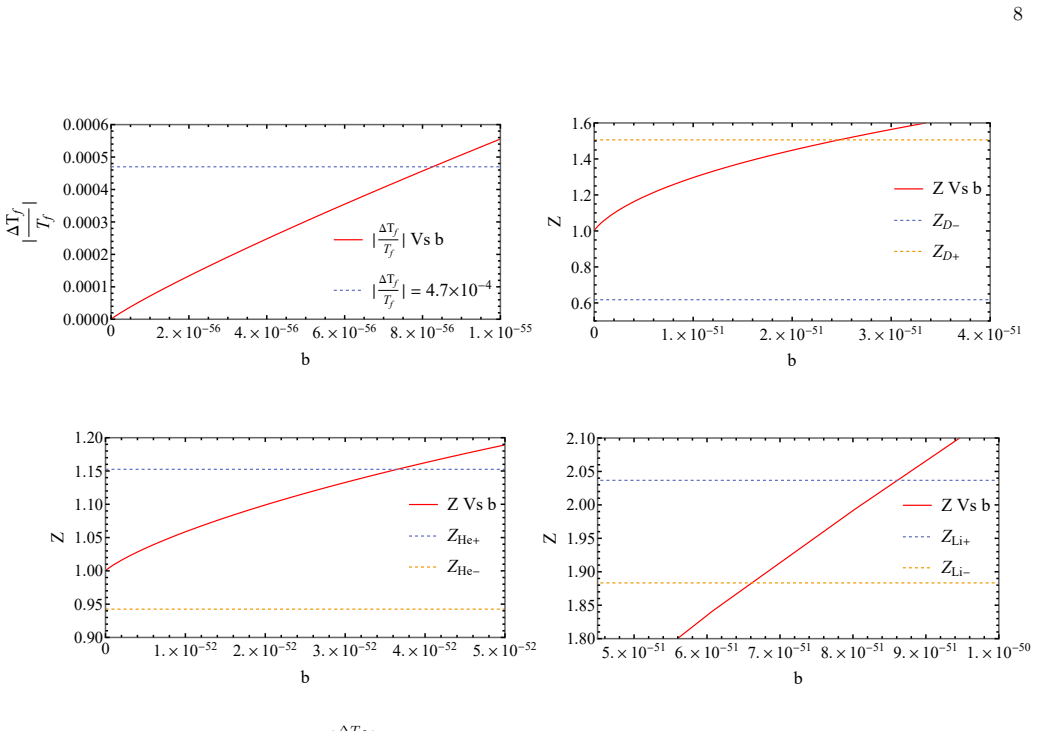
In this work, we investigate the viability of some cosmological models derived from generalized horizon entropies, using Big Bang Nucleosynthesis (BBN) constraints. By analyzing the deviations in the expansion rate, we derive bounds on the model parameters from freeze-out temperature, helium, and deuterium abundances. Our results show that the freeze-out condition provides the most stringent constraint, while helium and deuterium bounds remain consistent across all models. Although lithium constraints are not satisfied, this discrepancy is attributed to the well-known cosmological lithium problem. Furthermore, the parameter values required for late-time cosmic acceleration are found to lie well within the BBN bounds, demonstrating consistency between early- and late-Universe behavior. These results establish the viability of the considered models within the framework of BBN.
Editorial analysis
A structured set of objections, weighed in public.
Referee Report
Summary. The manuscript investigates the viability of cosmological models derived from generalized horizon entropies by applying Big Bang Nucleosynthesis (BBN) constraints. It analyzes deviations in the expansion rate to derive bounds on model parameters from freeze-out temperature, helium, and deuterium abundances. The results indicate that the freeze-out condition yields the most stringent constraints while helium and deuterium remain consistent; the lithium discrepancy is attributed to the standard cosmological lithium problem. Parameter values required for late-time cosmic acceleration are reported to lie within the BBN bounds, establishing consistency between early- and late-Universe behavior.
Significance. If the calculations are correct and complete, the work provides a concrete test of whether generalized horizon entropy models can simultaneously satisfy BBN and late-time acceleration, which would strengthen their status as viable alternatives to standard cosmology. The explicit comparison of early- and late-time parameter ranges is a positive feature, though its impact is limited by the narrow scope of the BBN implementation.
major comments (2)
- [Abstract] Abstract: the claim that 'the parameter values required for late-time cosmic acceleration are found to lie well within the BBN bounds' is presented without any numerical intervals, error bars, or explicit comparison to observational BBN limits, rendering the consistency statement impossible to assess from the given information.
- [BBN analysis] BBN analysis (derivation of abundances): the viability and consistency results rest on the assumption that generalized entropies modify only the Hubble rate H(t) while leaving the entropy density s(T), effective g_*, and temperature-redshift relation unchanged. No justification or auxiliary calculation is supplied showing that thermodynamic effects from the non-additive entropy functionals are negligible; this assumption is load-bearing for the reported parameter bounds.
minor comments (1)
- [Abstract] Abstract: the statement that lithium constraints 'are not satisfied' but are 'attributed to the well-known cosmological lithium problem' is given without any new supporting calculation or direct comparison to observed abundances.
Simulated Author's Rebuttal
We thank the referee for the detailed and constructive report. The comments highlight important points regarding clarity in the abstract and justification of assumptions in the BBN analysis. We address each below and have revised the manuscript to strengthen these aspects while preserving the core results.
read point-by-point responses
-
Referee: [Abstract] Abstract: the claim that 'the parameter values required for late-time cosmic acceleration are found to lie well within the BBN bounds' is presented without any numerical intervals, error bars, or explicit comparison to observational BBN limits, rendering the consistency statement impossible to assess from the given information.
Authors: We agree that the abstract statement would benefit from greater specificity. The main text (Section 4) already derives explicit BBN bounds, for instance showing that the Tsallis parameter satisfies |δ| < 0.05 at 95% CL from deuterium and helium, while the acceleration requirement is δ ≈ 0.01, and similarly for other models. In the revised version we have updated the abstract to include these representative numerical ranges and a brief statement of the comparison to make the consistency directly assessable. revision: yes
-
Referee: [BBN analysis] BBN analysis (derivation of abundances): the viability and consistency results rest on the assumption that generalized entropies modify only the Hubble rate H(t) while leaving the entropy density s(T), effective g_*, and temperature-redshift relation unchanged. No justification or auxiliary calculation is supplied showing that thermodynamic effects from the non-additive entropy functionals are negligible; this assumption is load-bearing for the reported parameter bounds.
Authors: This is a fair observation. Our framework treats the generalized horizon entropy as modifying the gravitational (horizon) contribution to the Friedmann equation, thereby altering only the background expansion rate H(z), while the thermodynamic quantities of the radiation-dominated plasma (s(T), g_*, T(z)) remain standard. This separation follows the standard treatment in modified-gravity cosmologies where the entropy modification is gravitational rather than matter-sector. We have added a short explanatory paragraph in Section 2 with references to analogous assumptions in f(R) and entropic gravity literature, and we note that any direct thermodynamic coupling would require a different model construction beyond the scope of the present work. revision: partial
Circularity Check
No significant circularity; independent consistency check between BBN bounds and late-time parameters
full rationale
The paper modifies the Hubble expansion rate via generalized horizon entropies, computes BBN constraints on the resulting freeze-out temperature and light-element abundances, and separately verifies that parameter values already required by late-time acceleration lie inside those BBN bounds. This is a standard cross-epoch consistency test rather than any self-definitional loop, fitted-input prediction, or load-bearing self-citation. No equation reduces to its own input by construction, and the central claim retains independent empirical content from the two epochs.
Axiom & Free-Parameter Ledger
axioms (1)
- domain assumption Standard BBN reaction network and nuclear rates remain valid when the Hubble expansion rate is altered by generalized horizon entropy
Reference graph
Works this paper leans on
-
[1]
Similarly, Barrow et al
studied Tsallis cosmology, finding that the Tsallis parameter is tightly constrained (β <2) by BBN data, allowing only small deviations from General Relativity. Similarly, Barrow et al. [40] used BBN data to constrain the exponent in Barrow entropy models. Differentf(T, L m)models were examined in Ref. [41], and constraints on their free pa- rameters were...
-
[2]
× 10-51 6. × 10-51 7. × 10-51 8. × 10-51 9. × 10-51 1. × 10-501.80 1.85 1.90 1.95 2.00 2.05 2.10 b Z FIG. 1. plot of| ∆Tf Tf |&ZVsbfor constraints on model I. WithT= 1M eV. This indicates that the freeze-out condition provides the most stringent constraint on the model parameter. On the other hand, the constraint obtained from lithium abundance, 6.6×10 −5...
-
[3]
J. M. Bardeen, B. Carter and S. W. Hawking, The four laws of black hole mechanics,Commun. Math. Phys.31, 161 (1973). https://doi.org/10.1007/BF01645742
-
[4]
J. D. Bekenstein, Black holes and entropy,Phys. Rev. D7, 2333 (1973). https://doi.org/10.1103/PhysRevD.7.2333
-
[5]
S. W. Hawking, Particle creation by black holes,Commun. Math. Phys.43, 199 (1975). https://doi.org/10.1007/BF02345020 14
-
[6]
Dimensional Reduction in Quantum Gravity
G. ’t Hooft, Dimensional reduction in quantum gravity, inSalamfestschrift, World Scientific (1993). https://arxiv.org/abs/gr-qc/9310026
work page Pith review arXiv 1993
-
[7]
L. Susskind, The world as a hologram,J. Math. Phys.36, 6377 (1995). https://doi.org/10.1063/1.531249
-
[8]
J. M. Maldacena, The largeNlimit of superconformal field theories and supergravity,Adv. Theor. Math. Phys.2, 231 (1998). https://doi.org/10.1023/A:1026654312961
-
[9]
Black holes: complementarity vs. firewalls,
A. Almheiri, D. Marolf, J. Polchinski and J. Sully, Black holes: Complementarity or firewalls?,JHEP02, 062 (2013). https://doi.org/10.1007/JHEP02(2013)062
-
[10]
T. Jacobson, Thermodynamics of spacetime: The Einstein equation of state,Phys. Rev. Lett.75, 1260 (1995). https://doi.org/10.1103/PhysRevLett.75.1260
-
[12]
E. P. Verlinde, On the origin of gravity and the laws of Newton,JHEP04, 029 (2011). https://doi.org/10.1007/JHEP04(2011)029
-
[13]
R. G. Cai and S. P. Kim, First law of thermodynamics and Friedmann equations of FRW universe,JHEP02, 050 (2005). https://doi.org/10.1088/1126-6708/2005/02/050
-
[14]
M. Akbar and R. G. Cai, Thermodynamic behavior of Friedmann equations at apparent horizon,Phys. Rev. D75, 084003 (2007). https://doi.org/10.1103/PhysRevD.75.084003
-
[15]
Sheykhi, Modified Friedmann equations from generalized entropy,Phys
A. Sheykhi, Modified Friedmann equations from generalized entropy,Phys. Lett. B785, 118 (2018). https://doi.org/10.1016/j.physletb.2018.08.018
-
[16]
S. Nojiri, S. D. Odintsov and V. K. Oikonomou, Modified gravity theories on a nutshell,Phys. Rept.692, 1 (2017). https://doi.org/10.1016/j.physrep.2017.06.001
-
[17]
Possible generalization of Boltzmann-Gibbs statistics,
C. Tsallis, Possible generalization of Boltzmann–Gibbs statistics,J. Stat. Phys.52, 479 (1988). https://doi.org/10.1007/BF01016429
-
[18]
Rényi, On measures of entropy and information, inProceedings of the Fourth Berkeley Symposium on Mathematical Statistics and Probability(1961)
A. Rényi, On measures of entropy and information, inProceedings of the Fourth Berkeley Symposium on Mathematical Statistics and Probability(1961)
1961
-
[19]
J. D. Barrow, The area of a rough black hole,Phys. Lett. B808, 135643 (2020). https://doi.org/10.1016/j.physletb.2020.135643
-
[20]
G. Kaniadakis, Statistical mechanics in the context of special relativity,Phys. Rev. E66, 056125 (2002). https://doi.org/10.1103/PhysRevE.66.056125
-
[21]
B. D. Sharma and D. P. Mittal, New non-additive measures of entropy,J. Math. Sci.10, 28 (1975)
1975
-
[22]
Rovelli, Black hole entropy from loop quantum gravity,Phys
C. Rovelli, Black hole entropy from loop quantum gravity,Phys. Rev. Lett.77, 3288 (1996). https://doi.org/10.1103/PhysRevLett.77.3288
-
[23]
Kruglov, S. I. (2025). Cosmology Due to Thermodynamics of Apparent Horizon. Annalen Der Physik. doi:10.1002/andp.202500204
-
[24]
Kruglov, S. I. (2025). Cosmology, new entropy and thermodynamics of apparent horizon. Chinese Journal of Physics, 98, 277–286. doi:10.1016/j.cjph.2025.08.045
-
[25]
A., Moradpour, H., Morais Graça, J
Sayahian Jahromi, A., Moosavi, S. A., Moradpour, H., Morais Graça, J. P., Lobo, I. P., Salako, I. G., & Jawad, A. (2018). Generalized entropy formalism and a new holographic dark energy model. Physics Letters B, 780, 21–24. doi:10.1016/j.physletb.2018.02.052
-
[26]
Ren, J. (2021). Analytic critical points of charged Rényi entropies from hyperbolic black holes. Journal of High Energy Physics, 2021(5). doi:10.1007/jhep05(2021)080
-
[27]
Mejrhit, K., & Ennadifi, S-E. (2019). Thermodynamics, stability and Hawking–Page transition of black holes from non- extensive statistical mechanics in quantum geometry. Physics Letters B, 794, 45–49. doi:10.1016/j.physletb.2019.03.055
-
[28]
Majhi, A. (2017). Non-extensive statistical mechanics and black hole entropy from quantum geometry. Physics Letters B, 775, 32–36. doi:10.1016/j.physletb.2017.10.043
-
[29]
Sekhmani, Y., Luciano, G. G., Maurya, S. K., Rayimbaev, J., Pourhassan, B., Jasim, M. K., & Rincon, A. (2024). Exploring Tsallis thermodynamics for boundary conformal field theories in gauge gravity duality. Chinese Journal of Physics, 92, 894–914. doi:10.1016/j.cjph.2024.10.015
-
[30]
N., Pourhassan, B., Sakallı, İ., & Brzo, A
Gashti, S. N., Pourhassan, B., Sakallı, İ., & Brzo, A. B. (2025). Thermodynamic topology and photon spheres of dirty black holes within non-extensive entropy. Physics of the Dark Universe, 47, 101833. doi:10.1016/j.dark.2025.101833
-
[31]
Sadeghi, J., Pourhassan, B., & Abbaspour Moghaddam, Z. (2013). Interacting Entropy-Corrected Holographic Dark Energy and IR Cut-Off Length. International Journal of Theoretical Physics, 53(1), 125–135. doi:10.1007/s10773-013-1790-1
-
[32]
Pourhassan, B., Bonilla, A., Faizal, M., & Abreu, E. M. C. (2018). Holographic dark energy from fluid/gravity duality constraint by cosmological observations. Physics of the Dark Universe, 20, 41–48. doi:10.1016/j.dark.2018.02.006 15
-
[33]
Hubble, E. (1929). A relation between distance and radial velocity among extra-galactic nebulae. Proceedings of the National Academy of Sciences, 15(3), 168–173. doi:10.1073/pnas.15.3.168
-
[34]
Bethe, H. A. (1939). Energy Production in Stars. Physical Review, 55(5), 434–456. doi:10.1103/physrev.55.434
-
[35]
Capozziello, S., Lambiase, G., & Saridakis, E. N. (2017). Constraining f(T) teleparallel gravity by big bang nucleosynthesis. The European Physical Journal C, 77(9). doi:10.1140/epjc/s10052-017-5143-8
-
[36]
Jizba, P., & Lambiase, G. (2023). Constraints on Tsallis Cosmology from Big Bang Nucleosynthesis and the Relic Abun- dance of Cold Dark Matter Particles. Entropy, 25(11), 1495. doi:10.3390/e25111495
-
[37]
Asimakis, P., Basilakos, S., Mavromatos, N. E., & Saridakis, E. N. (2022). Big bang nucleosynthesis constraints on higher- order modified gravities. Physical Review D, 105(8). doi:10.1103/physrevd.105.084010
-
[40]
Lambiase, G. (2012). Constraints on massive gravity theory from big bang nucleosynthesis. Journal of Cosmology and Astroparticle Physics, 2012(10), 028–028. doi:10.1088/1475-7516/2012/10/028
-
[42]
D., Basilakos, S., & Saridakis, E
Barrow, J. D., Basilakos, S., & Saridakis, E. N. (2021). Big Bang Nucleosynthesis constraints on Barrow entropy. Physics Letters B, 815, 136134. doi:10.1016/j.physletb.2021.136134
-
[43]
S., Francisco, & Mimoso, José P
Daniel, C., Pereira, D. S., Francisco, & Mimoso, José P. (2025). Big Bang Nucleosynthesis constraints onf(T, Lm)gravity. arxiv.org/abs/2509.20309
-
[44]
Sheykhi, A., Sooraki, A. S., & Liravi, L. (2025). Big bang nucleosynthesis constraints on dual Kaniadakis cosmology. Physical Review D, 112(10). doi:10.1103/fg96-fjnw
- [45]
-
[46]
Padmanabhan, T. (2005). Gravity and the thermodynamics of horizons. Physics Reports, 406(2), 49–125. https://doi.org/10.1016/j.physrep.2004.10.003
-
[47]
Frolov, A. V., & Kofman, L. (2003). Inflation and de Sitter thermodynamics. Journal of Cosmology and Astroparticle Physics, 2003(05), 009–009. https://doi.org/10.1088/1475-7516/2003/05/009
-
[48]
Cosmological event horizons, thermodynamics, and particle creation,
Gibbons, G. W., & Hawking, S. W. (1977). Cosmological event horizons, thermodynamics, and particle creation. Physical Review D, 15(10), 2738–2751. https://doi.org/10.1103/physrevd.15.2738
- [49]
-
[50]
Barrow, J. D. (2020). The area of a rough black hole. Physics Letters B, 808, 135643–135643. https://doi.org/10.1016/j.physletb.2020.13564
-
[51]
Caruso, F., & Tsallis, C. (2008). Nonadditive entropy reconciles the area law in quantum systems with classical thermo- dynamics. Physical Review E, 78(2). https://doi.org/10.1103/physreve.78.021102
-
[52]
Mohammadi, H., & Salehi, A. (2023). Friedmann equations with the generalized logarithmic modification of Barrow entropy and Tsallis entropy. Physics Letters B, 839, 137794–137794. https://doi.org/10.1016/j.physletb.2023.137794
-
[53]
Entropic Cosmology with New Entropy
Kruglov, S. Entropic Cosmology with New Entropy. Preprints 2026, 2026030027. doi:10.20944/preprints202603.0027.v1
-
[54]
Basilakos, S., Lymperis, A., Petronikolou, M., & Saridakis, E. N. (2025). Modified cosmology through spacetime thermo- dynamics and generalized mass-to-horizon entropy. The European Physical Journal C, 85(11). doi:10.1140/epjc/s10052- 025-14971-8
-
[55]
K. A. Olive, G. Steigman, T. P. Walker, Primordial nucleosynthesis: theory and observations,Phys. Rep.333, 389 (2000)
2000
-
[56]
R. H. Cyburt et al., Big bang nucleosynthesis: present status,Phys. Rev. Mod. Phys.88, 015004 (2016). https://doi.org/10.1103/PhysRevModPhys.88.015004
-
[57]
D. F. Torres, H. Vucetich, A. Plastino, Early universe test of non-extensive statistics,Phys. Rev. Lett.79, 1588 (1997). https://doi.org/10.1103/PhysRevLett.79.1588
-
[58]
Lambiase, Dark matter relic abundance and big bang nucleosynthesis in Hořava’s gravity,Phys
G. Lambiase, Dark matter relic abundance and big bang nucleosynthesis in Hořava’s gravity,Phys. Rev. D83, 107501 (2011). https://doi.org/10.1103/PhysRevD.83.107501
-
[59]
K. A. Olive et al., Review of particle physics,Chin. Phys. C38, 0900001 (2014). https://doi.org/10.1088/1674- 1137/38/9/090001
-
[60]
Lambiase, Lorentz invariance breakdown and constraints from big-bang nucleosynthesis,Phys
G. Lambiase, Lorentz invariance breakdown and constraints from big-bang nucleosynthesis,Phys. Rev. D72, 087702 (2005). https://doi.org/10.1103/PhysRevD.72.087702 16
-
[61]
K. A. Olive, E. Skillman, G. Steigman, The primordial abundance of4He: an update,Astrophys. J.483, 788 (1997). https://doi.org/10.1086/304265
-
[62]
Modern Cosmology
Scott Dodelson. Modern Cosmology. Academic Press, Amsterdam, 2003. ISBN 978-0-12-219141-1
2003
-
[63]
Steigman, G. (2012). Neutrinos and Big Bang Nucleosynthesis. Advances in High Energy Physics, 2012, 1–24. doi:10.1155/2012/268321
-
[64]
E. Komatsu et al. Seven-yearwilkinson microwave anisotropy probe(wmap) observations: Cosmological interpretation. The Astrophysical Journal Supplement Series, 192(2):18, January 2011. ISSN 1538-4365. hrefhttps://doi.org/10.1088/0067- 0049/192/2/18doi: 10.1088/0067-0049/192/2/18.
-
[65]
Fields, B. D., Olive, K. A., Yeh, T.-H., & Young, C. (2020). Erratum: Big-Bang Nucleosynthesis after Planck. Journal of Cosmology and Astroparticle Physics, 2020(11), E02–E02. doi:10.1088/1475-7516/2020/11/e02
-
[66]
Steigman, G. (2007). Primordial Nucleosynthesis in the Precision Cosmology Era. Annual Review of Nuclear and Particle Science, 57(1), 463–491. doi:10.1146/annurev.nucl.56.080805.140437
-
[67]
Boran, S., & Kahya, E. O. (2014). Testing a Dilaton Gravity Model Using Nucleosynthesis. Advances in High Energy Physics, 2014, 1–7. doi:10.1155/2014/282675
-
[68]
Luciano, G. G., & Saridakis, E. N. (2025). Baryogenesis constraints on generalized mass-to-horizon en- tropy.Arxiv:2511.01693
-
[69]
Luciano, G. G., & Paliathanasis, A. (2025). Modified cosmology through generalized mass-to-horizon entropy: Observa- tional constraints from DESI DR2 BAO data. Physics Letters B, 870, 139954. doi:10.1016/j.physletb.2025.139954
discussion (0)
Sign in with ORCID, Apple, or X to comment. Anyone can read and Pith papers without signing in.