Recognition: unknown
Quasinormal modes of charged covariant effective black holes with a cosmological constant
Pith reviewed 2026-05-10 02:09 UTC · model grok-4.3
The pith
Quantum corrections to charged black holes with a cosmological constant introduce new spectral features and mode interactions in their quasinormal ringing rather than only shifting frequencies.
A machine-rendered reading of the paper's core claim, the machinery that carries it, and where it could break.
Core claim
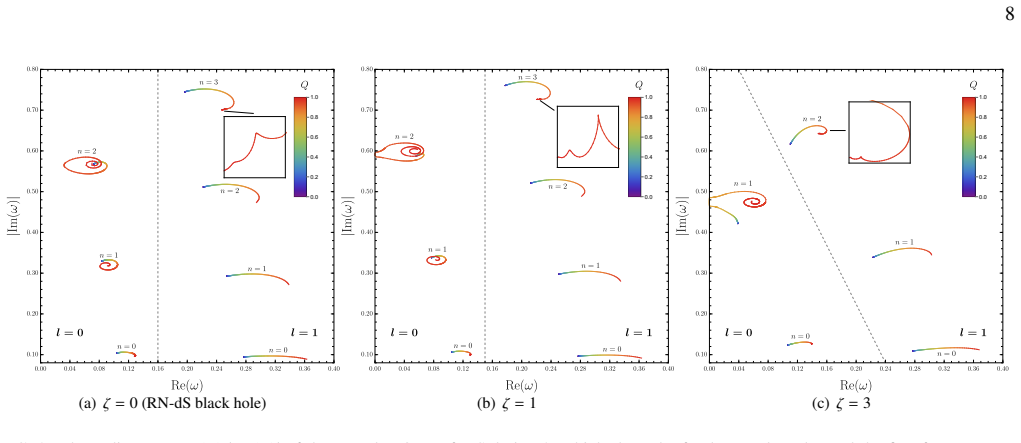
In the charged covariant effective black holes with quantum parameter zeta, cosmological constant Lambda, and charge Q, the quasinormal frequencies computed for scalar perturbations retain non-monotonic behavior and overtone outbursts under variation of zeta, yet the quantum correction adds distinct new features to the overtone spectrum and produces rich interactions, including damping-rate crossings and merging-splitting, between complex and purely imaginary modes that accompany the outbursts in near-extremal regimes.
What carries the argument
The pseudo-spectral discretization of the radial perturbation equation on the covariant effective metrics, which yields the full discrete set of complex frequencies including overtones and allows tracking of their trajectories as parameters vary.
If this is right
- Non-monotonic dependence on charge and overtone outbursts survive the inclusion of the quantum parameter.
- Overtone outbursts acquire extra spectral features that are absent in the classical limit.
- Complex and purely imaginary modes exhibit damping-rate crossings and merging-splitting near extremality.
- These mode interactions are systematically associated with the outbursts, suggesting a dynamical connection.
- Analysis limited to the fundamental mode misses the dominant new structures induced by quantum corrections.
Where Pith is reading between the lines
- The observed mode crossings could produce distinctive late-time tails in gravitational-wave signals from near-extremal black holes.
- Similar interaction patterns may appear when other quantum-inspired corrections are added to the same background.
- Tracking the full spectrum rather than isolated modes could become a diagnostic tool for distinguishing classical from quantum-corrected black-hole geometries.
Load-bearing premise
The covariant effective black hole metric with the single parameter zeta faithfully encodes the quantum gravity effects that matter for quasinormal modes, and the pseudo-spectral solver converges to the true frequencies without numerical artifacts.
What would settle it
A recomputation of the full spectrum for the same family of metrics that finds neither additional overtone peaks nor damping-rate crossings or merging-splitting when zeta is varied would falsify the reported spectral modifications.
Figures




read the original abstract
In this paper, we investigate the quasinormal modes of two covariant effective black holes characterized by the quantum parameter $\zeta$, charge $Q$, and cosmological constant $\Lambda$, under the scalar perturbation. By employing the pseudo-spectral method, we numerically calculate the quasinormal frequencies and analyze the influence of $\zeta$ on the spectra with respect to $Q$. Our results demonstrate that while the quantum parameter $\zeta$ significantly modifies the quasinormal frequency spectrum, the non-monotonic behavior and overtone outbursts persist. Notably, the impact of quantum gravity on the overtone outbursts is not merely limited to enhancement or suppression; instead, it introduces additional spectral features. Furthermore, a comprehensive analysis of the full quasinormal mode spectrum reveals rich interactions between complex and purely imaginary modes, including damping-rate crossings and merging-splitting behavior. These phenomena typically accompany overtone outbursts in near-extremal regimes, suggesting a potential connection between mode interactions and overtone outbursts. This work emphasizes the necessity of analyzing the full quasinormal frequency spectrum rather than focussing solely on fundamental modes, and provides novel insights into its underlying spectral structures.
Editorial analysis
A structured set of objections, weighed in public.
Referee Report
Summary. This paper examines the quasinormal modes of scalar perturbations on charged covariant effective black holes with quantum parameter ζ, charge Q, and cosmological constant Λ. Using the pseudo-spectral method, the authors calculate the quasinormal frequencies and report that ζ alters the spectrum, maintaining non-monotonic behaviors and overtone outbursts while adding new spectral features. The full spectrum analysis reveals interactions between complex and imaginary modes, such as damping-rate crossings and merging-splitting, linked to near-extremal overtone outbursts.
Significance. Should the numerical findings prove reliable, the manuscript advances the field by demonstrating that quantum gravity effects via ζ introduce nuanced changes to the quasinormal spectrum, not just monotonic shifts. The emphasis on full spectrum analysis and direct numerical computation without circular parameter fitting is a strength, offering potential insights for black hole spectroscopy in quantum gravity contexts.
major comments (1)
- [Numerical results section] The central claims of additional spectral features, damping-rate crossings, and merging-splitting behavior (abstract and results) rest on the pseudo-spectral solver output. No grid-convergence tables, residual norms, or cross-validation with independent methods are provided for the near-extremal parameter values where these delicate phenomena are reported. This is load-bearing for the conclusions about mode interactions and quantum gravity effects.
minor comments (2)
- The abstract mentions 'two covariant effective black holes' but does not clarify their distinction; this should be stated explicitly in the introduction or metric section.
- The notation for quasinormal frequencies and the definition of the effective metric parameters (ζ, Q, Λ) would benefit from a dedicated early subsection for clarity.
Simulated Author's Rebuttal
We thank the referee for their careful reading of the manuscript and for recognizing the potential significance of our findings on the effects of the quantum parameter ζ. We address the major comment on numerical validation below and will revise the manuscript accordingly.
read point-by-point responses
-
Referee: [Numerical results section] The central claims of additional spectral features, damping-rate crossings, and merging-splitting behavior (abstract and results) rest on the pseudo-spectral solver output. No grid-convergence tables, residual norms, or cross-validation with independent methods are provided for the near-extremal parameter values where these delicate phenomena are reported. This is load-bearing for the conclusions about mode interactions and quantum gravity effects.
Authors: We agree that the delicate features reported near extremality, including damping-rate crossings and merging-splitting, require explicit numerical validation to support the claims about mode interactions and the influence of ζ. In the revised manuscript we will add (i) grid-convergence tables showing the stabilization of the reported frequencies with increasing Chebyshev grid resolution for representative near-extremal values of Q and ζ, (ii) residual norms of the pseudo-spectral discretization for those modes, and (iii) cross-validation of a subset of the near-extremal spectra against an independent implementation of the continued-fraction method. These additions will be placed in a new subsection of the numerical results and will directly address the reliability of the reported spectral phenomena. revision: yes
Circularity Check
No circularity: results from direct numerical solution of perturbation equations
full rationale
The paper computes quasinormal frequencies by numerically solving the scalar perturbation wave equations on the given covariant effective black hole metric (with parameters ζ, Q, Λ) via the pseudo-spectral method. All reported features—non-monotonic spectra, overtone outbursts, damping-rate crossings, and merging-splitting between complex and imaginary modes—are direct outputs of this solver for chosen parameter values. No step defines a frequency in terms of itself, renames a fitted parameter as a prediction, or relies on a self-citation chain to force the central claims. The metric background is taken as input from prior literature; the present work performs an independent numerical analysis without reducing any result to its own inputs by construction.
Axiom & Free-Parameter Ledger
free parameters (3)
- quantum parameter ζ
- charge Q
- cosmological constant Λ
axioms (2)
- domain assumption The covariant effective metric provides a valid background geometry for studying linear scalar perturbations.
- standard math Quasinormal modes are defined by the boundary conditions of ingoing waves at the horizon and outgoing waves at infinity.
invented entities (1)
-
covariant effective black hole with quantum parameter ζ
no independent evidence
Reference graph
Works this paper leans on
-
[1]
5, we show the real part Re(ω) and the absolute value of the imaginary part|Im(ω)|of the QNFs for the first solution, Eq
Solution 1 In Fig. 5, we show the real part Re(ω) and the absolute value of the imaginary part|Im(ω)|of the QNFs for the first solution, Eq. (2.2), as functions of the chargeQfor different values of the quantum parameterζ. From panels 5(a) to 5(c), the influ- ence ofζon the QNFs is evident. We first discuss the funda- mental complex modes (n=0), shown in ...
-
[2]
(2.3), are shown in Fig
Solution 2 The results of Solution 2, Eq. (2.3), are shown in Fig. 9. Similarly, we first discuss the fundamental complex modes, which are presented in Fig. 10. Forl=0, similar to Solution 1, the difference in QNFs betweenζ=1 andζ=0 is minor. Both the real part Re(ω) and the absolute value of the imagi- nary part|Im(ω)|exhibit non-monotonic behavior withQ...
1977
-
[3]
In addition, Solution 1 has a larger negative region, suggesting increased susceptibility to instability under extreme conditions
Analysis of the effective potential shows that Solution 1 is more sensitive to quantum corrections, exhibiting a higher potential barrier, whereas Solution 2 shows a weaker response. In addition, Solution 1 has a larger negative region, suggesting increased susceptibility to instability under extreme conditions
-
[4]
Although increasing the cosmological constantΛweak- ens the influence of the quantum parameterζon the quasinormal frequencies, the characteristic features in- troduced byζare still preserved
-
[5]
For the conventional complex modes, only whenζis sufficiently large do the two solutions show signifi- cant differences. For the fundamental modes, whenζ reaches 3, it suppresses the non-monotonic behavior of the QNF spectrum in Solution 1, whereas this suppres- sion is not observed in Solution 2; for the overtones, the quantum gravity effect cannot be si...
-
[6]
For purely imaginary modes, increasingζstrengthens their dominance and accelerates the transition to expo- nential decay. Furthermore, complex and purely imag- inary modes exhibit interactions that generally accom- pany the overtone outbursts in near-extremal regimes, including damping-rate crossings and merging-splitting behavior, which become more frequ...
-
[7]
R. M. Wald,General Relativity(Chicago University Press, Chicago, 1984), 10.7208/chicago/9780226870373.001.0001
-
[8]
C. Liang and B. Zhou,Differential Geometry and General Rel- ativity: V olume 1, translated and revised by W. Jia and B. Zhou (Springer, Singapore, 2023), 10.1007/978-981-99-0022-0
-
[9]
Penrose, Gravitational Collapse and Space-time Singulari- ties, Phys
R. Penrose, Gravitational Collapse and Space-time Singulari- ties, Phys. Rev. Lett.14, 57 (1965)
1965
-
[10]
A. I. Janis, E. T. Newman, and J. Winicour, Reality of the Schwarzschild Singularity, Phys. Rev. Lett.20, 878 (1968)
1968
-
[11]
Hawking, The occurrence of singularities in cosmology, Proc
S. Hawking, The occurrence of singularities in cosmology, Proc. R. Soc. A294, 511 (1966)
1966
-
[12]
P. S. Joshi and D. Malafarina, Recent developments in gravita- tional collapse and spacetime singularities, Int. J. Mod. Phys. D20, 2641 (2011)
2011
-
[13]
T. Thiemann,Modern Canonical Quantum General Relativ- ity(Cambridge University Press, Cambridge, England, 2007), 10.1017/CBO9780511755682
-
[14]
C. Rovelli,Quantum Gravity(Cambridge University Press, Cambridge, England, 2004), 10.1017/CBO9780511755804
-
[15]
M. Han, Y . Ma, and W. Huang, Fundamental structure of loop quantum gravity, Int. J. Mod. Phys. D16, 1397 (2007)
2007
-
[16]
Giesel and H
K. Giesel and H. Sahlmann, From classical to quantum gravity: Introduction to loop quantum gravity, Proc. Sci. QGQGS2011 (2011) 002
2011
-
[17]
Yang and Y
J. Yang and Y . Ma, New volume and inverse volume operators for loop quantum gravity, Phys. Rev. D94, 044003 (2016)
2016
-
[18]
Yang and Y
J. Yang and Y . Ma, New Hamiltonian constraint operator for loop quantum gravity, Phys. Lett. B751, 343 (2015)
2015
-
[19]
J. Yang, C. Zhang, and Y . Ma, Relating spin-foam to canonical loop quantum gravity by graphical calculus, Phys. Rev. D104, 044025 (2021)
2021
-
[20]
Bojowald and K
M. Bojowald and K. Vandersloot, Loop quantum cosmology, boundary proposals, and inflation, Phys. Rev. D67, 124023 (2003)
2003
-
[21]
Tsujikawa, P
S. Tsujikawa, P. Singh, and R. Maartens, Loop quantum grav- ity effects on inflation and the CMB, Classical Quantum Grav- ity21, 5767 (2004)
2004
-
[22]
Bojowald, Absence of a Singularity in Loop Quantum Cos- mology, Phys
M. Bojowald, Absence of a Singularity in Loop Quantum Cos- mology, Phys. Rev. Lett.86, 5227 (2001)
2001
-
[23]
Bojowald, Loop quantum cosmology, Living Rev
M. Bojowald, Loop quantum cosmology, Living Rev. Relativ- 14 ity8, 11 (2005)
2005
-
[24]
Ashtekar, M
A. Ashtekar, M. Bojowald, and J. Lewandowski, Mathemati- cal structure of loop quantum cosmology, Adv. Theor. Math. Phys.7, 233 (2003)
2003
-
[25]
Singh, Are loop quantum cosmos never singular?, Classical Quantum Gravity26, 125005 (2009)
P. Singh, Are loop quantum cosmos never singular?, Classical Quantum Gravity26, 125005 (2009)
2009
-
[26]
Ashtekar, T
A. Ashtekar, T. Pawlowski, and P. Singh, Quantum nature of the big bang: An analytical and numerical investigation, Phys. Rev. D73, 124038 (2006)
2006
-
[27]
Zhang, Loop quantum black hole, Universe9, 313 (2023)
X. Zhang, Loop quantum black hole, Universe9, 313 (2023)
2023
-
[28]
Ashtekar, J
A. Ashtekar, J. Olmedo, and P. Singh, Quantum Transfigu- ration of Kruskal Black Holes, Phys. Rev. Lett.121, 241301 (2018)
2018
-
[29]
Zhang, Y
C. Zhang, Y . Ma, S. Song, and X. Zhang, Loop quantum de- parametrized Schwarzschild interior and discrete black hole mass, Phys. Rev. D105, 024069 (2022)
2022
-
[30]
Lin and X
J. Lin and X. Zhang, Effective four-dimensional loop quantum black hole with a cosmological constant, Phys. Rev. D110, 026002 (2024)
2024
-
[31]
Alonso-Bardaji, D
A. Alonso-Bardaji, D. Brizuela, and R. Vera, Nonsingular spherically symmetric black-hole model with holonomy cor- rections, Phys. Rev. D106, 024035 (2022)
2022
-
[32]
Gambini and J
R. Gambini and J. Pullin, Loop Quantization of the Schwarzschild Black Hole, Phys. Rev. Lett.110, 211301 (2013)
2013
-
[33]
Peltola and G
A. Peltola and G. Kunstatter, Effective polymer dynamics of D-dimensional black hole interiors, Phys. Rev. D80, 044031 (2009)
2009
-
[34]
Bojowald, Black-hole models in loop quantum gravity, Universe6, 125 (2020)
M. Bojowald, Black-hole models in loop quantum gravity, Universe6, 125 (2020)
2020
-
[35]
Bojowald, No-go result for covariance in models of loop quantum gravity, Phys
M. Bojowald, No-go result for covariance in models of loop quantum gravity, Phys. Rev. D102, 046006 (2020)
2020
-
[36]
Bojowald, S
M. Bojowald, S. Brahma, and J. D. Reyes, Covariance in mod- els of loop quantum gravity: Spherical symmetry, Phys. Rev. D92, 045043 (2015)
2015
-
[37]
Alonso-Bardaji and D
A. Alonso-Bardaji and D. Brizuela, Spacetime geometry from canonical spherical gravity, Phys. Rev. D109, 044065 (2024)
2024
-
[38]
Zhang, J
C. Zhang, J. Lewandowski, Y . Ma, and J. Yang, Black holes and covariance in effective quantum gravity, Phys. Rev. D111, L081504 (2025)
2025
-
[39]
Zhang, J
C. Zhang, J. Lewandowski, Y . Ma, and J. Yang, Black holes and covariance in effective quantum gravity: A solution with- out Cauchy horizons, Phys. Rev. D112, 044054 (2025)
2025
-
[40]
I. H. Belfaqih, M. Bojowald, S. Brahma, and E. I. Duque, Black holes in effective loop quantum gravity: Covariant holonomy modifications, Phys. Rev. D112, 046022 (2025)
2025
-
[41]
Zhang and Z
C. Zhang and Z. Cao, Covariant Dynamics from Static Spher- ically Symmetric Geometries, Phys. Rev. Lett.135, 261401 (2025)
2025
-
[42]
J. Yang, C. Zhang, and Y . Ma, Covariant effective spacetimes of spherically symmetric electrovacuum with a cosmological constant, Phys. Rev. D112, 064049 (2025)
2025
-
[43]
R. A. Konoplya and O. S. Stashko, Probing the effective quan- tum gravity via quasinormal modes and shadows of black holes, Phys. Rev. D111, 104055 (2025)
2025
-
[44]
W. Liu, D. Wu, and J. Wang, Light rings and shadows of static black holes in effective quantum gravity, Phys. Lett. B858, 139052 (2024)
2024
-
[45]
Liu, M.-Y
H. Liu, M.-Y . Lai, X.-Y . Pan, H. Huang, and D.-C. Zou, Gravi- tational lensing effect of black holes in effective quantum grav- ity, Phys. Rev. D110, 104039 (2024)
2024
-
[46]
Y . Wang, A. Vachher, Q. Wu, T. Zhu, and S. G. Ghosh, Strong gravitational lensing by static black holes in effective quantum gravity, Eur. Phys. J. C85, 302 (2025)
2025
-
[47]
Skvortsova, Quantum corrected black holes: testing the correspondence between grey-body factors and quasinormal modes, Eur
M. Skvortsova, Quantum corrected black holes: testing the correspondence between grey-body factors and quasinormal modes, Eur. Phys. J. C85, 854 (2025)
2025
-
[48]
Y . Du, Y . Liu, and X. Zhang, Spinning particle dynamics and the innermost stable circular orbit in covariant loop quantum gravity, J. Cosmol. Astropart. Phys. 05 (2025) 045
2025
-
[49]
Y . Liu, J. Jiang, and B. Sun, Repulsive effect of covariant ef- fective quantum gravity, Phys. Rev. D112, 124042 (2025)
2025
-
[50]
J. Lin, X. Zhang, and M. Bravo-Gaete, Mass inflation and strong cosmic censorship conjecture in the covariant quantum black hole, Phys. Rev. D111, 106025 (2025)
2025
-
[51]
Bolokhov, Long lived quasinormal modes in the effective quantum gravity, Eur
S. Bolokhov, Long lived quasinormal modes in the effective quantum gravity, Eur. Phys. J. C85, 1166 (2025)
2025
-
[52]
Umarov, F
D. Umarov, F. Atamurotov, S. G. Ghosh, A. Abdujabbarov, and G. Mustafa, Dynamics of spinning particles around static black holes in effective quantum gravity, Eur. Phys. J. C85, 800 (2025)
2025
-
[53]
R. A. Konoplya and O. S. Stashko, Transition from regular black holes to wormholes in covariant effective quantum grav- ity: Scattering, quasinormal modes, and Hawking radiation, Phys. Rev. D111, 084031 (2025)
2025
-
[54]
R.-B. Wang, L. You, S.-J. Ma, J.-B. Deng, and X.-R. Hu, Ther- modynamic phase transition and Joule-Thomson expansion of a quantum corrected black hole in AdS spacetime, Chin. Phys. 49, 115102 (2025)
2025
-
[55]
Ai, R.-T
W.-J. Ai, R.-T. Chen, L.-G. Zhu, and J.-P. Wu, Probing loop quantum effects through solar system experiments: observa- tional signatures and parameter constraints, Eur. Phys. J. C85, 792 (2025)
2025
-
[56]
B. C. L ¨utf¨uo˘glu, Long-lived quasinormal modes around regu- lar black holes and wormholes in Covariant Effective Quantum Gravity, J. Cosmol. Astropart. Phys. 06 (2025) 057
2025
-
[57]
Chen and J
J. Chen and J. Yang, Periodic orbits and gravitational wave- forms in quantum-corrected black hole spacetimes, Eur. Phys. J. C85, 726 (2025)
2025
- [58]
-
[59]
X. Liu, W. Liu, and S.-M. Wu, Entanglement degradation of static black holes in effective quantum gravity, Phys. Lett. B 875, 140334 (2026)
2026
-
[60]
Calz `a, D
M. Calz `a, D. Pedrotti, G.-W. Yuan, and S. Vagnozzi, Primor- dial regular black holes as all the dark matter. III. Covariant canonical quantum gravity models, Phys. Rev. D112, 124015 (2025)
2025
-
[61]
Motaharfar and P
M. Motaharfar and P. Singh, Love numbers of covariant loop quantum black holes, Phys. Rev. D112, 066008 (2025)
2025
-
[62]
Sahlmann and C
H. Sahlmann and C. Zhang, Dust shell in effective loop quan- tum black hole model, Phys. Rev. D112, 084079 (2025)
2025
-
[63]
Du, J.-R
Y . Du, J.-R. Sun, and X. Zhang, Information paradox and island of covariant black holes in LQG, Phys. Rev. D113, 046017 (2026)
2026
-
[64]
Yao and X
J.-T. Yao and X. Li, Probing covariant quantum black holes in effective quantum gravity through the orbital motion of the S2 star around Sagittarius A⋆, Phys. Rev. D113, 084003 (2026)
2026
-
[65]
J. Chen and J. Yang, Electric Penrose process in the space- time of a quantum-corrected Reissner-Nordstr ¨om black hole, arXiv:2601.01508
-
[66]
Q. Li and J.-H. Huang, Radiation properties and images of loop quantum Reissner-Nordstr ¨om black hole with a thin ac- cretion disk, arXiv:2601.05608
-
[67]
Y . Yang, Y .-X. Bai, Y .-Z. Li, and Y . Han, Particle motions and gravitational waveforms in rotating black hole spacetimes of loop quantum gravity, arXiv:2603.25084. 15
work page internal anchor Pith review Pith/arXiv arXiv
-
[68]
Berti, V
E. Berti, V . Cardoso, and A. O. Starinets, Quasinormal modes of black holes and black branes, Classical Quantum Gravity 26, 163001 (2009)
2009
-
[69]
R. A. Konoplya and A. Zhidenko, Quasinormal modes of black holes: From astrophysics to string theory, Rev. Mod. Phys.83, 793 (2011)
2011
-
[70]
K. D. Kokkotas and B. G. Schmidt, Quasinormal modes of stars and black holes, Living Rev. Relativity2, 2 (1999)
1999
-
[71]
Berti, Black hole quasinormal modes: Hints of quantum gravity?, Conf
E. Berti, Black hole quasinormal modes: Hints of quantum gravity?, Conf. Proc. C0405132, 145 (2004)
2004
-
[72]
Echeverria, Gravitational-wave measurements of the mass and angular momentum of a black hole, Phys
F. Echeverria, Gravitational-wave measurements of the mass and angular momentum of a black hole, Phys. Rev. D40, 3194 (1989)
1989
-
[73]
Berti, V
E. Berti, V . Cardoso, and C. M. Will, Gravitational-wave spec- troscopy of massive black holes with the space interferometer LISA, Phys. Rev. D73, 064030 (2006)
2006
-
[74]
Berti, J
E. Berti, J. Cardoso, V . Cardoso, and M. Cavaglia, Matched- filtering and parameter estimation of ringdown waveforms, Phys. Rev. D76, 104044 (2007)
2007
-
[75]
A. G. Abacet al.(KAGRA, Virgo, and LIGO Scientific Col- laborations), GW250114: Testing Hawking’s Area Law and the Kerr Nature of Black Holes, Phys. Rev. Lett.135, 111403 (2025)
2025
-
[76]
Barausse, V
E. Barausse, V . Cardoso, and P. Pani, Can environmental ef- fects spoil precision gravitational-wave astrophysics?, Phys. Rev. D89, 104059 (2014)
2014
-
[77]
Cardoso, S
V . Cardoso, S. Hopper, C. F. B. Macedo, C. Palenzuela, and P. Pani, Gravitational-wave signatures of exotic compact ob- jects and of quantum corrections at the horizon scale, Phys. Rev. D94, 084031 (2016)
2016
-
[78]
Berti, K
E. Berti, K. Yagi, H. Yang, and N. Yunes, Extreme gravity tests with gravitational waves from compact binary coalescences: (II) Ringdown, Gen. Relativ. Gravit.50, 49 (2018)
2018
-
[79]
G. Fu, D. Zhang, P. Liu, X.-M. Kuang, and J.-P. Wu, Peculiar properties in quasinormal spectra from loop quantum gravity effect, Phys. Rev. D109, 026010 (2024)
2024
-
[80]
H. Gong, S. Li, D. Zhang, G. Fu, and J.-P. Wu, Quasinormal modes of quantum-corrected black holes, Phys. Rev. D110, 044040 (2024)
2024
discussion (0)
Sign in with ORCID, Apple, or X to comment. Anyone can read and Pith papers without signing in.