Recognition: 2 theorem links
· Lean TheoremParticle motions and gravitational waveforms in rotating black hole spacetimes of loop quantum gravity
Pith reviewed 2026-05-15 00:52 UTC · model grok-4.3
The pith
The LQG holonomy correction parameter ξ enlarges deviations from Kerr gravitational waveforms in rotating black hole spacetimes, with stronger effects for type BH-II than BH-I.
A machine-rendered reading of the paper's core claim, the machinery that carries it, and where it could break.
Core claim
In the two rotating LQG black hole spacetimes, increasing the holonomy-correction parameter ξ at fixed spin enlarges the bound energy range of equatorial periodic orbits, suppresses the allowed Carter constant for off-equatorial motion, and drives adiabatic inspiral evolution in the direction opposite to the spin parameter a; the resulting leading-order post-Newtonian waveforms deviate from Kerr predictions with an amplitude that grows with ξ and is larger for the BH-II metric than for the BH-I metric.
What carries the argument
The holonomy-correction parameter ξ in the two rotating metrics (BH-I and BH-II) generated by the Newman-Janis algorithm from distinct spherically symmetric LQG seed solutions.
Load-bearing premise
The physically admissible range of ξ is set by simultaneously requiring the existence of event horizons, marginally bound orbits, and innermost stable circular orbits.
What would settle it
Detection of an EMRI waveform from a 10^7 solar-mass central black hole and 10 solar-mass companion at 200 Mpc that shows no greater deviation from the Kerr waveform than the Kerr case itself, in the 0.001–0.1 Hz band, would falsify the prediction of enhanced deviations for admissible nonzero ξ.
Figures




read the original abstract
We study the influence of the loop quantum gravity (LQG) holonomy-correction parameter $\xi$ on black hole horizon structure, timelike geodesic motion, and gravitational wave emission in two rotating LQG-inspired black hole spacetimes, constructed via Newman-Janis algorithm from two distinct spherically symmetric seed metrics (type BH-I and BH-II). The physically admissible range of $\xi$ is determined by requiring the existence of event horizons, marginally bound orbits, and innermost stable circular orbits simultaneously, and is found to shrink monotonically with increasing spin parameter $a$. For equatorial periodic orbits, increasing $\xi$ at fixed angular momentum enlarges the bound energy range, while for off-equatorial orbits, it suppresses the allowed range of the Carter constant, effectively confining trajectories closer to the equatorial plane. The effects of $\xi$ and $a$ on orbital dynamics are systematically antagonistic. Gravitational waveforms computed within a leading-order post-Newtonian extreme-mass-ratio inspiral (EMRI) model show that larger $\xi$ produces enhanced deviations from the Kerr waveform, more prominently so for type BH-II than type BH-I. The resulting characteristic strains occupy the $(10^{-3}, 0.1)$ Hz frequency band but fall below the sensitivity curves of current and near-future space-based detectors for the EMRI parameters considered ($M=10^7 M_\odot$, $m=10 M_\odot$, $D_L = 200$ Mpc). Adiabatic inspiral calculations confirm that $\xi$ and $a$ drive orbital evolution in opposite directions, with their relative magnitude determining whether quantum corrections accelerate or retard the inspiral. These results establish systematic observational signatures of holonomy corrections in rotating LQG black holes and motivate higher-fidelity waveform modeling for future space-based gravitational wave detectors.
Editorial analysis
A structured set of objections, weighed in public.
Referee Report
Summary. The manuscript studies the effects of the LQG holonomy-correction parameter ξ on two rotating black hole spacetimes (BH-I and BH-II) obtained via the Newman-Janis algorithm from distinct spherically symmetric seeds. It fixes the admissible ξ range by simultaneous existence of event horizons, marginally bound orbits, and ISCOs (which shrinks with spin a), examines equatorial and off-equatorial timelike geodesics (showing antagonistic ξ–a effects on bound energies and Carter constants), and computes gravitational waveforms and adiabatic inspirals in a leading-order post-Newtonian EMRI model. The central result is that larger ξ produces larger deviations from Kerr waveforms, more pronounced for BH-II than BH-I, with characteristic strains in the (10^{-3}, 0.1) Hz band that lie below current and near-future detector sensitivities for the chosen EMRI parameters.
Significance. If the waveform deviations survive higher-order checks, the work would supply concrete, observationally testable signatures of holonomy corrections in rotating LQG black holes and demonstrate that ξ and a drive inspiral evolution in opposite directions. The physically motivated bounding of ξ and the systematic comparison of orbit classes are strengths. The immediate significance is reduced by the leading-order PN truncation, whose accuracy for the small ξ-induced deviations is not quantified.
major comments (1)
- [Gravitational waveforms section] Gravitational waveforms section (following the geodesic analysis): the leading-order PN EMRI radiation formula is applied without an error budget or comparison to higher-order post-Newtonian or self-force terms. Because the admissible ξ interval contracts with a, the metric deviations are small; neglected higher-order phase corrections could therefore alter the reported enhancement for BH-II relative to BH-I. A quantitative assessment of truncation error for the specific ξ values and orbital parameters is required to support the central claim.
minor comments (3)
- [Admissible range determination] The abstract states that the admissible ξ range is determined by requiring horizons, MBOs, and ISCOs simultaneously; the corresponding section should explicitly tabulate the resulting ξ(a) bounds for both BH-I and BH-II to allow direct comparison with the waveform plots.
- [Figures] Figure captions for the characteristic-strain plots should list the exact EMRI parameters (M = 10^7 M_⊙, m = 10 M_⊙, D_L = 200 Mpc) and the specific ξ and a values shown, rather than referring only to the text.
- [§2] Notation for the two seed metrics (BH-I versus BH-II) is introduced in the abstract but should be defined with their explicit line elements in §2 before the Newman-Janis construction is applied.
Simulated Author's Rebuttal
We thank the referee for their careful reading and constructive comments on our manuscript arXiv:2603.25084. We address the major comment below and have revised the manuscript to incorporate a discussion of the approximation's limitations while preserving the exploratory nature of the study.
read point-by-point responses
-
Referee: [Gravitational waveforms section] Gravitational waveforms section (following the geodesic analysis): the leading-order PN EMRI radiation formula is applied without an error budget or comparison to higher-order post-Newtonian or self-force terms. Because the admissible ξ interval contracts with a, the metric deviations are small; neglected higher-order phase corrections could therefore alter the reported enhancement for BH-II relative to BH-I. A quantitative assessment of truncation error for the specific ξ values and orbital parameters is required to support the central claim.
Authors: We thank the referee for highlighting this important limitation. Our analysis employs the leading-order post-Newtonian EMRI radiation formula as an initial step to explore the qualitative effects of the LQG parameter ξ on waveforms, consistent with the small admissible ξ range (which indeed contracts with a). We agree that a full error budget would strengthen the central claim. In the revised manuscript we have added a dedicated paragraph in the gravitational waveforms section providing a rough quantitative estimate of truncation error: for the allowed ξ values (typically ≲0.2) the metric perturbations induce fractional waveform deviations of order 1–5% over the simulated inspiral segments, which we argue exceed the expected size of neglected higher-order PN phase corrections at the frequencies and durations considered. We have also qualified the conclusions to emphasize that the reported enhancement for BH-II relative to BH-I is a leading-order trend and that higher-fidelity self-force or higher-order PN calculations are needed for precision. A complete comparison to self-force results remains beyond the present scope. revision: partial
- A complete quantitative assessment of truncation error via direct comparison to higher-order post-Newtonian expansions or self-force calculations for the specific ξ values and EMRI parameters.
Circularity Check
No significant circularity in derivation chain
full rationale
The admissible range of ξ is fixed by independent physical requirements (existence of event horizons, MBOs, and ISCOs) that do not reference the target waveform deviations. Geodesic dynamics are obtained directly from the NJA-constructed metrics, and the leading-order PN EMRI waveforms are computed from those geodesics without any reduction of the output to a quantity defined in terms of ξ itself. No load-bearing self-citations, ansatzes smuggled via citation, or fitted parameters renamed as predictions appear in the derivation steps described.
Axiom & Free-Parameter Ledger
axioms (2)
- domain assumption The Newman-Janis algorithm applied to the two spherically symmetric LQG seed metrics yields valid rotating spacetimes.
- domain assumption Leading-order post-Newtonian expansion suffices to capture the dominant ξ-induced deviations in EMRI waveforms.
Lean theorems connected to this paper
-
IndisputableMonolith/Foundation/BranchSelection.leanbranch_selection unclear?
unclearRelation between the paper passage and the cited Recognition theorem.
Gravitational waveforms computed within a leading-order post-Newtonian extreme-mass-ratio inspiral (EMRI) model show that larger ξ produces enhanced deviations from the Kerr waveform
-
IndisputableMonolith/Foundation/AbsoluteFloorClosure.leanabsolute_floor_iff_bare_distinguishability unclear?
unclearRelation between the paper passage and the cited Recognition theorem.
The physically admissible range of ξ is determined by requiring the existence of event horizons, marginally bound orbits, and innermost stable circular orbits simultaneously
What do these tags mean?
- matches
- The paper's claim is directly supported by a theorem in the formal canon.
- supports
- The theorem supports part of the paper's argument, but the paper may add assumptions or extra steps.
- extends
- The paper goes beyond the formal theorem; the theorem is a base layer rather than the whole result.
- uses
- The paper appears to rely on the theorem as machinery.
- contradicts
- The paper's claim conflicts with a theorem or certificate in the canon.
- unclear
- Pith found a possible connection, but the passage is too broad, indirect, or ambiguous to say the theorem truly supports the claim.
Forward citations
Cited by 1 Pith paper
-
Quasinormal modes of charged covariant effective black holes with a cosmological constant
The quantum parameter ζ modifies quasinormal frequency spectra of charged effective black holes with Λ, preserving non-monotonic behaviors while adding new features to overtone outbursts and complex-imaginary mode int...
Reference graph
Works this paper leans on
-
[1]
For both black hole types, a larger value ofξleads to a more pronounced effect on the gravitational waveform. Notably, for type BH-II, the influence ofξis significantly more prominent compared to that for type BH-I. Our results show qualitatively similarξ-dependent en- hancements of gravitational wave amplitude as in Refs. [15, 18] in the static case, but...
work page 2000
-
[2]
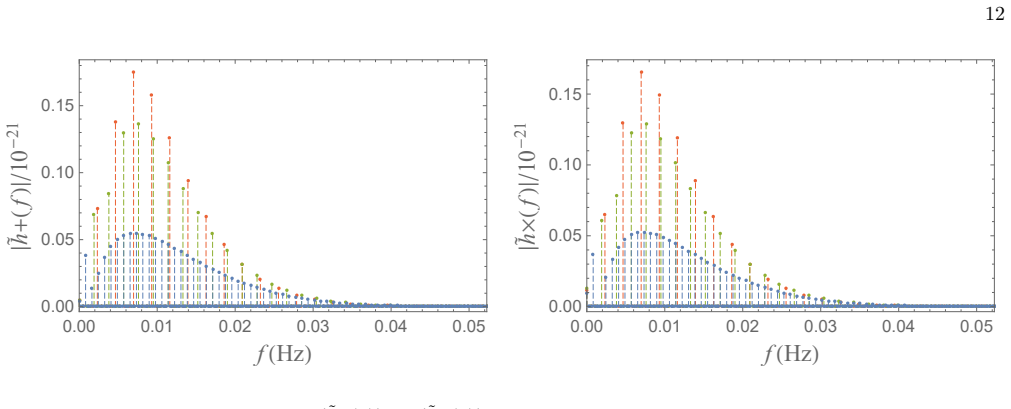
transform (DFT) to the time-domain gravitational wave- formsh + andh ×
The blue dotted line, the green dotdashed line and the red solid line correspond toξ= (1,0.5,0.1), respectively. transform (DFT) to the time-domain gravitational wave- formsh + andh ×. Such spectra provide a detailed ex- amination of the signal’s frequency distribution and are adopted to define the sensitivity curve of the detectors [97–100]. This curve s...
-
[3]
The blue dotted line, the green dotdashed line and the red solid line correspond toξ= (2,1,0.1), respectively. 10-10 10-7 10-4 0.1 100 10-28 10-24 10-20 10-16 10-12 f(Hz) Characteristic Strain eLISA LISA TaiJi TianQin LIGO DECIGO ASTROD-GW 10-10 10-7 10-4 0.1 100 10-28 10-24 10-20 10-16 10-12 f(Hz) Characteristic Strain ASTROD-GW eLISA LISA TianQin LIGO D...
-
[4]
reduce to the classical Schwarzschild case in GR. Up to first order ofe, the evolutions of the semi-latus rectum p(t)and the eccentricitye(t)is described by dp dt = L2 ˙E−E2 ˙Lz N4 ,(66) de dt = E′ 1 ˙Lz−˙EL′ 1 2eN4 +N5N6 2N 2 4 e,(67) N4 =L 2E′ 1−E2L′ 1,(68) N5 =L 2 ˙E−E2 ˙Lz,(69) N6 =E ′ 2L′ 1−E′ 1L′ 2,(70) where we again have ignored theO(e 2)terms. No...
-
[5]
B. P. Abbott et al. (LIGO Scientific, Virgo), Obser- vation of Gravitational Waves from a Binary Black Hole Merger, Phys. Rev. Lett.116, 061102 (2016), arXiv:1602.03837 [gr-qc]
work page internal anchor Pith review Pith/arXiv arXiv 2016
-
[6]
B.P.Abbott etal.(LIGOScientific, Virgo),GW151226: Observation of Gravitational Waves from a 22-Solar- Mass Binary Black Hole Coalescence, Phys. Rev. Lett. 116, 241103 (2016), arXiv:1606.04855 [gr-qc]
work page internal anchor Pith review Pith/arXiv arXiv 2016
-
[7]
B. P. Abbottet al. (LIGO Scientific, Virgo), Tests of general relativity with GW150914, Phys. Rev. Lett. 116, 221101 (2016), [Erratum: Phys.Rev.Lett. 121, 129902 (2018)], arXiv:1602.03841 [gr-qc]
work page internal anchor Pith review Pith/arXiv arXiv 2016
-
[8]
C. M. Will, Testing scalar - tensor gravity with gravita- tionalwaveobservationsofinspiralingcompactbinaries, Phys. Rev. D50, 6058 (1994), arXiv:gr-qc/9406022
work page internal anchor Pith review Pith/arXiv arXiv 1994
-
[9]
Gravitational Waves in Brans-Dicke Theory : Analysis by Test Particles around a Kerr Black Hole
M. Saijo, H.-a. Shinkai, and K.-i. Maeda, Gravitational waves in Brans-Dicke theory : Analysis by test particles around a Kerr black hole, Phys. Rev. D56, 785 (1997), arXiv:gr-qc/9701001
work page internal anchor Pith review Pith/arXiv arXiv 1997
-
[10]
Gravitational Wave Tests of General Relativity with Ground-Based Detectors and Pulsar Timing Arrays
N. Yunes and X. Siemens, Gravitational-Wave Tests of General Relativity with Ground-Based Detectors and Pulsar Timing-Arrays, Living Rev. Rel.16, 9 (2013), arXiv:1304.3473 [gr-qc]
work page internal anchor Pith review Pith/arXiv arXiv 2013
-
[11]
Testing General Relativity with Present and Future Astrophysical Observations
E. Bertiet al., Testing General Relativity with Present and Future Astrophysical Observations, Class. Quant. Grav.32, 243001 (2015), arXiv:1501.07274 [gr-qc]
work page internal anchor Pith review Pith/arXiv arXiv 2015
-
[12]
B. P. Abbottet al. (LIGO Scientific, Virgo), Tests of General Relativity with the Binary Black Hole Signals from the LIGO-Virgo Catalog GWTC-1, Phys. Rev. D 100, 104036 (2019), arXiv:1903.04467 [gr-qc]
work page internal anchor Pith review arXiv 2019
-
[13]
S. Brahma, C.-Y. Chen, and D.-h. Yeom, Testing Loop Quantum Gravity from Observational Consequences of Nonsingular Rotating Black Holes, Phys. Rev. Lett. 126, 181301 (2021), arXiv:2012.08785 [gr-qc]
-
[14]
R. Abbottet al. (LIGO Scientific, Virgo), Tests of gen- eral relativity with binary black holes from the second LIGO-Virgo gravitational-wave transient catalog, Phys. Rev. D103, 122002 (2021), arXiv:2010.14529 [gr-qc]
work page internal anchor Pith review arXiv 2021
- [15]
- [16]
-
[17]
Tests of General Relativity with GWTC-3
R. Abbott et al. (LIGO Scientific, VIRGO, KAGRA), Tests of General Relativity with GWTC-3, Phys. Rev. D112, 084080 (2025), arXiv:2112.06861 [gr-qc]
work page internal anchor Pith review Pith/arXiv arXiv 2025
- [18]
-
[19]
S. Yang, Y.-P. Zhang, T. Zhu, L. Zhao, and Y.- X. Liu, Gravitational waveforms from periodic orbits around a quantum-corrected black hole, JCAP01, 091, arXiv:2407.00283 [gr-qc]
-
[20]
Y.-Z. Li and X.-M. Kuang, The bound orbits and grav- itational waveforms of timelike particles around renor- malization group improved Kerr black holes, Eur. Phys. J. C86, 261 (2026), arXiv:2509.07333 [gr-qc]
-
[21]
J. Chen and J. Yang, Periodic orbits and gravitational waveforms in quantum-corrected black hole spacetimes, 17 Eur. Phys. J. C85, 726 (2025), arXiv:2505.02660 [gr- qc]
- [22]
- [23]
-
[24]
Introduction to Loop Quantum Gravity and Spin Foams
A. Perez, Introduction to loop quan- tum gravity and spin foams, in 2nd International Conference on Fundamental Interactions (2004) arXiv:gr-qc/0409061
work page internal anchor Pith review Pith/arXiv arXiv 2004
-
[25]
Loop Quantum Cosmology: A Status Report
A. Ashtekar and P. Singh, Loop Quantum Cosmol- ogy: A Status Report, Class. Quant. Grav.28, 213001 (2011), arXiv:1108.0893 [gr-qc]
work page internal anchor Pith review Pith/arXiv arXiv 2011
-
[26]
A. Ashtekar and E. Bianchi, A short review of loop quantum gravity, Rept. Prog. Phys.84, 042001 (2021), arXiv:2104.04394 [gr-qc]
-
[27]
Effective line elements and black-hole models in canonical (loop) quantum gravity
M. Bojowald, S. Brahma, and D.-h. Yeom, Effective line elements and black-hole models in canonical loop quantum gravity, Phys. Rev. D98, 046015 (2018), arXiv:1803.01119 [gr-qc]
work page internal anchor Pith review Pith/arXiv arXiv 2018
-
[28]
Quantum Transfiguration of Kruskal Black Holes
A. Ashtekar, J. Olmedo, and P. Singh, Quantum Trans- figuration of Kruskal Black Holes, Phys. Rev. Lett.121, 241301 (2018), arXiv:1806.00648 [gr-qc]
work page internal anchor Pith review Pith/arXiv arXiv 2018
- [29]
- [30]
- [31]
-
[32]
L. Modesto, Loop quantum black hole, Class. Quant. Grav.23, 5587 (2006), arXiv:gr-qc/0509078
work page internal anchor Pith review Pith/arXiv arXiv 2006
-
[33]
Black Holes in Loop Quantum Gravity
A. Perez, Black Holes in Loop Quantum Gravity, Rept. Prog. Phys.80, 126901 (2017), arXiv:1703.09149 [gr- qc]
work page internal anchor Pith review Pith/arXiv arXiv 2017
- [34]
- [35]
-
[36]
Zhang, Loop Quantum Black Hole, Universe9, 313 (2023), arXiv:2308.10184 [gr-qc]
X. Zhang, Loop Quantum Black Hole, Universe9, 313 (2023), arXiv:2308.10184 [gr-qc]
-
[37]
Modelling black holes with angular momentum in loop quantum gravity
E. Frodden, A. Perez, D. Pranzetti, and C. Röken, Modelling black holes with angular momentum in loop quantum gravity, Gen. Rel. Grav.46, 1828 (2014), arXiv:1212.5166 [gr-qc]
work page internal anchor Pith review Pith/arXiv arXiv 2014
-
[38]
Classical axisymmetric gravity in real Ashtekar variables
R. Gambini, E. Mato, J. Olmedo, and J. Pullin, Classical axisymmetric gravity in real Ashtekar variables, Class. Quant. Grav.36, 125009 (2019), arXiv:1812.05403 [gr-qc]
work page internal anchor Pith review Pith/arXiv arXiv 2019
-
[39]
R. Gambini, E. Mato, and J. Pullin, Axisymmet- ric gravity in real Ashtekar variables: the quan- tum theory, Class. Quant. Grav.37, 115010 (2020), arXiv:2001.02698 [gr-qc]
- [40]
- [41]
- [42]
- [43]
-
[44]
G. Mustafa, S. G. Ghosh, O. Donmez, S. K. Mau- rya, S. Orzuev, and F. Atamurotov, Testing quantum- corrected black holes with QPOs observations: a study of particle dynamics and accretion flow, JCAP10, 068, arXiv:2506.16405 [gr-qc]
-
[45]
Y. Sekhmani, H. Ali, S. G. Ghosh, and K. Boshkayev, Rotating charged nonsingular black holes in loop quan- tum gravity and their observational imprints from EHT, JHEAp49, 100425 (2026)
work page 2026
-
[46]
Applicability of the Newman-Janis Algorithm to Black Hole Solutions of Modified Gravity Theories
D. Hansen and N. Yunes, Applicability of the Newman- Janis Algorithm to Black Hole Solutions of Modified Gravity Theories, Phys. Rev. D88, 104020 (2013), arXiv:1308.6631 [gr-qc]
work page internal anchor Pith review Pith/arXiv arXiv 2013
-
[47]
Generating rotating regular black hole solutions without complexification
M. Azreg-Aïnou, Generating rotating regular black hole solutions without complexification, Phys. Rev. D90, 064041 (2014), arXiv:1405.2569 [gr-qc]
work page internal anchor Pith review Pith/arXiv arXiv 2014
-
[48]
Janis-Newman algorithm: generating rotating and NUT charged black holes
H. Erbin, Janis-Newman algorithm: generating rotating and NUT charged black holes, Universe3, 19 (2017), arXiv:1701.00037 [gr-qc]
work page internal anchor Pith review Pith/arXiv arXiv 2017
- [49]
-
[50]
P. Chaturvedi, U. Kumar, U. Thattarampilly, and V. Kakkat, Exact rotating black hole solutions for f(R) gravity by modified Newman Janis algorithm, Eur. Phys. J. C83, 1124 (2023), [Erratum: Eur.Phys.J.C 84, 1157 (2024)], arXiv:2309.17044 [gr-qc]
- [51]
- [52]
- [53]
-
[54]
S. Yang, W.-D. Guo, Q. Tan, L. Zhao, and Y.-X. Liu, Parametrized quasinormal frequencies and Hawk- 18 ing radiation for axial gravitational perturbations of a holonomy-corrected black hole, Phys. Rev. D110, 064051 (2024), arXiv:2406.15711 [gr-qc]
- [55]
- [56]
-
[57]
S. Sahu, K. Lochan, and D. Narasimha, Gravitational lensing by self-dual black holes in loop quantum gravity, Phys. Rev. D91, 063001 (2015), arXiv:1502.05619 [gr- qc]
work page internal anchor Pith review Pith/arXiv arXiv 2015
- [58]
-
[59]
S. Vagnozziet al., Horizon-scale tests of gravity theories and fundamental physics from the Event Horizon Tele- scope image of Sagittarius A, Class. Quant. Grav.40, 165007 (2023), arXiv:2205.07787 [gr-qc]
- [60]
-
[61]
Y. Huang and Z. Cao, Finite-distance gravitational de- flection of massive particles by a rotating black hole in loop quantum gravity, Eur. Phys. J. C83, 80 (2023), arXiv:2212.04254 [gr-qc]
-
[62]
R. Kumar Walia, Observational predictions of LQG mo- tivated polymerized black holes and constraints from Sgr A* and M87*, JCAP03, 029, arXiv:2207.02106 [gr- qc]
- [63]
- [64]
- [65]
-
[66]
Dong, The gravitational lensing by rotating black holes in loop quantum gravity, Nucl
Y. Dong, The gravitational lensing by rotating black holes in loop quantum gravity, Nucl. Phys. B1005, 116612 (2024)
work page 2024
- [67]
- [68]
- [69]
- [70]
- [71]
-
[72]
M. Alloqulov, Y. Isaqjonov, S. Shaymatov, and A. Jawad, Shadow and gravitational weak lensing around a quantum-corrected black hole surrounded by plasma, Chin. Phys. C49, 045104 (2025)
work page 2025
-
[73]
F. Mushtaq, X. Tiecheng, F. Javed, A. Ditta, B. Al- mutairi, G. Mustafa, and A. Hakimov, Impact of loop quantum gravity on gravitational lensing, thermal fluc- tuations, tidal force and geodesic deviation around a black hole, Eur. Phys. J. C85, 694 (2025), [Erratum: Eur.Phys.J.C 85, 877 (2025)]
work page 2025
-
[74]
A. Al-Badawi, F. Ahmed, T. Xamidov, S. Shaymatov, and İ. Sakallı, Shadow properties and orbital dynamics around an effective quantum-modified black hole sur- rounded by quintessential dark energy, arXiv preprint (2025), arXiv:2503.18027 [gr-qc]
- [75]
- [76]
-
[77]
Z.-L. Wang and E. Battista, Dynamical features and shadows of quantum Schwarzschild black hole in effec- tive field theories of gravity, Eur. Phys. J. C85, 304 (2025), arXiv:2501.14516 [gr-qc]
-
[78]
M. Alloqulov, S. Shaymatov, B. Ahmedov, and T. Zhu, Regular black hole’s impact on the gravitational wave- forms from periodic orbits, Eur. Phys. J. C86, 117 (2026), arXiv:2508.05245 [gr-qc]
- [79]
-
[80]
J. Chen and J. Yang, Motion of spinning particles around a quantum-corrected black hole without Cauchy horizons, arXiv preprint (2025), arXiv:2509.07682 [gr- qc]
discussion (0)
Sign in with ORCID, Apple, or X to comment. Anyone can read and Pith papers without signing in.