Recognition: unknown
Are X-ray Atmospheres Heated by Turbulent Dissipation? XRISM Constraints
Pith reviewed 2026-05-10 01:34 UTC · model grok-4.3
The pith
Turbulent dissipation from radio bubbles struggles to offset radiative cooling in Perseus and Virgo cluster atmospheres except near their centers.
A machine-rendered reading of the paper's core claim, the machinery that carries it, and where it could break.
Core claim
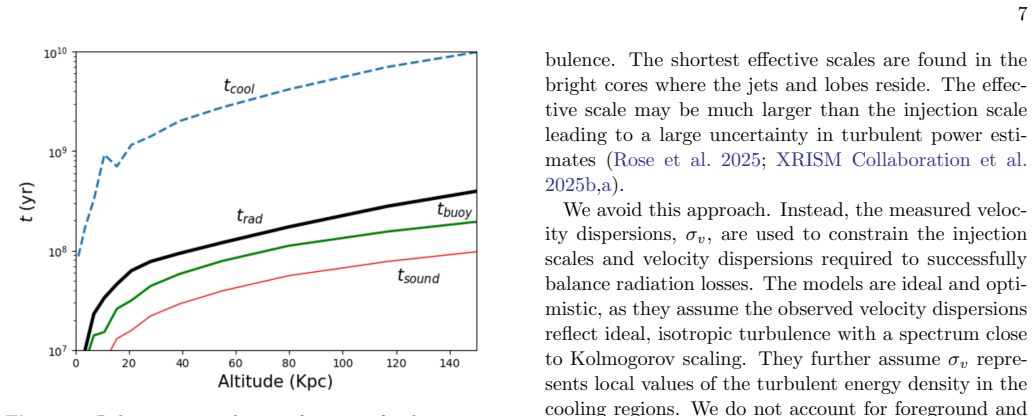
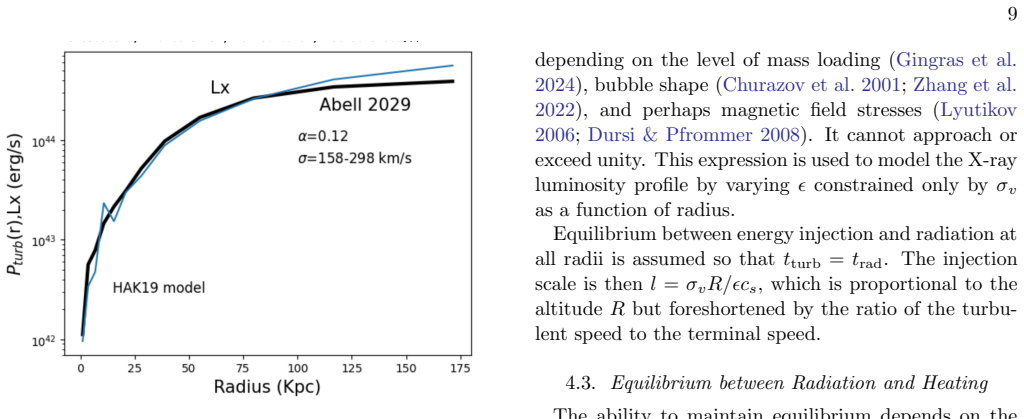
Assuming the measured velocity dispersions reflect jetted turbulence, up to roughly half the bubble enthalpy could dissipate into heat, yet a model balancing radiative losses against turbulent power from bubbles rising at terminal speeds shows that dissipation would struggle and probably fail to offset cooling in Perseus and Virgo except perhaps in their inner regions. The model is governed by the ratio of bubble terminal speed to atmospheric sound speed and requires bubbles to impart energy across a broad range of injection scales to reach the entire cooling volume. In the more powerful Hydra A system the level of turbulence may offset cooling over some of the volume. Several limiting因素—low
What carries the argument
A balance model for radiation losses and turbulent power injected by radio bubbles rising at terminal speeds, governed by the ratio of bubble terminal speed to atmospheric sound speed and anchored by XRISM velocity dispersion measurements.
If this is right
- Turbulent dissipation can offset cooling over only part of the volume in Hydra A and is insufficient in Perseus and Virgo beyond the inner regions.
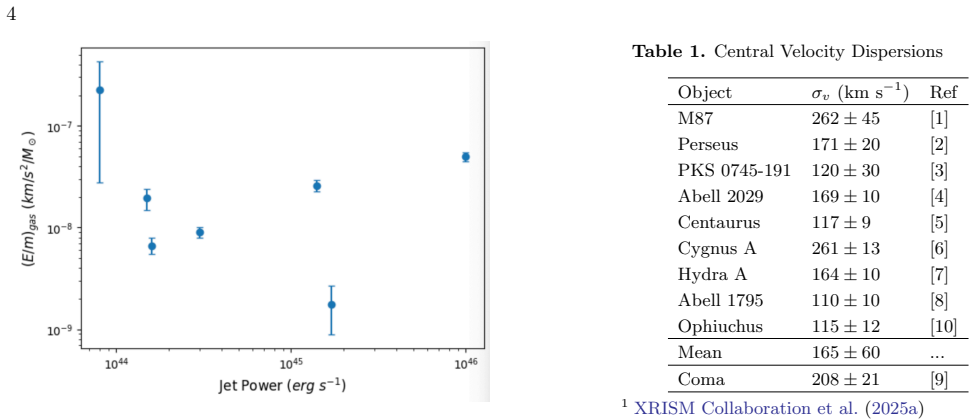
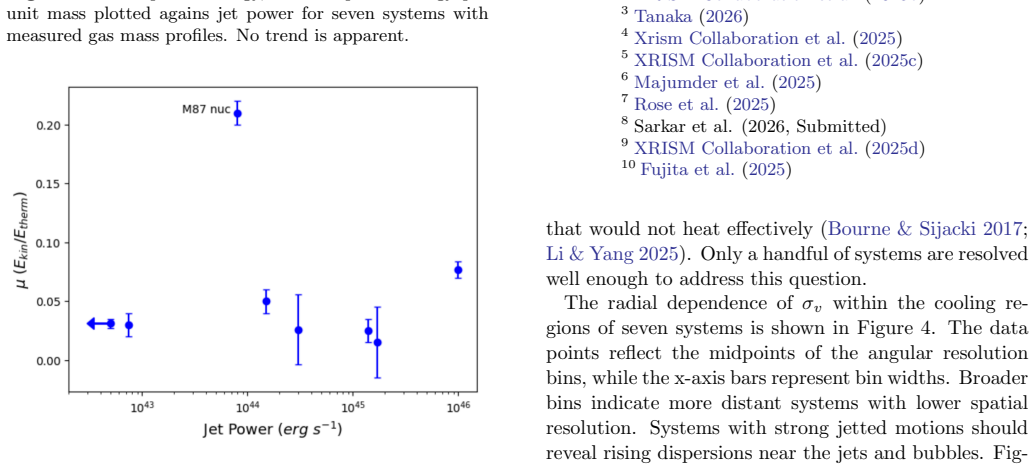
- Jets disperse their energy gently at roughly constant energy per gram of gas, with no trend between velocity dispersion and jet power over four decades.
- Bubbles must rise close to the sound speed and inject energy over a broad range of scales to heat the entire cooling volume.
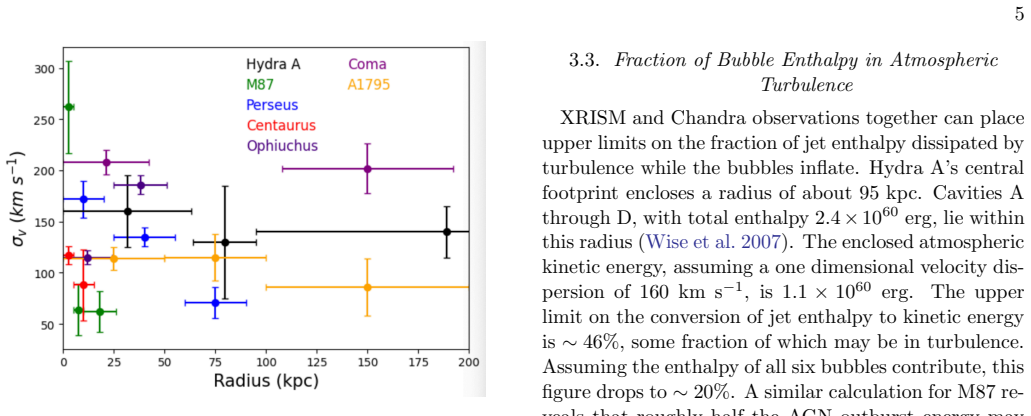
- Low velocity dispersions, small injection scales, short duty cycles, anisotropic injection, and long turbulent diffusion timescales challenge jetted turbulence heating models.
- A larger sample of spatially resolved cluster atmospheres is required to reach a definitive conclusion on whether turbulence can balance cooling.
Where Pith is reading between the lines
- Alternative heating channels such as sound waves, shocks, or cosmic-ray streaming may be needed to supplement turbulence in most of the cooling volume.
- AGN feedback models must incorporate multi-scale and anisotropic energy transfer rather than relying on isotropic turbulent dissipation.
- Observations that resolve velocity fields at larger radii in more clusters could test whether inner-region exceptions are common or rare.
- The absence of a trend with jet power suggests self-regulated coupling between bubbles and the surrounding gas that limits turbulence amplitude.
Load-bearing premise
That the observed central velocity dispersions represent turbulence driven by jets and bubbles, and that those bubbles rise near the sound speed while distributing energy over a wide range of scales across the full cooling volume.
What would settle it
A direct measurement showing velocity dispersions or turbulent diffusion rates high enough across the cooling radii of Perseus or Virgo for the integrated turbulent power to match the radiative cooling luminosity.
Figures




read the original abstract
We evaluate whether dissipation of turbulence injected into hot cluster atmospheres by jets and bubbles can offset radiative cooling flows. No trends are found between atmospheric velocity dispersion, $\sigma_v$, and either the ratio of kinetic to thermal energy or jet power over nearly four decades of jet power. Apparently, jets disperse their energy gently at roughly constant energy per gram of gas. Assuming the velocity dispersions at the centers of Perseus, Virgo, and Hydra A reflect jetted turbulence, up to roughly half the bubble enthalpy could be dissipated by turbulent motion. A model is presented that balances radiation losses and turbulent power injected by radio bubbles rising at their terminal speeds. The model is anchored by XRISM measurements of $\sigma_v$ and is governed by the ratio of the bubble's terminal speed to the atmospheric sound speed. Bubbles must rise close to the sound speed and impart energy with a broad range of injection scales to heat the entire cooling volume. The level of turbulence in the powerful Hydra A system may offset cooling over some of the cooling volume. However, turbulent dissipation would struggle and probably fail to balance cooling in Perseus and Virgo, except perhaps in their inner regions. Several factors including, low velocity dispersions, small injection scales, short duty cycles, anisotropic turbulence injection, and long turbulent diffusion timescales present severe challenges for jetted turbulence heating models. A larger sample of spatially resolved cluster atmospheres is needed to reach a definitive conclusion.
Editorial analysis
A structured set of objections, weighed in public.
Referee Report
Summary. The manuscript evaluates whether dissipation of turbulence injected by jets and bubbles can offset radiative cooling in galaxy cluster X-ray atmospheres. Using XRISM velocity dispersion measurements in Perseus, Virgo, and Hydra A, it reports no trends between σ_v and either the kinetic-to-thermal energy ratio or jet power over nearly four decades in power, interpreted as gentle, constant energy-per-gram dispersal. A model is presented that balances radiation losses against turbulent power from bubbles rising at terminal speeds, anchored to the XRISM σ_v data and governed by the v_term/c_s ratio. The analysis concludes that turbulent dissipation struggles and likely fails to balance cooling in Perseus and Virgo (except possibly inner regions) due to low dispersions, small injection scales, short duty cycles, anisotropy, and long diffusion times, while being more viable in Hydra A; a larger sample is needed.
Significance. If the attribution of observed σ_v to jetted turbulence is robust, the work offers timely constraints on AGN feedback models by quantifying limitations of turbulent heating scenarios in clusters. The use of new XRISM kinematic data and the reported absence of correlation with jet power are strengths that could inform simulations and future observations. The model provides a concrete, parameterized framework for testing bubble-driven turbulence. However, the overall significance is reduced by the load-bearing assumptions about the origin of σ_v and bubble dynamics, which limit the strength of the 'struggle to balance' conclusion.
major comments (3)
- [Abstract and data interpretation section] Abstract and § on data interpretation: The central claim that turbulent dissipation would struggle to balance cooling in Perseus and Virgo rests on attributing the XRISM σ_v values to jet-injected turbulence. The reported lack of correlation between σ_v and jet power (or kinetic-to-thermal ratio) over four decades is presented as evidence for gentle dispersal, but this absence is equally consistent with σ_v arising from unrelated processes (e.g., sloshing or mergers). Without independent justification or external benchmarks for the jet origin, the dissipation rate ρ σ_v³ / L cannot be attributed to bubbles, so the balance equation does not constrain jetted heating.
- [Model section] Model section (balance equation and conclusions): The model requires bubbles to rise close to the sound speed (v_term ≈ c_s) and impart energy over a broad range of injection scales to heat the full cooling volume. This ratio is a free parameter with no provided constraints, sensitivity analysis, or comparison to simulations/observations, yet it directly determines whether dissipation offsets cooling in Perseus/Virgo versus Hydra A. The quantitative claims about 'up to roughly half the bubble enthalpy' and failure except in inner regions are therefore under-supported.
- [Results and cluster-specific analysis] Results for Perseus, Virgo, and Hydra A: The assessments of cooling balance lack reported uncertainties on σ_v, explicit data selection criteria, definitions of cooling volumes, and step-by-step derivations of turbulent power versus radiative losses. This makes it impossible to evaluate the robustness of statements that dissipation 'would struggle and probably fail' or offsets cooling over 'some of the cooling volume'.
minor comments (2)
- [Abstract] The abstract states that 'up to roughly half the bubble enthalpy could be dissipated' without specifying the derivation or uncertainty on this fraction.
- [Throughout] Notation for σ_v, injection scale L, and the v_term/c_s ratio should be defined in a dedicated methods subsection or table to aid reproducibility.
Simulated Author's Rebuttal
We thank the referee for the constructive and detailed comments, which have helped us improve the clarity and robustness of the manuscript. We address each major comment point by point below. Revisions have been made where they strengthen the presentation without altering the core analysis or conclusions.
read point-by-point responses
-
Referee: [Abstract and data interpretation section] Abstract and § on data interpretation: The central claim that turbulent dissipation would struggle to balance cooling in Perseus and Virgo rests on attributing the XRISM σ_v values to jet-injected turbulence. The reported lack of correlation between σ_v and jet power (or kinetic-to-thermal ratio) over four decades is presented as evidence for gentle dispersal, but this absence is equally consistent with σ_v arising from unrelated processes (e.g., sloshing or mergers). Without independent justification or external benchmarks for the jet origin, the dissipation rate ρ σ_v³ / L cannot be attributed to bubbles, so the balance equation does not constrain jetted heating.
Authors: The manuscript explicitly conditions its analysis on the assumption that the XRISM-measured velocity dispersions reflect jetted turbulence, as stated in the abstract and data interpretation section. The reported absence of trends with jet power or kinetic-to-thermal ratio is interpreted, under this assumption, as evidence for gentle, roughly constant energy-per-gram dispersal by jets. We agree that sloshing, mergers, or other processes could contribute to the observed σ_v. However, the paper's purpose is to test the viability of jetted turbulence as a heating mechanism. If non-jet processes contribute significantly to σ_v, the turbulent power attributable specifically to jets would be lower than assumed, rendering it even less capable of balancing cooling. This reinforces rather than weakens the conclusion that jetted turbulence struggles in Perseus and Virgo. We have added clarifying text in the data interpretation section to emphasize the conditional nature of the attribution and to note possible non-jet contributions. revision: partial
-
Referee: [Model section] Model section (balance equation and conclusions): The model requires bubbles to rise close to the sound speed (v_term ≈ c_s) and impart energy over a broad range of injection scales to heat the full cooling volume. This ratio is a free parameter with no provided constraints, sensitivity analysis, or comparison to simulations/observations, yet it directly determines whether dissipation offsets cooling in Perseus/Virgo versus Hydra A. The quantitative claims about 'up to roughly half the bubble enthalpy' and failure except in inner regions are therefore under-supported.
Authors: The v_term/c_s ratio is a governing parameter in the model, as it controls both the terminal rise speed and the spatial scale over which energy is injected. The manuscript anchors the model to the observed σ_v and explores the consequences for heating balance. We have revised the model section to include an explicit sensitivity analysis varying v_term/c_s over a range (0.3–1.5) motivated by hydrodynamic simulations of buoyant bubbles in cluster atmospheres. This analysis confirms that only values near unity, combined with broad injection scales, allow partial offsets in systems like Hydra A, while low σ_v and limited scales prevent balance in Perseus and Virgo except possibly in the innermost regions. The estimate of up to roughly half the bubble enthalpy dissipated by turbulence follows from integrating the dissipation rate over the bubble rise timescale and comparing to the injected enthalpy; we have added the step-by-step derivation and references to relevant simulations for better support. revision: yes
-
Referee: [Results and cluster-specific analysis] Results for Perseus, Virgo, and Hydra A: The assessments of cooling balance lack reported uncertainties on σ_v, explicit data selection criteria, definitions of cooling volumes, and step-by-step derivations of turbulent power versus radiative losses. This makes it impossible to evaluate the robustness of statements that dissipation 'would struggle and probably fail' or offsets cooling over 'some of the cooling volume'.
Authors: We acknowledge that these supporting details were insufficiently explicit in the original submission. In the revised results section, we now report the published uncertainties on the XRISM σ_v measurements for each cluster, provide the explicit data selection criteria and radial apertures used, define the cooling volumes via standard cooling-time thresholds (t_cool < 1 Gyr and < 3 Gyr), and include step-by-step derivations of the turbulent power (ρ σ_v³ / L) relative to the radiative cooling rate, with all formulas, assumptions, and numerical values shown. These additions enable direct assessment of the robustness of the statements regarding balance in the different systems. revision: yes
Circularity Check
No significant circularity; conclusions follow from applying XRISM σ_v data to an explicit physical balance model under stated assumptions
full rationale
The paper reports an observational result (no trend between σ_v and jet power or kinetic-to-thermal ratio over four decades), states the explicit assumption that central σ_v values reflect jetted turbulence, and then evaluates a forward model balancing radiative losses against turbulent power governed by the ratio of bubble terminal speed to sound speed. Turbulent dissipation is computed from the measured σ_v (via quantities such as ρ σ_v³/L) and compared to cooling; the conclusion that dissipation struggles in Perseus and Virgo follows directly from inserting the observed low values. This is a data-driven application of a physical model rather than any reduction by construction, self-definition, fitted-input prediction, or load-bearing self-citation. No equations or steps in the abstract or summary collapse the output to the input by definition.
Axiom & Free-Parameter Ledger
free parameters (1)
- bubble terminal speed to sound speed ratio
axioms (2)
- domain assumption Velocity dispersions at cluster centers reflect turbulence injected by radio jets and bubbles
- domain assumption Bubbles rise at terminal speeds and inject energy over a broad range of scales
Reference graph
Works this paper leans on
-
[1]
Babul, A., Sharma, P., & Reynolds, C. S. 2013, ApJ, 768, 11, doi: 10.1088/0004-637X/768/1/11
-
[2]
Reynolds, C. S. 2018, MNRAS, 478, L44, doi: 10.1093/mnrasl/sly060
-
[3]
Bellomi, E., ZuHone, J. A., Truong, N., et al. 2025, arXiv e-prints, arXiv:2512.12754, doi: 10.48550/arXiv.2512.12754 Bˆ ırzan, L., McNamara, B. R., Nulsen, P. E. J., Carilli, C. L., & Wise, M. W. 2008, ApJ, 686, 859, doi: 10.1086/591416 Bˆ ırzan, L., Rafferty, D. A., McNamara, B. R., Wise, M. W., & Nulsen, P. E. J. 2004, ApJ, 607, 800, doi: 10.1086/383519
-
[4]
Bourne, M. A., & Sijacki, D. 2017, MNRAS, 472, 4707, doi: 10.1093/mnras/stx2269 —. 2021, MNRAS, 506, 488, doi: 10.1093/mnras/stab1662
-
[5]
T., Mellema, G., Pen, U.-L., et al
Bower, R. G., Benson, A. J., Malbon, R., et al. 2006, MNRAS, 370, 645, doi: 10.1111/j.1365-2966.2006.10519.x
-
[6]
Cavagnolo, K. W., McNamara, B. R., Nulsen, P. E. J., et al. 2010, ApJ, 720, 1066, doi: 10.1088/0004-637X/720/2/1066
-
[7]
2001, ApJ, 554, 261, doi: 10.1086/321357
Forman, W. 2001, ApJ, 554, 261, doi: 10.1086/321357
-
[8]
Churazov, E., Forman, W., Jones, C., & B¨ ohringer, H. 2000, A&A, 356, 788, doi: 10.48550/arXiv.astro-ph/0002375
work page internal anchor Pith review doi:10.48550/arxiv.astro-ph/0002375 2000
-
[9]
Churazov, E., Vikhlinin, A., Zhuravleva, I., et al. 2012, MNRAS, 421, 1123, doi: 10.1111/j.1365-2966.2011.20372.x
-
[10]
2018, A&A, 617, A58, doi: 10.1051/0004-6361/201832582
Volonteri, M. 2018, A&A, 617, A58, doi: 10.1051/0004-6361/201832582
-
[11]
Clarke, T. E., Blanton, E. L., & Sarazin, C. L. 2004, ApJ, 616, 178, doi: 10.1086/424911 17
-
[12]
2008, A&A, 484, 51, doi: 10.1051/0004-6361:20078428
Colafrancesco, S., & Marchegiani, P. 2008, A&A, 484, 51, doi: 10.1051/0004-6361:20078428
-
[13]
2006, MNRAS, 366, 689, doi: 10.1111/j.1365-2966.2005.09908.x
Croton, D. J., Springel, V., White, S. D. M., et al. 2006, MNRAS, 365, 11, doi: 10.1111/j.1365-2966.2005.09675.x
-
[14]
Dennis, T. J., & Chandran, B. D. G. 2005, ApJ, 622, 205, doi: 10.1086/427424
-
[15]
Diehl, S., Li, H., Fryer, C. L., & Rafferty, D. 2008, ApJ, 687, 173, doi: 10.1086/591310
-
[16]
Donahue, M., & Voit, G. M. 2022, PhR, 973, 1, doi: 10.1016/j.physrep.2022.04.005
-
[17]
Dunn, R. J. H., & Fabian, A. C. 2006, MNRAS, 373, 959, doi: 10.1111/j.1365-2966.2006.11080.x
-
[18]
Dunn, R. J. H., Fabian, A. C., & Sanders, J. S. 2006, MNRAS, 366, 758, doi: 10.1111/j.1365-2966.2005.09928.x
-
[19]
Dursi, L. J., & Pfrommer, C. 2008, ApJ, 677, 993, doi: 10.1086/529371
-
[20]
2021, MNRAS, 503, 1327, doi: 10.1093/mnras/stab551
Ehlert, K., Weinberger, R., Pfrommer, C., & Springel, V. 2021, MNRAS, 503, 1327, doi: 10.1093/mnras/stab551
-
[21]
Fabian, A. C., Sanders, J. S., Allen, S. W., et al. 2003, MNRAS, 344, L43, doi: 10.1046/j.1365-8711.2003.06902.x
-
[22]
Fabian, A. C., Walker, S. A., Russell, H. R., et al. 2017, MNRAS, 464, L1, doi: 10.1093/mnrasl/slw170
-
[23]
Fabian, A. C., ZuHone, J. A., & Walker, S. A. 2022, MNRAS, 510, 4000, doi: 10.1093/mnras/stab3655
-
[24]
2005, ApJ, 635, 894, doi: 10.1086/429746
Forman, W., Nulsen, P., Heinz, S., et al. 2005, ApJ, 635, 894, doi: 10.1086/429746
-
[25]
Fournier, M., Grete, P., Br¨ uggen, M., Glines, F. W., & O’Shea, B. W. 2024, A&A, 691, A239, doi: 10.1051/0004-6361/202451031
-
[26]
2025, arXiv e-prints, arXiv:2507.00126, doi: 10.48550/arXiv.2507.00126
Kondo, M. 2025, arXiv e-prints, arXiv:2507.00126, doi: 10.48550/arXiv.2507.00126
-
[27]
2013, MNRAS, 432, 1434, doi: 10.1093/mnras/stt563
Fujita, Y., Kimura, S., & Ohira, Y. 2013, MNRAS, 432, 1434, doi: 10.1093/mnras/stt563
-
[28]
2023, Frontiers in Astronomy and Space Sciences, 10, 1138613, doi: 10.3389/fspas.2023.1138613
Ganguly, S., Li, Y., Olivares, V., et al. 2023, Frontiers in Astronomy and Space Sciences, 10, 1138613, doi: 10.3389/fspas.2023.1138613
-
[29]
Gaspari, M., McDonald, M., Hamer, S. L., et al. 2018, ApJ, 854, 167, doi: 10.3847/1538-4357/aaaa1b
-
[30]
2025, arXiv e-prints, arXiv:2511.10740, doi: 10.48550/arXiv.2511.10740
Gatuzz, E., Sanders, J., Liu, A., et al. 2025, arXiv e-prints, arXiv:2511.10740, doi: 10.48550/arXiv.2511.10740
-
[31]
2020, ApJ, 891, 1, doi: 10.3847/1538-4357/ab6a9d
Giacintucci, S., Markevitch, M., Johnston-Hollitt, M., et al. 2020, ApJ, 891, 1, doi: 10.3847/1538-4357/ab6a9d
-
[32]
Gingras, M.-J., Coil, A. L., McNamara, B. R., et al. 2024, ApJ, 977, 159, doi: 10.3847/1538-4357/ad822a
-
[33]
Gitti, M., Nulsen, P. E. J., David, L. P., McNamara, B. R., & Wise, M. W. 2011, ApJ, 732, 13, doi: 10.1088/0004-637X/732/1/13
-
[34]
Guo, F., & Oh, S. P. 2008, MNRAS, 384, 251, doi: 10.1111/j.1365-2966.2007.12692.x
-
[35]
Heckman, T. M., & Best, P. N. 2014, ARA&A, 52, 589, doi: 10.1146/annurev-astro-081913-035722 —. 2023, Galaxies, 11, 21, doi: 10.3390/galaxies11010021
work page internal anchor Pith review doi:10.1146/annurev-astro-081913-035722 2014
-
[36]
Heinz, S., Br¨ uggen, M., Young, A., & Levesque, E. 2006, MNRAS, 373, L65, doi: 10.1111/j.1745-3933.2006.00243.x
-
[37]
2016, MNRAS, 455, 2139, doi: 10.1093/mnras/stv2483 —
Hillel, S., & Soker, N. 2016, MNRAS, 455, 2139, doi: 10.1093/mnras/stv2483 —. 2020, ApJ, 896, 104, doi: 10.3847/1538-4357/ab9109 Hitomi Collaboration, Aharonian, F., Akamatsu, H., et al. 2018, PASJ, 70, 9, doi: 10.1093/pasj/psx138
-
[38]
Hogan, M. T., McNamara, B. R., Pulido, F. A., et al. 2017, ApJ, 851, 66, doi: 10.3847/1538-4357/aa9af3
-
[39]
2025, A&A, 697, A196, doi: 10.1051/0004-6361/202452888
Igo, Z., & Merloni, A. 2025, A&A, 697, A196, doi: 10.1051/0004-6361/202452888
-
[40]
Kirkpatrick, C. C., Gitti, M., Cavagnolo, K. W., et al. 2009, ApJL, 707, L69, doi: 10.1088/0004-637X/707/1/L69
-
[41]
Li, J.-L., & Yang, H.-Y. K. 2025, arXiv e-prints, arXiv:2511.23267, doi: 10.48550/arXiv.2511.23267
-
[42]
doi:10.1093/mnras/staf134 , eprint =
Li, M., McNamara, B. R., & Zhuravleva, I. 2025, MNRAS, 537, 2198, doi: 10.1093/mnras/staf134
-
[43]
2020, ApJL, 889, L1, doi: 10.3847/2041-8213/ab65c7
Li, Y., Gendron-Marsolais, M.-L., Zhuravleva, I., et al. 2020, ApJL, 889, L1, doi: 10.3847/2041-8213/ab65c7
-
[44]
T., Mellema, G., Pen, U.-L., et al
Lyutikov, M. 2006, MNRAS, 373, 73, doi: 10.1111/j.1365-2966.2006.10835.x
-
[45]
2025, arXiv e-prints, arXiv:2512.10167, doi: 10.48550/arXiv.2512.10167
Majumder, A., Heckman, T., Meunier, J., et al. 2025, arXiv e-prints, arXiv:2512.10167, doi: 10.48550/arXiv.2512.10167
-
[46]
Mathews, W. G., Brighenti, F., Buote, D. A., & Lewis, A. D. 2003, ApJ, 596, 159, doi: 10.1086/377596
-
[47]
Tremblay, G. R. 2018, ApJ, 858, 45, doi: 10.3847/1538-4357/aabace
-
[48]
doi:10.1146/annurev.astro.45.051806.110625 , eprint =
McNamara, B. R., & Nulsen, P. E. J. 2007, ARA&A, 45, 117, doi: 10.1146/annurev.astro.45.051806.110625
-
[49]
New Journal of Physics , keywords =
McNamara, B. R., & Nulsen, P. E. J. 2012, New J. Phys., 14, 055023, doi: 10.1088/1367-2630/14/5/055023
-
[50]
McNamara, B. R., Russell, H. R., Nulsen, P. E. J., et al. 2016, ApJ, 830, 79, doi: 10.3847/0004-637X/830/2/79
-
[51]
McNamara, B. R., Wise, M., Nulsen, P. E. J., et al. 2000, ApJL, 534, L135, doi: 10.1086/312662
-
[52]
2020, MNRAS, 493, 5838, doi: 10.1093/mnras/staa711
Mohapatra, R., Federrath, C., & Sharma, P. 2020, MNRAS, 493, 5838, doi: 10.1093/mnras/staa711
-
[53]
2022, MNRAS, 510, 3778, doi: 10.1093/mnras/stab3603
Mohapatra, R., Jetti, M., Sharma, P., & Federrath, C. 2022, MNRAS, 510, 3778, doi: 10.1093/mnras/stab3603
-
[54]
2019, MNRAS, 484, 4881, doi: 10.1093/mnras/stz328
Mohapatra, R., & Sharma, P. 2019, MNRAS, 484, 4881, doi: 10.1093/mnras/stz328
-
[55]
Nulsen, P. E. J., Hambrick, D. C., McNamara, B. R., et al. 2005, ApJL, 625, L9, doi: 10.1086/430945
-
[56]
2019, A&A, 631, A22, doi: 10.1051/0004-6361/201935350 18
Olivares, V., Salome, P., Combes, F., et al. 2019, A&A, 631, A22, doi: 10.1051/0004-6361/201935350 18
-
[57]
2024, Nature Astronomy, 8, 256, doi: 10.1038/s41550-023-02138-y
Oosterloo, T., Morganti, R., & Murthy, S. 2024, Nature Astronomy, 8, 256, doi: 10.1038/s41550-023-02138-y
-
[58]
Pulido, F. A., McNamara, B. R., Edge, A. C., et al. 2018, ApJ, 853, 177, doi: 10.3847/1538-4357/aaa54b
-
[59]
Wise, M. W. 2006, ApJ, 652, 216, doi: 10.1086/507672
-
[60]
Randall, S. W., Nulsen, P. E. J., Jones, C., et al. 2015, ApJ, 805, 112, doi: 10.1088/0004-637X/805/2/112
-
[61]
T., Mellema, G., Pen, U.-L., et al
Rebusco, P., Churazov, E., B¨ ohringer, H., & Forman, W. 2006, MNRAS, 372, 1840, doi: 10.1111/j.1365-2966.2006.10977.x
-
[62]
Reynolds, C. S., Balbus, S. A., & Schekochihin, A. A. 2015, ApJ, 815, 41, doi: 10.1088/0004-637X/815/1/41
-
[63]
Rose, T., McNamara, B. R., Meunier, J., et al. 2025, ApJ, 990, 42, doi: 10.3847/1538-4357/adf32d
-
[64]
Russell, H. R., McNamara, B. R., Fabian, A. C., et al. 2019, MNRAS, 490, 3025, doi: 10.1093/mnras/stz2719
-
[65]
arXiv , author =:2306.03141 , journal =
Ruszkowski, M., & Pfrommer, C. 2023, A&A Rv, 31, 4, doi: 10.1007/s00159-023-00149-2
-
[66]
Sanders, J. S., & Fabian, A. C. 2012, MNRAS, 421, 726, doi: 10.1111/j.1365-2966.2011.20348.x —. 2013, MNRAS, 429, 2727, doi: 10.1093/mnras/sts543
-
[67]
2025, PASJ, 77, S254, doi: 10.1093/pasj/psaf093
Sarkar, A., Miller, E., Ota, N., et al. 2025, PASJ, 77, S254, doi: 10.1093/pasj/psaf093
-
[68]
2008, ApJ, 686, 927, doi: 10.1086/591228
Scannapieco, E., & Br¨ uggen, M. 2008, ApJ, 686, 927, doi: 10.1086/591228
-
[69]
I., & Sunyaev, R
Shakura, N. I., & Sunyaev, R. A. 1973, A&A, 24, 337
1973
-
[70]
1990, Advances in Space Research, 10, 25, doi: 10.1016/0273-1177(90)90004-J
Sidi, C., & Dalaudier, F. 1990, Advances in Space Research, 10, 25, doi: 10.1016/0273-1177(90)90004-J
-
[71]
2008, A&A, 482, 97, doi: 10.1051/0004-6361:20078749
Simionescu, A., Werner, N., Finoguenov, A., B¨ ohringer, H., & Br¨ uggen, M. 2008, A&A, 482, 97, doi: 10.1051/0004-6361:20078749
-
[72]
2026, arXiv e-prints, arXiv:2603.16263
Tanaka, K. 2026, arXiv e-prints, arXiv:2603.16263. https://arxiv.org/abs/2603.16263
-
[73]
2017, MNRAS, 468, 3516, doi: 10.1093/mnras/stx590
Tang, X., & Churazov, E. 2017, MNRAS, 468, 3516, doi: 10.1093/mnras/stx590
-
[74]
2025, PASJ, 77, S1, doi: 10.1093/pasj/psaf023
Tashiro, M., Kelley, R., Watanabe, S., et al. 2025, PASJ, 77, S1, doi: 10.1093/pasj/psaf023
-
[75]
2024, A&A, 686, A200, doi: 10.1051/0004-6361/202348562
Truong, N., Pillepich, A., Nelson, D., et al. 2024, A&A, 686, A200, doi: 10.1051/0004-6361/202348562
-
[76]
Vantyghem, A. N., McNamara, B. R., Russell, H. R., et al. 2014, MNRAS, 442, 3192, doi: 10.1093/mnras/stu1030
-
[77]
2026, A&A, 705, A129, doi: 10.1051/0004-6361/202556070
Vazza, F., & Brunetti, G. 2026, A&A, 705, A129, doi: 10.1051/0004-6361/202556070
-
[78]
2012, A&A, 544, A103, doi: 10.1051/0004-6361/201118688
Vazza, F., Roediger, E., & Br¨ uggen, M. 2012, A&A, 544, A103, doi: 10.1051/0004-6361/201118688
-
[79]
Vernaleo, J. C., & Reynolds, C. S. 2006, ApJ, 645, 83, doi: 10.1086/504029
-
[80]
Vigneron, B., Hlavacek-Larrondo, J., Rhea, C. L., et al. 2024, ApJ, 962, 96, doi: 10.3847/1538-4357/ad0fd8
discussion (0)
Sign in with ORCID, Apple, or X to comment. Anyone can read and Pith papers without signing in.