Can radio occultations constrain Uranus or Neptune's internal rotation periods?
Pith reviewed 2026-05-10 01:02 UTC · model grok-4.3
The pith
Uranus's 1-bar polar radius is limited to a narrow range around 24,968.6 km by its total rotation rate.
A machine-rendered reading of the paper's core claim, the machinery that carries it, and where it could break.
Core claim
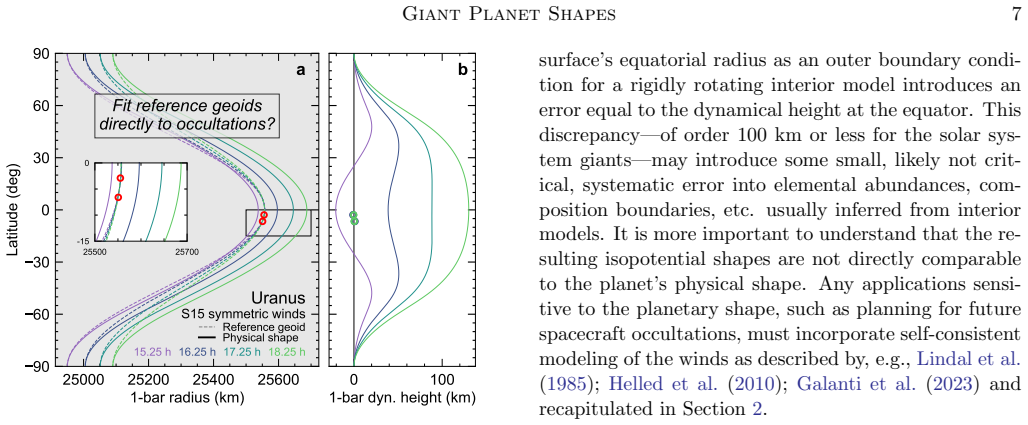
The isobaric shape of the ice giants depends on the total rotation of the isobaric surface. For Uranus this total is tightly constrained, producing a narrow consistent range for the 1-bar polar radius of 24,968.6±4.7 km irrespective of how the rotation is split between interior spin and winds. The magnetic periods give nonzero dynamical heights, and only interior periods near 15 h minimize those heights. Accurate modeling requires using the complete latitude-dependent rotation profile.
What carries the argument
The total rotation rate of the isobaric surface, which combines interior spin and atmospheric winds to determine the planetary shape via geodetic equations.
If this is right
- Radio occultations at multiple latitudes can test the assumption that winds represent the complete differential rotation.
- A permanent north-south asymmetry in Uranus winds would create a 5 km difference in polar radii detectable by occultations.
- Neptune allows radius variations of order 100 km due to wind uncertainties.
- Interior rotation periods near 15 hours minimize dynamical heights for both planets.
Where Pith is reading between the lines
- This suggests that shape data alone may not suffice to determine interior rotation without independent wind constraints.
- Future missions can use occultations to refine wind models or confirm asymmetries in Uranus's atmosphere.
- The requirement for full rotation profiles in radius fitting applies to any fluid planet with zonal winds.
Load-bearing premise
That the zonal winds observed in the atmosphere fully account for the differential rotation component that shapes the isobars.
What would settle it
A measured 1-bar polar radius for Uranus outside the range 24,968.6 ± 4.7 km would falsify the consistency between current wind, gravity, and shape data under the total rotation model.
Figures




read the original abstract
The shapes of fluid planets bear the signatures of rotational flattening and atmospheric flows. Precise knowledge of their shapes and wind profiles may therefore reveal their interior rotation rates. We re-examine this idea for the ice giants, where missions like the Uranus Orbiter and Probe could use radio occultations to measure atmospheric heights near 1 bar at multiple latitudes, complementing Voyager 2's near-equatorial constraint for Uranus. Applying geodetic calculations and considering zonal wind uncertainties, we find that only a narrow range for Uranus's 1-bar polar radius, $R_{\rm pol}=24,968.6\pm4.7$ km, is consistent with Uranus's winds, occultations, and gravity field, even treating Uranus's interior spin as a free parameter. This is because the isobaric shape depends on the total rotation of the isobaric surface, which is already well constrained by observations, irrespective of what portion is attributed to bulk rotation versus winds. Occultations will, however, be valuable for testing our underlying assumption that the winds manifest the full differential rotation that sets the shape. The apparent north-south asymmetry in Uranus's winds, if permanent, produces a 5-km difference between the northern and southern polar radii, measurable with suitable radio occultations. Neptune's much more uncertain winds yield ~100 km variations in polar and equatorial radii. We confirm that Uranus and Neptune's magnetic rotation periods yield nonzero mean dynamical heights for their atmospheres. Accurate results for Uranus and Neptune require that the full latitude-dependent rotation be incorporated when fitting radii from occultations. Only significantly faster interior rotation -- periods close to 15 h in both Uranus and Neptune -- would minimize their dynamical heights.
Editorial analysis
A structured set of objections, weighed in public.
Referee Report
Summary. The manuscript investigates whether radio occultations can constrain the internal rotation periods of Uranus and Neptune. Applying geodetic calculations while treating interior spin as a free parameter and incorporating zonal wind uncertainties, it concludes that only a narrow range for Uranus's 1-bar polar radius (R_pol = 24,968.6 ± 4.7 km) is consistent with existing winds, occultations, and gravity data. This follows because the isobaric shape depends on the total (bulk plus differential) rotation rate of the surface, which is already well constrained irrespective of how it is partitioned. For Neptune the more uncertain winds produce ~100 km variations in polar and equatorial radii. The paper also reports that magnetic rotation periods imply nonzero mean dynamical heights, that accurate radius fits require the full latitude-dependent rotation profile, and that occultations could test the key assumption that observed winds capture the complete differential rotation affecting shape. A possible 5 km north-south polar radius asymmetry for Uranus is noted as measurable.
Significance. If the results hold, the work provides concrete, quantitative guidance for mission planning (e.g., Uranus Orbiter radio occultations) by identifying a tight observable (polar radius to ~5 km precision) and a specific testable assumption about differential rotation. The explicit separation of total rotation from its bulk-versus-wind attribution, the prediction of a measurable 5 km asymmetry, and the confirmation of nonzero dynamical heights from magnetic periods are useful contributions to ice-giant interior studies. The framework of allowing interior spin to vary while deriving constraints from total rotation is a clear methodological strength.
major comments (3)
- [Abstract] Abstract: The central claim that 'only a narrow range for Uranus's 1-bar polar radius, R_pol=24,968.6±4.7 km, is consistent with Uranus's winds, occultations, and gravity field, even treating Uranus's interior spin as a free parameter' rests on the assumption that the observed zonal winds fully manifest the differential rotation that sets the isobaric shape. While the manuscript flags this assumption as testable by future occultations, it is load-bearing for the tightness of the quoted range; any unaccounted deep flows, vertical structure, or reference-frame mismatch would loosen the total-rotation constraint and reopen a wider interval of consistent R_pol values.
- [Results (Uranus)] Results section (Uranus analysis): The quoted ±4.7 km uncertainty on R_pol is stated to arise from wind uncertainties, yet the manuscript does not supply the explicit propagation (including covariance with the Voyager gravity harmonics and the single near-equatorial occultation datum) that would allow independent verification of the final error bar. Without this step the robustness of the 'narrow range' conclusion cannot be assessed quantitatively.
- [Discussion] Discussion: The statement that 'only significantly faster interior rotation—periods close to 15 h in both Uranus and Neptune—would minimize their dynamical heights' is presented without the intermediate dynamical-height equation or the reference radius against which the mean height is computed, making it impossible to reproduce or vary the 15 h threshold.
minor comments (2)
- [Abstract] The abstract and main text use R_pol without an explicit definition on first use; a short parenthetical (e.g., '1-bar polar radius') would improve readability.
- [Discussion] The north-south asymmetry prediction (5 km) is given without stating whether it assumes the wind profile is time-invariant or whether seasonal changes could alter the value.
Simulated Author's Rebuttal
We thank the referee for their constructive and detailed review, which has helped us improve the clarity and transparency of the manuscript. We address each major comment point by point below, indicating the revisions made to the text.
read point-by-point responses
-
Referee: [Abstract] Abstract: The central claim that 'only a narrow range for Uranus's 1-bar polar radius, R_pol=24,968.6±4.7 km, is consistent with Uranus's winds, occultations, and gravity field, even treating Uranus's interior spin as a free parameter' rests on the assumption that the observed zonal winds fully manifest the differential rotation that sets the isobaric shape. While the manuscript flags this assumption as testable by future occultations, it is load-bearing for the tightness of the quoted range; any unaccounted deep flows, vertical structure, or reference-frame mismatch would loosen the total-rotation constraint and reopen a wider interval of consistent R_pol values.
Authors: We agree that the quoted narrow range for R_pol assumes the observed zonal winds fully capture the differential rotation that contributes to the isobaric shape. The manuscript already states that occultations can test this assumption, and the core finding is that the total effective rotation (bulk plus differential) is tightly constrained by the combined data regardless of attribution. To address the concern directly, we have revised the abstract to state the assumption explicitly and added a paragraph in the Discussion section discussing potential impacts of unaccounted deep flows, vertical structure, or reference-frame mismatches. These revisions clarify the conditions under which the range holds without altering the central result that radio occultations primarily constrain total rotation rather than isolating internal spin. revision: yes
-
Referee: [Results (Uranus)] Results section (Uranus analysis): The quoted ±4.7 km uncertainty on R_pol is stated to arise from wind uncertainties, yet the manuscript does not supply the explicit propagation (including covariance with the Voyager gravity harmonics and the single near-equatorial occultation datum) that would allow independent verification of the final error bar. Without this step the robustness of the 'narrow range' conclusion cannot be assessed quantitatively.
Authors: The referee is correct that the explicit propagation details were not provided in the original manuscript. The ±4.7 km uncertainty was obtained through Monte Carlo sampling over literature-reported ranges for zonal wind speeds, with the Voyager gravity harmonics held fixed at their published values (including their uncertainties) and the single near-equatorial occultation treated as a fixed constraint. We have added a new paragraph in the Results section that describes this sampling procedure, the treatment of covariances (approximating gravity parameters as independent of wind uncertainties), and the incorporation of the occultation datum. This addition enables independent verification and strengthens the quantitative support for the narrow range under the stated assumptions. revision: yes
-
Referee: [Discussion] Discussion: The statement that 'only significantly faster interior rotation—periods close to 15 h in both Uranus and Neptune—would minimize their dynamical heights' is presented without the intermediate dynamical-height equation or the reference radius against which the mean height is computed, making it impossible to reproduce or vary the 15 h threshold.
Authors: We acknowledge that the dynamical height calculation was not presented with sufficient intermediate steps for full reproducibility. The mean dynamical height is the latitude-averaged deviation of the 1-bar isobar from a reference equipotential, with the reference radius taken as the mean 1-bar radius consistent with the gravity data. We have inserted the explicit equation for mean dynamical height (derived from the difference between the centrifugal potential of the total rotation profile and the gravitational potential) into the revised Discussion, along with the specific reference radii employed (25,559 km for Uranus and 24,766 km for Neptune). The 15 h threshold is obtained by solving for the interior period that reduces the mean dynamical height to near zero given the wind profile. This revision allows readers to reproduce and vary the threshold as requested. revision: yes
Circularity Check
No significant circularity in the derivation chain.
full rationale
The paper derives the narrow Uranus R_pol range from the dependence of isobaric shape on total (bulk + differential) rotation rate of the surface, which is stated to be already fixed by independent Voyager-era observations of winds, gravity, and equatorial occultations. Interior spin is explicitly treated as a free parameter whose value is not derived from the occultation data under test; instead, the total effective rotation is taken as an external constraint, and the resulting R_pol consistency range follows directly. The assumption that measured zonal winds represent the complete differential rotation component is flagged in the text as unvalidated and subject to future testing by occultations, rather than being defined into the result or smuggled via self-citation. No self-definitional steps, fitted inputs relabeled as predictions, load-bearing self-citations, or ansatz smuggling appear in the provided derivation. The argument is therefore self-contained against external benchmarks and receives the default non-circularity finding.
Axiom & Free-Parameter Ledger
free parameters (1)
- Uranus interior spin period
axioms (2)
- domain assumption The shape of the 1-bar isobaric surface is determined by the total angular velocity of that surface, including both bulk rotation and differential rotation from zonal winds.
- standard math Hydrostatic equilibrium governs the relationship between rotation and atmospheric shape for ice giants.
Reference graph
Works this paper leans on
-
[1]
Akins , A., Hofstadter , M., Butler , B., et al. 2023, Evidence of a Polar Cyclone on Uranus From VLA Observations , , 50, e2023GL102872, 10.1029/2023GL102872
-
[2]
Anderson , J. D., & Schubert , G. 2007, Saturn s Gravitational Field, Internal Rotation, and Interior Structure , Science, 317, 1384, 10.1126/science.1144835
-
[3]
Archinal , B. A., Acton , C. H., A'Hearn , M. F., et al. 2018, Report of the IAU Working Group on Cartographic Coordinates and Rotational Elements: 2015 , Celestial Mechanics and Dynamical Astronomy, 130, 22, 10.1007/s10569-017-9805-5
-
[4]
R., Helled , R., Parisi , M., Hubbard , W
Buccino , D. R., Helled , R., Parisi , M., Hubbard , W. B., & Folkner , W. M. 2020, Updated Equipotential Shapes of Jupiter and Saturn Using Juno and Cassini Grand Finale Gravity Science Measurements , Journal of Geophysical Research (Planets), 125, e06354, 10.1029/2019JE006354
-
[5]
Camisassa , M. E., & Featherstone , N. A. 2022, Solar-like to Antisolar Differential Rotation: A Geometric Interpretation , , 938, 65, 10.3847/1538-4357/ac879f
-
[6]
Cao , H., Dougherty , M. K., Hunt , G. J., et al. 2020, The landscape of Saturn's internal magnetic field from the Cassini Grand Finale , , 344, 113541, 10.1016/j.icarus.2019.113541
-
[7]
Caruso , A., Gomez Casajus , L., Smirnova , M., et al. 2025, Probing Jupiter's Atmosphere Through Juno Radio Occultations: Methodology and Initial Observations , , 52, e2024GL113231, 10.1029/2024GL113231
-
[8]
Connerney , J. E. P., Acuna , M. H., & Ness , N. F. 1987, The magnetic field of Uranus , , 92, 15329, 10.1029/JA092iA13p15329
-
[9]
1991, The magnetic field of Neptune , , 96, 19023, 10.1029/91JA01165
---. 1991, The magnetic field of Neptune , , 96, 19023, 10.1029/91JA01165
-
[10]
K., Rowe-Gurney , N., Orton , G
Dahl , E. K., Rowe-Gurney , N., Orton , G. S., et al. 2024, Atmospheric Science Questions for a Uranian Probe , , 220, 10, 10.1007/s11214-024-01046-5
-
[11]
Desch , M. D., Connerney , J. E. P., & Kaiser , M. L. 1986, The rotation period of Uranus , , 322, 42, 10.1038/322042a0
-
[12]
Duer-Milner , K., Gavriel , N., Galanti , E., Tziperman , E., & Kaspi , Y. 2025, From gas to ice giants: A unified mechanism for equatorial jets , Science Advances, 11, eads8899, 10.1126/sciadv.ads8899
-
[13]
Eshleman , V. R. 1973, The radio occultation method for the study of planetary atmospheres , , 21, 1521, 10.1016/0032-0633(73)90059-7
-
[14]
Foreman-Mackey , D., Hogg , D. W., Lang , D., & Goodman , J. 2013, emcee: The MCMC Hammer , , 125, 306, 10.1086/670067
-
[15]
French , R. G., Hedman , M. M., Nicholson , P. D., Longaretti , P.-Y., & McGhee-French , C. A. 2024, The Uranus system from occultation observations (1977-2006): Rings, pole direction, gravity field, and masses of Cressida, Cordelia, and Ophelia , , 411, 115957, 10.1016/j.icarus.2024.115957
-
[16]
French , R. G., McGhee , C. A., & Sicardy , B. 1998, Neptune's Stratospheric Winds from Three Central Flash Occultations , , 136, 27, 10.1006/icar.1998.6001
-
[17]
Friedson , A. J. 2020, Ice giant seismology: prospecting for normal modes , Philosophical Transactions of the Royal Society of London Series A, 378, 20190475, 10.1098/rsta.2019.047510.1002/essoar.10503888.1
work page doi:10.1098/rsta.2019.047510.1002/essoar.10503888.1 2020
-
[18]
J., Parisi , M., Mankovich, C
Friedson , A. J., Parisi , M., Mankovich, C. R., Hofstadter, M., & Akins, A. 2026, The prospects for gravitational seismology at Uranus with an orbiting spacecraft (in review), , 7, 0, 000
2026
-
[19]
Galanti , E., Kaspi , Y., & Guillot , T. 2023, The Shape of Jupiter and Saturn Based on Atmospheric Dynamics, Radio Occultations and Gravity Measurements , , 50, e2022GL102321, 10.1029/2022GL102321
-
[20]
2026, The size and shape of Jupiter , Nature Astronomy, 10.1038/s41550-026-02777-x
Galanti , E., Smirnova , M., Ziv , M., et al. 2026, The size and shape of Jupiter , Nature Astronomy, 10.1038/s41550-026-02777-x
-
[21]
Garc \' a-Melendo , E., P \'e rez-Hoyos , S., S \'a nchez-Lavega , A., & Hueso , R. 2011, Saturn's zonal wind profile in 2004-2009 from Cassini ISS images and its long-term variability , , 215, 62, 10.1016/j.icarus.2011.07.005
-
[22]
Gastine , T., Wicht , J., & Aurnou , J. M. 2013, Zonal flow regimes in rotating anelastic spherical shells: An application to giant planets , , 225, 156, 10.1016/j.icarus.2013.02.031
-
[23]
Gastine , T., Yadav , R. K., Morin , J., Reiners , A., & Wicht , J. 2014, From solar-like to antisolar differential rotation in cool stars , , 438, L76, 10.1093/mnrasl/slt162
-
[24]
Guendelman, I., & Kaspi, Y. 2025, An idealized general circulation model for the atmospheric circulation on the ice giants, Astronomy & Astrophysics, 702, A249, 10.1051/0004-6361/202554015
-
[25]
Helled , R., Anderson , J. D., & Schubert , G. 2010, Uranus and Neptune: Shape and rotation , , 210, 446, 10.1016/j.icarus.2010.06.037
-
[26]
Helled , R., Galanti , E., & Kaspi , Y. 2015, Saturn's fast spin determined from its gravitational field and oblateness , , 520, 202, 10.1038/nature14278
-
[27]
Helled , R., Schubert , G., & Anderson , J. D. 2009, Jupiter and Saturn rotation periods , , 57, 1467, 10.1016/j.pss.2009.07.008
-
[28]
Hess , S. L. G., Bonfond , B., Zarka , P., & Grodent , D. 2011, Model of the Jovian magnetic field topology constrained by the Io auroral emissions , Journal of Geophysical Research (Space Physics), 116, A05217, 10.1029/2010JA016262
-
[29]
Hofstadter , M., Helled , R., Stevenson , D. J., et al. 2024, Uranus Study Report: KISS , arXiv e-prints, arXiv:2412.01872, 10.48550/arXiv.2412.01872
-
[30]
Hubbard , W. B. 2013, Concentric Maclaurin Spheroid Models of Rotating Liquid Planets , , 768, 43, 10.1088/0004-637X/768/1/43
-
[31]
Jacobson , R. A. 2009, The Orbits of the Neptunian Satellites and the Orientation of the Pole of Neptune , , 137, 4322, 10.1088/0004-6256/137/5/4322
-
[32]
Karkoschka , E. 2015, Uranus' southern circulation revealed by Voyager 2: Unique characteristics , , 250, 294, 10.1016/j.icarus.2014.12.003
-
[33]
Kaspi , Y., Showman , A. P., Hubbard , W. B., Aharonson , O., & Helled , R. 2013, Atmospheric confinement of jet streams on Uranus and Neptune , , 497, 344, 10.1038/nature12131
-
[34]
Kurth , W. S., Averkamp , T. F., Gurnett , D. A., Groene , J. B., & Lecacheux , A. 2008, An update to a Saturnian longitude system based on kilometric radio emissions , Journal of Geophysical Research (Space Physics), 113, A05222, 10.1029/2007JA012861
-
[35]
Lamy , L., Prang \'e , R., Berthier , J., et al. 2025, A new rotation period and longitude system for Uranus , Nature Astronomy, 9, 658, 10.1038/s41550-025-02492-z
-
[36]
Lian, Y., & Showman, A. P. 2010, Generation of equatorial jets by large-scale latent heating on the giant planets, Icarus, 207, 373, 10.1016/j.icarus.2009.10.006
-
[37]
Lin , Z., Seager , S., & Weiss , B. P. 2025, Interior and Gravity Field Models for Uranus Suggest a Mixed-composition Interior: Implications for the Uranus Orbiter and Probe , , 6, 27, 10.3847/PSJ/ada124
-
[38]
Lindal , G. F. 1992, The Atmosphere of Neptune: an Analysis of Radio Occultation Data Acquired with Voyager 2 , , 103, 967, 10.1086/116119
-
[39]
Lindal , G. F., Lyons , J. R., Sweetnam , D. N., et al. 1987, The atmosphere of Uranus: Results of radio occultation measurements with Voyager 2 , , 92, 14987, 10.1029/JA092iA13p14987
-
[40]
Lindal , G. F., Sweetnam , D. N., & Eshleman , V. R. 1985, The atmosphere of Saturn - an analysis of the Voyager radio occultation measurements , , 90, 1136, 10.1086/113820
-
[41]
Lindal , G. F., Wood , G. E., Levy , G. S., et al. 1981, The atmosphere of Jupiter: an analysis of the Voyager radio occulation measurements , , 86, 8721, 10.1029/JA086iA10p08721
-
[42]
Lipa , B., & Tyler , G. L. 1979, Statistical and computational uncertainties in atmospheric profiles from radio occultation: Mariner 10 at Venus , , 39, 192, 10.1016/0019-1035(79)90163-5
-
[43]
2010, Mechanisms of Jet Formation on the Giant Planets , 10.1175/2010JAS3492.1
Liu, J., & Schneider, T. 2010, Mechanisms of Jet Formation on the Giant Planets , 10.1175/2010JAS3492.1
-
[44]
Mankovich, C., Akins, A., Buccino, D., Helled, R., & Parisi, M. 2026, giant-planet-geoids: A tool for calculating isobaric shapes of atmospheres undergoing zonally symmetric differential rotation, v1.1, Zenodo, 10.5281/zenodo.18023581
-
[45]
Mankovich , C., Marley , M. S., Fortney , J. J., & Movshovitz , N. 2019, Cassini Ring Seismology as a Probe of Saturn s Interior. I. Rigid Rotation , , 871, 1, 10.3847/1538-4357/aaf798
-
[46]
Mankovich , C. R., Dewberry , J. W., & Fuller , J. 2023, Saturn's Seismic Rotation Revisited , , 4, 59, 10.3847/PSJ/acc253
-
[47]
Mankovich , C. R., Parisi , M., Landau , D. F., & Dewberry , J. W. 2025 a , Isolating the Gravitational Influence of Uranus's Winds Requires Close Passages Inward of the Rings , , 6, 276, 10.3847/PSJ/ae1ae4
-
[48]
Mankovich , C. R., Friedson , A. J., Parisi , M., et al. 2025 b , Setting the Stage for Uranian Seismology from Rings and Radial Velocities , , 6, 70, 10.3847/PSJ/adb8eb
-
[49]
Militzer , B. 2024, Phase separation of planetary ices explains nondipolar magnetic fields of Uranus and Neptune , Proceedings of the National Academy of Science, 121, e2403981121, 10.1073/pnas.2403981121
-
[50]
Militzer , B., Wahl , S., & Hubbard , W. B. 2019, Models of Saturn's Interior Constructed with an Accelerated Concentric Maclaurin Spheroid Method , , 879, 78, 10.3847/1538-4357/ab23f0
-
[51]
Morf , L., M \"u ller , S., & Helled , R. 2024, The interior of Uranus: Thermal profile, bulk composition, and the distribution of rock, water, and hydrogen and helium , , 690, A105, 10.1051/0004-6361/202450698
-
[52]
Ness , N. F., Acuna , M. H., Behannon , K. W., et al. 1986, Magnetic Fields at Uranus , Science, 233, 85, 10.1126/science.233.4759.85
-
[53]
Ness , N. F., Acuna , M. H., Burlaga , L. F., et al. 1989, Magnetic Fields at Neptune , Science, 246, 1473, 10.1126/science.246.4936.1473
-
[54]
Nettelmann , N. 2017, Low- and high-order gravitational harmonics of rigidly rotating Jupiter , , 606, A139, 10.1051/0004-6361/201731550
-
[55]
Neuenschwander , B. A., & Helled , R. 2022, Empirical structure models of Uranus and Neptune , , 512, 3124, 10.1093/mnras/stac628
-
[56]
A., M \"u ller , S., & Helled , R
Neuenschwander , B. A., M \"u ller , S., & Helled , R. 2024, Uranus's complex internal structure , , 684, A191, 10.1051/0004-6361/202348028
-
[57]
Parisi , M., Friedson , A. J., Mankovich , C. R., et al. 2024, Uranus Orbiter and Probe: A Radio Science Investigation to Determine the Planet's Gravity Field, Depth of the Winds, and Tidal Deformations , , 5, 116, 10.3847/PSJ/ad4034
-
[58]
R., et al
Parisi , M., Kim , S., Mankovich , C. R., et al. 2026, A Multiarc Approach to Detecting Uranus Normal Modes via Doppler Tracking of a Planetary Orbiter (accepted , , 7, 0, 000
2026
-
[59]
Read , P. L., Dowling , T. E., & Schubert , G. 2009, Saturn's rotation period from its atmospheric planetary-wave configuration , , 460, 608, 10.1038/nature08194
-
[60]
and Nimmo, F
Simon, A. and Nimmo, F. and Anderson, R. C. 2021, Uranus Orbiter & Probe: Journey to an Ice Giant System
2021
-
[61]
Smirnova , M., Galanti , E., Caruso , A., et al. 2025, Probing Jupiter's Atmosphere Through Juno Radio Occultations: Analysis of the Atmospheric Thermal Structure , , 52, e2025GL116804, 10.1029/2025GL116804
-
[62]
Soderlund , K. M., & Stanley , S. 2020, The underexplored frontier of ice giant dynamos , Philosophical Transactions of the Royal Society of London Series A, 378, 20190479, 10.1098/rsta.2019.047910.1002/essoar.10503671.1
work page doi:10.1098/rsta.2019.047910.1002/essoar.10503671.1 2020
-
[63]
Soyuer , D., Neuenschwander , B., & Helled , R. 2023, Zonal Winds of Uranus and Neptune: Gravitational Harmonics, Dynamic Self-gravity, Shape, and Rotation , , 165, 27, 10.3847/1538-3881/aca08d
-
[64]
Soyuer , D., Soubiran , F., & Helled , R. 2020, Constraining the depth of the winds on Uranus and Neptune via Ohmic dissipation , , 498, 621, 10.1093/mnras/staa2461
-
[65]
Sromovsky , L. A., de Pater , I., Fry , P. M., Hammel , H. B., & Marcus , P. 2015, High S/N Keck and Gemini AO imaging of Uranus during 2012-2014: New cloud patterns, increasing activity, and improved wind measurements , , 258, 192, 10.1016/j.icarus.2015.05.029
-
[66]
Sromovsky , L. A., Fry , P. M., de Pater , I., & Hammel , H. B. 2024, The puzzling north polar region of Uranus: Continued zero-shear winds and increasing brightness from 2015 through 2022 according to 7 years of Keck AO imaging , , 420, 116186, 10.1016/j.icarus.2024.116186
-
[67]
Sromovsky , L. A., Limaye , S. S., & Fry , P. M. 1993, Dynamics of Neptune's Major Cloud Features , , 105, 110, 10.1006/icar.1993.1114
-
[68]
Stanley , S., & Bloxham , J. 2004, Convective-region geometry as the cause of Uranus' and Neptune's unusual magnetic fields , , 428, 151, 10.1038/nature02376
-
[69]
---. 2006, Numerical dynamo models of Uranus' and Neptune's magnetic fields , , 184, 556, 10.1016/j.icarus.2006.05.005
-
[70]
Stixrude , L., Baroni , S., & Grasselli , F. 2021, Thermal and Tidal Evolution of Uranus with a Growing Frozen Core , , 2, 222, 10.3847/PSJ/ac2a47
-
[71]
Tollefson , J., Pater , I. d., Marcus , P. S., et al. 2018, Vertical wind shear in Neptune's upper atmosphere explained with a modified thermal wind equation , , 311, 317, 10.1016/j.icarus.2018.04.009
-
[72]
Tollefson , J., Wong , M. H., Pater , I. d., et al. 2017, Changes in Jupiter's Zonal Wind Profile preceding and during the Juno mission , , 296, 163, 10.1016/j.icarus.2017.06.007
-
[73]
Warwick , J. W., Evans , D. R., Peltzer , G. R., et al. 1989, Voyager Planetary Radio Astronomy at Neptune , Science, 246, 1498, 10.1126/science.246.4936.1498
-
[74]
Weidenschilling , S. J., & Lewis , J. S. 1973, Atmospheric and cloud structures of the Jovian planets , , 20, 465, 10.1016/0019-1035(73)90019-5
-
[75]
N., & Trubitsyn , V
Zharkov , V. N., & Trubitsyn , V. P. 1978, Physics of Planetary Interiors (Tucson, AZ: Pachart)
1978
discussion (0)
Sign in with ORCID, Apple, or X to comment. Anyone can read and Pith papers without signing in.