Recognition: unknown
Cold molecular gas distribution and kinematics in the low-metallicity dusty starburst of Mrk 996 resolved with ALMA
Pith reviewed 2026-05-10 00:34 UTC · model grok-4.3
The pith
ALMA maps show compact molecular clouds offset from the starburst nucleus in low-metallicity galaxy Mrk 996, with narrow lines and no fast outflows.
A machine-rendered reading of the paper's core claim, the machinery that carries it, and where it could break.
Core claim
The central claim is that in this low-metallicity dusty starburst, cold molecular gas traced by CO exists in compact clouds displaced from the main star-forming site and highly ionized zones, exhibiting narrow lines indicative of dynamically perturbed but not outflowing gas, a low excitation ratio, and a total mass of several 10^7 solar masses derived from a metallicity-adjusted conversion factor, supporting the survival of dense molecular material in shielded regions amid strong feedback.
What carries the argument
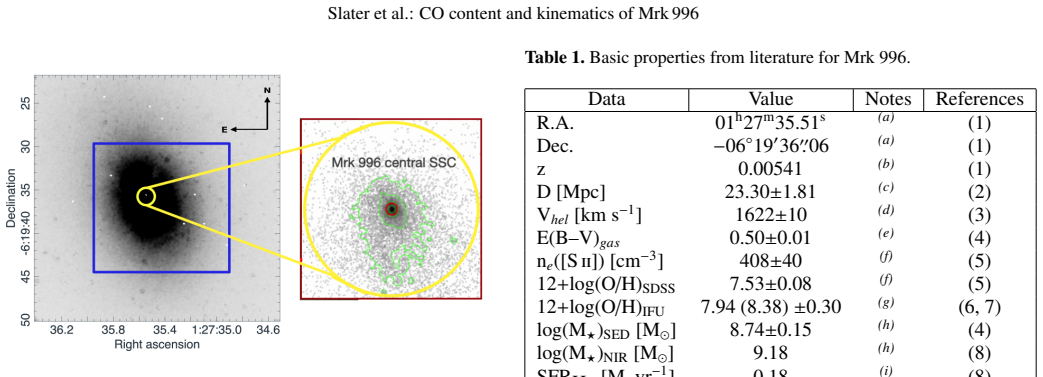
Spatially resolved ALMA CO(1-0) and CO(2-1) imaging compared to optical and UV maps of ionized gas and young stars, highlighting offsets and kinematic decoupling between phases.
If this is right
- The molecular phase remains largely unaffected by the stellar winds and radiation that shape the ionized gas kinematics.
- ALMA resolves only about half the total CO flux, implying a substantial extended low-brightness molecular component.
- The low R21 ratio indicates that the gas is not highly excited, consistent with cooler, denser conditions in low-metallicity environments.
- CO traces only the shielded dense clumps, with significant CO-dark H2 likely present in the envelopes.
Where Pith is reading between the lines
- Star formation in metal-poor galaxies may rely more on protected molecular reservoirs that decouple from ionized feedback.
- Independent tracers like far-infrared dust or atomic carbon lines could reveal the full extent of molecular gas missed by CO.
- Similar offset and multiphase patterns might appear in other Wolf-Rayet or dwarf starburst galaxies.
Load-bearing premise
The metallicity-dependent CO-to-H2 conversion factor gives an accurate total molecular mass despite the presence of a large CO-dark H2 component and possible local variations.
What would settle it
A direct measurement of the total H2 mass using an independent method, such as dust emission modeling or [C II] 158 micron emission, that yields a value inconsistent with the CO-derived mass by more than a factor of a few.
Figures


read the original abstract
Detecting cold molecular gas in metal-poor starbursts remains a major challenge. Low carbon and oxygen abundances hinder CO formation, while low dust content reduces shielding against UV photodissociation. Consequently, CO, the main tracer of molecular gas, becomes faint or undetectable. We study the spatial distribution and kinematics of cold molecular gas in Mrk 996, a nearby low-mass Wolf-Rayet galaxy hosting a dense, low-metallicity (about 1/5 solar) and nitrogen-enriched nuclear starburst with complex ionized gas kinematics. Using ALMA observations of CO(1-0) and CO(2-1), we map the morphology and kinematics of the molecular gas and compare them with optical and UV data, tracing the ionized gas and young stellar populations. We detect compact CO clouds within 800 pc of the starburst, spatially offset from the nuclear super star cluster (SSC) and the most highly ionized regions. The CO lines are narrow and supersonic, exhibiting velocity gradients with a mild global blueshift, indicating dynamically perturbed gas without evidence for fast outflows, in contrast with the highly ionized phase. The global CO(2-1)/CO(1-0) ratio is low (R21 ~ 0.3), consistent with subthermal excitation. The millimeter continuum peaks at the SSC, while CO emission is displaced toward obscured regions, suggesting it traces dense shielded clumps. ALMA recovers about half of the single-dish flux, indicating the presence of extended, low-surface-brightness molecular gas. Using a metallicity-dependent CO-to-H2 conversion factor, we infer a molecular gas mass of a few 10^7 solar masses. The molecular gas is only weakly coupled to the stellar feedback that dominates the ionized phase. Our results support a multiphase scenario in which dense molecular clumps survive in shielded regions, while CO is photodissociated in their envelopes, leaving a significant CO-dark H2 component (Abridged).
Editorial analysis
A structured set of objections, weighed in public.
Referee Report
Summary. The paper presents ALMA Band 3 and 6 observations of CO(1-0) and CO(2-1) in the low-metallicity (~1/5 Z_sun) starburst galaxy Mrk 996. It reports compact CO clouds detected within 800 pc of the nuclear starburst, spatially offset from the super star cluster (SSC) and the most highly ionized gas. The lines are narrow (supersonic but no fast outflows), show velocity gradients and a mild global blueshift, with a low global R21 ~ 0.3 indicating subthermal excitation. The mm continuum peaks at the SSC while CO is displaced toward obscured regions. ALMA recovers only ~half the single-dish flux. Using a metallicity-dependent CO-to-H2 conversion factor, the authors infer a molecular gas mass of a few 10^7 M_sun and argue for a multiphase ISM in which dense shielded clumps survive while CO is photodissociated in envelopes, leaving significant CO-dark H2.
Significance. The resolved ALMA imaging of CO morphology, kinematics, and line ratios in this low-metallicity environment is a clear strength and would be of interest to the field if the quantitative mass result can be placed on firmer footing. Direct detection of offset, dynamically perturbed molecular gas that is only weakly coupled to the ionized-phase feedback provides useful empirical input for multiphase ISM models in metal-poor starbursts.
major comments (2)
- [§4] §4 (molecular gas mass): The headline quantitative result—a molecular gas mass of a few 10^7 M_sun—is obtained by multiplying the observed CO(1-0) luminosity by a single metallicity-dependent X_CO. The text acknowledges both the ~50% missing flux and the presence of a significant CO-dark H2 component, yet provides neither a range of plausible X_CO values, a local calibration against dust continuum, nor an independent mass anchor. Because the CO emission is spatially offset from the SSC and the recovered flux is incomplete, local variations in shielding and excitation could alter the appropriate conversion factor by a factor of a few, directly affecting the claimed mass and the strength of the multiphase scenario.
- [§3.3] §3.3 and abstract (flux recovery and extended gas): The statement that ALMA recovers only half the single-dish flux is used to infer extended low-surface-brightness molecular gas, but the paper does not quantify how this missing flux is distributed relative to the compact clouds or whether it shares the same excitation and metallicity-dependent X_CO. This omission leaves open whether the total mass (and the CO-dark fraction) could be substantially higher.
minor comments (2)
- [Figure 2] Figure 2 (moment maps): The velocity gradient is described as 'mild global blueshift'; adding a quantitative measure (e.g., the fitted gradient in km/s/pc or the peak-to-peak velocity range) would make the kinematic claim more precise.
- Notation: The abstract and text use both 'R21 ~ 0.3' and 'CO(2-1)/CO(1-0) ratio'; consistent use of one symbol throughout would improve readability.
Simulated Author's Rebuttal
We thank the referee for their positive assessment of the ALMA imaging and kinematics in Mrk 996 and for the constructive comments on the quantitative mass estimate. We address each major point below and have revised the manuscript to strengthen the discussion of uncertainties.
read point-by-point responses
-
Referee: [§4] §4 (molecular gas mass): The headline quantitative result—a molecular gas mass of a few 10^7 M_sun—is obtained by multiplying the observed CO(1-0) luminosity by a single metallicity-dependent X_CO. The text acknowledges both the ~50% missing flux and the presence of a significant CO-dark H2 component, yet provides neither a range of plausible X_CO values, a local calibration against dust continuum, nor an independent mass anchor. Because the CO emission is spatially offset from the SSC and the recovered flux is incomplete, local variations in shielding and excitation could alter the appropriate conversion factor by a factor of a few, directly affecting the claimed mass and the strength of the multiphase scenario.
Authors: We agree that a range for X_CO would improve robustness. In the revised manuscript we add a dedicated paragraph in §4 citing recent low-metallicity calibrations that indicate X_CO can vary by factors of ~2–5 depending on local shielding and excitation. We explicitly state that the reported mass is an order-of-magnitude estimate and discuss how the observed spatial offset and 50% missing flux could change the effective conversion factor. We lack dust-continuum data for an independent local anchor in this dataset and will now highlight this limitation and its implications for the multiphase interpretation. revision: partial
-
Referee: [§3.3] §3.3 and abstract (flux recovery and extended gas): The statement that ALMA recovers only half the single-dish flux is used to infer extended low-surface-brightness molecular gas, but the paper does not quantify how this missing flux is distributed relative to the compact clouds or whether it shares the same excitation and metallicity-dependent X_CO. This omission leaves open whether the total mass (and the CO-dark fraction) could be substantially higher.
Authors: We accept that the properties of the missing flux require more explicit treatment. In the revised §3.3 we add a quantitative estimate assuming the extended component has comparable R21 and X_CO to the compact clouds, yielding a total molecular mass up to twice the compact value, and we discuss how this would increase the inferred CO-dark H2 fraction. We also note that the compact clouds likely trace the densest shielded phase while the extended gas may be more photodissociated, thereby clarifying the possible range for the total reservoir. revision: yes
Circularity Check
No significant circularity in derivation chain
full rationale
The paper derives its central results (CO morphology, kinematics, R21 ratio, and molecular gas mass) directly from ALMA interferometric observations of CO(1-0) and CO(2-1) lines in Mrk 996. The mass estimate applies a standard metallicity-dependent X_CO conversion factor drawn from the external literature to the measured CO luminosity, without any self-referential equations, fitted parameters that loop back to the observations, or load-bearing self-citations. The derivation chain remains independent of the paper's own outputs and is anchored in raw data plus established external relations, consistent with the default expectation for observational papers.
Axiom & Free-Parameter Ledger
free parameters (1)
- metallicity-dependent CO-to-H2 conversion factor
axioms (1)
- domain assumption CO emission traces dense molecular hydrogen in shielded regions
Reference graph
Works this paper leans on
-
[1]
2010, AJ, 140, 1194, doi: 10.1088/0004-6256/136/6/2846
The Star Formation Law in Nearby Galaxies on Sub-Kpc Scales. , keywords =. doi:10.1088/0004-6256/136/6/2846 , archivePrefix =. 0810.2541 , primaryClass =
-
[2]
The Dynamics of Radiation-pressure-dominated H II Regions. , keywords =. doi:10.1088/0004-637X/703/2/1352 , archivePrefix =. 0906.4343 , primaryClass =
-
[3]
Star Clusters Across Cosmic Time. , keywords =. doi:10.1146/annurev-astro-091918-104430 , archivePrefix =. 1812.01615 , primaryClass =
-
[4]
Wind from a starburst galaxy nucleus. , keywords =. doi:10.1038/317044a0 , adsurl =
-
[5]
2012, MNRAS, 427, 127, doi: 10.1111/j.1365-2966.2012.21948.x
On the fraction of star formation occurring in bound stellar clusters. , keywords =. doi:10.1111/j.1365-2966.2012.21923.x , archivePrefix =. 1208.2963 , primaryClass =
-
[6]
Deriving a multivariate _ CO conversion function using the [C II]/CO (1-0) ratio and its application to molecular gas scaling relations. , keywords =. doi:10.1093/mnras/stx1556 , archivePrefix =. 1702.03888 , primaryClass =
-
[7]
Cold dust and molecular gas towards the centers of Magellanic type galaxies and irregulars. I. The data. , keywords =. doi:10.1051/0004-6361:20031634 , adsurl =
-
[8]
Structural properties and scaling relations
The host in blue compact galaxies.. Structural properties and scaling relations. , keywords =. doi:10.1051/0004-6361/200809591 , archivePrefix =. 0903.2861 , primaryClass =
-
[9]
Scaling relations and the CO-to-H _ 2 conversion factor
Molecular gas in low-metallicity starburst galaxies:. Scaling relations and the CO-to-H _ 2 conversion factor. , keywords =. doi:10.1051/0004-6361/201526397 , archivePrefix =. 1512.06153 , primaryClass =
-
[10]
Dense Molecular Filaments Feeding a Starburst: ALMA Maps of CO(3-2) in Henize 2-10. , keywords =. doi:10.3847/1538-4357/aae481 , archivePrefix =. 1809.01339 , primaryClass =
-
[11]
Characterizing Extreme Emission-line Galaxies. I. A Four-zone Ionization Model for Very High-ionization Emission. , keywords =. doi:10.3847/1538-4357/ac141b , archivePrefix =. 2105.12765 , primaryClass =
-
[12]
CLASSY. IX. The Chemical Evolution of the Ne, S, Cl, and Ar Elements. , keywords =. doi:10.3847/1538-4357/ad34cf , archivePrefix =. 2403.08401 , primaryClass =
-
[13]
CLASSY XII: nitrogen enrichment shaped by gas density and feedback. , keywords =. doi:10.1093/mnras/staf1723 , archivePrefix =. 2507.11658 , primaryClass =
-
[14]
The COS Legacy Archive Spectroscopy Survey (CLASSY) Treasury Atlas. , keywords =. doi:10.3847/1538-4365/ac6c03 , archivePrefix =. 2203.07357 , primaryClass =
-
[15]
and Wolfire, Mark and Leroy, Adam K
The CO-to-H _ 2 Conversion Factor. , keywords =. doi:10.1146/annurev-astro-082812-140944 , archivePrefix =. 1301.3498 , primaryClass =
work page Pith review doi:10.1146/annurev-astro-082812-140944
-
[16]
Merger-induced metallicity dilution in cosmological galaxy formation simulations. , keywords =. doi:10.1093/mnras/sty1692 , archivePrefix =. 1712.03250 , primaryClass =
-
[17]
Multiband Analysis of a Sample of Blue Compact Dwarf Galaxies. I. Surface Brightness Distribution, Morphology, and Structural Parameters. , keywords =. doi:10.1086/320350 , adsurl =
-
[18]
The Relationship between Infrared, Optical, and Ultraviolet Extinction. , keywords =. doi:10.1086/167900 , adsurl =
-
[19]
N-enhancement in GN-z11: First evidence for supermassive stars nucleosynthesis in proto-globular clusters-like conditions at high redshift?. , keywords =. doi:10.1051/0004-6361/202346410 , archivePrefix =. 2303.07955 , primaryClass =
-
[20]
2024, ApJ, 972, 143, doi: 10.3847/1538-4357/ad5f88
JWST NIRSpec Spectroscopy of the Remarkable Bright Galaxy GHZ2/GLASS-z12 at Redshift 12.34. , keywords =. doi:10.3847/1538-4357/ad5f88 , archivePrefix =. 2403.10238 , primaryClass =
-
[21]
2017, A&A, 604, A53, doi: 10.1051/0004-6361/201730605
The final data release of ALLSMOG: a survey of CO in typical local low-M _ * star-forming galaxies. , keywords =. doi:10.1051/0004-6361/201730605 , archivePrefix =. 1705.05851 , primaryClass =
-
[22]
CARTA: Cube Analysis and Rendering Tool for Astronomy
-
[23]
ALMA Reveals Potential Localized Dust Enrichment from Massive Star Clusters in II Zw 40. , keywords =. doi:10.3847/2041-8205/833/1/L6 , archivePrefix =. 1611.09936 , primaryClass =
-
[24]
The nature of the interstellar medium of the starburst low-metallicity galaxy Haro 11: a multi-phase model of the infrared emission. , keywords =. doi:10.1051/0004-6361/201219818 , archivePrefix =. 1209.0804 , primaryClass =
-
[25]
A ground-based follow-up survey of CO(1-0), CO(2-1), and CO(3-2)
The molecular gas reservoir of 6 low-metallicity galaxies from the Herschel Dwarf Galaxy Survey. A ground-based follow-up survey of CO(1-0), CO(2-1), and CO(3-2). , keywords =. doi:10.1051/0004-6361/201322096 , archivePrefix =. 1401.0563 , primaryClass =
-
[26]
New ALMA constraints on the star-forming interstellar medium at low metallicity: a 50 pc view of the blue compact dwarf galaxy SBS 0335-052. , keywords =. doi:10.1093/mnrasl/slx034 , archivePrefix =. 1702.08467 , primaryClass =
-
[27]
The Herschel Dwarf Galaxy Survey. II. Physical conditions, origin of [C II] emission, and porosity of the multiphase low-metallicity ISM. , keywords =. doi:10.1051/0004-6361/201834457 , archivePrefix =. 1904.08434 , primaryClass =
-
[28]
CO(1-0), CO(2-1), and Neutral Gas in NGC 6946: Molecular Gas in a Late-Type, Gas-Rich, Spiral Galaxy. , keywords =. doi:10.1086/521645 , archivePrefix =. 0707.2636 , primaryClass =
-
[29]
Different Star Formation Laws for Disks Versus Starbursts at Low and High Redshifts. , keywords =. doi:10.1088/2041-8205/714/1/L118 , archivePrefix =. 1003.3889 , primaryClass =
-
[30]
doi:10.1111/j.1365-2966.2011.18805.x , eprint =
The reliability of [C II] as an indicator of the star formation rate. , keywords =. doi:10.1111/j.1365-2966.2011.19223.x , archivePrefix =. 1106.1643 , primaryClass =
-
[31]
New constraints on the ^ 12 CO(2-1)/(1-0) line ratio across nearby disc galaxies. , keywords =. doi:10.1093/mnras/stab859 , archivePrefix =. 2103.10442 , primaryClass =
-
[32]
CO Isotopologue-derived Molecular Gas Conditions and CO-to-H _ 2 Conversion Factors in M51. , keywords =. doi:10.3847/1538-3881/ad888a , archivePrefix =. 2410.21399 , primaryClass =
-
[33]
The IRAM M 33 CO(2-1) survey. A complete census of molecular gas out to 7 kpc. , keywords =. doi:10.1051/0004-6361/201423682 , archivePrefix =. 1405.5884 , primaryClass =
-
[34]
Warm Gas and Spatial Variations of Molecular Excitation in the Nuclear Region of IC 342. , keywords =. doi:10.1086/168252 , adsurl =
-
[35]
CO Excitation and its Connection to Star Formation at 200 pc in NGC 1365. , keywords =. doi:10.3847/1538-4357/ac8050 , archivePrefix =. 2207.05910 , primaryClass =
-
[36]
A CO molecular gas wind 340 pc away from the Seyfert 2 nucleus in ESO 420-G13 probes an elusive radio jet. , keywords =. doi:10.1051/0004-6361/201936552 , archivePrefix =. 1911.00015 , primaryClass =
-
[37]
Properties of the multiphase outflows in local (ultra)luminous infrared galaxies. , keywords =. doi:10.1093/mnras/stab1666 , archivePrefix =. 2006.13232 , primaryClass =
-
[38]
The Metallicity Dependence of the CO H _ 2 Conversion Factor in z >= 1 Star-forming Galaxies. , keywords =. doi:10.1088/0004-637X/746/1/69 , archivePrefix =. 1106.2098 , primaryClass =
-
[39]
doi:10.1111/j.1365-2966.2011.18805.x , eprint =
Searching for an intermediate-mass black hole in the blue compact dwarf galaxy MRK 996. , keywords =. doi:10.1111/j.1365-2966.2011.18248.x , archivePrefix =. 1009.5382 , primaryClass =
-
[40]
Palomar/Las Campanas Imaging Atlas of Blue Compact Dwarf Galaxies. II. Surface Photometry and the Properties of the Underlying Stellar Population. , keywords =. doi:10.1086/427068 , archivePrefix =. astro-ph/0410535 , primaryClass =
-
[41]
Systematic Difference between Ionized and Molecular Gas Velocity Dispersions in z 1-2 Disks and Local Analogs. , keywords =. doi:10.3847/1538-4357/abd5b9 , archivePrefix =. 2101.04122 , primaryClass =
-
[42]
On the relationship between molecular hydrogen and carbon monoxide abundances in molecular clouds. , keywords =. doi:10.1111/j.1365-2966.2010.17907.x , archivePrefix =. 1003.1340 , primaryClass =
-
[43]
The X _ CO Conversion Factor from Galactic Multiphase ISM Simulations. , keywords =. doi:10.3847/1538-4357/aab9af , archivePrefix =. 1803.09822 , primaryClass =
-
[44]
2024, A&A, 687, A244, doi: 10.1051/0004-6361/202449773
Molecular gas scaling relations for local star-forming galaxies in the low-M _ * regime. , keywords =. doi:10.1051/0004-6361/202449773 , archivePrefix =. 2402.18291 , primaryClass =
-
[45]
Kinematic Evidence of Minor Mergers in Normal SA Galaxies: NGC 3626, NGC 3900, NGC 4772, and NGC 5854. , keywords =. doi:10.1086/301457 , archivePrefix =. astro-ph/0004340 , primaryClass =
-
[46]
K., Garc´ıa-Burillo, S., Casasola, V., et al
Molecular depletion times and the CO-to-H _ 2 conversion factor in metal-poor galaxies. , keywords =. doi:10.1051/0004-6361/201526553 , archivePrefix =. 1509.04870 , primaryClass =
-
[47]
Physical conditions of the molecular gas in metal-poor galaxies. , keywords =. doi:10.1051/0004-6361/201731000 , archivePrefix =. 1704.05252 , primaryClass =
-
[48]
Gas, dust, and the CO-to-molecular gas conversion factor in low-metallicity starbursts. , keywords =. doi:10.1051/0004-6361/202245805 , archivePrefix =. 2305.03443 , primaryClass =
-
[49]
The Interstellar Medium in Dwarf Irregular Galaxies. , keywords =. doi:10.1146/annurev-astro-052722-104109 , archivePrefix =. 2402.17004 , primaryClass =
-
[50]
The size-density relation of extragalactic H II regions. , keywords =. doi:10.1051/0004-6361/200912020 , archivePrefix =. 0910.2804 , primaryClass =
-
[51]
Isobe, Y. and Maiolino, R. and D'Eugenio, F. and Curti, M. and Ji, X. and Juod. JADES: Nitrogen enhancement in high-redshift broad-line active galactic nuclei , journal =. 2025 , volume =. doi:10.1093/mnrasl/slaf007 , eprint =
-
[52]
Molecular gas in compact galaxies. , keywords =. doi:10.1051/0004-6361:20042237 , archivePrefix =. astro-ph/0504569 , primaryClass =
-
[53]
The Primordial Helium Abundance from a New Sample of Metal-deficient Blue Compact Galaxies. , keywords =. doi:10.1086/174843 , adsurl =
-
[54]
Journal of Astrophysics and Astronomy , keywords =
Devasthal Fast Optical Telescope Observations of Wolf Rayet Dwarf Galaxy Mrk 996. Journal of Astrophysics and Astronomy , keywords =. doi:10.1007/s12036-013-9182-8 , archivePrefix =. 1307.4594 , primaryClass =
-
[55]
2010, MNRAS, 401, 1670, doi: 10.1111/j.1365-2966.2009.15794.x
A VLT VIMOS study of the anomalous BCD Mrk996: mapping the ionized gas kinematics and abundances. , keywords =. doi:10.1111/j.1365-2966.2009.15172.x , archivePrefix =. 0903.2280 , primaryClass =
-
[56]
CLASSY. II. A Technical Overview of the COS Legacy Archive Spectroscopic Survey. , keywords =. doi:10.3847/1538-4365/ac8008 , archivePrefix =. 2206.01224 , primaryClass =
-
[57]
The Arizona Molecular ISM Survey with the SMT: Survey Overview and Public Data Release. , keywords =. doi:10.3847/1538-4357/ad7504 , archivePrefix =. 2408.02617 , primaryClass =
-
[58]
1998, ApJ, 498, 541, doi: 10.1086/305588
The Global Schmidt Law in Star-forming Galaxies. , keywords =. doi:10.1086/305588 , archivePrefix =. astro-ph/9712213 , primaryClass =
-
[59]
Star Formation in the Milky Way and Nearby Galaxies. , keywords =. doi:10.1146/annurev-astro-081811-125610 , archivePrefix =. 1204.3552 , primaryClass =
work page internal anchor Pith review doi:10.1146/annurev-astro-081811-125610
-
[60]
The Molecular Clouds Fueling A 1/5 Solar Metallicity Starburst. , keywords =. doi:10.3847/0004-637X/828/1/50 , archivePrefix =. 1607.01779 , primaryClass =
-
[61]
Mass, Luminosity, and Line Width Relations of Galactic Molecular Clouds. , keywords =. doi:10.1086/165493 , adsurl =
-
[62]
Turbulence and star formation in molecular clouds. , keywords =. doi:10.1093/mnras/194.4.809 , adsurl =
-
[63]
Dense Molecular Gas in the Nearby Low-metallicity Dwarf Starburst Galaxy IC 10. , keywords =. doi:10.3847/1538-4357/aacaf4 , archivePrefix =. 1806.07973 , primaryClass =
-
[64]
Physical Conditions in Molecular Clouds in the Arm and Interarm Regions of M51. , keywords =. doi:10.1088/0004-637X/761/1/41 , archivePrefix =. 1210.6349 , primaryClass =
-
[65]
Systematic Variations of CO J = 2-1/1-0 Ratio and Their Implications in The Nearby Barred Spiral Galaxy M83. , keywords =. doi:10.3847/2041-8213/ab70b7 , archivePrefix =. 2001.11043 , primaryClass =
-
[66]
The extraordinary hot molecular gas flow in the Eye of the NGC 4194 Medusa galaxy
Major impact from a minor merger. The extraordinary hot molecular gas flow in the Eye of the NGC 4194 Medusa galaxy. , keywords =. doi:10.1051/0004-6361/201732436 , archivePrefix =. 1712.04030 , primaryClass =
-
[67]
The effect of diffuse background on the spatially-resolved Schmidt relation in nearby spiral galaxies. , keywords =. doi:10.1051/0004-6361/201732467 , archivePrefix =. 1911.10211 , primaryClass =
-
[68]
An X-Ray + Radio Search for Massive Black Holes in Blue Compact Dwarf Galaxies. , keywords =. doi:10.3847/1538-4357/ab3289 , archivePrefix =. 1907.12585 , primaryClass =
-
[69]
First [N II]122 m Line Detection in a QSO-SMG Pair BRI 1202-0725 at z = 4.69. , keywords =. doi:10.3847/2041-8213/ab412e , archivePrefix =. 1909.02284 , primaryClass =
-
[70]
K., Walter, F., Brinks, E., et al
The Star Formation Efficiency in Nearby Galaxies: Measuring Where Gas Forms Stars Effectively. , keywords =. doi:10.1088/0004-6256/136/6/2782 , archivePrefix =. 0810.2556 , primaryClass =
-
[71]
K., Walter, F., Bigiel, F., et al
Heracles: The HERA CO Line Extragalactic Survey. , keywords =. doi:10.1088/0004-6256/137/6/4670 , archivePrefix =. 0905.4742 , primaryClass =
-
[72]
The EDGE-CALIFA Survey: Molecular and Ionized Gas Kinematics in Nearby Galaxies. , keywords =. doi:10.3847/1538-4357/aac2e5 , archivePrefix =. 1804.05853 , primaryClass =
-
[73]
[C II] 158 Micron Observations of IC 10: Evidence for Hidden Molecular Hydrogen in Irregular Galaxies. , keywords =. doi:10.1086/304247 , adsurl =
-
[74]
C., Cormier, D., Hony, S., et al
Tracing the total molecular gas in galaxies: [CII] and the CO-dark gas. , keywords =. doi:10.1051/0004-6361/202038860 , archivePrefix =. 2009.00649 , primaryClass =
-
[75]
Extreme N-emitters at high redshift: Possible signatures of supermassive stars and globular cluster or black hole formation in action. , keywords =. doi:10.1051/0004-6361/202347411 , archivePrefix =. 2307.04234 , primaryClass =
-
[76]
Superbubbles in Disk Galaxies. , keywords =. doi:10.1086/165936 , adsurl =
-
[77]
Astronomical Data Analysis Software and Systems XVI , year = 2007, editor =
CASA Architecture and Applications. Astronomical Data Analysis Software and Systems XVI , year = 2007, editor =
2007
-
[78]
CLASSY IV. Exploring UV Diagnostics of the Interstellar Medium in Local High-z Analogs at the Dawn of the JWST Era. , keywords =. doi:10.3847/1538-4357/ac952c , archivePrefix =. 2209.09047 , primaryClass =
-
[79]
CLASSY. VIII. Exploring the Source of Ionization with UV Interstellar Medium Diagnostics in Local High-z Analogs. , keywords =. doi:10.3847/1538-4357/ad1033 , archivePrefix =. 2306.15062 , primaryClass =
-
[80]
ALMA Observations toward the Starburst Dwarf Galaxy NGC 5253. I. Molecular Cloud Properties and Scaling Relations. , keywords =. doi:10.3847/1538-4357/aad69f , archivePrefix =. 1808.10089 , primaryClass =
discussion (0)
Sign in with ORCID, Apple, or X to comment. Anyone can read and Pith papers without signing in.