Recognition: unknown
Europa's Lyman-α emissions from HST/STIS observations
Pith reviewed 2026-05-09 23:38 UTC · model grok-4.3
The pith
Reanalysis of Hubble Lyman-alpha images finds no localized water vapor aurora on Europa.
A machine-rendered reading of the paper's core claim, the machinery that carries it, and where it could break.
Core claim
Emission from Europa's H exosphere is detected at all epochs but is attenuated when Europa's radial velocity relative to Earth is small. The velocity dependence yields an H-exosphere temperature of approximately 1000 K with an upper limit of 5100 K. For the best-constrained 2014-2015 data, the vertical H column density is 1.4 × 10^12 cm^{-2} and the source rate is 1.1 × 10^27 s^{-1}. After subtracting the full forward model, no localized emission residuals are found in any observation.
What carries the argument
A forward model that sums all known Lyman-alpha sources, including resonant scattering from Europa's atomic hydrogen exosphere, then subtracts the prediction from the observed images to reveal any localized anomalies.
If this is right
- Europa's hydrogen exosphere is global and persistent across more than two decades of observations.
- The temperature and column density of the exosphere are now constrained by the Doppler-shift dependence of Earth's absorption.
- No localized H2O aurora is required to explain any of the STIS data.
- Earlier reports of south-polar emission are explained by differences in disk positioning and omission of the exosphere component.
Where Pith is reading between the lines
- If water plumes exist, they must be either intermittent or too faint to produce detectable Lyman-alpha aurora under the conditions sampled here.
- The derived hydrogen source rate provides a benchmark for models of how Jupiter's magnetosphere erodes Europa's surface ice.
- Repeating similar forward-model subtractions on other planetary ultraviolet datasets may resolve conflicting reports of localized atmospheric features.
Load-bearing premise
The forward model captures every significant source of Lyman-alpha emission and the assumed position of Europa's disk on the detector is accurate enough to exclude localized residuals.
What would settle it
A new high-resolution Lyman-alpha image, after precise disk alignment and full exosphere subtraction, that shows a statistically significant localized residual bright spot would falsify the absence of localized aurora.
Figures




read the original abstract
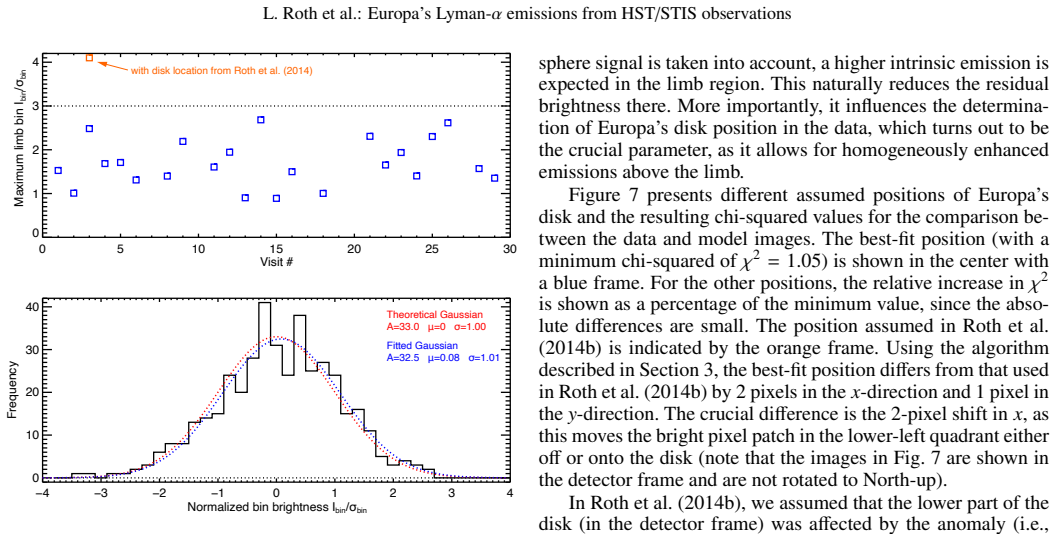
An image of Lyman-$\alpha$ (Ly$\alpha$) emission from Europa obtained with the Hubble Space Telescope Space Telescope Imaging Spectrograph (HST/STIS) has previously provided the first evidence of localized water vapor (H$_2$O) aurora, potentially originating from outgassing. Subsequent STIS observations have revealed the presence of a global atomic hydrogen (H) exosphere. We present a comprehensive analysis of STIS Ly$\alpha$ observations of Europa acquired in 1999 and between 2012 and 2020 to search for localized auroral emissions and constrain the properties of Europa's H exosphere. We analyze the complete dataset of STIS observations obtained when Europa was sunlit and not transiting Jupiter. A forward model is constructed to account for all known sources of Ly$\alpha$ emission, including resonantly scattered sunlight from Europa's H exosphere. To identify localized anomalies, such as H$_2$O aurora, the modeled Ly$\alpha$ emission is subtracted and the residuals are examined. Emission from Europa's H exosphere is detected at all observing epochs, but is attenuated by absorption in Earth's exosphere when Europa's radial velocity relative to Earth (and thus the Doppler shift) is small. From the velocity dependence of this attenuation, we estimate an H-exosphere temperature of $\sim 1000$ K and derive an upper limit of 5100 K. For the best-constrained epoch in 2014--2015, we infer a vertical H column density of $1.4x10^{12}$ cm$^{-2}$ and an H source rate of $1.1x10^{27}$ s$^{-1}$. No localized emission enhancements are detected in any of the observations, including the image previously interpreted as evidence of H$_2$O aurora near Europa's south pole. The discrepancy with earlier results arises primarily from differences in the assumed position of Europa's disk on the detector, as well as from the inclusion of an H-exosphere signal in the present analysis...
Editorial analysis
A structured set of objections, weighed in public.
Referee Report
Summary. The manuscript reanalyzes the full set of HST/STIS Lyman-α observations of sunlit, non-transiting Europa (1999 epoch plus 2012–2020). A forward model is constructed that includes resonantly scattered solar Lyα from a global atomic hydrogen exosphere (plus other known sources); this model is subtracted from the data to search for localized residuals. No localized emission enhancements are detected in any epoch, including the 1999 south-polar image previously interpreted as H₂O aurora. The discrepancy with earlier results is attributed to an incorrect assumed disk position on the detector and to the prior omission of the H-exosphere contribution. Velocity-dependent attenuation by Earth’s exosphere yields an H-exosphere temperature of ~1000 K (upper limit 5100 K); for the best-constrained 2014–2015 epoch the vertical H column is 1.4 × 10¹² cm⁻² and the H source rate is 1.1 × 10²⁷ s⁻¹.
Significance. If the no-localized-emission result is robust, the work resolves a long-standing discrepancy in the Europa aurora literature and supplies quantitative, velocity-constrained constraints on the atomic hydrogen exosphere from a complete, multi-epoch dataset. The forward-model subtraction approach and explicit treatment of Doppler-dependent attenuation are methodological strengths that could serve as a template for similar UV exosphere studies.
major comments (3)
- [Methods (disk positioning and residual analysis)] The procedure used to register Europa’s disk on the STIS detector (ephemeris projection, limb fitting, or centroiding) is not shown to be independent of the emission model itself. Because a sub-pixel offset can move apparent residuals on or off the south pole at the spatial scale of the previously claimed auroral feature, this step is load-bearing for the central “no localized emission” claim and requires explicit sensitivity tests or validation against an independent registration method.
- [Results (residual maps and statistical tests)] The forward model’s completeness is asserted but not quantified: residual maps are stated to be consistent with noise after subtraction of the H exosphere and other sources, yet no formal test (e.g., injection of synthetic localized sources or assessment of unmodeled instrumental or exospheric components) is presented to demonstrate that any plausible weak auroral signal would have been recovered.
- [H-exosphere parameter estimation] The temperature (~1000 K) and upper limit (5100 K) are derived from the velocity dependence of Earth-atmosphere attenuation, but the fitting procedure, covariance between the three free parameters (H temperature, vertical column density, source rate), and how the 5100 K limit is defined (e.g., 3σ, 95 % confidence) are not detailed; this affects the robustness of the quoted column density and source rate for the 2014–2015 epoch.
minor comments (3)
- [Abstract] The abstract reports an “upper limit of 5100 K” without stating the confidence level or statistical definition; this should be clarified in both abstract and main text.
- [Figures] Residual images should include per-pixel uncertainty maps or noise estimates so that the visual claim of “no detection” can be directly assessed by readers.
- [Results] A brief table summarizing the observing epochs, radial velocities, and derived H-exosphere parameters would improve readability.
Simulated Author's Rebuttal
We thank the referee for their careful review and constructive feedback on our manuscript. We address each of the major comments below and will revise the manuscript accordingly to incorporate the suggested improvements.
read point-by-point responses
-
Referee: The procedure used to register Europa’s disk on the STIS detector (ephemeris projection, limb fitting, or centroiding) is not shown to be independent of the emission model itself. Because a sub-pixel offset can move apparent residuals on or off the south pole at the spatial scale of the previously claimed auroral feature, this step is load-bearing for the central “no localized emission” claim and requires explicit sensitivity tests or validation against an independent registration method.
Authors: The disk registration procedure relies on ephemeris predictions and limb fitting to the observed brightness distribution in the raw data, performed prior to and independently of the emission model. We will add a dedicated subsection describing this process in detail. To address the concern about robustness, the revised manuscript will include explicit sensitivity tests applying sub-pixel offsets (±0.5 pixels) to the registered position and recomputing residuals, confirming that no localized south-polar feature emerges. We will also validate the results against an alternative centroiding approach for cross-check. revision: yes
-
Referee: The forward model’s completeness is asserted but not quantified: residual maps are stated to be consistent with noise after subtraction of the H exosphere and other sources, yet no formal test (e.g., injection of synthetic localized sources or assessment of unmodeled instrumental or exospheric components) is presented to demonstrate that any plausible weak auroral signal would have been recovered.
Authors: We agree that a quantitative demonstration of sensitivity strengthens the no-localized-emission conclusion. In the revised manuscript, we will add an analysis injecting synthetic localized sources (with intensities and spatial scales matching the previously reported auroral feature) at multiple positions, including the south pole, into the observed data. After applying the forward-model subtraction, we will report the recovery statistics and significance thresholds to show that any plausible weak auroral signal would have been detected above the noise. revision: yes
-
Referee: The temperature (~1000 K) and upper limit (5100 K) are derived from the velocity dependence of Earth-atmosphere attenuation, but the fitting procedure, covariance between the three free parameters (H temperature, vertical column density, source rate), and how the 5100 K limit is defined (e.g., 3σ, 95 % confidence) are not detailed; this affects the robustness of the quoted column density and source rate for the 2014–2015 epoch.
Authors: The parameter estimation uses a chi-squared minimization between the observed velocity-dependent attenuation profile and forward-model predictions, treating H temperature, vertical column density, and source rate as free parameters. In the revision, we will expand the methods to fully describe the fitting procedure, report the covariance matrix (or correlation coefficients) among the parameters, and explicitly state that the 5100 K value is the 3σ upper limit at which the model fails to reproduce the attenuation data. Revised values with uncertainties will be provided for the 2014–2015 epoch. revision: yes
Circularity Check
Forward modeling of known sources yields no circularity in no-detection result
full rationale
The paper builds a forward model that includes all stated Lyα sources (resonant scattering from the H exosphere plus other known contributions), subtracts it from the STIS data, and inspects residuals for localized anomalies. Column densities and source rates are derived directly from the velocity-dependent attenuation in the observed data after this subtraction. No equation defines a target quantity (residuals, column density, or source rate) in terms of itself or a fitted parameter that is then relabeled as a prediction. Disk-position differences with prior work are noted as an input assumption rather than an output of the model fit. The derivation chain therefore remains independent of the reported no-detection conclusion.
Axiom & Free-Parameter Ledger
free parameters (3)
- H exosphere temperature =
~1000 K (upper limit 5100 K)
- vertical H column density =
1.4e12 cm^{-2}
- H source rate =
1.1e27 s^{-1}
axioms (2)
- domain assumption All significant sources of Lyman-alpha emission from Europa and the background are included in the forward model.
- domain assumption The position of Europa's disk on the STIS detector can be determined with sufficient accuracy to exclude localized residuals.
Reference graph
Works this paper leans on
-
[1]
, keywords =
Science Overview of the Europa Clipper Mission. , keywords =
-
[2]
, keywords =
Galileo PLS Plasma Observations During the E12 Europa Flyby Refuting an Encounter With a Cryovolcanic Plume. , keywords =
-
[3]
, keywords =
Dissociative recombination of H ^ + _ 2 : Product state information and very large cross sections of vibrationally excited H ^ + _ 2. , keywords =
-
[4]
, keywords =
Europa's Sodium and Potassium Exosphere during Juno's Flyby. , keywords =
-
[5]
, keywords =
The Spatial Distribution and Temperature of Mercury's Potassium Exosphere. , keywords =
-
[6]
Photolysis and radiolysis of water ice on outer solar system bodies. , keywords =. doi:10.1029/97JE00068 , adsurl =
-
[7]
Sputtering and Molecular Synthesis Induced by 100 keV Protons in Condensed CO _ 2 and Relevance to the Outer Solar System. , keywords =. doi:10.1088/0004-637X/772/1/53 , adsurl =
-
[8]
8th Scientific Assembly of the IAGA, Uppsala, Sweden , Month = aug, Series =
-
[9]
, year = 2025, month = dec, doi =
Lyman- observations of Ganymede emerging from eclipse reveal a stable hydrogen exosphere. , year = 2025, month = dec, doi =
2025
-
[10]
Surface Science , keywords =
Sputtering of water ice by keV electrons at 60 K. Surface Science , keywords =
-
[11]
, keywords =
0.2 to 10 keV electrons interacting with water ice: Radiolysis, sputtering, and sublimation. , keywords =
-
[12]
AGU Fall Meeting Abstracts , volume=
NASA's Carruthers Geocorona Observatory: A new era of exospheric remote sensing , author=. AGU Fall Meeting Abstracts , volume=
-
[13]
AGU Fall Meeting Abstracts , year = 2024, series =
Retrieval of thermal atomic hydrogen density from Lyman-alpha emission measured by NASA's TIMED/GUVI and by NASA's Carruthers Geocorona Observatory. AGU Fall Meeting Abstracts , year = 2024, series =
2024
-
[14]
Ices in the Solar System , year = 1985, editor =
Sputtering of water ice at 30-140 K by 0.5-6.0 keV H(+) and Ne(+) ions. Ices in the Solar System , year = 1985, editor =
1985
-
[15]
European Physical Journal D , keywords =
Electron impact ionization in the icy Galilean satellites' atmospheres. European Physical Journal D , keywords =. doi:10.1140/epjd/s10053-023-00606-8 , archivePrefix =. 2301.11380 , primaryClass =
-
[16]
Plume Activity on Europa: Current Knowledge and Search Strategy for Europa Clipper. , keywords =. doi:10.3847/PSJ/adea6a , adsurl =
-
[17]
Endogenous CO _ 2 ice mixture on the surface of Europa and no detection of plume activity. Science , keywords =. doi:10.1126/science.adg4270 , adsurl =
-
[18]
2005 , publisher=
LASP interactive solar irradiance datacenter , author=. 2005 , publisher=
2005
-
[19]
Photodissociation and photoionisation of atoms and molecules of astrophysical interest. , keywords =. doi:10.1051/0004-6361/201628742 , archivePrefix =. 1701.04459 , primaryClass =
-
[20]
Solar-Cycle Variability Results from the Solar Radiation and Climate Experiment (SORCE) Mission. , keywords =. doi:10.1007/s11207-022-01980-z , adsurl =
-
[21]
Heliyon , volume=
The surface temperature of Europa , author=. Heliyon , volume=. 2019 , publisher=
2019
-
[22]
Frontiers in Astronomy and Space Sciences , keywords =
Comparison of terrestrial exospheric hydrogen 3D distributions at solar minimum and maximum using TWINS Lyman- observations. Frontiers in Astronomy and Space Sciences , keywords =
-
[23]
Journal of Geophysical Research (Space Physics) , keywords =
Lyman airglow emission: Implications for atomic hydrogen geocorona variability with solar cycle. Journal of Geophysical Research (Space Physics) , keywords =
-
[24]
Journal of Geophysical Research (Space Physics) , keywords =
Temporal Variability of Atomic Hydrogen From the Mesopause to the Upper Thermosphere. Journal of Geophysical Research (Space Physics) , keywords =
-
[25]
Journal of Geophysical Research (Space Physics) , keywords =
Observed and modeled solar cycle variation in geocoronal hydrogen using NRLMSISE-00 thermosphere conditions and the Bishop analytic exosphere model. Journal of Geophysical Research (Space Physics) , keywords =
-
[26]
and Katushkina, Olga A
Izmodenov, Vladislav V. and Katushkina, Olga A. and Quémerais, Eric and Bzowski, Maciej , editor =. Distribution of. Cross-. 2013 , doi =
2013
-
[27]
, keywords =
3D Monte-Carlo simulation of Ganymede's atmosphere. , keywords =
-
[28]
A patchy CO _ 2 exosphere on Ganymede revealed by the James Webb Space Telescope. , keywords =. doi:10.1051/0004-6361/202451599 , archivePrefix =
-
[29]
Earth and Space Science , keywords =
NRLMSIS 2.0: A Whole Atmosphere Empirical Model of Temperature and Neutral Species Densities. Earth and Space Science , keywords =
-
[30]
, keywords =
Uranus' hydrogen upper atmosphere: Insights from pre- and post-equinox HST Lyman- images. , keywords =
-
[31]
The Astrophysical Journal , volume=
Modeling Cassini UVIS Interplanetary Hydrogen Ly Observations from 1999 to 2017 , author=. The Astrophysical Journal , volume=. 2024 , publisher=
1999
-
[32]
Europa Voyager - Galileo SSI Global Mosaic 500m - https://astrogeology.usgs.gov/search/map/europa\_voyager\_galileo\_ssi\_global\_mosaic\_500m
United States Geological Survey. Europa Voyager - Galileo SSI Global Mosaic 500m - https://astrogeology.usgs.gov/search/map/europa\_voyager\_galileo\_ssi\_global\_mosaic\_500m
-
[33]
The Optical Aurorae of Europa, Ganymede, and Callisto. , keywords =. doi:10.3847/PSJ/acb53c , archivePrefix =. 2302.08487 , primaryClass =
-
[34]
Nature Astronomy , volume=
A measurement of water vapour amid a largely quiescent environment on Europa , author=. Nature Astronomy , volume=. 2020 , publisher=
2020
-
[35]
Geophysical Research Letters , volume=
Water-group pickup ions from Europa-genic neutrals orbiting Jupiter , author=. Geophysical Research Letters , volume=. 2022 , publisher=
2022
-
[36]
Nature Astronomy , volume=
Oxygen production from dissociation of Europa’s water-ice surface , author=. Nature Astronomy , volume=. 2024 , publisher=
2024
-
[37]
Geophysical Research Letters , volume=
Europa modifies Jupiter's plasma sheet , author=. Geophysical Research Letters , volume=. 2024 , publisher=
2024
-
[38]
Space Science Reviews , volume=
Towards a global unified model of Europa’s tenuous atmosphere , author=. Space Science Reviews , volume=. 2018 , publisher=
2018
-
[39]
COS Instrument Handbook v. 13.0. COS Instrument Handbook v. 13.0 , publisher =
-
[40]
Journal of Geophysical Research (Space Physics) , year = 2004, month = sep, volume =
Energetic ion characteristics and neutral gas interactions in Jupiter's magnetosphere. Journal of Geophysical Research (Space Physics) , year = 2004, month = sep, volume =
2004
-
[41]
, year = 1988, month = mar, volume =
Energy branching in the Io plasma torus: The failure of neutral cloud theory. , year = 1988, month = mar, volume =
1988
-
[42]
Probing Ganymede's Atmosphere with HST Ly Images in Transit of Jupiter. , keywords =. doi:10.3847/PSJ/acaf7f , archivePrefix =. 2301.05583 , primaryClass =
-
[43]
, keywords =
CHIANTI - an atomic database for emission lines. , keywords =
-
[44]
Version 8
CHIANTI - An atomic database for emission lines. Version 8. , keywords =
-
[45]
Journal of Geophysical Research (Space Physics) , keywords =
Io plasma torus ion composition: Voyager, Galileo, and Cassini. Journal of Geophysical Research (Space Physics) , keywords =
-
[46]
Journal of Geophysical Research (Planets) , keywords =
Survey of Galileo plasma observations in Jupiter's plasma sheet. Journal of Geophysical Research (Planets) , keywords =. doi:10.1002/2016JE005009 , adsurl =
-
[47]
Journal of Geophysical Research (Space Physics) , keywords =
Radial variation of sulfur and oxygen ions in the Io plasma torus as deduced from remote observations by Hisaki. Journal of Geophysical Research (Space Physics) , keywords =. doi:10.1002/2016JA023691 , adsurl =
-
[48]
Journal of Geophysical Research (Space Physics) , keywords =
The 3D Structure of Saturn Magnetospheric Neutral Tori Produced by the Enceladus Plumes. Journal of Geophysical Research (Space Physics) , keywords =. doi:10.1029/2020JA028775 , adsurl =
-
[49]
Journal of Geophysical Research (Space Physics) , keywords =
Enceladus plume variability and the neutral gas densities in Saturn's magnetosphere. Journal of Geophysical Research (Space Physics) , keywords =. doi:10.1029/2009JA015184 , adsurl =
-
[50]
Journal of Geophysical Research (Space Physics) , keywords =
Enceladus: A potential source of ammonia products and molecular nitrogen for Saturn's magnetosphere. Journal of Geophysical Research (Space Physics) , keywords =. doi:10.1029/2008JA013352 , adsurl =
-
[51]
, year = 2007, month = jun, volume =
Enceladus: The likely dominant nitrogen source in Saturn's magnetosphere. , year = 2007, month = jun, volume =. doi:10.1016/j.icarus.2006.12.007 , adsurl =
-
[52]
Discovery of nitrogen in Saturn's inner magnetosphere. , keywords =. doi:10.1029/2005GL022654 , adsurl =
-
[53]
A Stable H _ 2 O Atmosphere on Europa's Trailing Hemisphere From HST Images. , keywords =. doi:10.1029/2021GL094289 , adsurl =
-
[54]
Nature of the iogenic plasma source in Jupiter's magnetosphere. I. Circumplanetary distribution. , keywords =
-
[55]
Journal of Geophysical Research (Space Physics) , keywords =
Insight Into Io Enabled by Characterization of Its Neutral Oxygen Torus. Journal of Geophysical Research (Space Physics) , keywords =
-
[56]
, year = 2020, month = jul, volume =
The composition and structure of Enceladus' plume from the complete set of Cassini UVIS occultation observations. , year = 2020, month = jul, volume =. doi:10.1016/j.icarus.2019.113461 , adsurl =
-
[57]
Far UV spectroscopy at 3.5 A resolution
The ultraviolet dayglow at solar maximum 1. Far UV spectroscopy at 3.5 A resolution. , keywords =. doi:10.1029/JA090iA07p06594 , adsurl =
-
[58]
Cassini UVIS observations of the Io plasma torus. II. Radial variations. , keywords =. doi:10.1016/j.icarus.2004.04.016 , archivePrefix =. 1301.3813 , primaryClass =
-
[59]
First evidence for a Europa plasma torus. , keywords =. doi:10.1029/JA087iA10p08081 , adsurl =
-
[60]
, keywords =
Io s Atmosphere Silhouetted by Jupiter Ly. , keywords =
-
[61]
and Bagenal, F
Allegrini, F. and Bagenal, F. and Ebert, R. W. and Louarn, P. and McComas, D. J. and Szalay, J. R. and Valek, P. and Wilson, R. and Bolton, S. J. and Connerney, J. E. P. and Clark, G. and Duling, S. and Kurth, W. S. and Mauk, B. and Saur, J. and Waite, J. H. , title =. Geophysical Research Letters , volume =
-
[62]
, year = 2013, month = apr, volume =
JUpiter ICy moons Explorer (JUICE): An ESA mission to orbit Ganymede and to characterise the Jupiter system. , year = 2013, month = apr, volume =
2013
-
[63]
Journal of Geophysical Research (Planets) , keywords =
Callisto's Atmosphere: First Evidence for H _ 2 and Constraints on H _ 2 O. Journal of Geophysical Research (Planets) , keywords =. doi:10.1029/2022JE007294 , archivePrefix =. 2210.14511 , primaryClass =
-
[64]
Journal of Geophysical Research (Planets) , keywords =
Callisto's Atmosphere: First Evidence for H _ 2 and Constraints on H _ 2 O. Journal of Geophysical Research (Planets) , keywords =
-
[65]
, year = 1987, month = may, volume =
Types of planetary tori. , year = 1987, month = may, volume =
1987
-
[66]
, year = 2019, month = sep, volume =
Ultraviolet observation of Enceladus' plume in transit across Saturn, compared to Europa. , year = 2019, month = sep, volume =
2019
-
[67]
Earth and Space Science , keywords =
An Improved Lyman-Alpha Composite. Earth and Space Science , keywords =
-
[68]
An Empirical Model of the Variation of the Solar Lyman- Spectral Irradiance. , keywords =. doi:10.1002/2017GL076318 , adsurl =
-
[69]
Journal of Geophysical Research (Planets) , keywords =
Mapping the Brightness of Ganymede's Ultraviolet Aurora Using Hubble Space Telescope Observations. Journal of Geophysical Research (Planets) , keywords =
-
[70]
Science , year = 1996, month = jan, volume =
Evidence for Supersonic Turbulence in the Upper Atmosphere of Jupiter. Science , year = 1996, month = jan, volume =. doi:10.1126/science.273.5278.1085 , adsurl =
-
[71]
, keywords =
Jupiter's hydrogen bulge: A Cassini perspective. , keywords =
-
[72]
, year = 1980, month = sep, volume =
Spatial imaging of hydrogen Lyman-alpha emission from Jupiter. , year = 1980, month = sep, volume =
1980
-
[73]
The stratosphere of Jupiter. Jupiter. The Planet, Satellites and Magnetosphere , year = 2004, editor =
2004
-
[74]
Nature Astronomy , keywords =
A sublimated water atmosphere on Ganymede detected from Hubble Space Telescope observations. Nature Astronomy , keywords =
-
[75]
2022 , pages =
Ganymede’s tenuous atmosphere , author=. 2022 , pages =
2022
-
[76]
Copernicus measurements of the Lyman-alpha albedo of Jupiter. , keywords =. doi:10.1086/158080 , adsurl =
-
[77]
, year = 2007, month = oct, volume =
The H Lyman- emission line from the upper atmosphere of Jupiter: Parametric radiative transfer study and comparison with data. , year = 2007, month = oct, volume =. doi:10.1016/j.icarus.2007.03.013 , adsurl =
-
[78]
, year = 2008, month = sep, volume =
Electron impact dissociation of oxygen-containing molecules A critical review. , year = 2008, month = sep, volume =. doi:10.1016/j.physrep.2008.05.001 , adsurl =
-
[79]
, keywords =
Europa Neutral Torus Confirmation and Characterization Based on Observations and Modeling. , keywords =
-
[80]
, keywords =
Exogenic and endogenic albedo and color patterns on Europa. , keywords =
discussion (0)
Sign in with ORCID, Apple, or X to comment. Anyone can read and Pith papers without signing in.