Quantum many-body scars leading to time-translation symmetry breaking in kicked interacting spin models
Pith reviewed 2026-05-09 23:32 UTC · model grok-4.3
The pith
Period-doubling oscillations in a kicked long-range Ising model arise from a minority of Floquet states that break time-translation symmetry.
A machine-rendered reading of the paper's core claim, the machinery that carries it, and where it could break.
Core claim
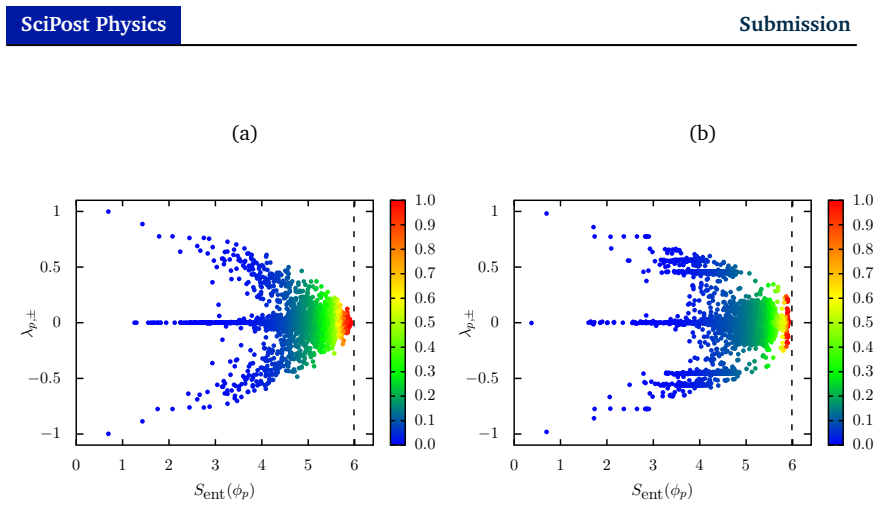
When period doubling is observed, the initial state overlaps with Floquet states showing time-translation symmetry breaking. These states form doublets with π-spectral pairing, highlighted by a π-spectral gap, and exhibit long-range order via the eigenvalues of the magnetization operator. Finite-size scaling of the π-shifted gap and magnetization eigenvalues indicates that the period-doubling oscillations persist for larger system sizes and last a time exponential in the system size. Although only a minority of Floquet states display this symmetry breaking, their number is exponential in system size, accounting for the effect across various initial conditions.
What carries the argument
Floquet eigenstate doublets with π-spectral pairing and magnetization long-range order, which carry the time-translation symmetry breaking responsible for period doubling.
If this is right
- Period-doubling oscillations can persist exponentially long in system size for appropriate initial states.
- The symmetry-breaking states are a minority but exponentially numerous, enabling the phenomenon from many starting configurations.
- Most Floquet states are thermal, resulting in weak ergodicity breaking akin to quantum scars.
- Initial states with domain walls or tilted spins both exhibit the period-doubling behavior.
Where Pith is reading between the lines
- Similar scar-induced symmetry breaking might appear in other periodically driven interacting spin models beyond long-range Ising.
- The mechanism could be tested by preparing specific initial states in quantum simulators and measuring the duration of oscillations.
- Connecting this to other forms of Floquet time crystals might reveal broader classes of non-ergodic driven systems.
Load-bearing premise
The finite-size scaling of the π-spectral gap and magnetization eigenvalues remains stable as system size grows, implying the oscillations do not decay faster than exponentially.
What would settle it
Numerical simulations on larger system sizes showing the π-spectral gap closing to zero or the magnetization eigenvalues becoming size-independent in a way that prevents long-time period doubling.
Figures




read the original abstract
We study an Ising model with long-range interactions undergoing a time-periodic kicking. For different initial states we observe persistent period doubling. When there is period doubling we find that the initial state has relevant overlap with Floquet states showing time-translation symmetry breaking, organized in doublets displaying $\pi$-spectral pairing (as highlighted by the $\pi$-spectral gap) and long-range order (as shown by the eigenvalues of the magnetization in the doublet). We observe period doubling for initial states with domain walls and tilted spins, and for the latter ones a finite-size scaling of the relevant $\pi$-shifted gap and magnetization eigenvalues suggests period-doubling oscillations persisting for larger system sizes and lasting a time exponential in the system size. We find that just a minority of Floquet states displays time-translation symmetry breaking while the rest is thermal, a weak-ergodicity breaking situation typical of systems with quantum scars. Although the time-translation symmetry breaking eigenstates are the minority, their number is exponential in the system size and this motivates the period doubling observed for many different initial states.
Editorial analysis
A structured set of objections, weighed in public.
Referee Report
Summary. The manuscript examines a long-range interacting Ising model subject to periodic kicking and reports the observation of persistent period-doubling dynamics in several classes of initial states. These dynamics are linked to the initial state's overlap with a subset of Floquet eigenstates that exhibit time-translation symmetry breaking, organized into π-paired doublets characterized by a π-spectral gap and long-range magnetic order. The authors note that while only a minority of Floquet states display this behavior, their number grows exponentially with system size, consistent with quantum many-body scars and weak ergodicity breaking. For initial states with tilted spins, finite-size scaling of the π-gap and magnetization eigenvalues is invoked to argue that the period-doubling persists for times exponential in system size.
Significance. If the reported exponential persistence of the period-doubling holds in the thermodynamic limit, the work would establish a mechanism by which quantum scars can produce long-lived time-translation symmetry breaking in driven spin systems. The exponential scaling of the number of scar states would explain why the effect is observable for a wide range of initial conditions, providing a new example of weak ergodicity breaking in Floquet settings with potential implications for understanding non-ergodic dynamics in periodically driven many-body systems.
major comments (1)
- [finite-size scaling discussion for tilted spins] The finite-size scaling analysis of the π-shifted gap and magnetization eigenvalues (as described for the tilted-spin initial states): the statement that this scaling 'suggests' period-doubling oscillations persisting for larger system sizes and lasting a time exponential in the system size is load-bearing for the headline claim of persistent TTSB. No quantitative details are supplied on the system sizes studied, the functional form assumed for the extrapolation, error bars, goodness-of-fit metrics, or explicit checks ruling out polynomial or saturating alternatives; without these the thermodynamic-limit behavior remains unverified.
minor comments (1)
- [abstract and results] The abstract and main text use the term 'relevant overlap' with the TTSB doublets without stating a quantitative threshold or overlap measure; specifying this criterion would aid reproducibility.
Simulated Author's Rebuttal
We thank the referee for their careful reading of our manuscript and for highlighting the importance of rigorous finite-size scaling to support the claim of persistent time-translation symmetry breaking. We address the major comment below and will revise the manuscript to incorporate additional quantitative details as requested.
read point-by-point responses
-
Referee: The finite-size scaling analysis of the π-shifted gap and magnetization eigenvalues (as described for the tilted-spin initial states): the statement that this scaling 'suggests' period-doubling oscillations persisting for larger system sizes and lasting a time exponential in the system size is load-bearing for the headline claim of persistent TTSB. No quantitative details are supplied on the system sizes studied, the functional form assumed for the extrapolation, error bars, goodness-of-fit metrics, or explicit checks ruling out polynomial or saturating alternatives; without these the thermodynamic-limit behavior remains unverified.
Authors: We agree that the finite-size scaling for tilted-spin initial states is central to the claim of exponentially long-lived period-doubling and that the current phrasing relies on an implicit extrapolation. The manuscript does not currently include the requested quantitative details. In the revised version we will expand this section to specify the system sizes used (up to the largest N accessible in our exact diagonalization), the functional form fitted to the π-gap and magnetization eigenvalues (typically an exponential decay with N), the fitting procedure with associated error bars, goodness-of-fit metrics, and explicit comparisons showing that polynomial or saturating forms are inconsistent with the data. These additions will make the evidence for thermodynamic-limit persistence transparent and address the concern directly. revision: yes
Circularity Check
No circularity: claims rest on direct Floquet numerics and finite-size observations
full rationale
The paper reports numerical observations of period-doubling dynamics, π-spectral pairing in Floquet doublets, and magnetization eigenvalues obtained from exact diagonalization of the kicked Ising model for finite chains. The finite-size scaling of the π-gap and order parameters is presented as suggestive evidence for exponential lifetimes rather than an analytical derivation or fitted prediction. No equations reduce a claimed result to a self-referential definition, a fitted input renamed as prediction, or a load-bearing self-citation chain. The derivation chain is self-contained against external benchmarks (exact diagonalization and time evolution) and does not invoke uniqueness theorems or ansatze from prior author work.
Axiom & Free-Parameter Ledger
axioms (2)
- standard math Floquet theory applies and the time-evolution operator can be diagonalized to obtain quasi-energies and eigenstates.
- domain assumption Finite-size numerical simulations faithfully capture the relevant spectral and dynamical features for the system sizes considered.
Reference graph
Works this paper leans on
-
[4]
Higher-order and fractional discrete time crystals in Floquet-driven Rydberg atoms , volume =
Liu, Bang and Zhang, Lihua and Wang, Qi-Feng and Ma, Yu and Han, Tian-Yu and Zhang, Jun and Zhang, Zheng-Yuan and Shao, Shi-Yao and Li, Qing and Chen, Han-Chao and Shi, Bao-Sen and Ding, D.-S , year =. Higher-order and fractional discrete time crystals in Floquet-driven Rydberg atoms , volume =. Nature Communications , doi =
-
[10]
Quantum Science and Technology , url=
Chen, Tianqi and Shen, Ruizhe and Lee, Ching Hua and Yang, Bo and Bomantara, Raditya Weda , title=. Quantum Science and Technology , url=. 2026 , abstract=
work page 2026
-
[11]
A Qudit-native Framework for Discrete Time Crystals , author=. 2025 , eprint=
work page 2025
- [15]
-
[53]
Exact quantum scars of frustrated hardcore bosons for cross-platform realizations , author=. 2026 , eprint=
work page 2026
-
[55]
Thermalization of exact quantum many-body scars in spin-1 XY chain under perturbation , author=. 2025 , eprint=
work page 2025
-
[56]
Quantum thermalization mechanism and the emergence of symmetry-breaking phases , author=. 2025 , eprint=
work page 2025
- [60]
-
[61]
Physical Review Letters , volume =
Theory of Dynamical Phase Transitions in Quantum Systems with Symmetry-Breaking Eigenstates , author =. Physical Review Letters , volume =. 2023 , month =. doi:10.1103/PhysRevLett.130.100402 , url =
-
[63]
Relaxation time as a control parameter for exploring dynamical phase diagrams , author =. Physical Review B , volume =. 2023 , month =. doi:10.1103/PhysRevB.108.174305 , url =
-
[64]
Mechanism of dynamical phase transitions: The complex-time survival amplitude , author =. Physical Review B , volume =. 2023 , month =. doi:10.1103/PhysRevB.107.094307 , url =
-
[65]
Journal of Physics A: Mathematical and Theoretical , volume =
Excited-state quantum phase transitions , author =. Journal of Physics A: Mathematical and Theoretical , volume =. 2021 , month =. doi:10.1088/1751-8121/abdbef , url =
-
[66]
Irreversible processes without energy dissipation in an isolated Lipkin-Meshkov-Glick model , author =. Physical Review E , volume =. 2015 , month =. doi:10.1103/PhysRevE.92.012101 , url =
-
[67]
Anomalous dynamical phase in quantum spin chains with long-range interactions , author =. Physical Review B , volume =. 2017 , month =. doi:10.1103/PhysRevB.96.104436 , url =
-
[68]
Validity of many-body approximation methods for a solvable model: (I). Exact solutions and perturbation theory , author =. Nuclear Physics , volume =. 1965 , publisher =. doi:10.1016/0029-5582(65)90862-X , url =
-
[82]
Prethermalization in one-dimensional quantum many-body systems with confinement , author =. Nature Communications , volume =. 2022 , month =. doi:10.1038/s41467-022-35301-6 , url =
-
[85]
Enhancing Revivals Via Projective Measurements in a Quantum Scarred System , author=. 2025 , eprint=
work page 2025
-
[86]
Quantum Thermalization beyond Non-Integrability and Quantum Scars in a Multispecies Bose-Josephson Junction , author=. 2026 , eprint=
work page 2026
-
[89]
Floquet quantum many-body scars in the tilted Fermi-Hubbard chain , author=. 2025 , eprint=
work page 2025
-
[92]
Noise-stabilized discrete time crystals on digital quantum processors , author=. 2026 , eprint=
work page 2026
-
[100]
Ling-Zhi Tang and Xiao Li and Z. D. Wang and Dan-Wei Zhang. Discrete time crystals enabled by Floquet strong Hilbert space fragmentation
-
[101]
N. Y. Yao and C. Nayak, Time crystals in periodically driven systems, Physics Today 71(9), 40–47 (2018), doi:10.1063/pt.3.4020
-
[102]
D. V. Else, C. Monroe, C. Nayak and N. Y. Yao, Discrete time crystals, Annual Review of Condensed Matter Physics 11(Volume 11, 2020), 467 (2020), doi:https://doi.org/10.1146/annurev-conmatphys-031119-050658
-
[103]
D. V. Else, B. Bauer and C. Nayak, Floquet time crystals, Phys. Rev. Lett. 117, 090402 (2016), doi:10.1103/PhysRevLett.117.090402
-
[104]
V. Khemani, A. Lazarides, R. Moessner and S. L. Sondhi, Phase structure of driven quantum systems, Phys. Rev. Lett. 116, 250401 (2016), doi:10.1103/PhysRevLett.116.250401
-
[105]
B. Liu, L. Zhang, Q.-F. Wang, Y. Ma, T.-Y. Han, J. Zhang, Z.-Y. Zhang, S.-Y. Shao, Q. Li, H.-C. Chen, B.-S. Shi and D.-S. Ding, Higher-order and fractional discrete time crystals in floquet-driven rydberg atoms, Nature Communications 15 (2024), doi:10.1038/s41467-024-53712-5
-
[106]
J. Zhang, P. W. Hess, A. Kyprianidis, P. Becker, A. Lee, J. Smith, G. Pagano, I.-D. Potirniche, A. C. Potter, A. Vishwanath, N. Y. Yao and C. Monroe, Observation of a discrete time crystal, Nature 543(7644), 217–220 (2017), doi:10.1038/nature21413
-
[107]
S. Choi, J. Choi, R. Landig, G. Kucsko, H. Zhou, J. Isoya, F. Jelezko, S. Onoda, H. Sumiya, V. Khemani, C. von Keyserlingk, N. Y. Yao et al., Observation of discrete time-crystalline order in a disordered dipolar many-body system, Nature 543(7644), 221–225 (2017), doi:10.1038/nature21426
-
[108]
M. Ippoliti, K. Kechedzhi, R. Moessner, S. Sondhi and V. Khemani, Many-body physics in the nisq era: Quantum programming a discrete time crystal, PRX Quantum 2, 030346 (2021), doi:10.1103/PRXQuantum.2.030346
-
[109]
X. Mi , M. Ippoliti , C. Quintana , A. Greene , Z. Chen , J. Gross , F. Arute , K. Arya , J. Atalaya , R. Babbush , J. C. Bardin , J. Basso et al., Time-crystalline eigenstate order on a quantum processor , Nature 601(7894), 531 (2022), doi:10.1038/s41586-021-04257-w, 2107.13571
-
[110]
J. Randall, C. Bradley, F. van der Gronden , A. Galicia, M. Abobeih, M. Markham, D. Twitchen, F. Machado, N. Yao and T. Taminiau, Many-body-localized discrete time crystal with a programmable spin-based quantum simulator, Science 374(6574), 1474 (2021), doi:10.1126/science.abk0603
-
[111]
P. Frey and S. Rachel, Realization of a discrete time crystal on 57 qubits of a quantum computer, Science Advances 8(9), eabm7652 (2022), doi:10.1126/sciadv.abm7652, https://www.science.org/doi/pdf/10.1126/sciadv.abm7652
-
[112]
T. Chen, R. Shen, C. H. Lee, B. Yang and R. W. Bomantara, A robust large-period discrete time crystal and its signature in a digital quantum computer, Quantum Science and Technology (2026)
work page 2026
-
[113]
W.-G. Ma, H. Fan and S.-X. Zhang, A qudit-native framework for discrete time crystals (2025), 2512.04577
work page internal anchor Pith review arXiv 2025
- [114]
-
[115]
Directed-graph epidemio- logical models of computer viruses,
V. Khemani, R. Moessner and S. L. Sondhi, A brief history of time crystals (2019), 1910.10745
-
[116]
Sambe, Steady states and quasienergies of a quantum-mechanical system in an oscillating field,Phys
H. Sambe, Steady states and quasienergies of a quantum-mechanical system in an oscillating field, Phys. Rev. A 7, 2203 (1973), doi:10.1103/PhysRevA.7.2203
-
[117]
J. H. Shirley, Solution of the schr\"odinger equation with a hamiltonian periodic in time, Phys. Rev. 138, B979 (1965), doi:10.1103/PhysRev.138.B979
-
[118]
C. W. von Keyserlingk, V. Khemani and S. L. Sondhi, Absolute stability and spatiotemporal long-range order in floquet systems, Phys. Rev. B 94, 085112 (2016), doi:10.1103/PhysRevB.94.085112
-
[120]
W. C. Yu, J. Tangpanitanon, A. W. Glaetzle, D. Jaksch and D. G. Angelakis, Discrete time crystal in globally driven interacting quantum systems without disorder, Phys. Rev. A 99, 033618 (2019), doi:10.1103/PhysRevA.99.033618
-
[121]
A. Pizzi, J. Knolle and A. Nunnenkamp, Higher-order and fractional discrete time crystals in clean long-range interacting systems, Nature Communications 12(1) (2021), doi:10.1038/s41467-021-22583-5
-
[122]
R. Gargiulo, G. Passarelli, P. Lucignano and A. Russomanno, Swapping floquet time crystal, Phys. Rev. B 109, 174310 (2024), doi:10.1103/PhysRevB.109.174310
-
[123]
H. Yu and T.-C. Wei, Robustness condition for general disordered discrete time crystals: Subspace-thermal discrete time crystals from phase transitions between different n -tuple discrete time crystals, Phys. Rev. B 111, 174311 (2025), doi:10.1103/PhysRevB.111.174311
-
[124]
A. Russomanno, F. Iemini, M. Dalmonte and R. Fazio, Floquet time crystal in the lipkin-meshkov-glick model, Phys. Rev. B 95, 214307 (2017), doi:10.1103/PhysRevB.95.214307
-
[125]
A. Lerose, T. Parolini, R. Fazio, D. A. Abanin and S. Pappalardi, Theory of robust quantum many-body scars in long-range interacting systems, Physical Review X 15(1) (2025), doi:10.1103/physrevx.15.011020
-
[126]
A. Russomanno, M. Fava and M. Heyl, Quantum chaos and ensemble inequivalence of quantum long-range ising chains, Phys. Rev. B 104, 094309 (2021), doi:10.1103/PhysRevB.104.094309
-
[127]
A. L. Corps and A. Rela\ no, Scarred ferromagnetic phase in the long-range transverse-field ising model, Phys. Rev. B 113, L100304 (2026), doi:10.1103/kv2w-mk4t
-
[128]
H. Bernien, S. Schwartz, A. Keesling, H. Levine, A. Omran, H. Pichler, S. Choi, A. S. Zibrov, M. Endres, M. Greiner, V. Vuletić and M. D. Lukin, Probing many-body dynamics on a 51-atom quantum simulator, Nature 551(7682), 579–584 (2017), doi:10.1038/nature24622
-
[129]
C. J. Turner , A. A. Michailidis , D. A. Abanin , M. Serbyn and Z. Papi \'c , Weak ergodicity breaking from quantum many-body scars , Nature Physics 14(7), 745 (2018), doi:10.1038/s41567-018-0137-5
-
[130]
C. J. Turner, A. A. Michailidis, D. A. Abanin, M. Serbyn and Z. Papić, Quantum scarred eigenstates in a rydberg atom chain: Entanglement, breakdown of thermalization, and stability to perturbations, Physical Review B 98(15) (2018), doi:10.1103/physrevb.98.155134
-
[131]
V. Khemani, C. R. Laumann and A. Chandran, Signatures of integrability in the dynamics of rydberg-blockaded chains, Phys. Rev. B 99, 161101 (2019), doi:10.1103/PhysRevB.99.161101
-
[132]
C.-J. Lin and O. I. Motrunich, Exact quantum many-body scar states in the rydberg-blockaded atom chain, Phys. Rev. Lett. 122, 173401 (2019), doi:10.1103/PhysRevLett.122.173401
-
[133]
T. Iadecola, M. Schecter and S. Xu, Quantum many-body scars from magnon condensation, Physical Review B 100(18) (2019), doi:10.1103/physrevb.100.184312
-
[134]
S. Choi, C. J. Turner, H. Pichler, W. W. Ho, A. A. Michailidis, Z. Papić, M. Serbyn, M. D. Lukin and D. A. Abanin, Emergent su(2) dynamics and perfect quantum many-body scars, Physical Review Letters 122(22) (2019), doi:10.1103/physrevlett.122.220603
-
[135]
W. W. Ho, S. Choi, H. Pichler and M. D. Lukin, Periodic orbits, entanglement, and quantum many-body scars in constrained models: Matrix product state approach, Physical Review Letters 122(4) (2019), doi:10.1103/physrevlett.122.040603
-
[136]
B. Mukherjee, S. Nandy, A. Sen, D. Sen and K. Sengupta, Collapse and revival of quantum many-body scars via floquet engineering, Phys. Rev. B 101, 245107 (2020), doi:10.1103/PhysRevB.101.245107
-
[137]
F. M. Surace, M. Votto, E. G. Lazo, A. Silva, M. Dalmonte and G. Giudici, Exact many-body scars and their stability in constrained quantum chains, Physical Review B 103(10) (2021), doi:10.1103/physrevb.103.104302
-
[138]
A. Paviglianiti and A. Silva, Enhancing revivals via projective measurements in a quantum scarred system (2025), 2503.22618
-
[139]
I. Affleck, T. Kennedy, E. H. Lieb and H. Tasaki, Rigorous results on valence-bond ground states in antiferromagnets, Phys. Rev. Lett. 59, 799 (1987), doi:10.1103/PhysRevLett.59.799
-
[140]
N. Shiraishi, Connection between quantum-many-body scars and the affleck–kennedy–lieb–tasaki model from the viewpoint of embedded hamiltonians, Journal of Statistical Mechanics: Theory and Experiment 2019(8), 083103 (2019), doi:10.1088/1742-5468/ab342e
-
[141]
S. Moudgalya, N. Regnault and B. A. Bernevig, Entanglement of exact excited states of affleck-kennedy-lieb-tasaki models: Exact results, many-body scars, and violation of the strong eigenstate thermalization hypothesis, Phys. Rev. B 98, 235156 (2018), doi:10.1103/PhysRevB.98.235156
-
[142]
A. Russomanno, M. Fava and R. Fazio, Weak ergodicity breaking in josephson-junction arrays, Phys. Rev. B 106, 035123 (2022), doi:10.1103/PhysRevB.106.035123
-
[143]
H. Halder, Thermalization of exact quantum many-body scars in spin-1 xy chain under perturbation (2025), 2511.17476
-
[144]
W.-Y. Zhang, Y.-N. Wang, D. Liu, J. Ren, J. Li, N. Wu, A. M. Ole s \' s and W.-L. You, Quantum many-body scars in spin-1 kitaev chain with uniaxial single-ion anisotropy, Phys. Rev. B 108, 104411 (2023), doi:10.1103/PhysRevB.108.104411
-
[145]
W.-L. You, Z. Zhao, J. Ren, G. Sun, L. Li and A. M. Oleś, Quantum many-body scars in spin-1 kitaev chains, Physical Review Research 4(1) (2022), doi:10.1103/physrevresearch.4.013103
-
[146]
M. Schecter and T. Iadecola, Weak ergodicity breaking and quantum many-body scars in spin-1 xy magnets, Physical Review Letters 123(14) (2019), doi:10.1103/physrevlett.123.147201
-
[147]
S. Mohapatra, S. Moudgalya and A. C. Balram, Additional quantum many-body scars of the spin-1 xy model with fock-space cages and commutant algebras, Phys. Rev. B 113, 054310 (2026), doi:10.1103/4tv9-q7g7
-
[148]
S. Mohapatra and A. C. Balram, Pronounced quantum many-body scars in the one-dimensional spin-1 kitaev model, Phys. Rev. B 107, 235121 (2023), doi:10.1103/PhysRevB.107.235121
-
[149]
Z. Ding, R. Verresen and Z. Z. Yan, Exact quantum scars of frustrated hardcore bosons for cross-platform realizations (2026), 2603.11191
work page internal anchor Pith review Pith/arXiv arXiv 2026
-
[150]
F. D. Menna, S. Ciuchi and S. Paganelli, Quantum thermalization beyond non-integrability and quantum scars in a multispecies bose-josephson junction (2026), 2603.25829
work page internal anchor Pith review Pith/arXiv arXiv 2026
-
[151]
W. B. Fontana, F. G. Oliviero and Y.-P. Huang, Quantum many-body scarring from kramers-wannier duality, Physical Review B 113(2) (2026), doi:10.1103/ny73-r1ss
-
[152]
K. Pakrouski, P. N. Pallegar, F. K. Popov and I. R. Klebanov, Group theoretic approach to many-body scar states in fermionic lattice models, Phys. Rev. Res. 3, 043156 (2021), doi:10.1103/PhysRevResearch.3.043156
-
[153]
D. K. Mark and O. I. Motrunich, -pairing states as true scars in an extended hubbard model , Phys. Rev. B 102, 075132 (2020), doi:10.1103/PhysRevB.102.075132
-
[154]
S. Moudgalya, N. Regnault and B. A. Bernevig, -pairing in hubbard models: From spectrum generating algebras to quantum many-body scars , Phys. Rev. B 102, 085140 (2020), doi:10.1103/PhysRevB.102.085140
-
[155]
K. Pakrouski, P. N. Pallegar, F. K. Popov and I. R. Klebanov, Many-body scars as a group invariant sector of hilbert space, Phys. Rev. Lett. 125, 230602 (2020), doi:10.1103/PhysRevLett.125.230602
-
[156]
Z. Sun, F. K. Popov, I. R. Klebanov and K. Pakrouski, Majorana scars as group singlets, Phys. Rev. Res. 5, 043208 (2023), doi:10.1103/PhysRevResearch.5.043208
-
[157]
M. Nakagawa, H. Katsura and M. Ueda, Exact eigenstates of multicomponent hubbard models: Su( n ) magnetic pairing, weak ergodicity breaking, and partial integrability , Phys. Rev. Res. 6, 043259 (2024), doi:10.1103/PhysRevResearch.6.043259
-
[158]
P. Kolb and K. Pakrouski, Stability of the many-body scars in fermionic spin-1/2 models, PRX Quantum 4, 040348 (2023), doi:10.1103/PRXQuantum.4.040348
-
[159]
A. Lazarides, A. Das and R. Moessner, Equilibrium states of generic quantum systems subject to periodic driving, Phys. Rev. E 90, 012110 (2014), doi:10.1103/PhysRevE.90.012110
-
[160]
N. Maskara, A. Michailidis, W. Ho, D. Bluvstein, S. Choi, M. Lukin and M. Serbyn, Discrete time-crystalline order enabled by quantum many-body scars: Entanglement steering via periodic driving, Physical Review Letters 127(9) (2021), doi:10.1103/physrevlett.127.090602
discussion (0)
Sign in with ORCID, Apple, or X to comment. Anyone can read and Pith papers without signing in.