KinetiDiff: Docking-Guided Diffusion for De Novo ACVR1 Inhibitor Design in Fibrodysplasia Ossificans Progressiva
Pith reviewed 2026-05-10 06:43 UTC · model grok-4.3
The pith
KinetiDiff steers diffusion models with real-time docking gradients to generate ACVR1 inhibitors exceeding the reference by 19 percent.
A machine-rendered reading of the paper's core claim, the machinery that carries it, and where it could break.
Core claim
By injecting physics-based docking gradients into the diffusion denoising loop, KinetiDiff steers molecule generation toward high-affinity conformations for ACVR1. From 10,000 diffusion samples, the framework produced 9,997 valid molecules. The best candidate achieved -11.05 kcal/mol (pKd = 8.10), a 19.2% improvement over the crystallographic reference. The top 100 candidates all exceed the reference, with 100% Lipinski compliance, median synthetic accessibility of 2.67, and internal diversity of 0.790. Systematic ablation across four guidance strategies demonstrates that real-time docking guidance dominates on all metrics.
What carries the argument
The injection of real-time AutoDock Vina docking gradients into the denoising loop of a Geometry-Complete Diffusion Model, which continuously steers each step of molecule generation toward higher predicted binding affinity to the ACVR1 target.
If this is right
- Nearly all diffusion samples produce chemically valid molecules ready for further filtering.
- The strongest generated candidate improves predicted binding energy by 19.2 percent over the reference.
- Every member of the top 100 molecules exceeds the reference affinity while meeting Lipinski rules and showing favorable synthetic accessibility.
- Real-time docking guidance outperforms neural-proxy guidance and unguided diffusion across affinity, validity, and diversity measures.
- The method supplies a concrete route for creating inhibitors against rare-disease kinase targets such as ACVR1.
Where Pith is reading between the lines
- The same gradient-injection strategy could be applied to other kinases simply by providing their crystal structures as guidance targets.
- The high rate of valid molecules suggests guided diffusion can serve as an efficient sampler for exploring drug-like chemical space beyond this single target.
- Replacing full docking with faster approximations at each step might preserve most of the guidance benefit while lowering compute cost.
- Experimental testing in cellular models of Fibrodysplasia Ossificans Progressiva would reveal whether the predicted affinities translate into functional inhibition.
Load-bearing premise
AutoDock Vina docking scores accurately predict true biological binding affinity, synthetic feasibility, and in vivo activity of the generated molecules.
What would settle it
Synthesize the top-scoring molecule and measure its experimental binding affinity to ACVR1 via surface plasmon resonance or enzymatic assay; if the measured affinity does not exceed that of the crystallographic reference ligand, the performance claim is falsified.
Figures


read the original abstract
We present KinetiDiff, a structure-based framework for de novo kinase inhibitor design that integrates a Geometry-Complete Diffusion Model with real-time AutoDock Vina gradient guidance. By injecting physics-based docking gradients into the diffusion denoising loop, KinetiDiff steers molecule generation toward high-affinity conformations for ACVR1 (ALK2), the causative kinase in Fibrodysplasia Ossificans Progressiva. From 10,000 diffusion samples, the framework produced 9,997 valid molecules. The best candidate achieved $-11.05$ kcal/mol (pKd = 8.10), a 19.2% improvement over the crystallographic reference. The top 100 candidates all exceed the reference, with 100% Lipinski compliance, median synthetic accessibility of 2.67, and internal diversity of 0.790. Systematic ablation across four guidance strategies--Vina-Direct (physics), HNN-Denovo (neural proxy), multi-objective, and unguided--demonstrates that real-time docking guidance dominates on all metrics. We evaluate HNN-Denovo as a computationally efficient alternative (60-fold speedup per step), revealing a domain-mismatch limitation (r = 0.224 correlation with Vina) that explains its inferior performance. These results establish gradient-guided geometric diffusion as a practical approach for generating potent, synthetically accessible inhibitors against rare-disease kinase targets.
Editorial analysis
A structured set of objections, weighed in public.
Referee Report
Summary. The manuscript presents KinetiDiff, a structure-based de novo design framework that integrates a Geometry-Complete Diffusion Model with real-time AutoDock Vina gradient guidance during the denoising process. Applied to ACVR1 (ALK2) for Fibrodysplasia Ossificans Progressiva, the method generates 9,997 valid molecules from 10,000 samples. The best candidate achieves a Vina score of -11.05 kcal/mol, representing a 19.2% improvement over the crystallographic reference, with all top-100 candidates exceeding the reference score. Ablation studies compare Vina-Direct guidance against neural proxy (HNN-Denovo), multi-objective, and unguided approaches, showing superiority of physics-based guidance, while noting the neural proxy's limitations due to low correlation (r=0.224) with Vina.
Significance. If the generated molecules can be shown to bind ACVR1 with affinities consistent with the reported Vina scores through independent means, the integration of physics-based docking gradients into geometric diffusion could advance computational methods for designing inhibitors against rare-disease targets. The high molecular validity rate, Lipinski compliance, and synthetic accessibility metrics are positive features, and the ablation provides useful comparison between direct physics guidance and learned proxies.
major comments (2)
- [Abstract and Results] Abstract and Results sections: The reported affinity improvements (e.g., best Vina score of -11.05 kcal/mol and top-100 ranking) are evaluated exclusively using the same AutoDock Vina docking scores that supply the gradients for guidance. This renders the gains expected by construction of the optimization loop rather than an external test of binding quality. No orthogonal scoring (alternative docking engine, MM-GBSA, MD free energies) or comparison to experimentally measured affinities of known ACVR1 inhibitors is provided.
- [Ablation study] Ablation study (Vina-Direct vs. HNN-Denovo): While the r=0.224 correlation correctly identifies domain mismatch for the neural proxy, the comparison still relies on Vina as the sole ground truth. This does not establish whether Vina itself is predictive of true biological binding for the generated ACVR1 ligands or whether the steered poses are physically realistic.
minor comments (2)
- [Abstract] Abstract: The reported 'internal diversity of 0.790' and 'median synthetic accessibility of 2.67' should specify the exact diversity metric (e.g., Tanimoto on ECFP) and reference scale for SA score to allow direct comparison.
- [Methods] Methods: Provide more detail on the precise mechanism of 'real-time' Vina gradient injection, including gradient computation frequency, scaling factor, and how it is combined with the diffusion denoising update.
Simulated Author's Rebuttal
We thank the referee for their constructive feedback and for acknowledging the potential of integrating physics-based guidance into geometric diffusion models. We address each major comment below with clarifications and indicate where revisions will be made to the manuscript.
read point-by-point responses
-
Referee: [Abstract and Results] Abstract and Results sections: The reported affinity improvements (e.g., best Vina score of -11.05 kcal/mol and top-100 ranking) are evaluated exclusively using the same AutoDock Vina docking scores that supply the gradients for guidance. This renders the gains expected by construction of the optimization loop rather than an external test of binding quality. No orthogonal scoring (alternative docking engine, MM-GBSA, MD free energies) or comparison to experimentally measured affinities of known ACVR1 inhibitors is provided.
Authors: We agree that the reported improvements are assessed using AutoDock Vina scores, which also provide the guidance gradients. This design choice allows direct demonstration that the diffusion process, when steered by real-time Vina gradients, produces molecules with better scores than the crystallographic reference and outperforms unguided or alternative guidance baselines in the ablation studies. The 99.97% validity rate and drug-likeness metrics provide supporting evidence of molecular quality within the Vina optimization landscape. However, we acknowledge that this constitutes an internal evaluation rather than fully independent validation. In the revised manuscript, we will add a limitations subsection in the Discussion explicitly noting this point and recommending future orthogonal assessments (e.g., alternative docking engines or MD simulations). We will also include a comparison of top candidates' Vina scores against literature-reported values for known ACVR1 inhibitors. revision: partial
-
Referee: [Ablation study] Ablation study (Vina-Direct vs. HNN-Denovo): While the r=0.224 correlation correctly identifies domain mismatch for the neural proxy, the comparison still relies on Vina as the sole ground truth. This does not establish whether Vina itself is predictive of true biological binding for the generated ACVR1 ligands or whether the steered poses are physically realistic.
Authors: The ablation study isolates the effect of guidance type by holding the evaluation metric (Vina) constant across conditions, thereby showing that direct physics-based guidance outperforms the neural proxy and other strategies. The low correlation for HNN-Denovo is presented precisely to illustrate the domain mismatch issue. We do not assert that Vina scores predict experimental affinities for these specific de novo ligands, nor do we claim to have validated pose realism beyond the geometric constraints enforced by the diffusion model and docking engine. In the revised manuscript, we will expand the Discussion to address the known limitations of docking scores as proxies for binding and to emphasize the need for experimental confirmation of activity. revision: partial
- Experimental measurement of binding affinities for the generated de novo molecules
- Independent orthogonal scoring such as MM-GBSA or MD free-energy calculations on the generated ligands
Circularity Check
Vina docking scores used for both real-time gradient guidance and post-hoc evaluation create circular assessment of 'high-affinity' claim
specific steps
-
fitted input called prediction
[Abstract]
"By injecting physics-based docking gradients into the diffusion denoising loop, KinetiDiff steers molecule generation toward high-affinity conformations for ACVR1 (ALK2)... The best candidate achieved $-11.05$ kcal/mol (pKd = 8.10), a 19.2% improvement over the crystallographic reference. The top 100 candidates all exceed the reference"
The guidance mechanism explicitly optimizes the AutoDock Vina score via gradients; success is then declared by the same Vina scores exceeding the reference ligand. The 19.2% improvement and 100% top-100 superiority are therefore enforced by construction of the objective, not validated externally.
full rationale
The paper's core claim—that gradient-guided diffusion produces superior ACVR1 binders—is supported only by reporting improved AutoDock Vina scores. Because the identical Vina function supplies both the denoising gradients and the final ranking metric (best candidate -11.05 kcal/mol, top-100 all exceed reference), the reported gains are the direct, expected output of the optimization loop rather than an independent test. Ablations confirm Vina-Direct beats alternatives on Vina metrics, but this does not escape the circularity; no orthogonal scoring or experimental affinities are provided.
Axiom & Free-Parameter Ledger
axioms (2)
- domain assumption AutoDock Vina docking scores are reliable proxies for binding affinity
- domain assumption The geometry-complete diffusion model produces chemically valid and diverse molecules when guided by docking gradients
Reference graph
Works this paper leans on
-
[1]
Dushyanth Srinivasan, Martin Arostegui, Erich J
doi:10.1016/j.berh.2007.11.007. Dushyanth Srinivasan, Martin Arostegui, Erich J. Goebel, Kaitlin N. Hart, Senem Aykul, John B. Lees-Shepard, Vincent Idone, Sarah J. Hatsell, and Aris N. Economides. How activin a became a therapeutic target in fibrodysplasia ossificans progressiva.Biomolecules, 14(1):101,
-
[2]
Eleanor Williams, Jana Bagarova, Georgina Kerr, Dong-Dong Xia, Elsie S
doi:10.3390/biom14010101. Eleanor Williams, Jana Bagarova, Georgina Kerr, Dong-Dong Xia, Elsie S. Place, Devaveena Dey, Yue Shen, Geoffrey A. Bocobo, Agustin H. Mohedas, Xiuli Huang, Philip E. Sanderson, Arthur Lee, Wei Zheng, Aris N. Economides, James C. Smith, Paul B. Yu, and Alex N. Bullock. Saracatinib is an efficacious clinical candidate for fibrodys...
-
[3]
doi:10.1172/jci.insight.95042. Thomas Ullrich, Sabine Guth, Luca Arista, Sven Weiler, Nikolaus Stiefl, Sylvie Teixeira-Fouchard, Carien Dekker, Alexandra Hinniger, Victoria Head, Michaela Kneissel, and Ina Kramer. Discovery and characterization of zilur- gisertib, a potent and selective inhibitor of activin receptor-like kinase-2 (alk2) for the treatment ...
-
[4]
doi:10.1021/acsmedchemlett.5c00516. Alex Zhavoronkov, Yan A. Ivanenkov, Alex Aliper, Mark S. Veselov, Vladimir A. Aladinskiy, Anastasiya V . Aladinskaya, Victor A. Terentiev, Daniil A. Polykovskiy, Maksim D. Kuznetsov, Arip Asadulaev, Yury V olkov, Artem Zholus, Rim R. Shayakhmetov, Alexander Zhebrak, Lidiya I. Minaeva, Bogdan A. Zagribelnyy, Lennart H. L...
-
[5]
doi:10.1038/s41587-019-0224-x. 11 Yueshan Li, Liting Zhang, Yifei Wang, Jun Zou, Ruicheng Yang, Xinling Luo, Chengyong Wu, Wei Yang, Chenyu Tian, Haixing Xu, Falu Wang, Xin Yang, Linli Li, and Shengyong Yang. Generative deep learning enables the discovery of a potent and selective ripk1 inhibitor.Nature Communications, 13(1):6891,
-
[6]
doi:10.1038/s41467-022-34692-w. Uddalak Das. Generative ai for drug discovery and protein design: the next frontier in ai-driven molecular science. Medicine in Drug Discovery, 27:100213,
-
[7]
Alex Morehead and Jianlin Cheng
doi:10.1016/j.medidd.2025.100213. Alex Morehead and Jianlin Cheng. Geometry-complete diffusion for 3d molecule generation and optimization. Communications Chemistry, 7(1):150,
-
[8]
Song, Qianru Zhao, Xiaodong Wu, Daniel Bhowmik, and Hugh A
Xinzhe Zheng, Yifan Ren, Tianrui Lai, Xian Chen, Luke P. Song, Qianru Zhao, Xiaodong Wu, Daniel Bhowmik, and Hugh A. Carlson. Apo2mol: 3d molecule generation via dynamic pocket-aware diffusion models.arXiv preprint arXiv:2404.08777,
-
[9]
Yue Jian, Curtis Wu, Danny Reidenbach, and Aditi S
doi:10.1093/bioinformatics/btac781. Yue Jian, Curtis Wu, Danny Reidenbach, and Aditi S. Krishnapriyan. General binding affinity guidance for diffusion models in structure-based drug design.arXiv preprint arXiv:2406.16821,
-
[10]
doi:10.1038/s41467-025-63245-0. Jesse A. Weller, Remo Rohs, Brandon A. Chapman, Mason Meyer, Michael De Montigny, Lee Kuo, Justin L. Wichman, Max D. Thomas, Matthew O’Meara, John McPhail, Li Cheng, and Alán Aspuru-Guzik. Structure-based drug design with a deep hierarchical generative model.Journal of Chemical Information and Modeling, 64(16):6450–6463,
-
[11]
Alex Nichol and Prafulla Dhariwal
doi:10.1021/acs.jcim.4c01193. Alex Nichol and Prafulla Dhariwal. Improved denoising diffusion probabilistic models. InInternational Conference on Machine Learning, pages 8162–8171,
-
[12]
doi:10.1002/jcc.21334. Tong Liu, Youjun Lin, Xin Wen, Robyn N. Jorissen, and Michael K. Gilson. Bindingdb: a web-accessible database of experimentally determined protein–ligand binding affinities.Nucleic Acids Research, 35(Database issue):D198–D201,
-
[13]
doi:10.1093/nar/gkl899. Google. Google tpu research cloud (trc),
-
[14]
Table 3 summarizes the full Vina guidance configuration
3D conformers were embedded using RDKit’s ETKDGv3 (with v2 and random-coordinate fallbacks), minimized with MMFF94 (UFF fallback), and converted to PDBQT format via Meeko’sMoleculePreparation and PDBQTWriterLegacy. Table 3 summarizes the full Vina guidance configuration. A.4 Training Data and HNN-Denovo Architecture The HNN-Denovo affinity predictor was t...
work page 2007
-
[15]
Table 4: Multi-objective scoring targets and thresholds. Objective Target Threshold Direction Affinity (pKd) 7.0≥6.0Maximize Docking (kcal/mol)−11.0≤ −10.0Minimize SA score 3.0≤3.5Minimize Adaptive threshold weights were updated with rate α= 0.1 and bounded to [0.1,0.6] . The SA objective enforced a minimum weight floor of 0.25 and an exponential penalty ...
work page 2024
-
[16]
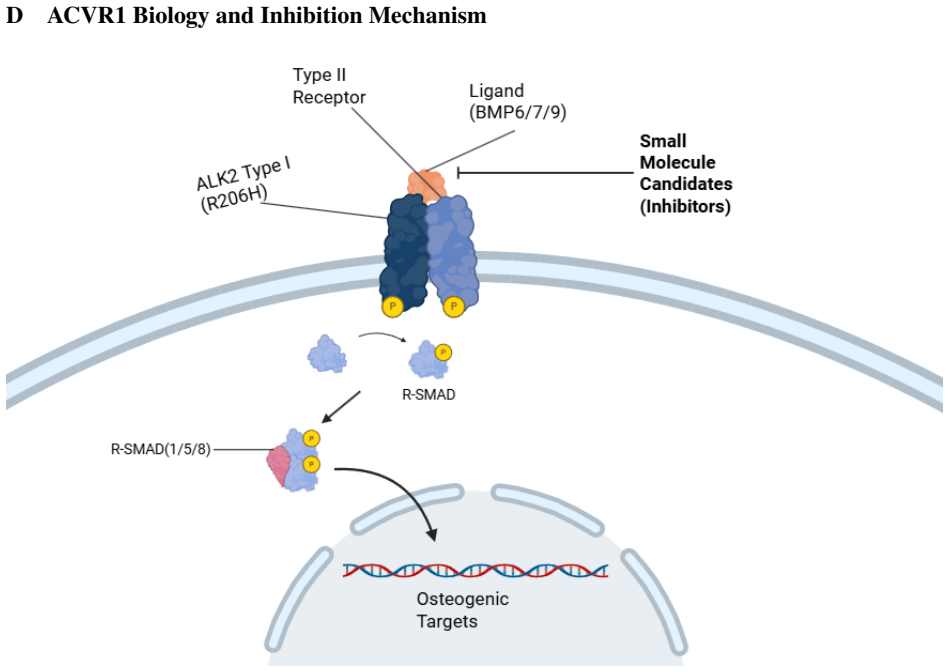
17 D ACVR1 Biology and Inhibition Mechanism Figure 9: ACVR1/ALK2 signaling pathway and mechanism of heterotopic ossification in FOP.Left:Normal BMP signaling through wild-type ALK2, which is activated only by BMP ligands and remains unresponsive to activin A. Center:The R206H gain-of-function mutation renders ALK2 constitutively active and responsive to a...
work page 2026
discussion (0)
Sign in with ORCID, Apple, or X to comment. Anyone can read and Pith papers without signing in.