Recognition: unknown
Ans\"atz Expressivity and Optimization in Variational Quantum Simulations of Transverse-field Ising Model Across System Sizes
Pith reviewed 2026-05-10 00:05 UTC · model grok-4.3
The pith
VQE simulations of the transverse-field Ising model show that ansatz expressivity and optimization directly shape how accurately highly entangled ground states are captured across dimensions and sizes up to 27 spins.
A machine-rendered reading of the paper's core claim, the machinery that carries it, and where it could break.
Core claim
Benchmarking shows that the hardware-efficient EfficientSU2 ansatz, the physics-inspired Hamiltonian variational ansatz, and its symmetry-broken variant recover TFIM ground-state properties with different degrees of success. The symmetry-broken HVA often matches entanglement entropy and critical behavior more closely because it better accommodates the symmetry properties of the target state, while all three face increasing optimization difficulty as dimensionality and entanglement rise.
What carries the argument
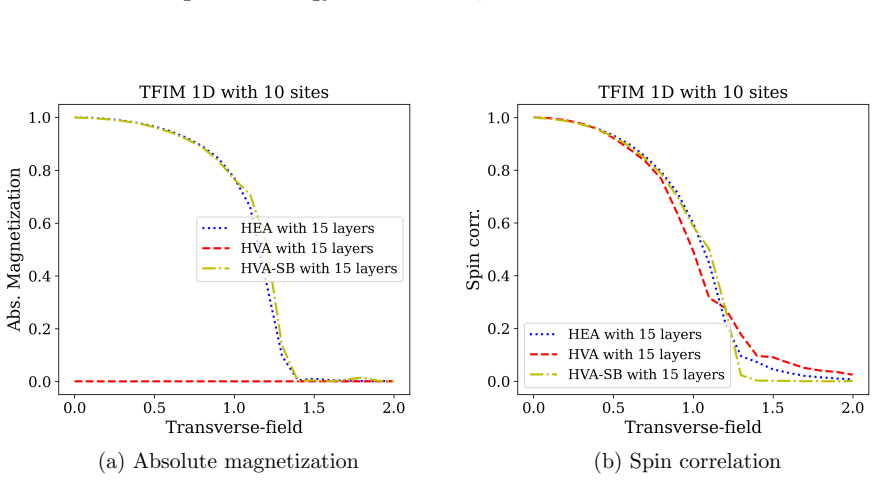
The three ansatze (EfficientSU2, HVA, and symmetry-broken HVA) and their evaluation through energy variance, entanglement entropy, spin correlations, and magnetization to test VQE performance on TFIM ground states.
If this is right
- Symmetry breaking in the ansatz improves fidelity for ground states whose symmetry is broken at the critical point.
- Expressivity gaps between hardware-efficient and physics-inspired ansatze become visible once entanglement entropy approaches its maximum value.
- Optimization success in VQE depends on matching the ansatz structure to the entanglement structure of the target Hamiltonian.
- The same benchmarking metrics can be used to test whether any given ansatz will scale to larger lattices before full quantum hardware is available.
Where Pith is reading between the lines
- The observed trade-off between expressivity and optimization suggests that adaptive ansatz construction, where circuit depth or structure grows with measured entanglement, may be required beyond the sizes tested here.
- Similar controlled comparisons on other critical models, such as the Heisenberg chain, would show whether the performance ordering of these ansatze is model-specific or general.
- If optimization remains the dominant bottleneck, hybrid classical pre-training of variational parameters could extend the reachable system sizes without changing the ansatz form.
Load-bearing premise
The three chosen ansatze remain sufficiently expressive and their parameters remain optimizable for the most entangled ground states as system size reaches 27 spins in higher dimensions.
What would settle it
Exact diagonalization of the 27-spin three-dimensional TFIM showing that all three ansatze produce entanglement entropy values deviating by more than the reported error bars from the exact result would falsify the claim of effective capture of critical phenomena.
Figures




read the original abstract
We explore the application of the Variational Quantum Eigensolver (VQE) to investigate the ground state properties, particularly the entanglement entropy, of the Transverse Field Ising Model (TFIM) in one, two, and three dimensions, considering systems of up to 27 spins. By benchmarking VQE results against exact diagonalization and analyzing the entanglement properties across different system sizes and geometries, we assess the algorithm's effectiveness in capturing critical phenomena. Using results of TFIM, we also investigate how VQE's expressivity and optimization influence the simulation of highly entangled quantum states. We employ different ans\"atze: the hardware-efficient EfficientSU2 from Qiskit, the physics-inspired Hamiltonian Variational ans\"atz (HVA) and HVA with symmetry breaking, and benchmark their performance using energy variance, entanglement entropy, spin correlations, and magnetization. We further discuss the implications for scaling these methods to larger quantum systems.
Editorial analysis
A structured set of objections, weighed in public.
Referee Report
Summary. The manuscript applies VQE to the TFIM ground states in 1D/2D/3D lattices up to 27 spins, comparing the EfficientSU2, HVA, and symmetry-broken HVA ansatze against exact diagonalization. It reports energy variance, entanglement entropy, spin correlations, and magnetization to evaluate ansatz expressivity and optimization performance for critical phenomena and highly entangled states.
Significance. If the numerical benchmarks hold, the work supplies concrete evidence on the scaling limits of standard hardware-efficient and physics-inspired ansatze for non-local observables at criticality, which is useful for guiding ansatz design in variational quantum algorithms. The direct ED comparisons for accessible sizes constitute a reproducible check on the central claims.
major comments (3)
- [Results and Discussion (entanglement entropy subsection)] The central claim that the chosen ansatze remain sufficiently expressive for highly entangled critical states up to N=27 rests on energy variance as the primary convergence diagnostic. However, variance bounds only local observables; for von Neumann entropy (especially its logarithmic scaling at criticality), even small infidelity can produce O(1) distortions while keeping variance at the reported 10^{-3}–10^{-4} level. No quantitative map from achieved variance to entropy error is provided, nor are direct entropy comparisons shown for the largest sizes where ED remains feasible.
- [Methods] The abstract and methods sections give no details on optimizer choice, iteration counts, convergence thresholds, or post-selection criteria. Without these, it is impossible to assess whether the reported performance differences between EfficientSU2, HVA, and symmetry-broken HVA reflect intrinsic expressivity limits or merely optimization failures.
- [Ansatz definitions] For the symmetry-broken HVA, the manuscript does not specify how the symmetry-breaking terms are introduced, at what strength, or whether they are variationally optimized. This omission makes it difficult to interpret the reported improvement in entanglement entropy relative to the unbroken HVA.
minor comments (2)
- [Figures] Figure captions should explicitly state the system sizes, dimensions, and ansatz used in each panel to improve readability.
- [Title] The title contains a typographical artifact (Ansatz with escaped quote); this should be corrected in the final version.
Simulated Author's Rebuttal
We thank the referee for their careful reading and constructive comments on our manuscript. We have revised the paper to strengthen the analysis of entanglement entropy, provide missing methodological details, and clarify the ansatz definitions. Our point-by-point responses follow.
read point-by-point responses
-
Referee: [Results and Discussion (entanglement entropy subsection)] The central claim that the chosen ansatze remain sufficiently expressive for highly entangled critical states up to N=27 rests on energy variance as the primary convergence diagnostic. However, variance bounds only local observables; for von Neumann entropy (especially its logarithmic scaling at criticality), even small infidelity can produce O(1) distortions while keeping variance at the reported 10^{-3}–10^{-4} level. No quantitative map from achieved variance to entropy error is provided, nor are direct entropy comparisons shown for the largest sizes where ED remains feasible.
Authors: We agree that energy variance alone does not rigorously bound errors in non-local observables such as von Neumann entropy. In the revised manuscript we have added an explicit error-propagation analysis that relates the observed energy variance to an upper bound on the infidelity (via the variance of the Hamiltonian) and then to the maximum possible deviation in entanglement entropy using continuity bounds on the von Neumann entropy. We also now include direct VQE-versus-ED comparisons of entanglement entropy for every system size at which exact diagonalization remains feasible (up to N=16 in 2D and N=8 in 3D), together with a discussion of how the observed scaling of entropy error with variance supports the claims for the larger lattices where only variance is available. revision: yes
-
Referee: [Methods] The abstract and methods sections give no details on optimizer choice, iteration counts, convergence thresholds, or post-selection criteria. Without these, it is impossible to assess whether the reported performance differences between EfficientSU2, HVA, and symmetry-broken HVA reflect intrinsic expressivity limits or merely optimization failures.
Authors: We apologize for the omission. The revised Methods section now contains a dedicated paragraph specifying the optimizer (SPSA with learning rate 0.1 and perturbation 0.01), the maximum iteration count (2000), the convergence criterion (energy variance < 10^{-4} or no improvement for 100 consecutive iterations), and the post-selection protocol (ten random initializations per ansatz, retaining only the lowest-variance result). These additions make clear that the performance ordering is driven by expressivity rather than optimization artifacts and allow full reproducibility. revision: yes
-
Referee: [Ansatz definitions] For the symmetry-broken HVA, the manuscript does not specify how the symmetry-breaking terms are introduced, at what strength, or whether they are variationally optimized. This omission makes it difficult to interpret the reported improvement in entanglement entropy relative to the unbroken HVA.
Authors: We have expanded the ansatz section to state that symmetry breaking is realized by augmenting the HVA circuit with additional single-qubit X rotations whose angles are initialized to a small fixed value (0.05) and then variationally optimized together with all other parameters. The explicit circuit diagram and the list of variational parameters are now provided, demonstrating that the observed improvement in entanglement entropy originates from the additional expressivity supplied by these optimized symmetry-breaking terms. revision: yes
Circularity Check
Numerical benchmarking study with independent exact-diagonalization validation exhibits no circularity
full rationale
The manuscript reports VQE simulations of TFIM ground states up to 27 spins in 1D/2D/3D using EfficientSU2, HVA and symmetry-broken HVA ansatze. All reported quantities (energies, variances, entanglement entropies, correlations, magnetizations) are obtained by direct execution on quantum simulators or hardware and compared to exact diagonalization results computed independently of the VQE runs. No analytical derivation chain exists that reduces a claimed prediction to a fitted parameter, self-citation, or ansatz choice by construction; the study is purely empirical benchmarking whose central claims rest on the external ED benchmark rather than internal redefinition.
Axiom & Free-Parameter Ledger
axioms (2)
- standard math The variational principle guarantees that the minimum of the expectation value of the Hamiltonian is the ground-state energy.
- domain assumption Exact diagonalization provides the true ground-state properties for the small systems considered.
Reference graph
Works this paper leans on
-
[1]
Castelvecchi, IBM releases first-ever 1,000-qubit quantum chip, Nature624, 238 (2023)
D. Castelvecchi, IBM releases first-ever 1,000-qubit quantum chip, Nature624, 238 (2023)
2023
-
[2]
Acharya and et al., Quantum error correction below the surface code threshold, Nature638, 920926 (2024)
R. Acharya and et al., Quantum error correction below the surface code threshold, Nature638, 920926 (2024). 19
2024
-
[3]
P. D. Nation, A. A. Saki, S. Brandhofer, L. Bello, S. Garion, M. Treinish, and A. Javadi-Abhari, Benchmarking the performance of quantum computing software for quantum circuit creation, manipulation and compilation, Nature Computational Science5, 427435 (2025)
2025
-
[4]
A. Peruzzo, J. McClean, P. Shadbolt, M.-H. Yung, X.-Q. Zhou, P. J. Love, A. Aspuru-Guzik, and J. L. OBrien, A variational eigenvalue solver on a photonic quantum processor, Nature Communications5, 10.1038/ncomms5213 (2014)
-
[5]
J. R. McClean, J. Romero, R. Babbush, and A. Aspuru-Guzik, The theory of variational hybrid quantum-classical algorithms, New Journal of Physics18, 023023 (2016)
2016
-
[6]
P. OMalley, R. Babbush, I. Kivlichan, J. Romero, J. McClean, R. Barends, J. Kelly, P. Roushan, A. Tranter, N. Ding, B. Campbell, Y. Chen, Z. Chen, B. Chiaro, A. Dunsworth, A. Fowler, E. Jeffrey, E. Lucero, A. Megrant, J. Mutus, M. Neeley, C. Neill, C. Quintana, D. Sank, A. Vainsencher, J. Wenner, T. White, P. Coveney, P. Love, H. Neven, A. Aspuru-Guzik, a...
-
[7]
Kandala, A
A. Kandala, A. Mezzacapo, K. Temme, M. Takita, M. Brink, J. M. Chow, and J. M. Gambetta, Hardware-efficient variational quantum eigensolver for small molecules and quantum magnets, Nature549, 242246 (2017)
2017
-
[8]
R. M. Parrish, E. G. Hohenstein, P. L. McMahon, and T. J. Martnez, Quantum computation of electronic transitions using a variational quantum eigensolver, Physical Review Letters122, 10.1103/physrevlett.122.230401 (2019)
-
[9]
Arute and et
F. Arute and et. al, Hartree-fock on a superconducting qubit quantum computer, Science369, 10841089 (2020)
2020
-
[11]
L. Zhao, J. Goings, K. Shin, W. Kyoung, J. I. Fuks, J.-K. Kevin Rhee, Y. M. Rhee, K. Wright, J. Nguyen, J. Kim, and S. Johri, Orbital-optimized pair-correlated electron simulations on trapped-ion quantum computers, npj Quantum Information9, 10.1038/s41534-023-00730-8 (2023). 20
-
[12]
Kokail, C
C. Kokail, C. Maier, R. van Bijnen, T. Brydges, M. K. Joshi, P. Jurcevic, C. A. Muschik, P. Silvi, R. Blatt, C. F. Roos, and P. Zoller, Self-verifying variational quantum simulation of lattice models, Nature569, 355360 (2019)
2019
-
[13]
Tilly, H
J. Tilly, H. Chen, S. Cao, D. Picozzi, K. Setia, Y. Li, E. Grant, L. Wossnig, I. Rungger, G. H. Booth, and J. Tennyson, The variational quantum eigensolver: A review of methods and best practices, Physics Reports986, 1128 (2022)
2022
-
[14]
M. S. Jattana, F. Jin, H. De Raedt, and K. Michielsen, Assessment of the variational quan- tum eigensolver: Application to the heisenberg model, Frontiers in Physics10, 10.3389/f- phy.2022.907160 (2022)
work page doi:10.3389/f- 2022
-
[15]
S. Stanisic, J. L. Bosse, F. M. Gambetta, R. A. Santos, W. Mruczkiewicz, T. E. OBrien, E. Os- tby, and A. Montanaro, Observing ground-state properties of the fermi-hubbard model using a scalable algorithm on a quantum computer, Nature Communications13, 10.1038/s41467-022- 33335-4 (2022)
-
[16]
A. N. Ciavarella and I. A. Chernyshev, Preparation of the su(3) lattice yang-mills vacuum with variational quantum methods, Physical Review D105, 10.1103/physrevd.105.074504 (2022)
-
[17]
Zhang, R
J. Zhang, R. Ferguson, S. Khn, J. F. Haase, C. Wilson, K. Jansen, and C. A. Muschik, Sim- ulating gauge theories with variational quantum eigensolvers in superconducting microwave cavities, Quantum7, 1148 (2023)
2023
-
[18]
S. Maiti, D. Banerjee, B. Chakraborty, and E. Huffman, Spontaneous symmetry breaking in a so(3) non-abelian lattice gauge theory in 2+1d with quantum algorithms, Physical Review Research7, 10.1103/physrevresearch.7.013283 (2025)
-
[19]
L. Nagano, A. Bapat, and C. W. Bauer, Quench dynamics of the schwinger model via variational quantum algorithms, Physical Review D108, 10.1103/physrevd.108.034501 (2023)
-
[20]
S. Notarnicola, M. Collura, and S. Montangero, Real-time-dynamics quantum simulation of (1+1)-d lattice qed with rydberg atoms, Physical Review Research2, 10.1103/physrevre- search.2.013288 (2020)
-
[21]
J. R. McClean, S. Boixo, V. N. Smelyanskiy, R. Babbush, and H. Neven, Barren plateaus in quantum neural network training landscapes, Nature Communications9, 10.1038/s41467-018- 07090-4 (2018)
-
[22]
Larocca, S
M. Larocca, S. Thanasilp, S. Wang, K. Sharma, J. Biamonte, P. J. Coles, L. Cincio, J. R. Mc- Clean, Z. Holmes, and M. Cerezo, Barren plateaus in variational quantum computing, Nature 21 Reviews Physics7, 174189 (2025)
2025
-
[23]
D. Wu, R. Rossi, F. Vicentini, N. Astrakhantsev, F. Becca, X. Cao, J. Carrasquilla, F. Ferrari, A. Georges, M. Hibat-Allah, M. Imada, A. M. Luchli, G. Mazzola, A. Mezzacapo, A. Mil- lis, J. Robledo Moreno, T. Neupert, Y. Nomura, J. Nys, O. Parcollet, R. Pohle, I. Romero, M. Schmid, J. M. Silvester, S. Sorella, L. F. Tocchio, L. Wang, S. R. White, A. Wiete...
2024
-
[24]
A. Kirmani, E. Pelofske, A. Brtschi, S. Eidenbenz, and J.-X. Zhu, Variational quantum simu- lations of a two-dimensional frustrated transverse-field ising model on a trapped-ion quantum computer (2025), arXiv:2505.22932 [quant-ph]
-
[26]
Suzuki, J.-I
S. Suzuki, J.-I. Inoue, and B. K. Chakrabarti, Quantum ising phases and transitions in trans- verse ising models (2012)
2012
-
[27]
Sachdev, Quantum Phase Transitions (Cambridge University Press, 2011)
S. Sachdev, Quantum Phase Transitions (Cambridge University Press, 2011)
2011
-
[28]
Nagai, Y
O. Nagai, Y. Yamada, and Y. Miyatake, Monte carlo simula- tions of three-dimensional heisenberg and transverse-ising magnets, in Quantum Monte Carlo Methods in Equilibrium and Nonequilibrium Systems, edited by M. Suzuki (Springer Berlin Heidelberg, Berlin, Heidelberg, 1987) pp. 95–103
1987
-
[29]
B. Braiorr-Orrs, M. Weyrauch, and M. V. Rakov, Phase diagram of one-, two-, and three-dimensional quantum spin systems derived from entanglement properties (2015), arXiv:1508.06508 [quant-ph]
-
[30]
A. Javadi-Abhari, M. Treinish, K. Krsulich, C. J. Wood, J. Lishman, J. Gacon, S. Martiel, P. D. Nation, L. S. Bishop, A. W. Cross, B. R. Johnson, and J. M. Gambetta, Quantum computing with Qiskit (2024), arXiv:2405.08810 [quant-ph]
work page internal anchor Pith review arXiv 2024
-
[31]
Exploring entanglement and optimization within the Hamiltonian variational ansatz
R. Wiersema, C. Zhou, Y. de Sereville, J. F. Carrasquilla, Y. B. Kim, and H. Yuen, Exploring entanglement and optimization within the hamiltonian variational ansatz, PRX Quantum1, 10.1103/prxquantum.1.020319 (2020)
-
[32]
C.-Y. Park, Efficient ground state preparation in variational quantum eigensolver with symmetry-breaking layers (2024), arXiv:2106.02509 [quant-ph]. 22
-
[33]
D. A. Roberts and B. Yoshida, Chaos and complexity by design, Journal of High Energy Physics 2017, 10.1007/jhep04(2017)121 (2017)
-
[34]
S. Sim, P. D. Johnson, and A. AspuruGuzik, Expressibility and entangling capability of param- eterized quantum circuits for hybrid quantumclassical algorithms, Advanced Quantum Tech- nologies2, 10.1002/qute.201900070 (2019)
-
[35]
M. B. Hastings, I. Gonzlez, A. B. Kallin, and R. G. Melko, Measuring renyi entanglement entropy in quantum montecarlo simulations, Physical Review Letters104, 10.1103/phys- revlett.104.157201 (2010)
-
[36]
Dalmonte, B
M. Dalmonte, B. Vermersch, and P. Zoller, Quantum simulation and spectroscopy of entangle- ment hamiltonians, Nature Physics14, 827831 (2018)
2018
-
[37]
Mendes-Santos, G
T. Mendes-Santos, G. Giudici, R. Fazio, and M. Dalmonte, Measuring von neumann entangle- ment entropies without wave functions, New Journal of Physics22, 013044 (2020)
2020
-
[38]
cuQuantum development team, Nvidia cuquantum sdk (2023)
T. cuQuantum development team, Nvidia cuquantum sdk (2023)
2023
-
[39]
Schollwck, The density-matrix renormalization group in the age of matrix product states, Annals of Physics326, 96192 (2011)
U. Schollwck, The density-matrix renormalization group in the age of matrix product states, Annals of Physics326, 96192 (2011)
2011
-
[40]
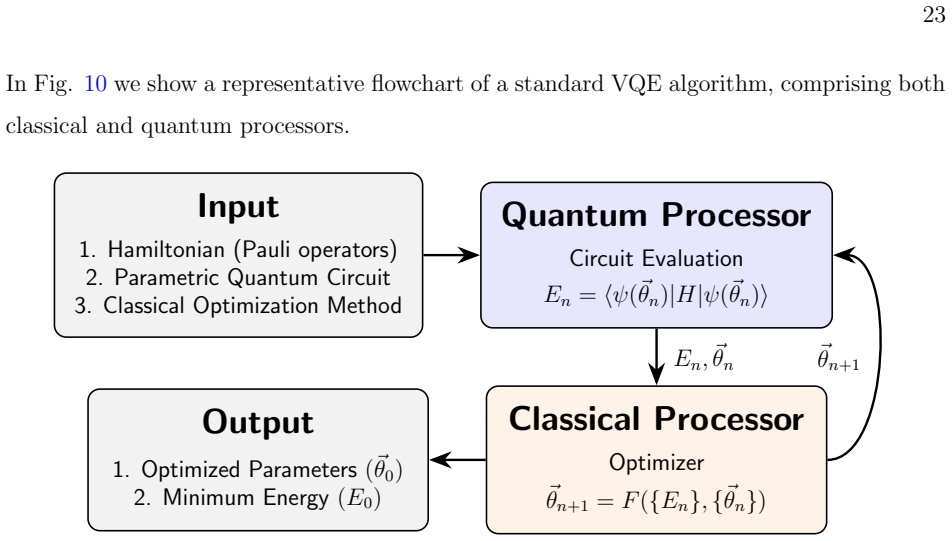
G. Catarina and B. Murta, Density-matrix renormalization group: a pedagogical introduction, The European Physical Journal B96, 10.1140/epjb/s10051-023-00575-2 (2023). Appendix A: VQE and its limitations Variational quantum eigensolver is a commonly used algorithm in NISQ era taking ad- vantage of quantum scaling while working with noisy quantum hardware. ...
-
[41]
Hamiltonian (Pauli operators)
-
[42]
Parametric Quantum Circuit
-
[43]
Classical Optimization Method Quantum Processor Circuit Evaluation En =⟨ψ( ⃗θn)|H|ψ( ⃗θn)⟩ Classical Processor Optimizer ⃗θn+1 =F({E n},{ ⃗θn}) Output
-
[44]
Optimized Parameters( ⃗θ0)
-
[45]
Minimum Energy(E 0) En, ⃗θn ⃗θn+1 Figure 10: VQE flowchart
-
[46]
Below we explain that with a simple example
Expressivity of a VQE circuit Though VQE is a general algorithm, one needs to be careful about the expressivity of a given VQE circuit. Below we explain that with a simple example. Imagine we want to study a 2-qubit Hamiltonian with only one term, H=σ x 0 σz 1 (A3) One can use various ans¨ atz circuits and we show two of them in Fig.11a (ans¨ atz-1) and 1...
discussion (0)
Sign in with ORCID, Apple, or X to comment. Anyone can read and Pith papers without signing in.