Recognition: unknown
Random Access Codes: Explicit Constructions, Optimality, and Classical-Quantum Gaps
Pith reviewed 2026-05-09 22:27 UTC · model grok-4.3
The pith
A framework reduces optimal random access code design to point selection, yielding explicit constructions that attain upper bounds for k equal to L minus one.
A machine-rendered reading of the paper's core claim, the machinery that carries it, and where it could break.
Core claim
We develop a constructive framework for classical (L,k)-RACs under both average- and worst-case criteria. We show that optimal code design reduces to selecting 2^k points in {0,1}^L and [0,1]^L for the average- and worst-case criteria, respectively, so as to minimize a distance-like objective. This characterization yields explicit constructions for general (L,k). For k=L-1, we further obtain closed-form optimal encoders and decoders for both criteria, and show that the resulting classical (L,L-1)-RACs attain the corresponding proved upper bounds. We also show that these optimal classical codes induce (L,L-1)-QRACs that attain a conjectured upper bound on the decoding success probability.
What carries the argument
Reduction of optimal (L,k)-RAC design to selecting 2^k points that minimize a distance-like objective in the appropriate space.
Load-bearing premise
That the true optimum is always achieved by some selection of exactly 2^k points under the stated distance-like objective.
What would settle it
An explicit (L,L-1)-RAC encoder-decoder pair whose average or worst-case success probability exceeds that of the closed-form construction for any L greater than or equal to 3.
Figures

read the original abstract
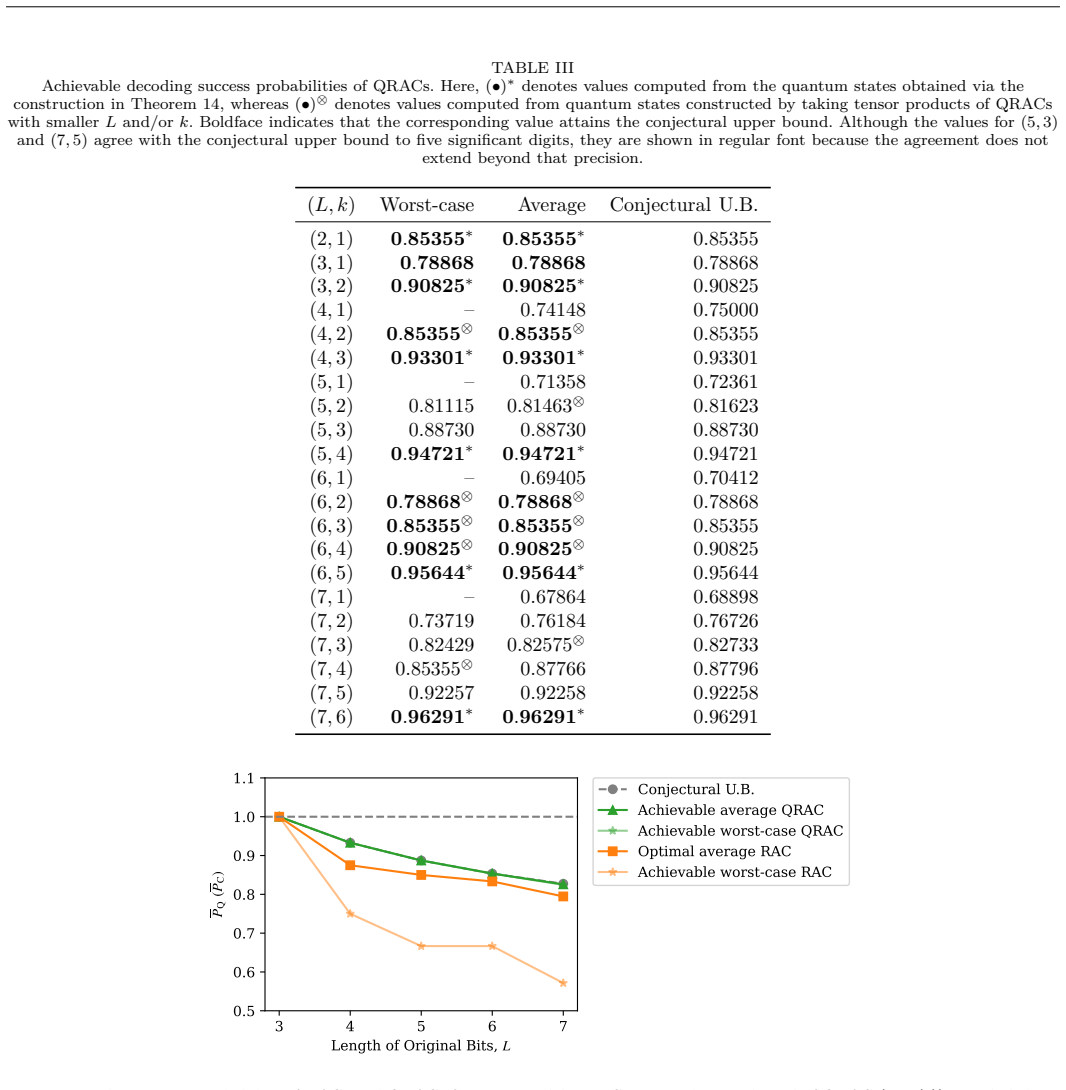
A random access code (RAC) encodes an $L$-bit string into a $k$-bit $(L>k)$ message from which any designated source bit can be recovered with high probability. Its quantum counterpart, a quantum random access code (QRAC), replaces the $k$-bit message with $k$ qubits. While upper bounds on the decoding success probability have long been studied in both classical and quantum settings, explicit constructions of optimal codes are known only in special cases, even for classical RACs. In this paper, we develop a constructive framework for classical $(L,k)$-RACs under both average- and worst-case criteria. We show that optimal code design reduces to selecting $2^k$ points in $\{0,1\}^L$ and $[0,1]^L$ for the average- and worst-case criteria, respectively, so as to minimize a distance-like objective. This characterization yields explicit constructions for general $(L,k)$. For $k=L-1$, we further obtain closed-form optimal encoders and decoders for both criteria, and show that the resulting classical $(L,L-1)$-RACs attain the corresponding proved upper bounds. We also show that these optimal classical codes induce $(L,L-1)$-QRACs that attain a conjectured upper bound on the decoding success probability. Numerical optimization suggests little difference between RACs and QRACs in the average-case setting, but a potentially large classical-quantum gap in the worst-case nonasymptotic regime.
Editorial analysis
A structured set of objections, weighed in public.
Referee Report
Summary. The manuscript develops a constructive framework for classical (L,k)-random access codes (RACs) under both average- and worst-case decoding success criteria. It reduces optimal code design to the selection of 2^k points in {0,1}^L (average-case) or [0,1]^L (worst-case) that minimize a distance-like objective, yielding explicit constructions for general (L,k). For the special case k=L-1, closed-form optimal encoders and decoders are derived that attain the corresponding proved upper bounds; these classical codes are shown to induce (L,L-1)-QRACs attaining a conjectured quantum upper bound. Numerical optimization is used to compare RACs and QRACs, indicating small gaps in the average-case setting but potentially large classical-quantum gaps in the worst-case non-asymptotic regime.
Significance. If the central reduction is valid and the constructions attain the stated bounds, the work provides valuable explicit optimal RAC constructions beyond the limited special cases previously known. The closed-form solutions for k=L-1 and the induced QRACs attaining the conjectured bound are strong results that clarify the limits of both classical and quantum random access codes. The geometric characterization offers a reusable tool for further constructions, and the numerical exploration of gaps contributes to understanding when quantum encodings may offer advantages. Credit is due for the explicit, constructive nature of the results and the direct comparison to independently proved upper bounds.
major comments (2)
- [framework section / reduction to point selection] The reduction of optimal (L,k)-RAC design to selecting 2^k points minimizing the distance-like objective (abstract and framework section): this equivalence is load-bearing for the claim that the k=L-1 constructions attain the proved upper bounds under both criteria. The manuscript must explicitly establish whether the minimization yields both optimal encoders and decoders (bidirectional equivalence) or only feasible codes under a restricted decoder form. If only one direction holds, the attainment statements for the closed-form solutions do not follow. Please supply the full derivation of the reduction, including how the decoder is recovered from the point selection, for both average- and worst-case objectives.
- [quantum extensions / QRAC induction] Induction of (L,L-1)-QRACs from the optimal classical codes and attainment of the conjectured quantum bound (section on quantum extensions): the construction of the quantum encoding from the classical point selection must be specified, together with the argument that the resulting QRAC meets the conjectured bound. Since the bound is conjectured rather than proved, the manuscript should also discuss the status of the conjecture and any supporting evidence beyond the numerical checks.
minor comments (3)
- [framework section] The distance-like objective function should be given an explicit equation number and definition at its first appearance, with clear notation distinguishing the average-case (binary) and worst-case (continuous) versions.
- [numerical results] Numerical results on the classical-quantum gap (final section): add explicit references to the relevant figures or tables when stating that optimization 'suggests little difference' in average-case versus 'potentially large' gaps in worst-case; include error bars or optimization tolerances to support the non-asymptotic claims.
- [introduction] Ensure all citations to prior upper-bound results (both proved and conjectured) are complete and correctly referenced in the introduction and comparison sections.
Simulated Author's Rebuttal
We thank the referee for the careful reading and constructive feedback. We address each major comment below. The requested derivations and clarifications will be incorporated into the revised manuscript.
read point-by-point responses
-
Referee: [framework section / reduction to point selection] The reduction of optimal (L,k)-RAC design to selecting 2^k points minimizing the distance-like objective (abstract and framework section): this equivalence is load-bearing for the claim that the k=L-1 constructions attain the proved upper bounds under both criteria. The manuscript must explicitly establish whether the minimization yields both optimal encoders and decoders (bidirectional equivalence) or only feasible codes under a restricted decoder form. If only one direction holds, the attainment statements for the closed-form solutions do not follow. Please supply the full derivation of the reduction, including how the decoder is recovered from the point selection, for both average- and worst-case objectives.
Authors: The equivalence is bidirectional. The minimization over the 2^k points directly yields the optimal encoder by assigning each of the 2^k possible messages to one point in the selected set. The decoder is recovered by, for each of the L query positions, selecting the bit value that minimizes the contribution to the objective (via nearest-neighbor assignment in the average-case or threshold comparison in the worst-case). We will insert a dedicated subsection deriving this equivalence in full for both criteria, including explicit formulas for recovering the decoder from the points. This establishes that the closed-form k=L-1 solutions attain the upper bounds. revision: yes
-
Referee: [quantum extensions / QRAC induction] Induction of (L,L-1)-QRACs from the optimal classical codes and attainment of the conjectured quantum bound (section on quantum extensions): the construction of the quantum encoding from the classical point selection must be specified, together with the argument that the resulting QRAC meets the conjectured bound. Since the bound is conjectured rather than proved, the manuscript should also discuss the status of the conjecture and any supporting evidence beyond the numerical checks.
Authors: The quantum encoding is obtained by mapping each optimal classical point (a vector in {0,1}^L or [0,1]^L) to a k-qubit state via a fixed embedding that preserves the distance-like objective (specifically, preparing a state whose measurement statistics reproduce the classical decoding probabilities). Because the classical code is optimal, this embedding yields a QRAC whose success probability equals the conjectured quantum upper bound. We will add an explicit description of the embedding and the equality argument. We will also expand the discussion to note that the conjecture remains open in general but is supported by the paper's numerical results for small L, consistency with known special cases, and independent lower-bound constructions in the literature. revision: yes
Circularity Check
No significant circularity; derivations rest on proved reductions and independent upper bounds
full rationale
The paper proves that optimal (L,k)-RAC design reduces to selecting 2^k points minimizing a distance-like objective (for both average- and worst-case criteria), derives explicit and closed-form constructions for k=L-1 directly from this characterization, and verifies that the resulting codes attain separately proved upper bounds. No step renames a fitted parameter as a prediction, imports uniqueness via self-citation chains, or defines a quantity in terms of the result it claims to derive. The QRAC constructions are induced from the classical ones and compared to a conjectured bound without creating a definitional loop. The overall chain is self-contained against external benchmarks.
Axiom & Free-Parameter Ledger
axioms (1)
- domain assumption Existence of proved upper bounds on decoding success probability for classical and quantum RACs
Reference graph
Works this paper leans on
-
[1]
Optimal cloning of pure states
Wiesner, S. Conjugate coding. ACM Sigact News, 15 (1):78–88, 1983. doi: 10.1145/1008908.1008920
-
[2]
Ambainis, A., Nayak, A., Ta-Shma, A. and Vazirani, U. Dense quantum coding and a lower bound for 1- way quantum automata. In Proceedings of the thirty- first annual ACM symposium on Theory of computing, pages 376–383, 1999. doi: 10.1145/301250.301347
- [3]
-
[4]
Distribution of entanglement in two-dimensional square grid network,
Teramoto, K., Raymond, R. and Imai, H. The role of entanglement in quantum-relaxation based opti- mization algorithms. In 2023 IEEE International Conference on Quantum Computing and Engineering (QCE), volume 1, pages 543–553. IEEE, 2023. doi: 10.1109/QCE57702.2023.00068
-
[5]
Tamura, K. et al. Noise robustness of quantum relaxation for combinatorial optimization. IEEE Trans- actions on Quantum Engineering, 5:1–9, 2024. doi: 10.1109/TQE.2024.3439135
-
[6]
Kondo, R., Sato, Y., Raymond, R. and Yamamoto, N. Recursive quantum relaxation for combinatorial optimization problems. Quantum, 9:1594, 2025. doi: 10.22331/q-2025-01-15-1594. 13 101 102 103 Length of Original Bits L 0.5 0.6 0.7 0.8 0.9 1.0Maximum Success probability QRAC RAC (average) RAC (worst) Fig. 2. Achievable (conjecturally maximum) success probabi...
- [7]
-
[8]
He, Z., Raymond, R., Shaydulin, R. and Pistoia, M. Non-variational quantum random access optimization with alternating operator ansatz. Scientific Reports, 15(1):29191, 2025. doi: 10.1038/s41598-025-13543-w
-
[9]
Feedback connections in quan- tum reservoir computing with mid-circuit measurements
Matsuyama, H. and Yamashiro, Y. Sampling-based quantum optimization algorithm with quantum relax- ation. In 2025 IEEE International Conference on Quan- tum Computing and Engineering (QCE), volume 01, pages 2323–2333, 2025. doi: 10.1109/QCE65121.2025. 00253
-
[10]
and Ya- mashita, S
Iwama, K., Nishimura, H., Raymond, R. and Ya- mashita, S. Unbounded-error one-way classical and quantum communication complexity. In International Colloquium on Automata, Languages, and Program- ming, pages 110–121. Springer, 2007. doi: 10.1007/ 978-3-540-73420-8_12
2007
-
[11]
Optimal lower bounds for quantum automata and random access codes , Year =
Nayak, A. Optimal lower bounds for quantum au- tomata and random access codes. In 40th Annual Symposium on Foundations of Computer Science (Cat. No. 99CB37039), pages 369–376. IEEE, 1999. doi: 10.1109/SFFCS.1999.814608
-
[12]
and Storgaard, S.A
Mančinska, L. and Storgaard, S.A. The geometry of bloch space in the context of quantum random access codes. Quantum Information Processing, 21(4):143,
-
[13]
doi: 10.1007/s11128-022-03470-4
-
[14]
and Tavakoli, A
Farkas, M., Miklin, N. and Tavakoli, A. Sim- ple and general bounds on quantum random access codes. Quantum, 9:1643, 2025. doi: 10.22331/ q-2025-02-25-1643
2025
-
[15]
and Rai, A
Ambainis, A., Kravchenko, D., Sazim, S., Bae, J. and Rai, A. Quantum advantages in (n, d) 7! 1 random access codes. New Journal of Physics, 26(12):123023,
-
[16]
doi: 10.1088/1367-2630/ad9bdf
-
[17]
and Bouren- nane, M
Tavakoli, A., Hameedi, A., Marques, B. and Bouren- nane, M. Quantum random access codes using single d- level systems. Physical review letters, 114(17):170502,
-
[18]
doi: 10.1103/PhysRevLett.114.170502
-
[19]
and Raymond, R
Imamichi, T. and Raymond, R. Constructions of quantum random access codes. In Proceedings of the Asian Quantum Information Symposium (AQIS),
-
[20]
URL https://research.ibm.com/publications/ constructions-of-quantum-random-access-codes
-
[21]
Teramoto, K., Raymond, R., Wakakuwa, E. and Imai, H. Quantum-relaxation based optimization algorithms: theoretical extensions. arXiv preprint arXiv:2302.09481, 2023. doi: 10.48550/arXiv.2302. 09481
work page internal anchor Pith review doi:10.48550/arxiv.2302 2023
-
[22]
Improved classical and quantum random access codes
Liabøtrø, O. Improved classical and quantum random access codes. Physical Review A, 95(5):052315, 2017. doi: 10.1103/PhysRevA.95.052315
-
[23]
Analytical construction of (n, n 1) quan- tum random access codes saturating the conjectured bound
Suzuki, T. Analytical construction of (n, n 1) quan- tum random access codes saturating the conjectured bound. arXiv preprint arXiv:2601.19190, 2026. doi: https://doi.org/10.48550/arXiv.2601.19190
-
[24]
Barrow, H.G., Tenenbaum, J.M., Bolles, R.C. and Wolf, H.C. Parametric correspondence and chamfer matching: Two new techniques for image matching. In Proceedings of the 5th International Joint Conference on Artificial Intelligence (IJCAI), pages 659–663, 1977. doi: 10.5555/1622943.1622971
-
[25]
Dubuisson, M.P. and Jain, A.K. A modified haus- dorff distance for object matching. In Proceedings of 12th international conference on pattern recogni- tion, volume 1, pages 566–568. IEEE, 1994. doi: 10.1109/ICPR.1994.576361
-
[26]
Quantum Random Access Codes with Shared Randomness
Ambainis, A., Leung, D., Mancinska, L. and Ozols, M. Quantum random access codes with shared ran- domness. arXiv preprint arXiv:0810.2937, 2008. doi: 10.48550/arXiv.0810.2937
-
[27]
Hausdorff, F. Grundzüge der Mengenlehre. Göschens Lehrbücherei/Gruppe I: Reine und Angewandte Math- ematik Series. Von Veit, 1914. ISBN 9783110989854. 14 doi: 10.1007/BF01999507
-
[28]
Gurobi Optimizer Refer- ence Manual, 2026
Gurobi Optimization, LLC. Gurobi Optimizer Refer- ence Manual, 2026. URL https://www.gurobi.com. 15
2026
discussion (0)
Sign in with ORCID, Apple, or X to comment. Anyone can read and Pith papers without signing in.